Record Information
Version1.0
Creation Date2009-03-06 18:57:59 UTC
Update Date2026-04-06 04:24:29 UTC
Accession NumberCHEM000049
Identification
Common NameNickel
ClassSmall Molecule
DescriptionNickel is a solid, silver-white, hard, malleable transition metal with an atomic number of 28. It resists corrosion even at high temperatures. It is present in many alloys in widespread use, including stainless steels. It may also be present as an impurity in any alloy. Nickel is used in the production of coins, jewellery, and nickel-cadmium batteries, and as a catalyst for the hydrogenation of liquid oils to solid fats such as oleomargarine and vegetable shortening. Nickel-containing dental alloys continue to be used successfully in the provision of various forms of dental care. Many of these alloys have applications in the construction of restorations designed to remain in clinical service for many years, including crowns, fixed bridgework, and removable partial dentures. Furthermore, nickel containing alloys find extensive application in orthodontics, including metallic brackets, arch wires, bands, springs and ligature wires. Many instruments and devises, for example, endodontic instruments also contain nickel. Allergic responses are mediated through the immune system. In a sensitized individual, allergic responses can be initiated by relatively small amounts of the allergen; for example, if nickel ions are released from a nickel plated material following direct and prolonged contact with the skin. Individuals are first sensitized to the allergen. Subsequent exposures, if sufficiently high, may then result in an allergic reaction. A number of allergens are used in the clinical practice of dentistry, notably eugenol, mercury, nickel, chromium, cobalt, components of resin-based materials and a host of other chemical agents. The majority of dental allergies, including allergic responses to nickel-containing dental alloys, comprise Type IV hypersensitivity reactions, cell-mediated by T-lymphocytes. Physiologically, it exists as an ion in the body.(7, 8).
Contaminant Sources
  • Clean Air Act Chemicals
  • EAFUS Chemicals
  • FooDB Chemicals
  • HMDB Contaminants - Urine
  • HPV EPA Chemicals
  • IARC Carcinogens Group 2B
  • OECD HPV Chemicals
  • T3DB toxins
Contaminant Type
  • Food Toxin
  • Household Toxin
  • Industrial/Workplace Toxin
  • Inorganic Compound
  • Metabolite
  • Metal
  • Natural Compound
  • Nickel Compound
  • Pollutant
Chemical Structure
Thumb
Synonyms
ValueSource
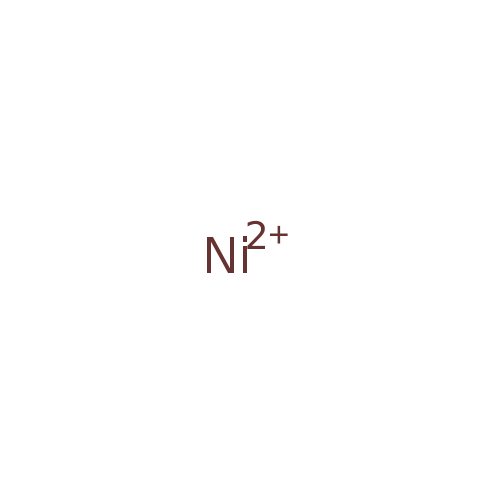
Ni2+ChEBI
Ni(2+)ChEBI
NICKEL (II) ionChEBI
Nickel, ion (ni2+)ChEBI
Nickelous ionChEBI
Ni(II)Kegg
Carbonyl nickel powderHMDB
Malleable nickelHMDB
NIHMDB
NichelHMDB
Nickel 200HMDB
Nickel 201HMDB
Nickel 204HMDB
Nickel 205HMDB
Nickel 211HMDB
Nickel 212HMDB
Nickel 213HMDB
Nickel 222HMDB
Nickel 223HMDB
Nickel 229HMDB
Nickel 270HMDB
Nickel particlesHMDB
Nickel spongeHMDB
Raney alloyHMDB
Raney nickelHMDB
Chemical FormulaNi
Average Molecular Mass58.693 g/mol
Monoisotopic Mass57.935 g/mol
CAS Registry Number7440-02-0
IUPAC Namenickel(2+) ion
Traditional Namenickel(2+) ion
SMILES[Ni++]
InChI IdentifierInChI=1S/Ni/q+2
InChI KeyVEQPNABPJHWNSG-UHFFFAOYSA-N
Chemical Taxonomy
Description belongs to the class of inorganic compounds known as homogeneous transition metal compounds. These are inorganic compounds containing only metal atoms,with the largest atom being a transition metal atom.
KingdomInorganic compounds
Super ClassHomogeneous metal compounds
ClassHomogeneous transition metal compounds
Sub ClassNot Available
Direct ParentHomogeneous transition metal compounds
Alternative Parents
Substituents
  • Homogeneous transition metal
  • Inorganic nickel compound
Molecular FrameworkNot Available
External Descriptors
Biological Properties
StatusDetected and Not Quantified
OriginExogenous
Cellular Locations
  • Cytoplasm
  • Extracellular
Biofluid LocationsNot Available
Tissue LocationsNot Available
PathwaysNot Available
ApplicationsNot Available
Biological Roles
Chemical RolesNot Available
Physical Properties
StateSolid
AppearanceSilvery-white metallic solid.
Experimental Properties
PropertyValue
Melting Point1455°C
Boiling PointNot Available
SolubilityNot Available
Predicted Properties
PropertyValueSource
logP0.16ChemAxon
Physiological Charge2ChemAxon
Hydrogen Acceptor Count0ChemAxon
Hydrogen Donor Count0ChemAxon
Polar Surface Area0 ŲChemAxon
Rotatable Bond Count0ChemAxon
Refractivity0 m³·mol⁻¹ChemAxon
Polarizability1.78 ųChemAxon
Number of Rings0ChemAxon
Bioavailability1ChemAxon
Rule of FiveYesChemAxon
Ghose FilterNoChemAxon
Veber's RuleYesChemAxon
MDDR-like RuleNoChemAxon
Spectra
Spectra
Spectrum TypeDescriptionSplash KeyView
Predicted LC-MS/MSPredicted LC-MS/MS Spectrum - 10V, Positivesplash10-0a4i-9000000000-08256b3c9e2cc1750f60Spectrum
Predicted LC-MS/MSPredicted LC-MS/MS Spectrum - 20V, Positivesplash10-0a4i-9000000000-08256b3c9e2cc1750f60Spectrum
Predicted LC-MS/MSPredicted LC-MS/MS Spectrum - 40V, Positivesplash10-0a4i-9000000000-08256b3c9e2cc1750f60Spectrum
Predicted LC-MS/MSPredicted LC-MS/MS Spectrum - 10V, Negativesplash10-0a4i-9000000000-4648ffc6f53552c41503Spectrum
Predicted LC-MS/MSPredicted LC-MS/MS Spectrum - 20V, Negativesplash10-0a4i-9000000000-4648ffc6f53552c41503Spectrum
Predicted LC-MS/MSPredicted LC-MS/MS Spectrum - 40V, Negativesplash10-0a4i-9000000000-4648ffc6f53552c41503Spectrum
Toxicity Profile
Route of ExposureOral (13) ; inhalation (13) ; dermal (13)
Mechanism of ToxicityNickel is known to substitute for other essential elements in certain enzmes, such as calcineurin. It is genotoxic, and some nickel compounds have been shown to promote cell proliferation. Nickel has a high affinity for chromatin proteins, particularly histones and protamines. The complexing of nickel ions with heterochromatin results in a number of alterations including condensation, DNA hypermethylation, gene silencing, and inhibition of histone acetylation, which have been shown to disturb gene expression. Nickel has also been shown to alter several transcription factors, including hypoxia-inducible transcription factor, activating transcription factor, and NF-KB transcription factor. There is also evidence that nickel ions inhibit DNA repair, either by directly inhibiting DNA repair enzymes or competing with zinc ions for binding to zinc-finger DNA binding proteins, resulting in structural changes in DNA that prevent repair enzymes from binding. Nickel ions can also complex with a number of cellular ligands including amino acids, peptides, and proteins resulting in the generation of oxygen radicals, which induce base damage, DNA strand breaks, and DNA protein crosslinks. (13, 1)
MetabolismNickel is absorbed mainly through the lungs and gastrointestinal tract. Once in the body it enters the bloodstream, where it binds to albumin, L-histidine, and α2-macroglobulin. Nickel tends to accumulate in the lungs, thyroid, kidney, heart, and liver. Absorbed nickel is excreted in the urine, whereas unabsorbed nickel is excreted in the faeces. (13)
Toxicity ValuesLD50: 250 mg/kg (Intraperitoneal, Rat) (17)
Lethal DoseNot Available
Carcinogenicity (IARC Classification)Metallic nickel is possibly carcinogenic to humons (Group 2B). Nickel compounds are carcinogenic to humans (Group 1). (16)
Uses/SourcesPure nickel is mainly used to make alloys, which are found in items such as coins, jewelry, valves and heat exchangers. Nickel compounds are used for nickel plating, to color ceramics, to make some batteries, and as catalysts. (13)
Minimum Risk LevelIntermediate Inhalation: 0.0002 mg/m3 (15) Chronic Inhalation: 0.00009 mg/m3 (15)
Health EffectsThe most common harmful health effect of nickel in humans is an allergic reaction. This usually manifests as a skin rash, although some people experience asthma attacks. Long term inhahation of nickel causes chronic bronchitis and reduced lung function, as well as damage to the naval cavity. Ingestion of excess nickel results in damage to the stomach, blood, liver, kidneys, and immune system, as well as having adverse effects on reproduction and development. (13)
SymptomsSymptoms of nickel poisoning include headache, nausea, vomiting, dizziness, irritability, and difficulty sleeping, followed by chest pains, sweating, rapid heart beat, and a dry cough. (14)
TreatmentExcess exposure to nickel is usually handled by preventing further exposure and symptomatic treatment. Nickel poisoning may also be treated using chelation therapy with sodium diethyldithiocarbamate. (14)
Concentrations
Not Available
DrugBank IDNot Available
HMDB IDHMDB0002457
FooDB IDFDB013444
Phenol Explorer IDNot Available
KNApSAcK IDNot Available
BiGG IDNot Available
BioCyc IDNot Available
METLIN IDNot Available
PDB IDNot Available
Wikipedia LinkNickel
Chemspider ID909
ChEBI ID49786
PubChem Compound ID934
Kegg Compound IDC19609
YMDB IDNot Available
ECMDB IDECMDB21391
References
Synthesis ReferenceLightner, David A.; Crist, B. Vincent; Kalyanam, Nagabushanam; May, Leslie M.; Jackman, Dennis E. The octant rule. 15. Antioctant effects: synthesis and circular dichroism of 2-exo- and 2-endo-alkylbicyclo[2.2.1]heptan-7-ones and bicyclo[3.2.1]octan-8-one

MSDSNot Available
General References
1. Lightner, David A.; Crist, B. Vincent; Kalyanam, Nagabushanam; May, Leslie M.; Jackman, Dennis E. The octant rule. 15. Antioctant effects: synthesis and circular dichroism of 2-exo- and 2-endo-alkylbicyclo[2.2.1]heptan-7-ones and bicyclo[3.2.1]octan-8-one. J. Org. Chem. 1985,50, 3867-3878. DOI: 10.1021/jo00220a037
2. Patricia Cava-Montesinos, M. Luisa Cervera Agustín Pastor Miguel de la Guardia. 2005. Room temperature acid sonication ICP-MS multielemental analysis of milk.Analytica Chimica Acta Volume 531, Issue 1, Pages 111-123
3. Fooddata+, The Technical University of Denmark (DTU): https://frida.fooddata.dk/QueryFood.php?fn=milk&lang=en
4. Lightner, David A.; Crist, B. Vincent; Kalyanam, Nagabushanam; May, Leslie M.; Jackman, Dennis E. The octant rule. 15. Antioctant effects: synthesis and circular dichroism of 2-exo- and 2-endo-alkylbicyclo[2.2.1]heptan-7-ones and bicyclo[3.2.1]octan-8-one. J. Org. Chem. 1985,50, 3867-3878. DOI: 10.1021/jo00220a037
5. Nielsen FH: How should dietary guidance be given for mineral elements with beneficial actions or suspected of being essential? J Nutr. 1996 Sep;126(9 Suppl):2377S-2385S.
6. Biego GH, Joyeux M, Hartemann P, Debry G: Daily intake of essential minerals and metallic micropollutants from foods in France. Sci Total Environ. 1998 Jun 30;217(1-2):27-36.
7. Uthus EO, Seaborn CD: Deliberations and evaluations of the approaches, endpoints and paradigms for dietary recommendations of the other trace elements. J Nutr. 1996 Sep;126(9 Suppl):2452S-2459S.
8. Hostynek JJ: Sensitization to nickel: etiology, epidemiology, immune reactions, prevention, and therapy. Rev Environ Health. 2006 Oct-Dec;21(4):253-80.
9. Setcos JC, Babaei-Mahani A, Silvio LD, Mjor IA, Wilson NH: The safety of nickel containing dental alloys. Dent Mater. 2006 Dec;22(12):1163-8. Epub 2006 Jan 6.
10. Brunk E, Sahoo S, Zielinski DC, Altunkaya A, Drager A, Mih N, Gatto F, Nilsson A, Preciat Gonzalez GA, Aurich MK, Prlic A, Sastry A, Danielsdottir AD, Heinken A, Noronha A, Rose PW, Burley SK, Fleming RMT, Nielsen J, Thiele I, Palsson BO: Recon3D enables a three-dimensional view of gene variation in human metabolism. Nat Biotechnol. 2018 Mar;36(3):272-281. doi: 10.1038/nbt.4072. Epub 2018 Feb 19.
11. https://www.ncbi.nlm.nih.gov/pubmed/?term=20456924