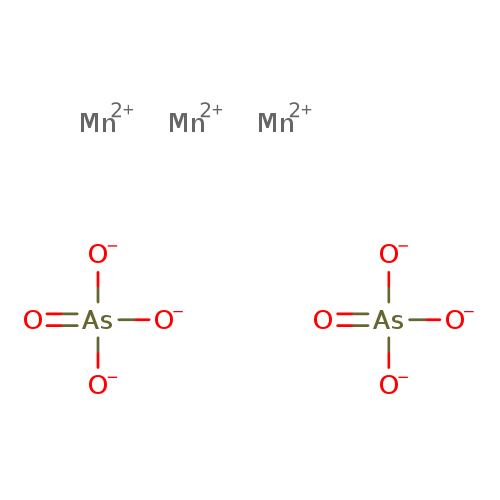
Manganese arsenate is a chemical compound of manganese and aresenic. It is derived from arsenic acid. Arsenic is a chemical element that has the symbol As and atomic number 33. It is a poisonous metalloid that has many allotropic forms: yellow (molecular non-metallic) and several black and grey forms (metalloids) are a few that are seen. Three metalloidal forms of arsenic with different crystal structures are found free in nature (the minerals arsenopyrite and the much rarer arsenolamprite and pararsenolamprite), but it is more commonly found as a compound with other elements. Manganese is a naturally occurring metal with the symbol Mn and the atomic number 25. It does not occur naturally in its pure form, but is found in many types of rocks in combination with other substances such as oxygen, sulfur, or chlorine. Manganese occurs naturally in most foods and small amounts are needed to stay healthy, as manganese ions act as cofactors for a number of enzymes. (8, 9, 11)
belongs to the class of inorganic compounds known as transition metal arsenates. These are inorganic compounds in which the largest oxoanion is arsenate, and in which the heaviest atom not in an oxoanion is a transition metal.
Manganese is a cellular toxicant that can impair transport systems, enzyme activities, and receptor functions. It primarily targets the central nervous system, particularily the globus pallidus of the basal ganglia. It is believed that the manganese ion, Mn(II), enhances the autoxidation or turnover of various intracellular catecholamines, leading to increased production of free radicals, reactive oxygen species, and other cytotoxic metabolites, along with a depletion of cellular antioxidant defense mechanisms, leading to oxidative damage and selective destruction of dopaminergic neurons. In addition to dopamine, manganese is thought to perturbations other neurotransmitters, such as GABA and glutamate. In order to produce oxidative damage, manganese must first overwhelm the antioxidant enzyme manganese superoxide dismutase. The neurotoxicity of Mn(II) has also been linked to its ability to substitute for Ca(II) under physiological conditions. It can enter mitochondria via the calcium uniporter and inhibit mitochondrial oxidative phosphorylation. It may also inhibit the efflux of Ca(II), which can result in a loss of mitochondrial membrane integrity. Mn(II) has been shown to inhibit mitochondrial aconitase activity to a significant level, altering amino acid metabolism and cellular iron homeostasis. Arsenic and its metabolites disrupt ATP production through several mechanisms. At the level of the citric acid cycle, arsenic inhibits pyruvate dehydrogenase and by competing with phosphate it uncouples oxidative phosphorylation, thus inhibiting energy-linked reduction of NAD+, mitochondrial respiration, and ATP synthesis. Hydrogen peroxide production is also increased, which might form reactive oxygen species and oxidative stress. Arsenic's carginogenicity is influenced by the arsenical binding of tubulin, which results in aneuploidy, polyploidy and mitotic arrests. The binding of other arsenic protein targets may also cause altered DNA repair enzyme activity, altered DNA methylation patterns and cell proliferation. (10, 1, 8)
Metabolism
Manganese is absorbed mainly via ingestion, but can also be inhaled. It binds to alpha-2-macroglobulin, albumin, or transferrin in the plasma and is distributed to the brain and all other mammalian tissues, though it tends to accumulate more in the liver, pancreas, and kidney. Manganese is capable of existing in a number of oxidation states and is believed to undergo changes in oxidation state within the body. Manganese oxidation state can influence tissue toxicokinetic behavior, and possibly toxicity. Manganese is excreted primarily in the faeces. Arsenic is absorbed mainly by inhalation or ingestion, as to a lesser extent, dermal exposure. It is then distributed throughout the body, where it is reduced into arsenite if necessary, then methylated into monomethylarsenic (MMA) and dimethylarsenic acid (DMA) by arsenite methyltransferase. Arsenic and its metabolites are primarily excreted in the urine. Arsenic is known to induce the metal-binding protein metallothionein, which decreases the toxic effects of arsenic and other metals by binding them and making them biologically inactive, as well as acting as an antioxidant. (4, 8)
Manganese mainly affects the nervous system and may cause behavioral changes and other nervous system effects, which include movements that may become slow and clumsy. This combination of symptoms when sufficiently severe is referred to as “manganism”. (8)
Symptoms
The symptoms of manganese toxicity may appear slowly over months and years; they include tremors, difficulty walking, and facial muscle spasms. These symptoms are often preceded by other lesser symptoms, including irritability, aggressiveness, and hallucinations. (8)
Treatment
Arsenic poisoning can be treated by chelation therapy, using chelating agents such as dimercaprol, EDTA or DMSA. Charcoal tablets may also be used for less severe cases. In addition, maintaining a diet high in sulfur helps eliminate arsenic from the body. (4)