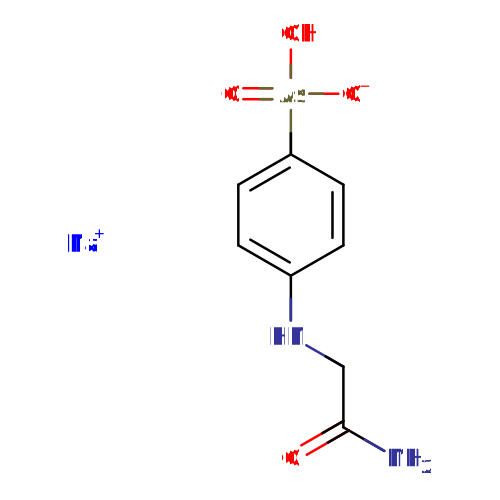
Tryparsamide is a synthetic arsenical drug with the formula C8H10AsN2NaO4 and an average molecular weight of 296.09 g/mol. It exists as a solid at room temperature and is of exogenous origin. Tryparsamide belongs to the amino acids, peptides, and analogues, a subclass of carboxylic acids and derivatives within the organic compounds. It is used to treat trypanosomiasis, also known as African sleeping sickness.
The compound interacts with 32 recorded protein targets. Arsenic binds to hemoglobin subunits alpha (HBA1) and beta (HBB), haptoglobin, the estrogen receptor (ESR1), the glucocorticoid receptor (NR3C1), and various forms of actin, including alpha skeletal muscle (ACTA1), aortic smooth muscle (ACTA2), cytoplasmic 1 (ACTB), and cytoplasmic 2 (ACTG1). Arsenic binding to XPA is believed to induce carcinogenesis by affecting DNA repair. Additionally, arsenic binds glutathione reductase, mitochondrial (GSR), resulting in the inhibition of essential biochemical reactions, alteration of cellular redox status, and eventual cytotoxicity.
The compound disrupts ATP production through several mechanisms involving the pyruvate dehydrogenase complex, specifically the dihydrolipoyllysine-residue acetyltransferase component (DLAT) and pyruvate dehydrogenase E1 component subunits alpha (PDHA1, PDHA2) and beta (PDHB). At the level of the citric acid cycle, arsenic inhibits pyruvate dehydrogenase and competes with phosphate to uncouple oxidative phosphorylation. This process inhibits mitochondrial respiration, ATP synthesis, and the energy-linked reduction of NAD+. Furthermore, hydrogen peroxide production is increased, which may lead to oxidative stress and the formation of reactive oxygen species.
Arsenic and its metabolites disrupt ATP production through several mechanisms. At the level of the citric acid cycle, arsenic inhibits pyruvate dehydrogenase and by competing with phosphate it uncouples oxidative phosphorylation, thus inhibiting energy-linked reduction of NAD+, mitochondrial respiration, and ATP synthesis. Hydrogen peroxide production is also increased, which might form reactive oxygen species and oxidative stress. Arsenic's carcinogenicity is influenced by the arsenical binding of tubulin, which results in aneuploidy, polyploidy and mitotic arrests. The binding of other arsenic protein targets may also cause altered DNA repair enzyme activity, altered DNA methylation patterns and cell proliferation. (7, 1)
Metabolism
Arsenic is absorbed mainly by inhalation or ingestion, as to a lesser extent, dermal exposure. It is then distributed throughout the body, where it is reduced into arsenite if necessary, then methylated into monomethylarsenic (MMA) and dimethylarsenic acid (DMA) by arsenite methyltransferase. Arsenic and its metabolites are primarily excreted in the urine. Arsenic is known to induce the metal-binding protein metallothionein, which decreases the toxic effects of arsenic and other metals by binding them and making them biologically inactive, as well as acting as an antioxidant. (3)
Hypovolemia from capillary leakage (third-spacing of fluids) is a common, serious, early effect. Muscle cramps, facial edema, bronchitis, dyspnea, chest pain, dehydration, intense thirst, and fluid-electrolyte disturbances are also common following significant exposures. A garlic-like odor of the breath and feces may also occur. After absorption, arsenic may cause multi-organ failure by inhibiting sulfhydryl-containing enzymes. Encephalopathy, with headache, lethargy, mental confusion, hallucinations, emotional lability, memory loss and delirium may occur; seizures, stupor, convulsions, coma, and death may follow within 24 hours of a severe acute exposure. Dysrhythmias (particularly QTc prolongation and torsade de pointes), cardiomyopathy, ARDS, hepatitis, rhabdomyolysis, hemolysis, and renal failure may develop over several days. The sequence of chronic poisoning involves hyperpigmentation, and eczematoid and allergic dermatitis. muscle fasciculations; gross tremors; ataxia; incoordination; and mental confusion. Muscular weakness, limb tenderness and difficulty walking may follow. The final phase consists of peripheral sensory neuropathy of the hands and feet. That may be associated with a motor neuropathy as well (8).
Symptoms
Initial signs and symptoms of arsenic ingestion include burning lips, throat constriction and dysphagia, followed by excruciating abdominal pain, hemorrhagic gastritis, gastroenteritis, severe nausea, projectile voting, profuse "rice water-like" diarrhea, with hypovolemia that may result in hypotension and an irregular pulse. The sequence of chronic poisoning involves weakness, anorexia, hepatomegaly, jaundice, and gastrointestinal complaints, followed by conjunctivitis, irritation of the throat and respiratory tract. ther effects of chronic exposure include conjunctivitis with irritation and lacrimation; hair, skin and nail changes; hyperkeratosis of feet and hands; and melanosis, with pigment spots in corneal and conjunctival epithelium. Peripheral nervous system symptoms may include numbness, burning, and tingling of the hands and feet; pain; paresthesias; tenderness (8).
Treatment
Aggressive decontamination with gastric lavage is recommended if the patient has consumed a potentially life-threatening dose and if the patient is not vomiting (8).