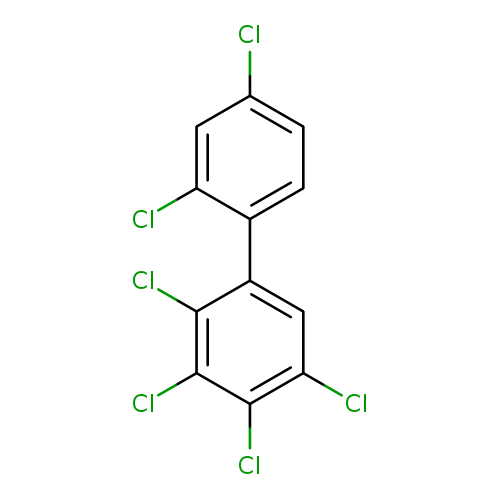
2,2',3,4,4',5-Hexachlorobiphenyl belongs to the biphenyls and derivatives, a subclass of benzene and substituted derivatives within the organic compounds. This exogenous compound has the formula C12H4Cl6, an average molecular weight of 360.88 g/mol, and exists as a solid at room temperature. It has been used in Low-Density Polyethylene and High-Density Polyethylene.
The compound interacts with seven recorded protein targets. It binds to the aryl hydrocarbon receptor (AHR), which alters gene transcription and induces the expression of hepatic Phase I and Phase II enzymes, particularly those of the cytochrome P450 family. It causes endocrine disruption in humans by binding to and inhibiting the estrogen receptor (ESR1) and estrogen receptor beta (ESR2). Additionally, binding to estrogen sulfotransferase (SULT1E1) can produce estrogenic effects, such as reproductive dysfunction, and stimulate the growth of certain cancer cells. Inhibition of tyrosine 3-monooxygenase (TH) and aromatic-L-amino-acid decarboxylase (DDC) is believed to cause decreased dopamine synthesis. Finally, the compound binds to receptor proteins such as uteroglobin (SCGB1A1), which leads to bioaccumulation.
belongs to the class of organic compounds known as polychlorinated biphenyls. These are organic compounds containing at least two chlorine atoms attached to either benzene ring of the biphenyl moiety.
The mechanism of action varies with the specific PCB. Dioxin-like PCBs bind to the aryl hydrocarbon receptor, which disrupts cell function by altering the transcription of genes, mainly be inducing the expression of hepatic Phase I and Phase II enzymes, especially of the cytochrome P450 family. Most of the toxic effects of PCBs are believed to be results of Ah receptor binding. Other PBCs are believed to interfere with calcium channels and/or change brain dopamine levels. PCBs can also cause endocrine disurption by altering the production of thyroid hormones and binding to estrogen receptors, which can stimulate the growth of certain cancer cells and produce other estrogenic effects, such as reproductive dysfunction. They will bioaccumulate by binding to receptor proteins such as uteroglobin. (1, 2, 4, 5)
Metabolism
PCBs are absorbed via inhalation, oral, and dermal routes of exposure. They are trasported in the blood, often bound to albumin. Due to their lipophilic nature they tend to accumulate in lipid-rich tissues, such as the liver, adipose, and skin. Metabolism of PCBs is very slow and varies based on the degree and position of chlorination. PCBs are metabolized by the microsomal monooxygenase system catalyzed by cytochrome P-450 enzymes to polar metabolites that can undergo conjugation with glutathione and glucuronic acid. The major metabolites are hydroxylated products which are excreted in the bile and faeces. The slow metabolism of PCBs means they tend to accumulate in body tissues. (6, 9)
PCBs were used as coolants and lubricants in transformers, capacitors, and other electrical devices (such as fluorescent lights and refridgerators) produced before 1977. PCBs may contaminate the air and water near hazardous waste sites. In addition, PCBs bioaccumulate in the environment and may be found in fish, meat, and dairy products. (6)
The most common health effects of PCBs are skin conditions such as chloracne and rashes. Chronic PCB exposure has also been shown to cause liver, stomach and kidney, damage, jaundice, edema, anemia, changes in the immune system, behavioral alterations, and impaired reproduction. (6)
Symptoms
Chronic PCB exposure results in symptoms such as abdominal pain, nausea, vomiting, diarrhea, headache, dizziness, depression, nervousness, dermal and ocular lesions, fatigue, irregular menstrual cycles and a lowered immune response. (1)
Treatment
There are no specific treatments for PCB poisoning, since it is not usually recognized until after substantial chronic exposure. Only preventing further exposure and treating the observed symptoms can be done. Acute inhalation can be treated by administering oxygen. (6)