Record Information
Version1.0
Creation Date2009-06-19 21:58:24 UTC
Update Date2016-11-09 01:08:25 UTC
Accession NumberCHEM001010
Identification
Common NameUranyl nitrate
ClassSmall Molecule
DescriptionUranyl nitrate is a chemical compound of uranium. It is used as a negative stain in electron microscopy and in nuclear reprocessing. Uranium is a chemical element that has the symbol U and atomic number 92. It is a normal part of rocks, soil, air, and water, and occurs in nature in the form of minerals. Nitrite is a toxic compound known to cause methemoglobinemia. (10, 7, 8, 9)
Contaminant Sources
  • Clean Air Act Chemicals
  • T3DB toxins
Contaminant Type
  • Industrial/Workplace Toxin
  • Inorganic Compound
  • Nitrate
  • Nitrite
  • Pollutant
  • Radioactive
  • Synthetic Compound
  • Uranium Compound
Chemical Structure
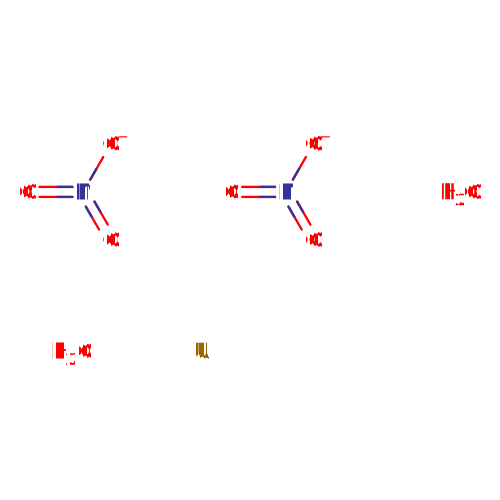
Thumb
Synonyms
ValueSource
Dihydric acid uranium dinitric acidGenerator
Chemical FormulaH4N2O8U
Average Molecular Mass398.068 g/mol
Monoisotopic Mass398.049 g/mol
CAS Registry Number10102-06-4
IUPAC Namedihydrate uranium dinitrate
Traditional Namedihydrate uranium dinitrate
SMILESO.O.[U].[O-]N(=O)=O.[O-]N(=O)=O
InChI IdentifierInChI=1S/2NO3.2H2O.U/c2*2-1(3)4;;;/h;;2*1H2;/q2*-1;;;
InChI KeyVDYKSBLVUVUZLM-UHFFFAOYSA-N
Chemical Taxonomy
Description belongs to the class of inorganic compounds known as actinide nitrates. These are inorganic compounds in which the largest oxoanion is nitrate, and in which the heaviest atom not in an oxoanion is an actinide.
KingdomInorganic compounds
Super ClassMixed metal/non-metal compounds
ClassActinide oxoanionic compounds
Sub ClassActinide nitrates
Direct ParentActinide nitrates
Alternative Parents
Substituents
  • Actinide nitrate
  • Inorganic oxide
Molecular FrameworkNot Available
External DescriptorsNot Available
Biological Properties
StatusDetected and Not Quantified
OriginExogenous
Cellular Locations
  • Cytoplasm
  • Extracellular
Biofluid LocationsNot Available
Tissue LocationsNot Available
PathwaysNot Available
ApplicationsNot Available
Biological RolesNot Available
Chemical RolesNot Available
Physical Properties
StateSolid
AppearanceYellow/green solid.
Experimental Properties
PropertyValue
Melting Point60°C
Boiling Point118°C (decomposes)
SolubilityNot Available
Predicted Properties
PropertyValueSource
logP0.028ChemAxon
pKa (Strongest Acidic)-1.4ChemAxon
pKa (Strongest Basic)-10ChemAxon
Physiological Charge-1ChemAxon
Hydrogen Acceptor Count3ChemAxon
Hydrogen Donor Count0ChemAxon
Polar Surface Area68.88 ŲChemAxon
Rotatable Bond Count0ChemAxon
Refractivity9.85 m³·mol⁻¹ChemAxon
Polarizability3.24 ųChemAxon
Number of Rings0ChemAxon
Bioavailability1ChemAxon
Rule of FiveYesChemAxon
Ghose FilterNoChemAxon
Veber's RuleNoChemAxon
MDDR-like RuleNoChemAxon
Spectra
Spectra
Spectrum TypeDescriptionSplash KeyView
Predicted LC-MS/MSPredicted LC-MS/MS Spectrum - 10V, Positivesplash10-0002-0009000000-c41251d6f86ee6efeb47Spectrum
Predicted LC-MS/MSPredicted LC-MS/MS Spectrum - 20V, Positivesplash10-0002-0009000000-c41251d6f86ee6efeb47Spectrum
Predicted LC-MS/MSPredicted LC-MS/MS Spectrum - 40V, Positivesplash10-0002-0009000000-c41251d6f86ee6efeb47Spectrum
Predicted LC-MS/MSPredicted LC-MS/MS Spectrum - 10V, Negativesplash10-0002-0009000000-274972e37b72666db5d7Spectrum
Predicted LC-MS/MSPredicted LC-MS/MS Spectrum - 20V, Negativesplash10-0002-0009000000-274972e37b72666db5d7Spectrum
Predicted LC-MS/MSPredicted LC-MS/MS Spectrum - 40V, Negativesplash10-0002-0009000000-274972e37b72666db5d7Spectrum
Toxicity Profile
Route of ExposureOral (8) ; inhalation (8) ; dermal (8)
Mechanism of ToxicityUranium is combined with either bicarbonate or a plasma protein in the blood but once in the kidney, it is released and forms complexes with phosphate ligands and proteins in the tubular wall, causing damage. Uranium may also inhibit both sodium transport-dependent and independent ATP utilization and mitochondrial oxidative phosphorylation in the renal proximal tubule. Uranium causes respiratory diseases by damaging alveolar epithelium type II cells in the lungs. Uranium induces c-Jun N-terminal kinase (JNK) and p38 mitogen-activated protein kinase (p38 MAPK) activation, which in turn induces tumor necrosis factor alpha (TNF-alpha) secretion and generates and inflammatory response in the lungs. Studies have shown that the more soluble the uranium salt, the more toxic it is. Ionizing radiation produced by uranium damages the DNA, resulting in gene mutations and chromosomal aberrations. This can both both initiate and promote carcinogenesis, and interfere with reproduction and development. Nitrate's toxicity is a result of it's conversion to nitrite once in the body. Nitrite causes the autocatalytic oxidation of oxyhemoglobin to hydrogen peroxide and methemoglobin. This elevation of methemoglobin levels is a condition known as methemoglobinemia, and is characterized by tissue hypoxia, as methemoglobin cannot bind oxygen. (3, 11, 8, 1)
MetabolismUranium is absorbed in low amounts via oral, inhalation, and dermal routes. Uranium in body fluids generally exists as the uranyl ion (UO2)2+ complexed with anions, such as citrate and bicarbonate, or plasma proteins. Uranium preferentially distributes to bone, liver, and kidney. The large majority of uranium that enters the body is not absorbed and is eliminated from the body via the urine and faeces. Intake of some amount of nitrates and nitrites is a normal part of the nitrogen cycle in humans. In vivo conversion of nitrates to nitrites can occur in the gastrointestional tract under the right conditions, significantly enhancing nitrates' toxic potency. The major metabolic pathway for nitrate is conversion to nitrite, and then to ammonia. Nitrites, nitrates, and their metabolites are excreted in the urine. (10, 7)
Toxicity ValuesLD50: 2 mg/kg (Intraperitoneal, Rat) (12)
Lethal DoseNot Available
Carcinogenicity (IARC Classification)Uranium: Group 1, carcinogenic to humans (5)
Uses/SourcesUranyl nitrate is used as a negative stain in electron microscopy and in nuclear reprocessing. (9)
Minimum Risk LevelIntermediate Inhalation: 0.0004 mg/m3 (Soluble uranium salts) (4) Chronic Inhalation: 0.0003 mg/m3 (Soluble uranium salts) (4) Intermediate Oral: 0.002 mg/kg/day (Soluble uranium salts) (4) Intermediate Inhalation: 0.008 mg/m3 (Insoluble uranium compounds) (4)
Health EffectsUranium primarily damages the kidney, but may also damage the lungs, central nervous system, and immune system. Uranium's radioactivity is believed to damage the DNA, resulting in carcinogenic effects and reproductive and developmental damage. Nitrate and nitrite poisoning causes methemoglobinemia. Nitrites may cause pregnancy complications and developmental effects. They may also be carcinogenic. (10, 7, 8)
SymptomsIngestion of uranium may cause vomiting and diarrhea. Nitrate and nitrite poisoning causes methemoglobinemia. Symptoms include cyanosis, cardiac dysrhythmias and circulatory failure, and progressive central nervous system (CNS) effects. CNS effects can range from mild dizziness and lethargy to coma and convulsions. (10, 7)
TreatmentMethemoglobinemia can be treated with supplemental oxygen and methylene blue 1% solution administered intravenously slowly over five minutes followed by IV flush with normal saline. Methylene blue restores the iron in hemoglobin to its normal (reduced) oxygen-carrying state. (11)

Concentrations
Not Available
DrugBank IDNot Available
HMDB IDNot Available
FooDB IDNot Available
Phenol Explorer IDNot Available
KNApSAcK IDNot Available
BiGG IDNot Available
BioCyc IDNot Available
METLIN IDNot Available
PDB IDNot Available
Wikipedia LinkNot Available
Chemspider IDNot Available
ChEBI IDNot Available
PubChem Compound IDNot Available
Kegg Compound IDNot Available
YMDB IDNot Available
ECMDB IDNot Available
References
Synthesis ReferenceNot Available
MSDSNot Available
General ReferencesNot Available