Record Information
Version1.0
Creation Date2009-07-03 22:19:14 UTC
Update Date2026-03-26 19:48:03 UTC
Accession NumberCHEM002075
Identification
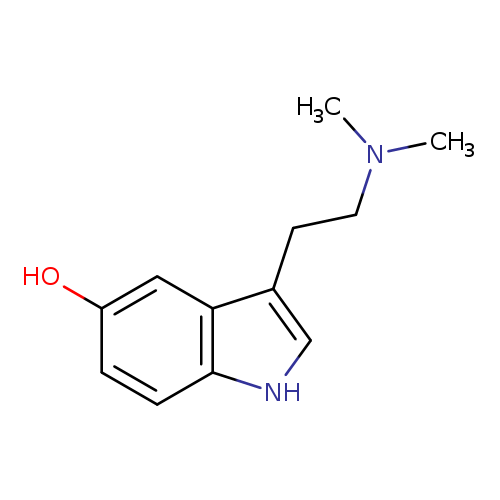
Common NameBufotenin
ClassSmall Molecule
DescriptionBufotenin (5-OH-DMT), is a tryptamine related to the neurotransmitter serotonin. It is an alkaloid found in the skin of some species of toads; in mushrooms, higher plants, and mammals. Bufotenin is a chemical constituent in the venom and eggs of several species of toads belonging to the Bufo genus, but most notably in the Colorado River toad (Bufo alvarius) as it is the only toad species in which bufotenin is present in large enough quantities for a psychoactive effect. Extracts of toad venom, containing bufotenin and other bioactive compounds, have been used in some traditional medicines (probably derived from Bufo gargarizans), which has been used medicinally for centuries in China. Bufotenin is a constituent of the seeds of Anadenanthera colubrina and Anadenanthera peregrina trees. Anadenanthera seeds have been used as an ingredient in psychedelic snuff preparations by indigenous cultures of the Caribbean, Central and South America. The acute toxicity (LD50) of bufotenin in rodents has been estimated at 200 to 300 mg/kg. Death occurs by respiratory arrest.
Contaminant Sources
  • STOFF IDENT Compounds
  • T3DB toxins
  • ToxCast & Tox21 Chemicals
Contaminant Type
  • Amine
  • Animal Toxin
  • Frog/Toad Toxin
  • Fungal Toxin
  • Metabolite
  • Natural Compound
  • Organic Compound
Chemical Structure
Thumb
Synonyms
ValueSource
3-[2-(Dimethylamino)ethyl]-5-indololChEBI
3-[2-(Dimethylamino)ethyl]indol-5-olChEBI
3-[beta-(Dimethylamino)ethyl]-5-hydroxyindoleChEBI
5-Hydroxy-N,N-dimethyltryptamineChEBI
BufotenineChEBI
DM5-HTChEBI
N,N-DimethylserotoninChEBI
3-[b-(Dimethylamino)ethyl]-5-hydroxyindoleGenerator
3-[Β-(dimethylamino)ethyl]-5-hydroxyindoleGenerator
1H-indol-5-Ol, {3-[2-(dimethylamino)ethyl]-}HMDB
3-(2-(Dimethylamino)ethyl)-1H-indol-5-ol (acd/name 4.0)HMDB
3-(2-Dimethylaminoethyl)-5-indololHMDB
3-(2-Dimethylaminoethyl)indol-5-olHMDB
3-(beta-Dimethylaminoethyl)-5-hydroxyindoleHMDB
3-[2-(Dimethylamino)ethyl]-1H-indol-5-olHMDB
3-[2-(Dimethylamino)ethyl]-indol-5-olHMDB
5-Hydroxy-N, N-dimethyltryptamineHMDB
CinobufotenineHMDB
CohobaHMDB
DimethylserotoninHMDB
indol-5-Ol, {3-[2-(dimethylamino)ethyl]-}HMDB
MapineHMDB
MappinHMDB
MappineHMDB
N, N-DimethylserotoninHMDB
N,N-Dimethyl-5-hydroxytryptamineHMDB
{3-[(2-dimethylamino)ethyl]-5-indolol}HMDB
{3-[(beta-dimethylamino)ethyl]-5-hydroxyindole}HMDB
N,N Dimethyl 5 hydroxytryptamineHMDB
5 Hydroxy N,N dimethyltryptamineHMDB
BufoteninKEGG
Chemical FormulaC12H16N2O
Average Molecular Mass204.268 g/mol
Monoisotopic Mass204.126 g/mol
CAS Registry Number487-93-4
IUPAC Name3-[2-(dimethylamino)ethyl]-1H-indol-5-ol
Traditional Namebufotenine
SMILESCN(C)CCC1=CNC2=C1C=C(O)C=C2
InChI IdentifierInChI=1S/C12H16N2O/c1-14(2)6-5-9-8-13-12-4-3-10(15)7-11(9)12/h3-4,7-8,13,15H,5-6H2,1-2H3
InChI KeyVTTONGPRPXSUTJ-UHFFFAOYSA-N
Chemical Taxonomy
Description belongs to the class of organic compounds known as serotonins. Serotonins are compounds containing a serotonin moiety, which consists of an indole that bears an aminoethyl a position 2 and a hydroxyl group at position 5.
KingdomOrganic compounds
Super ClassOrganoheterocyclic compounds
ClassIndoles and derivatives
Sub ClassTryptamines and derivatives
Direct ParentSerotonins
Alternative Parents
Substituents
  • Serotonin
  • Hydroxyindole
  • 3-alkylindole
  • Indole
  • Alkaloid or derivatives
  • 1-hydroxy-2-unsubstituted benzenoid
  • Aralkylamine
  • Substituted pyrrole
  • Benzenoid
  • Pyrrole
  • Heteroaromatic compound
  • Tertiary aliphatic amine
  • Tertiary amine
  • Azacycle
  • Hydrocarbon derivative
  • Organopnictogen compound
  • Organic oxygen compound
  • Amine
  • Organooxygen compound
  • Organonitrogen compound
  • Organic nitrogen compound
  • Aromatic heteropolycyclic compound
Molecular FrameworkAromatic heteropolycyclic compounds
External Descriptors
Biological Properties
StatusDetected and Not Quantified
OriginExogenous
Cellular Locations
  • Cytoplasm
  • Extracellular
Biofluid LocationsNot Available
Tissue LocationsNot Available
PathwaysNot Available
Applications
Biological Roles
Chemical RolesNot Available
Physical Properties
StateSolid
AppearanceWhite powder.
Experimental Properties
PropertyValue
Melting Point146.5°C
Boiling PointNot Available
SolubilityNot Available
Predicted Properties
PropertyValueSource
Water Solubility3.2 g/LALOGPS
logP2.04ALOGPS
logP1.29ChemAxon
logS-1.8ALOGPS
pKa (Strongest Acidic)9.23ChemAxon
pKa (Strongest Basic)9.91ChemAxon
Physiological Charge1ChemAxon
Hydrogen Acceptor Count2ChemAxon
Hydrogen Donor Count2ChemAxon
Polar Surface Area39.26 ŲChemAxon
Rotatable Bond Count3ChemAxon
Refractivity62.42 m³·mol⁻¹ChemAxon
Polarizability23.29 ųChemAxon
Number of Rings2ChemAxon
Bioavailability1ChemAxon
Rule of FiveYesChemAxon
Ghose FilterYesChemAxon
Veber's RuleYesChemAxon
MDDR-like RuleNoChemAxon
Spectra
Spectra
Spectrum TypeDescriptionSplash KeyView
Predicted GC-MSPredicted GC-MS Spectrum - GC-MS (Non-derivatized) - 70eV, Positivesplash10-0a4i-9200000000-0af816b35b1e16d258a1Spectrum
Predicted GC-MSPredicted GC-MS Spectrum - GC-MS (1 TMS) - 70eV, Positivesplash10-0a4i-9130000000-7bbf336895ab1b156223Spectrum
Predicted GC-MSPredicted GC-MS Spectrum - GC-MS (Non-derivatized) - 70eV, PositiveNot AvailableSpectrum
Predicted LC-MS/MSPredicted LC-MS/MS Spectrum - 10V, Positivesplash10-0a4i-0390000000-af3dd65f76ad8654b621Spectrum
Predicted LC-MS/MSPredicted LC-MS/MS Spectrum - 20V, Positivesplash10-08fr-0940000000-8952400d2cb6d011de82Spectrum
Predicted LC-MS/MSPredicted LC-MS/MS Spectrum - 40V, Positivesplash10-01qa-1900000000-34b8e0879f296431d1e8Spectrum
Predicted LC-MS/MSPredicted LC-MS/MS Spectrum - 10V, Negativesplash10-0udi-0090000000-59bc27deb381d771d0aeSpectrum
Predicted LC-MS/MSPredicted LC-MS/MS Spectrum - 20V, Negativesplash10-0udi-1290000000-c4aa46abeccd608387a9Spectrum
Predicted LC-MS/MSPredicted LC-MS/MS Spectrum - 40V, Negativesplash10-0536-5900000000-1b322d788e0c55bfa242Spectrum
Predicted LC-MS/MSPredicted LC-MS/MS Spectrum - 10V, Negativesplash10-0udi-0190000000-aa5796e407ec72620b1bSpectrum
Predicted LC-MS/MSPredicted LC-MS/MS Spectrum - 20V, Negativesplash10-0ue9-0970000000-fa89d4528ce714421e8aSpectrum
Predicted LC-MS/MSPredicted LC-MS/MS Spectrum - 40V, Negativesplash10-001i-1900000000-df031839bb432c50ef0dSpectrum
Predicted LC-MS/MSPredicted LC-MS/MS Spectrum - 10V, Positivesplash10-0a4i-0190000000-7230690add489b3c18b9Spectrum
Predicted LC-MS/MSPredicted LC-MS/MS Spectrum - 20V, Positivesplash10-0bt9-1950000000-42c05e07b418d453a0a8Spectrum
Predicted LC-MS/MSPredicted LC-MS/MS Spectrum - 40V, Positivesplash10-0a4i-8900000000-cd0c40dcec1955a75dcbSpectrum
MSMass Spectrum (Electron Ionization)splash10-0a4i-9100000000-3e8c21621c306ca36decSpectrum
1D NMR1H NMR SpectrumNot AvailableSpectrum
1D NMR13C NMR SpectrumNot AvailableSpectrum
1D NMR1H NMR SpectrumNot AvailableSpectrum
1D NMR13C NMR SpectrumNot AvailableSpectrum
1D NMR1H NMR SpectrumNot AvailableSpectrum
1D NMR13C NMR SpectrumNot AvailableSpectrum
1D NMR1H NMR SpectrumNot AvailableSpectrum
1D NMR13C NMR SpectrumNot AvailableSpectrum
1D NMR1H NMR SpectrumNot AvailableSpectrum
1D NMR13C NMR SpectrumNot AvailableSpectrum
1D NMR1H NMR SpectrumNot AvailableSpectrum
1D NMR13C NMR SpectrumNot AvailableSpectrum
1D NMR1H NMR SpectrumNot AvailableSpectrum
1D NMR13C NMR SpectrumNot AvailableSpectrum
1D NMR1H NMR SpectrumNot AvailableSpectrum
1D NMR13C NMR SpectrumNot AvailableSpectrum
1D NMR1H NMR SpectrumNot AvailableSpectrum
1D NMR13C NMR SpectrumNot AvailableSpectrum
1D NMR1H NMR SpectrumNot AvailableSpectrum
1D NMR13C NMR SpectrumNot AvailableSpectrum
Toxicity Profile
Route of ExposureIngestion (8)
Mechanism of ToxicityBufotenin is a neurotoxin similar to the mushroom toxin psilocin. Thus it likely acts as a partial agonist at the 5-HT2A serotonin receptor in the brain where it mimics the effects of serotonin (5-HT). It is likely also a 5-HT1A and 5-HT2A/2C agonist. (6, 7)
MetabolismNot Available
Toxicity ValuesNot Available
Lethal DoseNot Available
Carcinogenicity (IARC Classification)No indication of carcinogenicity to humans (not listed by IARC).
Uses/SourcesBufotenin is a toxin found in some toads (genus Bufo) and mushrooms (genus Amanita). (6)
Minimum Risk LevelNot Available
Health EffectsBufotenin is neurotoxic and can cause hallucinations. (6)
SymptomsBufotenin exposure produces local irritation and causes hallucinations. It may also cause circulation problems peripheral nervous system effects such as flushing and hyperventilation. (6)
TreatmentNot Available
Concentrations
Not Available
DrugBank IDDB01445
HMDB IDHMDB0041842
FooDB IDFDB111673
Phenol Explorer IDNot Available
KNApSAcK IDC00001402
BiGG IDNot Available
BioCyc IDNot Available
METLIN IDNot Available
PDB IDNot Available
Wikipedia LinkBufotenin
Chemspider ID9839
ChEBI ID3210
PubChem Compound ID10257
Kegg Compound IDC08299
YMDB IDNot Available
ECMDB IDNot Available
References
Synthesis ReferenceNot Available
MSDSNot Available
General References
1. https://www.ncbi.nlm.nih.gov/pubmed/?term=11718320
2. https://www.ncbi.nlm.nih.gov/pubmed/?term=16095048
3. https://www.ncbi.nlm.nih.gov/pubmed/?term=19303230
4. https://www.ncbi.nlm.nih.gov/pubmed/?term=20150873
5. https://www.ncbi.nlm.nih.gov/pubmed/?term=20206139
6. https://www.ncbi.nlm.nih.gov/pubmed/?term=20942780
7. https://www.ncbi.nlm.nih.gov/pubmed/?term=21624387
8. https://www.ncbi.nlm.nih.gov/pubmed/?term=4091027
9. https://www.ncbi.nlm.nih.gov/pubmed/?term=658125
10. https://www.ncbi.nlm.nih.gov/pubmed/?term=8532147
11. https://www.ncbi.nlm.nih.gov/pubmed/?term=8747157
12. https://www.ncbi.nlm.nih.gov/pubmed/?term=8895112
13. Carpenter WT Jr, Fink EB, Narasimhachari N, Himwich HE: A test of the transmethylation hypothesis in acute schizophrenic patients. Am J Psychiatry. 1975 Oct;132(10):1067-71.
14. Takeda N, Ikeda R, Ohba K, Kondo M: Bufotenine reconsidered as a diagnostic indicator of psychiatric disorders. Neuroreport. 1995 Nov 27;6(17):2378-80.
15. Ciprian-Ollivier J, Cetkovich-Bakmas MG: Altered consciousness states and endogenous psychoses: a common molecular pathway? Schizophr Res. 1997 Dec 19;28(2-3):257-65.
16. Pomilio AB, Vitale AA, Ciprian-Ollivier J, Cetkovich-Bakmas M, Gomez R, Vazquez G: Ayahoasca: an experimental psychosis that mirrors the transmethylation hypothesis of schizophrenia. J Ethnopharmacol. 1999 Apr;65(1):29-51.
17. Sponheim E, Myhre AM, Reichelt KL, Aalen OO: [Urine peptide patterns in children with milder types of autism]. Tidsskr Nor Laegeforen. 2006 May 25;126(11):1475-7.