Record Information
Version1.0
Creation Date2009-07-15 20:44:41 UTC
Update Date2026-03-27 00:45:52 UTC
Accession NumberCHEM002114
Identification
Common NameZoledronate
ClassSmall Molecule
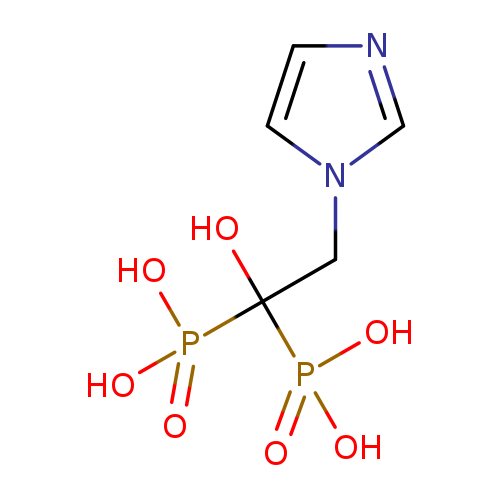
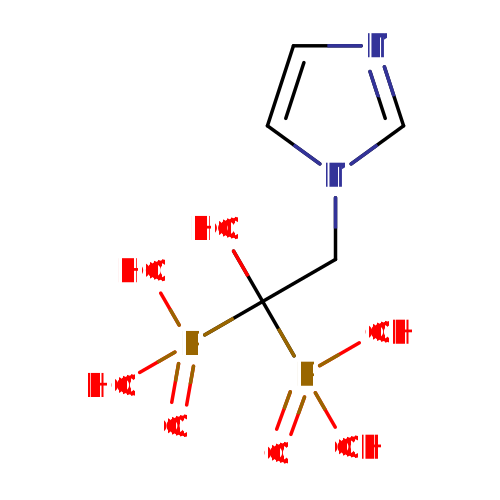
DescriptionZoledronate (zoledronic acid, marketed by Novartis under the trade names Zometa and Reclast) is a bisphosphonate. Zometa is used to prevent skeletal fractures in patients with cancers such as multiple myeloma and prostate cancer. It can also be used to treat hypercalcemia of malignancy and can be helpful for treating pain from bone metastases. An annual dose of Zoledronate may also prevent recurring fractures in patients with a previous hip fracture. Zoledronate is a single 5 mg infusion for the treatment of Paget's disease of bone. In 2007, the FDA also approved Reclast for the treatment of postmenopausal osteoporosis.
Contaminant Sources
  • HMDB Contaminants - Urine
  • STOFF IDENT Compounds
  • T3DB toxins
  • ToxCast & Tox21 Chemicals
Contaminant Type
  • Antihypocalcemic Agent
  • Antiresorptive
  • Bisphosphonate
  • Bone Density Conservation Agent
  • Drug
  • Metabolite
  • Organic Compound
  • Synthetic Compound
Chemical Structure
Thumb
Synonyms
ValueSource
(1-Hydroxy-2-(1H-imidazol-1-yl)ethylidene)bisphosphonic acidChEBI
(1-Hydroxy-2-imidazol-1-ylethylidene)diphosphonic acidChEBI
ReclastChEBI
ZOLChEBI
ZometaKegg
(1-Hydroxy-2-(1H-imidazol-1-yl)ethylidene)bisphosphonateGenerator
(1-Hydroxy-2-imidazol-1-ylethylidene)diphosphonateGenerator
Zoledronic acidGenerator
2-(Imidazol-1-yl)-1-hydroxyethylidene-1,1-bisphosphonic acidHMDB
Novartis brand OF zoledronic acidHMDB
Zoledronic acid anhydrousHMDB
Chemical FormulaC5H10N2O7P2
Average Molecular Mass272.090 g/mol
Monoisotopic Mass271.996 g/mol
CAS Registry Number118072-93-8
IUPAC Name[1-hydroxy-2-(1H-imidazol-1-yl)-1-phosphonoethyl]phosphonic acid
Traditional Namezoledronate
SMILESOC(CN1C=CN=C1)(P(O)(O)=O)P(O)(O)=O
InChI IdentifierInChI=1S/C5H10N2O7P2/c8-5(15(9,10)11,16(12,13)14)3-7-2-1-6-4-7/h1-2,4,8H,3H2,(H2,9,10,11)(H2,12,13,14)
InChI KeyXRASPMIURGNCCH-UHFFFAOYSA-N
Chemical Taxonomy
Description belongs to the class of organic compounds known as bisphosphonates. These are organic compounds containing two phosphonate groups linked together through a carbon atoms.
KingdomOrganic compounds
Super ClassOrganic acids and derivatives
ClassOrganic phosphonic acids and derivatives
Sub ClassBisphosphonates
Direct ParentBisphosphonates
Alternative Parents
Substituents
  • Bisphosphonate
  • N-substituted imidazole
  • Heteroaromatic compound
  • Organophosphonic acid
  • Imidazole
  • Azole
  • Azacycle
  • Organoheterocyclic compound
  • Organic nitrogen compound
  • Organic oxygen compound
  • Organopnictogen compound
  • Organic oxide
  • Hydrocarbon derivative
  • Organophosphorus compound
  • Organooxygen compound
  • Organonitrogen compound
  • Aromatic heteromonocyclic compound
Molecular FrameworkAromatic heteromonocyclic compounds
External Descriptors
Biological Properties
StatusDetected and Not Quantified
OriginExogenous
Cellular Locations
  • Cytoplasm
  • Membrane
Biofluid LocationsNot Available
Tissue LocationsNot Available
Pathways
NameSMPDB LinkKEGG Link
Zoledronate PathwayNot AvailableNot Available
Applications
Biological RolesNot Available
Chemical RolesNot Available
Physical Properties
StateSolid
AppearanceWhite powder.
Experimental Properties
PropertyValue
Melting PointNot Available
Boiling PointNot Available
SolubilitySparingly soluble
Predicted Properties
PropertyValueSource
Water Solubility3.27 g/LALOGPS
logP-0.93ALOGPS
logP-3.9ChemAxon
logS-1.9ALOGPS
pKa (Strongest Acidic)0.66ChemAxon
pKa (Strongest Basic)6.67ChemAxon
Physiological Charge-2ChemAxon
Hydrogen Acceptor Count8ChemAxon
Hydrogen Donor Count5ChemAxon
Polar Surface Area153.11 ŲChemAxon
Rotatable Bond Count4ChemAxon
Refractivity52.16 m³·mol⁻¹ChemAxon
Polarizability20.1 ųChemAxon
Number of Rings1ChemAxon
Bioavailability1ChemAxon
Rule of FiveYesChemAxon
Ghose FilterNoChemAxon
Veber's RuleNoChemAxon
MDDR-like RuleNoChemAxon
Spectra
Spectra
Spectrum TypeDescriptionSplash KeyView
Predicted GC-MSPredicted GC-MS Spectrum - GC-MS (Non-derivatized) - 70eV, Positivesplash10-001i-9120000000-239c3921d9c0513b29bfSpectrum
Predicted GC-MSPredicted GC-MS Spectrum - GC-MS (1 TMS) - 70eV, Positivesplash10-0089-9010000000-350e054fb0333ac6c489Spectrum
Predicted GC-MSPredicted GC-MS Spectrum - GC-MS (Non-derivatized) - 70eV, PositiveNot AvailableSpectrum
LC-MS/MSLC-MS/MS Spectrum - DI-ESI-qTof , Negativesplash10-000i-0910000000-6c7cee1b60ea3968e2f7Spectrum
Predicted LC-MS/MSPredicted LC-MS/MS Spectrum - 10V, Positivesplash10-00di-0190000000-d743d302781bf9a387dcSpectrum
Predicted LC-MS/MSPredicted LC-MS/MS Spectrum - 20V, Positivesplash10-001l-8910000000-89833833ce5df6ce7fbfSpectrum
Predicted LC-MS/MSPredicted LC-MS/MS Spectrum - 40V, Positivesplash10-014i-9350000000-6a8817aebcf8b58c9872Spectrum
Predicted LC-MS/MSPredicted LC-MS/MS Spectrum - 10V, Negativesplash10-00di-1290000000-3a385a1ab40b3030223aSpectrum
Predicted LC-MS/MSPredicted LC-MS/MS Spectrum - 20V, Negativesplash10-0fki-4690000000-90b5d47e0913184a3303Spectrum
Predicted LC-MS/MSPredicted LC-MS/MS Spectrum - 40V, Negativesplash10-004i-9100000000-8fed5642f16554892c2dSpectrum
Predicted LC-MS/MSPredicted LC-MS/MS Spectrum - 10V, Positivesplash10-00dl-0690000000-d8e121c2f8fde6d36c50Spectrum
Predicted LC-MS/MSPredicted LC-MS/MS Spectrum - 20V, Positivesplash10-00di-1490000000-73b24204457ff8cb45cbSpectrum
Predicted LC-MS/MSPredicted LC-MS/MS Spectrum - 40V, Positivesplash10-00lr-9100000000-a6b7ed66230e1c22c0cfSpectrum
Predicted LC-MS/MSPredicted LC-MS/MS Spectrum - 10V, Negativesplash10-0fk9-0090000000-39599d85059cab3fb733Spectrum
Predicted LC-MS/MSPredicted LC-MS/MS Spectrum - 20V, Negativesplash10-0iu0-9220000000-54fc3ff7d337e2817e04Spectrum
Predicted LC-MS/MSPredicted LC-MS/MS Spectrum - 40V, Negativesplash10-03mi-9110000000-c37cf2658c6d4e001274Spectrum
1D NMR1H NMR SpectrumNot AvailableSpectrum
1D NMR13C NMR SpectrumNot AvailableSpectrum
1D NMR1H NMR SpectrumNot AvailableSpectrum
1D NMR13C NMR SpectrumNot AvailableSpectrum
1D NMR1H NMR SpectrumNot AvailableSpectrum
1D NMR13C NMR SpectrumNot AvailableSpectrum
1D NMR1H NMR SpectrumNot AvailableSpectrum
1D NMR13C NMR SpectrumNot AvailableSpectrum
1D NMR1H NMR SpectrumNot AvailableSpectrum
1D NMR13C NMR SpectrumNot AvailableSpectrum
1D NMR1H NMR SpectrumNot AvailableSpectrum
1D NMR13C NMR SpectrumNot AvailableSpectrum
1D NMR1H NMR SpectrumNot AvailableSpectrum
1D NMR13C NMR SpectrumNot AvailableSpectrum
1D NMR1H NMR SpectrumNot AvailableSpectrum
1D NMR13C NMR SpectrumNot AvailableSpectrum
1D NMR1H NMR SpectrumNot AvailableSpectrum
1D NMR13C NMR SpectrumNot AvailableSpectrum
1D NMR1H NMR SpectrumNot AvailableSpectrum
1D NMR13C NMR SpectrumNot AvailableSpectrum
Toxicity Profile
Route of ExposureIntravenous. Poorly absorbed (oral absorption is about 1% of what intravenous absorption is).
Mechanism of ToxicityThe action of zoledronate on bone tissue is based partly on its affinity for hydroxyapatite, which is part of the mineral matrix of bone. Zoledronate also targets farnesyl pyrophosphate (FPP) synthase. Nitrogen-containing bisphosphonates such as zoledronate appear to act as analogues of isoprenoid diphosphate lipids, thereby inhibiting FPP synthase, an enzyme in the mevalonate pathway. Inhibition of this enzyme in osteoclasts prevents the biosynthesis of isoprenoid lipids (FPP and GGPP) that are essential for the post-translational farnesylation and geranylgeranylation of small GTPase signalling proteins. This activity inhibits osteoclast activity and reduces bone resorption and turnover. In postmenopausal women, it reduces the elevated rate of bone turnover, leading to, on average, a net gain in bone mass.
MetabolismZoledronate does not inhibit human P450 enzymes in vitro and does not undergo biotransformation in vivo. Route of Elimination: In 64 patients with cancer and bone metastases, on average (± s.d.) 39 ± 16% of the administered zoledronic acid dose was recovered in the urine within 24 hours, with only trace amounts of drug found in urine post-Day 2. Half Life: 146 hours
Toxicity ValuesNot Available
Lethal DoseNot Available
Carcinogenicity (IARC Classification)No indication of carcinogenicity to humans (not listed by IARC).
Uses/SourcesFor the treatment of hypercalcemia of malignancy. Also for the treatment of patients with multiple myeloma and patients with documented bone metastases from solid tumors, in conjunction with standard antineoplastic therapy. In May of 2007, the drug was approved for treatment of Paget's Disease.
Minimum Risk LevelNot Available
Health EffectsNot Available
SymptomsThere is no experience of acute overdose. Two patients received zoledronate (32 mg) over 5 minutes in clinical trials. Neither patient experienced any clinical or laboratory toxicity. Overdosage may cause clinically significant hypocalcemia, hypophosphatemia, and hypomagnesemia.
TreatmentNot Available
Concentrations
Not Available
DrugBank IDDB00399
HMDB IDHMDB0014543
FooDB IDNot Available
Phenol Explorer IDNot Available
KNApSAcK IDNot Available
BiGG IDNot Available
BioCyc IDNot Available
METLIN IDNot Available
PDB IDZOL
Wikipedia LinkZoledronic_Acid
Chemspider ID61986
ChEBI ID46557
PubChem Compound ID68740
Kegg Compound IDNot Available
YMDB IDNot Available
ECMDB IDNot Available
References
Synthesis Reference

Judith Aronhime, Revital Lifshitz-Liron, “Zoledronic acid crystal forms, zoledronate sodium salt crystal forms, amorphous zoledronate sodium salt, and processes for their preparation.” U.S. Patent US20050054616, issued March 10, 2005.

MSDSLink
General References
1. Reid IR, Brown JP, Burckhardt P, Horowitz Z, Richardson P, Trechsel U, Widmer A, Devogelaer JP, Kaufman JM, Jaeger P, Body JJ, Brandi ML, Broell J, Di Micco R, Genazzani AR, Felsenberg D, Happ J, Hooper MJ, Ittner J, Leb G, Mallmin H, Murray T, Ortolani S, Rubinacci A, Saaf M, Samsioe G, Verbruggen L, Meunier PJ: Intravenous zoledronic acid in postmenopausal women with low bone mineral density. N Engl J Med. 2002 Feb 28;346(9):653-61.
2. Durie BG, Katz M, Crowley J: Osteonecrosis of the jaw and bisphosphonates. N Engl J Med. 2005 Jul 7;353(1):99-102; discussion 99-102.
3. Lyles KW, Colon-Emeric CS, Magaziner JS, Adachi JD, Pieper CF, Mautalen C, Hyldstrup L, Recknor C, Nordsletten L, Moore KA, Lavecchia C, Zhang J, Mesenbrink P, Hodgson PK, Abrams K, Orloff JJ, Horowitz Z, Eriksen EF, Boonen S: Zoledronic acid and clinical fractures and mortality after hip fracture. N Engl J Med. 2007 Nov 1;357(18):1799-809. doi: 10.1056/NEJMoa074941. Epub 2007 Sep 17.