Record Information
Version1.0
Creation Date2009-07-15 20:47:26 UTC
Update Date2026-03-26 18:30:48 UTC
Accession NumberCHEM002121
Identification
Common NameMethadone
ClassSmall Molecule
DescriptionA synthetic opioid that is used as the hydrochloride. It is an opioid analgesic that is primarily a mu-opioid agonist. It has actions and uses similar to those of morphine. It also has a depressant action on the cough center and may be given to control intractable cough associated with terminal lung cancer. Methadone is also used as part of the treatment of dependence on opioid drugs, although prolonged use of methadone itself may result in dependence. (From Martindale, The Extra Pharmacopoeia, 30th ed, p1082-3). In Australia methadone is a Schedule 8 (controlled) drug.
Contaminant Sources
  • HMDB Contaminants - Urine
  • STOFF IDENT Compounds
  • Suspected Compounds
  • Suspected Compounds - Waste Water
  • T3DB toxins
Contaminant Type
  • Amine
  • Analgesic
  • Analgesic, Opioid
  • Antitussive Agent
  • Drug
  • Metabolite
  • Narcotic
  • Opiate Agonist
  • Organic Compound
  • Synthetic Compound
Chemical Structure
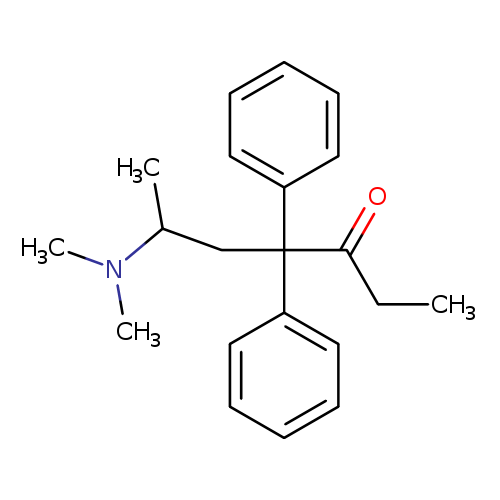
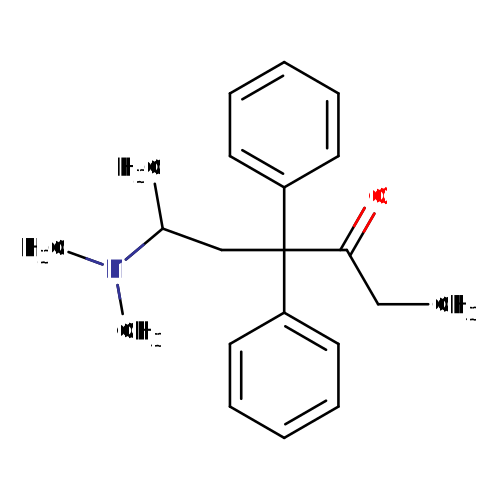
Thumb
Synonyms
ValueSource
6-(Dimethylamino)-4,4-diphenyl-3-heptanoneChEBI
(+-)-MethadoneChEBI
6-dimethylamino-4,4-Diphenyl-3-heptanoneChEBI
DL-MethadoneChEBI
MethadonumChEBI
(+/-)-methadoneHMDB
(+/-)-methadone hydrochlorideHMDB
DL-Methadone hydrochlorideHMDB
MethadonHMDB
Methadone HCLHMDB
Methadone hydrochlorideHMDB
Phenadone hydrochlorideHMDB
AmidoneMeSH, HMDB
Biomet brand OF methadone hydrochlorideMeSH, HMDB
MethadoseMeSH, HMDB
Yamanouchi brand OF methadone hydrochlorideMeSH, HMDB
AddiCare brand OF methadone hydrochlorideMeSH, HMDB
DolophineMeSH, HMDB
Generics brand OF methadone hydrochlorideMeSH, HMDB
GlaxoSmithKline brand OF methadone hydrochlorideMeSH, HMDB
Hydrochloride, methadoneMeSH, HMDB
Mallinckrodt brand OF methadone hydrochlorideMeSH, HMDB
MethexMeSH, HMDB
Pharmascience brand OF methadone hydrochlorideMeSH, HMDB
PhymetMeSH, HMDB
PhyseptoneMeSH, HMDB
PinadoneMeSH, HMDB
Esteve brand OF methadone hydrochlorideMeSH, HMDB
MetasedinMeSH, HMDB
MethaddictMeSH, HMDB
PhenadoneMeSH, HMDB
Rosemont brand OF methadone hydrochlorideMeSH, HMDB
Roxane brand OF methadone hydrochlorideMeSH, HMDB
SymoronMeSH, HMDB
BiodoneMeSH, HMDB
Martindale brand OF methadone hydrochlorideMeSH, HMDB
MetadolMeSH, HMDB
Pinewood brand OF methadone hydrochlorideMeSH, HMDB
Chemical FormulaC21H27NO
Average Molecular Mass309.445 g/mol
Monoisotopic Mass309.209 g/mol
CAS Registry Number76-99-3
IUPAC Name6-(dimethylamino)-4,4-diphenylheptan-3-one
Traditional Namemethadone
SMILESCCC(=O)C(CC(C)N(C)C)(C1=CC=CC=C1)C1=CC=CC=C1
InChI IdentifierInChI=1S/C21H27NO/c1-5-20(23)21(16-17(2)22(3)4,18-12-8-6-9-13-18)19-14-10-7-11-15-19/h6-15,17H,5,16H2,1-4H3
InChI KeyUSSIQXCVUWKGNF-UHFFFAOYSA-N
Chemical Taxonomy
Description belongs to the class of organic compounds known as diphenylmethanes. Diphenylmethanes are compounds containing a diphenylmethane moiety, which consists of a methane wherein two hydrogen atoms are replaced by two phenyl groups.
KingdomOrganic compounds
Super ClassBenzenoids
ClassBenzene and substituted derivatives
Sub ClassDiphenylmethanes
Direct ParentDiphenylmethanes
Alternative Parents
Substituents
  • Diphenylmethane
  • Aralkylamine
  • Gamma-aminoketone
  • Ketone
  • Tertiary amine
  • Tertiary aliphatic amine
  • Carbonyl group
  • Organooxygen compound
  • Organonitrogen compound
  • Amine
  • Organic oxygen compound
  • Organic nitrogen compound
  • Organopnictogen compound
  • Hydrocarbon derivative
  • Organic oxide
  • Aromatic homomonocyclic compound
Molecular FrameworkAromatic homomonocyclic compounds
External Descriptors
Biological Properties
StatusDetected and Not Quantified
OriginExogenous
Cellular Locations
  • Membrane
Biofluid LocationsNot Available
Tissue LocationsNot Available
PathwaysNot Available
Applications
Biological Roles
Chemical RolesNot Available
Physical Properties
StateSolid
AppearanceCrystalline powder (MSDS A308)
Experimental Properties
PropertyValue
Melting Point235.0°C
Boiling PointNot Available
Solubility5.90e-03 g/L
Predicted Properties
PropertyValueSource
Water Solubility0.0059 g/LALOGPS
logP4.14ALOGPS
logP5.01ChemAxon
logS-4.7ALOGPS
pKa (Strongest Acidic)18.78ChemAxon
pKa (Strongest Basic)9.12ChemAxon
Physiological Charge1ChemAxon
Hydrogen Acceptor Count2ChemAxon
Hydrogen Donor Count0ChemAxon
Polar Surface Area20.31 ŲChemAxon
Rotatable Bond Count7ChemAxon
Refractivity97.27 m³·mol⁻¹ChemAxon
Polarizability36.29 ųChemAxon
Number of Rings2ChemAxon
Bioavailability1ChemAxon
Rule of FiveNoChemAxon
Ghose FilterYesChemAxon
Veber's RuleYesChemAxon
MDDR-like RuleNoChemAxon
Spectra
Spectra
Spectrum TypeDescriptionSplash KeyView
GC-MSGC-MS Spectrum - EI-B (Non-derivatized)splash10-00di-9310000000-d71659ee33e210178a79Spectrum
GC-MSGC-MS Spectrum - CI-B (Non-derivatized)splash10-03di-0009000000-c583dd769bf5998ac160Spectrum
GC-MSGC-MS Spectrum - EI-B (Non-derivatized)splash10-00di-9310000000-d71659ee33e210178a79Spectrum
GC-MSGC-MS Spectrum - CI-B (Non-derivatized)splash10-03di-0009000000-c583dd769bf5998ac160Spectrum
Predicted GC-MSPredicted GC-MS Spectrum - GC-MS (Non-derivatized) - 70eV, Positivesplash10-0uk9-9080000000-1cd26d01442b30c05512Spectrum
Predicted GC-MSPredicted GC-MS Spectrum - GC-MS (Non-derivatized) - 70eV, PositiveNot AvailableSpectrum
LC-MS/MSLC-MS/MS Spectrum - LC-ESI-QTOF , positivesplash10-03di-0029000000-43d5c8da88c1aa260682Spectrum
LC-MS/MSLC-MS/MS Spectrum - LC-ESI-QTOF , positivesplash10-014i-0090000000-31b8655a24b30962bd8cSpectrum
LC-MS/MSLC-MS/MS Spectrum - LC-ESI-QTOF , positivesplash10-01b9-0590000000-9894da52e88d32034318Spectrum
LC-MS/MSLC-MS/MS Spectrum - LC-ESI-QTOF , positivesplash10-014i-0940000000-fedb75bd4c80c6c4fea9Spectrum
LC-MS/MSLC-MS/MS Spectrum - LC-ESI-QTOF , positivesplash10-0gb9-0940000000-a27b5f75aab7fac8931dSpectrum
LC-MS/MSLC-MS/MS Spectrum - LC-ESI-ITFT , positivesplash10-014i-0090000000-1d4283f6dffa11b765e7Spectrum
LC-MS/MSLC-MS/MS Spectrum - LC-ESI-ITFT , positivesplash10-03di-0019000000-416fca50b212d00b968cSpectrum
LC-MS/MSLC-MS/MS Spectrum - LC-ESI-ITFT , positivesplash10-014i-0090000000-ad95925610aed55afe91Spectrum
LC-MS/MSLC-MS/MS Spectrum - LC-ESI-ITFT , positivesplash10-0aor-1980000000-6d4d0adc4c8db177eaadSpectrum
LC-MS/MSLC-MS/MS Spectrum - LC-ESI-ITFT , positivesplash10-0a4i-1920000000-0548504791642aa3b2e0Spectrum
LC-MS/MSLC-MS/MS Spectrum - LC-ESI-ITFT , positivesplash10-0a4i-2920000000-dd2ce03c02a54aa24f83Spectrum
LC-MS/MSLC-MS/MS Spectrum - LC-ESI-ITFT , positivesplash10-0a4i-3910000000-1af5f56241eabde05700Spectrum
LC-MS/MSLC-MS/MS Spectrum - LC-ESI-ITFT , positivesplash10-03di-0019000000-015df6e52b9d5ebe5cb2Spectrum
LC-MS/MSLC-MS/MS Spectrum - LC-ESI-ITFT , positivesplash10-014i-0091000000-b328f3740a7ca4485324Spectrum
LC-MS/MSLC-MS/MS Spectrum - LC-ESI-ITFT , positivesplash10-0aor-0980000000-24074e0b5c722d7279c0Spectrum
LC-MS/MSLC-MS/MS Spectrum - LC-ESI-ITFT , positivesplash10-0a4i-1920000000-5477eb89abafab290dd1Spectrum
LC-MS/MSLC-MS/MS Spectrum - LC-ESI-ITFT , positivesplash10-0a4i-2920000000-b4ffdf7888e464422c0cSpectrum
LC-MS/MSLC-MS/MS Spectrum - LC-ESI-ITFT , positivesplash10-0a4i-3910000000-6053da2e4586dbcae300Spectrum
LC-MS/MSLC-MS/MS Spectrum - LC-ESI-ITFT , positivesplash10-014i-0090000000-0863c3130ca5df5f25b6Spectrum
Predicted LC-MS/MSPredicted LC-MS/MS Spectrum - 10V, Positivesplash10-03di-0069000000-144e893c575a6cb0ceb3Spectrum
Predicted LC-MS/MSPredicted LC-MS/MS Spectrum - 20V, Positivesplash10-0229-8093000000-72ef33a6770239211ec3Spectrum
Predicted LC-MS/MSPredicted LC-MS/MS Spectrum - 40V, Positivesplash10-0aw9-9780000000-930cd0f8dcbecbc72f1bSpectrum
Predicted LC-MS/MSPredicted LC-MS/MS Spectrum - 10V, Negativesplash10-0a4i-0019000000-3418a56694229e2c6595Spectrum
Predicted LC-MS/MSPredicted LC-MS/MS Spectrum - 20V, Negativesplash10-0a4i-3069000000-10bb89e35854fe0680a5Spectrum
Predicted LC-MS/MSPredicted LC-MS/MS Spectrum - 40V, Negativesplash10-00fu-9180000000-abf68f949ff2ecf35fccSpectrum
MSMass Spectrum (Electron Ionization)splash10-00di-9210000000-7542d8c3f742c7713c13Spectrum
Toxicity Profile
Route of ExposureInhalation (MSDS, RxList, A308); dermal (MSDS, RxList, A308); ingestion (MSDS, RxList, A308); intravenous injection (MSDS, RxList, A308). Well absorbed following oral administration. The bioavailability of methadone ranges between 36 to 100%.
Mechanism of ToxicityMethadone is a mu-agonist; a synthetic opioid analgesic with multiple actions qualitatively similar to those of morphine, the most prominent of which involves the central nervous system and organs composed of smooth muscle. The principal therapeutic uses for methadone are for analgesia and for detoxification or maintenance in opioid addiction. The methadone abstinence syndrome, although qualitatively similar to that of morphine, differs in that the onset is slower, the course is more prolonged, and the symptoms are less severe. Some data also indicate that methadone acts as an antagonist at the N-methyl-D-aspartate (NMDA) receptor. The contribution of NMDA receptor antagonism to methadone's efficacy is unknown. Other NMDA receptor antagonists have been shown to produce neurotoxic effects in animals.
MetabolismHepatic. Cytochrome P450 enzymes, primarily CYP3A4, CYP2B6, and CYP2C19 and to a lesser extent CYP2C9 and CYP2D6, are responsible for conversion of methadone to EDDP and other inactive metabolites, which are excreted mainly in the urine. Route of Elimination: The elimination of methadone is mediated by extensive biotransformation, followed by renal and fecal excretion. Unmetabolized methadone and its metabolites are excreted in urine to a variable degree. Half Life: 24-36 hours
Toxicity ValuesNot Available
Lethal DoseNot Available
Carcinogenicity (IARC Classification)No indication of carcinogenicity to humans (not listed by IARC).
Uses/SourcesFor the treatment of dry cough, drug withdrawal syndrome, opioid type drug dependence, and pain (1).
Minimum Risk LevelNot Available
Health EffectsBradycardia and hypotension. In severe overdosage, particularly by the intravenous route, apnea, circulatory collapse, cardiac arrest, and death may occur (RxList, A308). Medical problems can include congested lungs, liver disease, tetanus, infection of the heart valves, skin abscesses, anemia and pneumonia. Death can occur from overdose.
SymptomsIn severe overdosage, particularly by the intravenous route, apnea, circulatory collapse, cardiac arrest, and death may occur.
TreatmentPrimary attention should be given to the reestablishment of adequate respiratory exchange through provision of a patent airway and institution of assisted or controlled ventilation. If a non-tolerant person, takes a large dose of methadone, effective opioid antagonists are available to counteract the potentially lethal respiratory depression. (10)
Concentrations
Not Available
DrugBank IDDB00333
HMDB IDHMDB0257401
FooDB IDNot Available
Phenol Explorer IDNot Available
KNApSAcK IDNot Available
BiGG IDNot Available
BioCyc IDNot Available
METLIN IDNot Available
PDB IDNot Available
Wikipedia LinkMethadone
Chemspider ID3953
ChEBI ID167309
PubChem Compound IDNot Available
Kegg Compound IDC07163
YMDB IDNot Available
ECMDB IDNot Available
References
Synthesis Reference

Charles J. Barnett, “Modification of methadone synthesis process step.” U.S. Patent US4048211, issued August, 1952.

MSDSLink
General ReferencesNot Available