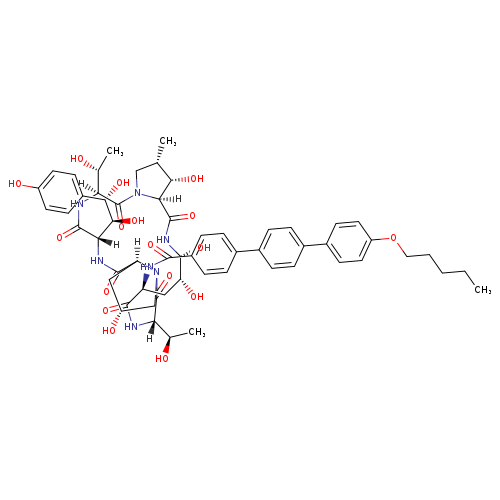
Anidulafungin is a solid, exogenous compound with the formula C58H73N7O17. Anidulafungin belongs to the amino acids, peptides, and analogues, a subclass of carboxylic acids and derivatives within the organic compounds. With an average molecular weight of 1,140 g/mol, Anidulafungin is a heavy molecule. It functions as an antibiotic and antifungal agent. It is found in antimycotics within healthcare, pharmaceuticals, and veterinary products, as well as in other smoking requisites and non-electric simulated smoking devices within household cleaning and consumer products. The recorded route of exposure for this compound is intravenous.
As a semi-synthetic echinocandin, anidulafungin exhibits antifungal activity by inhibiting glucan synthase. Because this enzyme is present in fungal cells but not mammalian cells, the compound inhibits the formation of 1,3-β-D-glucan, which is an essential component of the fungal cell wall. Additionally, anidulafungin acts as an inhibitor of Cytochrome P450 1A2 (CYP1A2), Cytochrome P450 2D6 (CYP2D6), Cytochrome P450 2C9 (CYP2C9), and Cytochrome P450 2B6 (CYP2B6), along with three other proteins.
belongs to the class of organic compounds known as pyrimidones. Pyrimidones are compounds that contain a pyrimidine ring, which bears a ketone. Pyrimidine is a 6-membered ring consisting of four carbon atoms and two nitrogen centers at the 1- and 3- ring positions.
Anidulafungin is a semi-synthetic echinocandin with antifungal activity. Anidulafungin inhibits glucan synthase, an enzyme present in fungal, but not mammalian cells. This results in inhibition of the formation of 1,3-β-D-glucan, an essential component of the fungal cell wall, ultimately leading to osmotic instability and cell death.
During clinical trials a single 400 mg dose of anidulafungin was inadvertently administered as a loading dose. No clinical adverse events were reported. The maximum non-lethal dose of anidulafungin in rats was 50 mg/kg, a dose which is equivalent to 10 times the recommended daily dose for esophageal candidiasis (50mg/day).
Metabolism
Hepatic metabolism of anidulafungin has not been observed. Anidulafungin is not a clinically relevant substrate, inducer, or inhibitor of cytochrome P450 (CYP450) isoenzymes. Anidulafungin undergoes slow chemical degradation at physiologic temperature and pH to a ring-opened peptide that lacks antifungal activity.
Route of Elimination: Less than 1% of the administered radioactive dose was excreted in the urine. Anidulafungin is not hepatically metabolized.
Half Life: 40-50 hours
Toxicity Values
During clinical trials a single 400 mg dose of anidulafungin was inadvertently administered as a loading dose. No clinical adverse events were reported. The maximum non-lethal dose of anidulafungin in rats was 50 mg/kg, a dose which is equivalent to 10 times the recommended daily dose for esophageal candidiasis (50mg/day).
No indication of carcinogenicity to humans (not listed by IARC).
Uses/Sources
For use in the treatment of the following fungal infections: Candidemia and other forms of Candida infections (intra-abdominal abscess, and peritonitis), Aspergillus infections, and esophageal candidiasis. Also considered an alternative treatment for oropharyngeal canaidiasis.
Minimum Risk Level
Not Available
Health Effects
Possible side effects include allergic reaction; bronchospasm; fever, chills, body aches, flu symptoms, sores in mouth and throat; nausea, upper stomach pain, itching, loss of appetite, dark urine, clay-colored stools, jaundice (yellowing of the skin or eyes); low potassium; hot flashes; diarrhea or constipation; nausea, vomiting. (10)
Symptoms
During clinical trials a single 400 mg dose of anidulafungin was inadvertently administered as a loading dose. No clinical adverse events were reported. The maximum non-lethal dose of anidulafungin in rats was 50 mg/kg, a dose which is equivalent to 10 times the recommended daily dose for esophageal candidiasis (50mg/day).
Scott Jenkins, Gary Liversidge, Deborah Neville, “Nanoparticulate Anidulafungin Compositions and Methods for Making the Same.” U.S. Patent US20090238867, issued September 24, 2009.