Record Information
Version1.0
Creation Date2009-07-21 20:27:43 UTC
Update Date2026-05-14 16:49:40 UTC
Accession NumberCHEM002279
Identification
Common NameMeloxicam
ClassSmall Molecule
DescriptionMeloxicam is a nonsteroidal anti-inflammatory drug (NSAID) used to relieve the symptoms of arthritis, primary dysmenorrhea, fever; and as an analgesic, especially where there is an inflammatory component. It is closely related to piroxicam. In Europe it is marketed under the brand names Movalis, Melox, and Recoxa. In North America it is generally marketed under the brand name Mobic. In Latin America, the drug is marketed as Tenaron. [Wikipedia]
Contaminant Sources
  • HMDB Contaminants - Urine
  • STOFF IDENT Compounds
  • Suspected Compounds
  • T3DB toxins
  • ToxCast & Tox21 Chemicals
Contaminant Type
  • Amide
  • Amine
  • Analgesic
  • Anti-Inflammatory Agent, Non-Steroidal
  • Antiemetic
  • Antineoplastic Agent
  • Cyclooxygenase Inhibitor
  • Drug
  • Ester
  • Growth Inhibitor
  • Human Neurotoxin
  • Metabolite
  • Organic Compound
  • Synthetic Compound
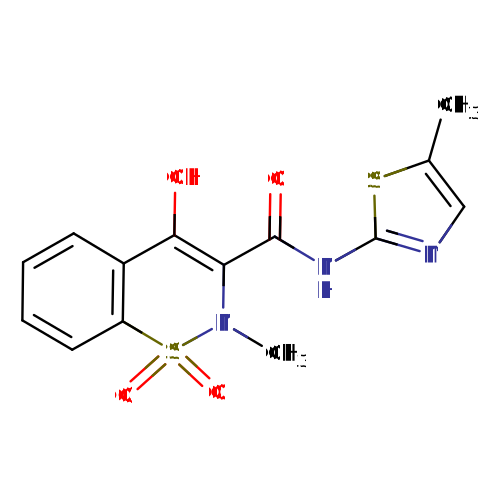
Chemical Structure
Thumb
Synonyms
ValueSource
MeloxicamumChEBI
MobicChEBI
UNII-VG2QF83CGLChEBI
MasflexHMDB
MobicoxHMDB
MovalisHMDB
MovicoxHMDB
MobecHMDB
UticoxHMDB
ParocinHMDB
MiloxicamHMDB
ReumoxicamHMDB
Chemical FormulaC14H13N3O4S2
Average Molecular Mass351.401 g/mol
Monoisotopic Mass351.035 g/mol
CAS Registry Number71125-38-7
IUPAC Name4-hydroxy-2-methyl-N-(5-methyl-1,3-thiazol-2-yl)-1,1-dioxo-2H-1lambda6,2-benzothiazine-3-carboxamide
Traditional Namemeloxicam
SMILESCN1C(C(=O)NC2=NC=C(C)S2)=C(O)C2=C(C=CC=C2)S1(=O)=O
InChI IdentifierInChI=1S/C14H13N3O4S2/c1-8-7-15-14(22-8)16-13(19)11-12(18)9-5-3-4-6-10(9)23(20,21)17(11)2/h3-7,18H,1-2H3,(H,15,16,19)
InChI KeyZRVUJXDFFKFLMG-UHFFFAOYSA-N
Chemical Taxonomy
Description belongs to the class of organic compounds known as benzothiazines. These are organic compounds containing a benzene fused to a thiazine ring (a six-membered ring with four carbon atoms, one nitrogen atom and one sulfur atom).
KingdomOrganic compounds
Super ClassOrganoheterocyclic compounds
ClassBenzothiazines
Sub ClassNot Available
Direct ParentBenzothiazines
Alternative Parents
Substituents
  • Alpha-amino acid or derivatives
  • Benzothiazine
  • N-arylamide
  • 2,5-disubstituted 1,3-thiazole
  • Ortho-thiazine
  • Benzenoid
  • Organosulfonic acid amide
  • Azole
  • Heteroaromatic compound
  • Vinylogous acid
  • Thiazole
  • Organosulfonic acid or derivatives
  • Organic sulfonic acid or derivatives
  • Carboxamide group
  • Secondary carboxylic acid amide
  • Azacycle
  • Carboxylic acid derivative
  • Organic oxygen compound
  • Organic nitrogen compound
  • Carbonyl group
  • Hydrocarbon derivative
  • Organic oxide
  • Organopnictogen compound
  • Organonitrogen compound
  • Organooxygen compound
  • Aromatic heteropolycyclic compound
Molecular FrameworkAromatic heteropolycyclic compounds
External Descriptors
Biological Properties
StatusDetected and Not Quantified
OriginExogenous
Cellular Locations
  • Cytoplasm
  • Membrane
Biofluid LocationsNot Available
Tissue LocationsNot Available
Pathways
NameSMPDB LinkKEGG Link
Meloxicam PathwayNot AvailableNot Available
Applications
Biological Roles
Chemical Roles
Physical Properties
StateSolid
AppearanceWhite powder.
Experimental Properties
PropertyValue
Melting Point254 dec°C
Boiling PointNot Available
Solubility7.15 mg/L
Predicted Properties
PropertyValueSource
Water Solubility0.15 g/LALOGPS
logP2.28ALOGPS
logP1.6ChemAxon
logS-3.4ALOGPS
pKa (Strongest Acidic)4.47ChemAxon
pKa (Strongest Basic)0.47ChemAxon
Physiological Charge-1ChemAxon
Hydrogen Acceptor Count5ChemAxon
Hydrogen Donor Count2ChemAxon
Polar Surface Area99.6 ŲChemAxon
Rotatable Bond Count2ChemAxon
Refractivity88.62 m³·mol⁻¹ChemAxon
Polarizability34.25 ųChemAxon
Number of Rings3ChemAxon
Bioavailability1ChemAxon
Rule of FiveYesChemAxon
Ghose FilterYesChemAxon
Veber's RuleNoChemAxon
MDDR-like RuleNoChemAxon
Spectra
Spectra
Spectrum TypeDescriptionSplash KeyView
Predicted GC-MSPredicted GC-MS Spectrum - GC-MS (Non-derivatized) - 70eV, Positivesplash10-014i-2902000000-442e82736bdaa71629b1Spectrum
Predicted GC-MSPredicted GC-MS Spectrum - GC-MS (1 TMS) - 70eV, Positivesplash10-001i-4290100000-70369ef9629adcb66252Spectrum
Predicted GC-MSPredicted GC-MS Spectrum - GC-MS (Non-derivatized) - 70eV, PositiveNot AvailableSpectrum
LC-MS/MSLC-MS/MS Spectrum - LC-ESI-qTof , Positivesplash10-0uxr-0905000000-155a653652a8dc132b5cSpectrum
LC-MS/MSLC-MS/MS Spectrum - LC-ESI-qTof , Positivesplash10-001i-1390000000-e476bc93f0f2236bccdcSpectrum
LC-MS/MSLC-MS/MS Spectrum - LC-ESI-qTof , Positivesplash10-0006-3910000000-5a451a906b9cf9bd15b8Spectrum
LC-MS/MSLC-MS/MS Spectrum - LC-ESI-QTOF , positivesplash10-0udi-0009000000-d860614369de32fc5b55Spectrum
LC-MS/MSLC-MS/MS Spectrum - LC-ESI-QTOF , positivesplash10-00kf-0901000000-0d362af6b48e1604f3c0Spectrum
LC-MS/MSLC-MS/MS Spectrum - LC-ESI-QTOF , positivesplash10-0006-0900000000-f79d2bd45c77067c33bfSpectrum
LC-MS/MSLC-MS/MS Spectrum - LC-ESI-QTOF , positivesplash10-0006-0900000000-385da9c2b565923f3591Spectrum
LC-MS/MSLC-MS/MS Spectrum - LC-ESI-QTOF , positivesplash10-0006-0900000000-24d8592c133da8552647Spectrum
LC-MS/MSLC-MS/MS Spectrum - , positivesplash10-0uxr-0905000000-155a653652a8dc132b5cSpectrum
LC-MS/MSLC-MS/MS Spectrum - , positivesplash10-0uxu-2905000000-a1d5ee29626527977b8eSpectrum
LC-MS/MSLC-MS/MS Spectrum - , positivesplash10-014l-3900000000-835e2ce927e75b3bb1fbSpectrum
LC-MS/MSLC-MS/MS Spectrum - , positivesplash10-014l-3910000000-cf38e48efa983293e01fSpectrum
LC-MS/MSLC-MS/MS Spectrum - 30V, Positivesplash10-0006-0900000000-f79d2bd45c77067c33bfSpectrum
LC-MS/MSLC-MS/MS Spectrum - 40V, Positivesplash10-0006-0900000000-385da9c2b565923f3591Spectrum
LC-MS/MSLC-MS/MS Spectrum - 45V, Positivesplash10-03dj-0900000000-25904bb34a812496ce8bSpectrum
LC-MS/MSLC-MS/MS Spectrum - 20V, Positivesplash10-00kf-0901000000-0d362af6b48e1604f3c0Spectrum
LC-MS/MSLC-MS/MS Spectrum - 10V, Positivesplash10-0udi-0009000000-d860614369de32fc5b55Spectrum
LC-MS/MSLC-MS/MS Spectrum - 15V, Positivesplash10-000i-0292000000-431ebc79a9e58b6de11fSpectrum
LC-MS/MSLC-MS/MS Spectrum - 50V, Positivesplash10-0006-0900000000-24d8592c133da8552647Spectrum
Predicted LC-MS/MSPredicted LC-MS/MS Spectrum - 10V, Positivesplash10-0w29-0709000000-28418136a19ad7e133bfSpectrum
Predicted LC-MS/MSPredicted LC-MS/MS Spectrum - 20V, Positivesplash10-03di-1900000000-09c918b92fb04726ae80Spectrum
Predicted LC-MS/MSPredicted LC-MS/MS Spectrum - 40V, Positivesplash10-0ikc-8900000000-b213c50ee4ed1505df38Spectrum
Predicted LC-MS/MSPredicted LC-MS/MS Spectrum - 10V, Negativesplash10-0udi-0229000000-acae128204108b962183Spectrum
Predicted LC-MS/MSPredicted LC-MS/MS Spectrum - 20V, Negativesplash10-0ik9-1496000000-6b38c2d88b94b6dcf7cbSpectrum
Predicted LC-MS/MSPredicted LC-MS/MS Spectrum - 40V, Negativesplash10-03g0-6900000000-cedcff29bec701cd8ff3Spectrum
Toxicity Profile
Route of ExposureOral. Absolute bioavailability = 89%
Mechanism of ToxicityAnti-inflammatory effects of meloxicam are believed to be due to inhibition of prostaglandin synthetase (cylooxygenase), leading to the inhibition of prostaglandin synthesis. As prostaglandins sensitize pain receptors, inhibition of their synthesis may be associated with the analgesic and antipyretic effects of meloxicam.
MetabolismMeloxicam is almost completely metabolized into inactive metabolites by the cytochrome P450 (CYP450) isozymes. CYP2C9 is primarily responsible for metabolism of meloxicam while CYP3A4 plays a minor role. An intermediate metabolite, 5'-hydroxymethyl meloxicam, is further metabolized to 5'-carboxy meloxicam, the major metabolite. Peroxidase activity is thought to produce the two other inactive metabolites of meloxicam. Route of Elimination: Meloxicam is almost completely metabolized to four pharmacologically inactive metabolites. Meloxicam excretion is predominantly in the form of metabolites, and occurs to equal extents in the urine and feces. Only traces of the unchanged parent compound are excreted in the urine (0.2%) and feces (1.6%). The extent of the urinary excretion was confirmed for unlabeled multiple 7.5 mg doses: 0.5%, 6% and 13% of the dose were found in urine in the form of meloxicam, and the 5'-hydroxymethyl and 5'-carboxy metabolites, respectively. Half Life: 15-20 hours
Toxicity ValuesLD50: 84 mg/kg (Oral, Rat) (1) LD50: 470 mg/kg (Oral, Mouse) (1) LD50: 320 mg/kg (Oral, Rabbit) (1)
Lethal DoseNot Available
Carcinogenicity (IARC Classification)No indication of carcinogenicity to humans (not listed by IARC).
Uses/SourcesUsed to relieve the symptoms of arthritis, primary dysmenorrhea, fever; and as an analgesic, especially where there is an inflammatory component.
Minimum Risk LevelNot Available
Health EffectsCan result in gastrointestinal toxicity and bleeding, tinnitus, headache, rash, very dark or black stool (sign of intestinal bleeding). [Wikipedia]
SymptomsNot Available
TreatmentPatients should be managed with symptomatic and supportive care following an NSAID overdose. In cases of acute overdose, gastric lavage followed by activated charcoal is recommended. Gastric lavage performed more than one hour after overdose has little benefit in the treatment of overdose. Administration of activated charcoal is recommended for patients who present 1-2 hours after overdose. For substantial overdose or severely symptomatic patients, activated charcoal may be administered repeatedly. Accelerated removal of meloxicam by 4 gm oral doses of cholestyramine given three times a day was demonstrated in a clinical trial. Administration of cholestyramine may be useful following an overdose. Forced diuresis, alkalinization of urine, hemodialysis, or hemoperfusion may not be useful due to high protein binding. (3)
Concentrations
Not Available
DrugBank IDDB00814
HMDB IDHMDB0014952
FooDB IDNot Available
Phenol Explorer IDNot Available
KNApSAcK IDNot Available
BiGG IDNot Available
BioCyc IDNot Available
METLIN IDNot Available
PDB IDNot Available
Wikipedia LinkMeloxicam
Chemspider ID10442740
ChEBI ID6741
PubChem Compound ID54677470
Kegg Compound IDC08169
YMDB IDNot Available
ECMDB IDNot Available
References
Synthesis Reference

Laura Coppi, “Crystalline forms of meloxicam and processes for their preparation and interconversion.” U.S. Patent US20030109701, issued June 12, 2003.

MSDSLink
General References
1. https://www.ncbi.nlm.nih.gov/pubmed/?term=10092958
2. https://www.ncbi.nlm.nih.gov/pubmed/?term=12387696
3. https://www.ncbi.nlm.nih.gov/pubmed/?term=16197363
4. https://www.ncbi.nlm.nih.gov/pubmed/?term=16623613
5. https://www.ncbi.nlm.nih.gov/pubmed/?term=16863437
6. https://www.ncbi.nlm.nih.gov/pubmed/?term=18405470
7. https://www.ncbi.nlm.nih.gov/pubmed/?term=19821429
8. https://www.ncbi.nlm.nih.gov/pubmed/?term=23306395
9. https://www.ncbi.nlm.nih.gov/pubmed/?term=23388116
10. https://www.ncbi.nlm.nih.gov/pubmed/?term=23406022
11. https://www.ncbi.nlm.nih.gov/pubmed/?term=24041211
12. https://www.ncbi.nlm.nih.gov/pubmed/?term=24084190
13. https://www.ncbi.nlm.nih.gov/pubmed/?term=28166217
14. https://www.ncbi.nlm.nih.gov/pubmed/?term=8882380
15. https://www.ncbi.nlm.nih.gov/pubmed/?term=9219316