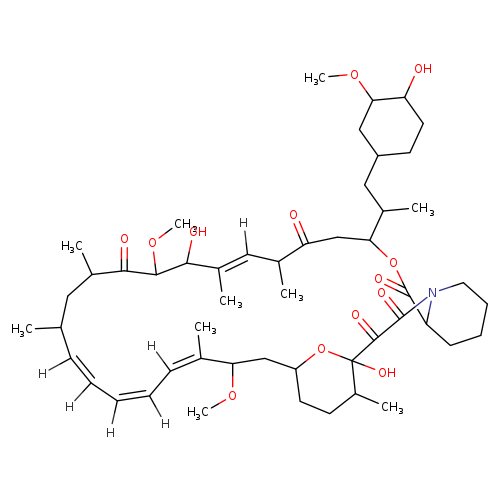
Sirolimus belongs to the macrolide lactams, a class of phenylpropanoids and polyketides within the organic compounds. With an average molecular weight of 914.19 g/mol, Sirolimus is a heavy molecule. This exogenous solid, with the formula C51H79NO13, is a bacterial metabolite. It functions as an mTOR inhibitor and is utilized as an immunosuppressive agent, antifungal agent, antineoplastic agent, antibiotic, and antibacterial drug. It is found in pharmaceutical, veterinary, and healthcare products, specifically within categories for antibiotics, ophthalmologicals, immunosuppressants, and antineoplastic agents. Recorded exposure routes include oral, intravenous, topical, and inhalation, and the compound has been detected in the liver and kidney.
Sirolimus targets four proteins: Eukaryotic translation initiation factor 4E (EIF4E), Fibroblast growth factor 2 (FGF2), Serine/threonine-protein kinase mTOR (MTOR), and Peptidyl-prolyl cis-trans isomerase FKBP1A. By binding to the immunophilin FK Binding Protein-12 (FKBP-12) in cells, sirolimus generates an immunosuppressive complex that inhibits antibody production and the activation and proliferation of T lymphocytes. This process occurs in response to cytokine stimulation (Interleukin IL-2, IL-4, and IL-15) and antigenic stimulation through a mechanism distinct from other immunosuppressants. The resulting sirolimus:FKBP-12 complex has no effect on calcineurin activity.
belongs to the class of organic compounds known as macrolide lactams. These are cyclic polyketides containing both a cyclic amide and a cyclic ester group.
Sirolimus inhibits T lymphocyte activation and proliferation that occurs in response to antigenic and cytokine (Interleukin IL-2, IL-4, and IL-15) stimulation by a mechanism that is distinct from that of other immunosuppressants. Sirolimus also inhibits antibody production. In cells, sirolimus binds to the immunophilin, FK Binding Protein-12 (FKBP-12), to generate an immunosuppressive complex. The sirolimus:FKBP-12 complex has no effect on calcineurin activity. This complex binds to and inhibits the activation of the mammalian Target Of Rapamycin (mTOR), a key regulatory kinase. This inhibition suppresses cytokine-driven T-cell proliferation, inhibiting the progression from the G1 to the S phase of the cell cycle.
No indication of carcinogenicity to humans (not listed by IARC).
Uses/Sources
Used to prevent rejection in organ transplantation; it is especially useful in kidney transplants. [Wikipedia]
Minimum Risk Level
Not Available
Health Effects
Increased susceptibility to infection, lymphoma, and malignancy; bronchial anastomotic dehiscence in lung transplant patients; decline in renal function in long-term combination of cyclosporine with Rapamune; proteinuria. (8)
Symptoms
The most common ( ≥ 30%) adverse reactions observed with Rapamune in clinical studies are: peripheral edema, hypertriglyceridemia, hypertension, hypercholesterolemia, creatinine increased, constipation, abdominal pain, diarrhea, headache, fever, urinary tract infection, anemia, nausea, arthralgia, pain, and thrombocytopenia. (8)
Treatment
General supportive measures should be followed in all cases of overdose. Based on the low aqueous solubility and high erythrocyte and plasma protein binding of sirolimus, it is anticipated that sirolimus is not dialyzable to any significant extent. (7)
Madhup K. Dhaon, Chi-nung Hsiao, Subhash R. Patel, Peter J. Bonk, Sanjay R. Chemburkar, Yong Y. Chen, “One pot synthesis of tetrazole derivatives of sirolimus.” U.S. Patent US20080167335, issued July 10, 2008.