Record Information
Version1.0
Creation Date2009-07-21 20:27:56 UTC
Update Date2026-03-26 18:35:07 UTC
Accession NumberCHEM002300
Identification
Common NameZonisamide
ClassSmall Molecule
DescriptionZonisamide is a sulfonamide anticonvulsant approved for use as an adjunctive therapy in adults with partial-onset seizures. Zonisamide may be a carbonic anhydrase inhibitor although this is not one of the primary mechanisms of action. Zonisamide may act by blocking repetitive firing of voltage-gated sodium channels leading to a reduction of T-type calcium channel currents, or by binding allosterically to GABA receptors. This latter action may inhibit the uptake of the inhibitory neurotransmitter GABA while enhancing the uptake of the excitatory neurotransmitter glutamate.
Contaminant Sources
  • HMDB Contaminants - Urine
  • STOFF IDENT Compounds
  • T3DB toxins
  • ToxCast & Tox21 Chemicals
Contaminant Type
  • Amide
  • Anticonvulsant
  • Antioxidant
  • Drug
  • Metabolite
  • Organic Compound
  • Synthetic Compound
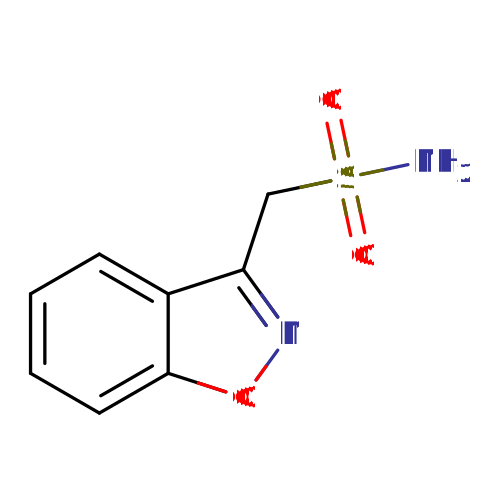
Chemical Structure
Thumb
Synonyms
ValueSource
1,2-Benzisoxazole-3-methanesulfonamideChEBI
3-(Sulfamoylmethyl)-1,2-benzisoxazoleChEBI
Benzo[D]isoxazol-3-yl-methanesulfonamideChEBI
ZonisamidaChEBI
ZonisamidumChEBI
ExcegranKegg
1,2-Benzisoxazole-3-methanesulphonamideGenerator
3-(Sulphamoylmethyl)-1,2-benzisoxazoleGenerator
Benzo[D]isoxazol-3-yl-methanesulphonamideGenerator
3-Sulfamoylmethyl-1,2-benzisoxazoleHMDB
Elan brand OF zonisamideHMDB
Zonisamide monosodiumHMDB
ZonegranHMDB
3 Sulfamoylmethyl 1,2 benzisoxazoleHMDB
Chemical FormulaC8H8N2O3S
Average Molecular Mass212.226 g/mol
Monoisotopic Mass212.026 g/mol
CAS Registry Number68291-97-4
IUPAC Name1,2-benzoxazol-3-ylmethanesulfonamide
Traditional Namezonisamide
SMILESNS(=O)(=O)CC1=NOC2=CC=CC=C12
InChI IdentifierInChI=1S/C8H8N2O3S/c9-14(11,12)5-7-6-3-1-2-4-8(6)13-10-7/h1-4H,5H2,(H2,9,11,12)
InChI KeyUBQNRHZMVUUOMG-UHFFFAOYSA-N
Chemical Taxonomy
Description belongs to the class of organic compounds known as benzisoxazoles. These are aromatic compounds containing a benzene ring fused to an isoxazole ring. Isoxazole is five-membered ring with three carbon atoms, and an oxygen atom next to a nitrogen atom.
KingdomOrganic compounds
Super ClassOrganoheterocyclic compounds
ClassBenzisoxazoles
Sub ClassNot Available
Direct ParentBenzisoxazoles
Alternative Parents
Substituents
  • Benzisoxazole
  • Organic sulfonic acid amide
  • Organosulfonic acid amide
  • Benzenoid
  • Azole
  • Isoxazole
  • Organic sulfonic acid or derivatives
  • Organosulfonic acid or derivatives
  • Sulfonyl
  • Aminosulfonyl compound
  • Heteroaromatic compound
  • Azacycle
  • Oxacycle
  • Organopnictogen compound
  • Organic oxygen compound
  • Organic nitrogen compound
  • Organonitrogen compound
  • Organooxygen compound
  • Organic oxide
  • Organosulfur compound
  • Hydrocarbon derivative
  • Aromatic heteropolycyclic compound
Molecular FrameworkAromatic heteropolycyclic compounds
External Descriptors
Biological Properties
StatusDetected and Not Quantified
OriginExogenous
Cellular Locations
  • Cytoplasm
  • Extracellular
  • Membrane
Biofluid LocationsNot Available
Tissue LocationsNot Available
PathwaysNot Available
Applications
Biological RolesNot Available
Chemical Roles
Physical Properties
StateSolid
AppearanceWhite powder.
Experimental Properties
PropertyValue
Melting Point161-163°C
Boiling PointNot Available
Solubility0.8 mg/mL
Predicted Properties
PropertyValueSource
Water Solubility2.09 g/LALOGPS
logP0.67ALOGPS
logP0.11ChemAxon
logS-2ALOGPS
pKa (Strongest Acidic)9.84ChemAxon
pKa (Strongest Basic)-1.8ChemAxon
Physiological Charge0ChemAxon
Hydrogen Acceptor Count3ChemAxon
Hydrogen Donor Count1ChemAxon
Polar Surface Area86.19 ŲChemAxon
Rotatable Bond Count2ChemAxon
Refractivity50.3 m³·mol⁻¹ChemAxon
Polarizability19.48 ųChemAxon
Number of Rings2ChemAxon
Bioavailability1ChemAxon
Rule of FiveYesChemAxon
Ghose FilterYesChemAxon
Veber's RuleNoChemAxon
MDDR-like RuleNoChemAxon
Spectra
Spectra
Spectrum TypeDescriptionSplash KeyView
Predicted GC-MSPredicted GC-MS Spectrum - GC-MS (Non-derivatized) - 70eV, Positivesplash10-001i-1900000000-073e3341083b72e5e4ceSpectrum
Predicted GC-MSPredicted GC-MS Spectrum - GC-MS (Non-derivatized) - 70eV, PositiveNot AvailableSpectrum
LC-MS/MSLC-MS/MS Spectrum - LC-ESI-qTof , Positivesplash10-0gx0-0940000000-22533c93dd06de52f6a8Spectrum
LC-MS/MSLC-MS/MS Spectrum - LC-ESI-QFT , negativesplash10-014i-0900000000-c05ae650c884adcaba5aSpectrum
LC-MS/MSLC-MS/MS Spectrum - LC-ESI-QFT , negativesplash10-014i-0900000000-477908537d156d43e3a9Spectrum
LC-MS/MSLC-MS/MS Spectrum - LC-ESI-QFT , negativesplash10-014i-0900000000-f537644668fbc9b2e02bSpectrum
LC-MS/MSLC-MS/MS Spectrum - LC-ESI-QFT , negativesplash10-014i-1900000000-6359b9c8e68ec5477b26Spectrum
LC-MS/MSLC-MS/MS Spectrum - LC-ESI-QFT , negativesplash10-014i-3900000000-db3cf8881465259c48caSpectrum
LC-MS/MSLC-MS/MS Spectrum - LC-ESI-QFT , negativesplash10-014i-6900000000-cd4c8b86f36ce38b3a49Spectrum
LC-MS/MSLC-MS/MS Spectrum - LC-ESI-QFT , positivesplash10-0udi-0930000000-a0dd3941aea211aeb201Spectrum
LC-MS/MSLC-MS/MS Spectrum - LC-ESI-QFT , positivesplash10-0udi-0900000000-88938a9c69a2d4daf36aSpectrum
LC-MS/MSLC-MS/MS Spectrum - LC-ESI-QFT , positivesplash10-0udi-2900000000-3440f1648bff05d21a31Spectrum
LC-MS/MSLC-MS/MS Spectrum - LC-ESI-QFT , positivesplash10-0udi-5900000000-a727755cf1e18764e9d0Spectrum
LC-MS/MSLC-MS/MS Spectrum - LC-ESI-QFT , positivesplash10-0udj-9600000000-aa8a18a9ab17508f689dSpectrum
LC-MS/MSLC-MS/MS Spectrum - LC-ESI-QFT , positivesplash10-0udj-9200000000-41d7e769a93444ba3751Spectrum
LC-MS/MSLC-MS/MS Spectrum - , positivesplash10-0gx0-0940000000-22533c93dd06de52f6a8Spectrum
LC-MS/MSLC-MS/MS Spectrum - 90V, Negativesplash10-014i-6900000000-939416688f52f3115006Spectrum
LC-MS/MSLC-MS/MS Spectrum - 75V, Negativesplash10-014i-3900000000-cbdf90b73153e2a0fbe8Spectrum
LC-MS/MSLC-MS/MS Spectrum - 45V, Positivesplash10-0udi-2900000000-3440f1648bff05d21a31Spectrum
LC-MS/MSLC-MS/MS Spectrum - 45V, Negativesplash10-014i-0900000000-5a5537d57ee730d36955Spectrum
LC-MS/MSLC-MS/MS Spectrum - 60V, Negativesplash10-014i-1900000000-e876f2ad2510dae90ae9Spectrum
Predicted LC-MS/MSPredicted LC-MS/MS Spectrum - 10V, Positivesplash10-03di-0190000000-beb3210644ad8c7d48b5Spectrum
Predicted LC-MS/MSPredicted LC-MS/MS Spectrum - 20V, Positivesplash10-03di-1790000000-685d923694e188b3784fSpectrum
Predicted LC-MS/MSPredicted LC-MS/MS Spectrum - 40V, Positivesplash10-0udi-6900000000-84377f08dd399ceffa08Spectrum
Predicted LC-MS/MSPredicted LC-MS/MS Spectrum - 10V, Negativesplash10-03di-0190000000-072fa6d7f1016dc5122fSpectrum
Predicted LC-MS/MSPredicted LC-MS/MS Spectrum - 20V, Negativesplash10-01q9-3970000000-14adb301eed37c18b5f7Spectrum
Predicted LC-MS/MSPredicted LC-MS/MS Spectrum - 40V, Negativesplash10-004i-9000000000-e80af2cb8bf5e38fe770Spectrum
Toxicity Profile
Route of ExposureOral. Variable, yet relatively rapid rate of absorption with a time to peak concentration of 2.8-3.9 hours. Food has no effect on the bioavailability of zonisamide.
Mechanism of ToxicityZonisamide binds to sodium channels and voltage sensitive calcium channels, which suppresses neuronal depolarization and hypersynchronization. Zonisamide also inhibits carbonic anhydrase to a weaker extent, but such an effect is not thought to contribute substantially to the drug's anticonvulsant activity.
MetabolismPrimarily hepatic through cytochrome P450 isoenzyme 3A4 (CYP3A4). Undergoes acetylation and reduction, forming N-acetyl zonisamide, and the open-ring metabolite 2–sulfamoylacetyl phenol, respectively. Route of Elimination: Zonisamide is excreted primarily in urine as parent drug and as the glucuronide of a metabolite. Half Life: 63 hours
Toxicity ValuesNot Available
Lethal DoseNot Available
Carcinogenicity (IARC Classification)No indication of carcinogenicity to humans (not listed by IARC).
Uses/SourcesFor use as adjunctive treatment of partial seizures in adults with epilepsy.
Minimum Risk LevelNot Available
Health EffectsMay cause a potentially dangerous rash that may develop into Stevens Johnson syndrome, an extremely rare but potentially fatal skin disease.
SymptomsSymptoms of overdose include diminished breathing, loss of consciousness, low blood pressure, and slow heartbeat.
TreatmentNo specific antidotes for Zonisamide overdosage are available. Following a suspected recent overdose, emesis should be induced or gastric lavage performed with the usual precautions to protect the airway. General supportive care is indicated, including frequent monitoring of vital signs and close observation. (12)
Concentrations
Not Available
DrugBank IDDB00909
HMDB IDHMDB0015045
FooDB IDNot Available
Phenol Explorer IDNot Available
KNApSAcK IDNot Available
BiGG IDNot Available
BioCyc IDNot Available
METLIN IDNot Available
PDB IDZON
Wikipedia LinkZonisamide
Chemspider ID5532
ChEBI ID10127
PubChem Compound ID5734
Kegg Compound IDC07504
YMDB IDNot Available
ECMDB IDNot Available
References
Synthesis Reference

Tamar Nidam, “Novel sulfonation method for zonisamide intermediate in zonisamide synthesis and their novel crystal forms.” U.S. Patent US20030114682, issued June 19, 2003.

MSDSLink
General References
1. Peters DH, Sorkin EM: Zonisamide. A review of its pharmacodynamic and pharmacokinetic properties, and therapeutic potential in epilepsy. Drugs. 1993 May;45(5):760-87.
2. Murata M, Horiuchi E, Kanazawa I: Zonisamide has beneficial effects on Parkinson's disease patients. Neurosci Res. 2001 Dec;41(4):397-9.
3. Gadde KM, Franciscy DM, Wagner HR 2nd, Krishnan KR: Zonisamide for weight loss in obese adults: a randomized controlled trial. JAMA. 2003 Apr 9;289(14):1820-5.
4. Ueda Y, Doi T, Tokumaru J, Willmore LJ: Effect of zonisamide on molecular regulation of glutamate and GABA transporter proteins during epileptogenesis in rats with hippocampal seizures. Brain Res Mol Brain Res. 2003 Aug 19;116(1-2):1-6.
5. Sobieszek G, Borowicz KK, Kimber-Trojnar Z, Malek R, Piskorska B, Czuczwar SJ: Zonisamide: a new antiepileptic drug. Pol J Pharmacol. 2003 Sep-Oct;55(5):683-9.
6. Hasegawa H: Utilization of zonisamide in patients with chronic pain or epilepsy refractory to other treatments: a retrospective, open label, uncontrolled study in a VA hospital. Curr Med Res Opin. 2004 May;20(5):577-80.
7. Leppik IE: Zonisamide: chemistry, mechanism of action, and pharmacokinetics. Seizure. 2004 Dec;13 Suppl 1:S5-9; discussion S10.
8. Kothare SV, Kaleyias J: Zonisamide: review of pharmacology, clinical efficacy, tolerability, and safety. Expert Opin Drug Metab Toxicol. 2008 Apr;4(4):493-506. doi: 10.1517/17425255.4.4.493 .
9. Farooq MU, Moore PW, Bhatt A, Aburashed R, Kassab MY: Therapeutic role of zonisamide in neuropsychiatric disorders. Mini Rev Med Chem. 2008 Sep;8(10):968-75.
10. Schulze-Bonhage A: Zonisamide in the treatment of epilepsy. Expert Opin Pharmacother. 2010 Jan;11(1):115-26. doi: 10.1517/14656560903468728.