Record Information
Version1.0
Creation Date2009-07-30 17:56:33 UTC
Update Date2026-03-26 19:13:36 UTC
Accession NumberCHEM002449
Identification
Common NameMenthol
ClassSmall Molecule
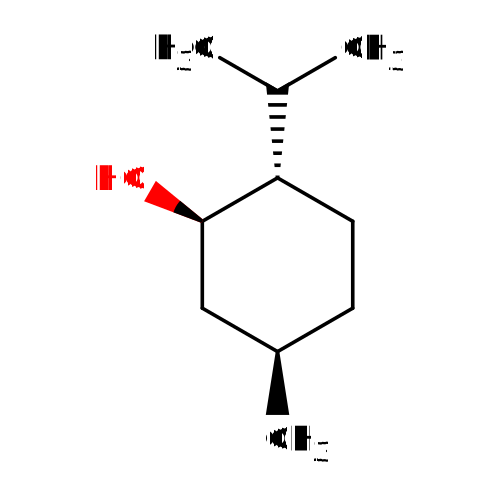
DescriptionMenthol is an alcohol produced from mint oils or prepared synthetically. Menthol is a covalent organic compound made synthetically or obtained from peppermint or other mint oils. It is a waxy, crystalline substance, clear or white in color, which is solid at room temperature and melts slightly above. The main form of menthol occurring in nature is (-)-menthol, which is assigned the (1R,2S,5R) configuration. Menthol has local anesthetic and counterirritant qualities, and it is widely used to relieve minor throat irritation.
Contaminant Sources
  • Cosmetic Chemicals
  • EAFUS Chemicals
  • FooDB Chemicals
  • HMDB Contaminants - Feces
  • HMDB Contaminants - Urine
  • HPV EPA Chemicals
  • OECD HPV Chemicals
  • T3DB toxins
  • Tobacco Smoke Compounds
  • ToxCast & Tox21 Chemicals
Contaminant Type
  • Antipruritic
  • Drug
  • Food Toxin
  • Fragrance Toxin
  • Household Toxin
  • Metabolite
  • Natural Compound
  • Organic Compound
  • Plant Toxin
Chemical Structure
Thumb
Synonyms
ValueSource
(-)-(1R,3R,4S)-MentholChEBI
(1alpha,2beta,5alpha)-5-Methyl-2(1-methylethyl)cyclohexanolChEBI
(1R,3R,4S)-(-)-MentholChEBI
(1R-(1-alpha,2-beta,5-alpha))-5-Methyl-2-(1-methylethyl)cyclohexanolChEBI
L-MentholChEBI
LevomentholChEBI
LevomentholumChEBI
LevomentolChEBI
(1a,2b,5a)-5-Methyl-2(1-methylethyl)cyclohexanolGenerator
(1Α,2β,5α)-5-methyl-2(1-methylethyl)cyclohexanolGenerator
(1R-(1-a,2-b,5-a))-5-Methyl-2-(1-methylethyl)cyclohexanolGenerator
(1R-(1-Α,2-β,5-α))-5-methyl-2-(1-methylethyl)cyclohexanolGenerator
(-)-Menthyl alcoholHMDB
(-)-trans-p-Menthan-cis-olHMDB
(1R)-(-)-MentholHMDB
(1R,2S,5R)-(-)-MentholHMDB
(R)-(-)-MentholHMDB
1-MentholHMDB
2-Isopropyl-5-methylcyclohexanolHMDB
5-Methyl-2-(1-methylethyl)cyclohexanolHMDB
5-Methyl-2-propan-2-ylcyclohexan-1-olHMDB
D-(-)-MentholHMDB
HexahydrothymolHMDB
L-(-)-MentholHMDB
MenthacamphorHMDB
MenthomentholHMDB
p-Menthan-3-olHMDB
Peppermint camphorHMDB
U.S.p. mentholHMDB
KerasalHMDB
Menthol, (1alpha,2beta,5alpha)-isomerHMDB
MentholMeSH
Chemical FormulaC10H20O
Average Molecular Mass156.269 g/mol
Monoisotopic Mass156.151 g/mol
CAS Registry Number2216-51-5
IUPAC Name(1R,2S,5R)-5-methyl-2-(propan-2-yl)cyclohexan-1-ol
Traditional Namementhol
SMILESCC(C)[C@@H]1CC[C@@H](C)C[C@H]1O
InChI IdentifierInChI=1S/C10H20O/c1-7(2)9-5-4-8(3)6-10(9)11/h7-11H,4-6H2,1-3H3/t8-,9+,10-/m1/s1
InChI KeyNOOLISFMXDJSKH-KXUCPTDWSA-N
Chemical Taxonomy
Description belongs to the class of organic compounds known as menthane monoterpenoids. These are monoterpenoids with a structure based on the o-, m-, or p-menthane backbone. P-menthane consists of the cyclohexane ring with a methyl group and a (2-methyl)-propyl group at the 1 and 4 ring position, respectively. The o- and m- menthanes are much rarer, and presumably arise by alkyl migration of p-menthanes.
KingdomOrganic compounds
Super ClassLipids and lipid-like molecules
ClassPrenol lipids
Sub ClassMonoterpenoids
Direct ParentMenthane monoterpenoids
Alternative Parents
Substituents
  • P-menthane monoterpenoid
  • Monocyclic monoterpenoid
  • Cyclohexanol
  • Cyclic alcohol
  • Secondary alcohol
  • Organic oxygen compound
  • Hydrocarbon derivative
  • Organooxygen compound
  • Alcohol
  • Aliphatic homomonocyclic compound
Molecular FrameworkAliphatic homomonocyclic compounds
External Descriptors
Biological Properties
StatusDetected and Not Quantified
OriginExogenous
Cellular Locations
  • Extracellular
  • Membrane
Biofluid LocationsNot Available
Tissue Locations
  • Bladder
  • Mouth
  • Nerve Cells
  • Neuron
  • Skeletal Muscle
  • Stratum Corneum
PathwaysNot Available
Applications
Biological RolesNot Available
Chemical RolesNot Available
Physical Properties
StateSolid
AppearanceWhite crystals (18).
Experimental Properties
PropertyValue
Melting Point43°C
Boiling Point212°C
Solubility490 mg/L (at 25°C)
Predicted Properties
PropertyValueSource
Water Solubility0.56 g/LALOGPS
logP2.68ALOGPS
logP2.66ChemAxon
logS-2.4ALOGPS
pKa (Strongest Acidic)19.55ChemAxon
pKa (Strongest Basic)-0.81ChemAxon
Physiological Charge0ChemAxon
Hydrogen Acceptor Count1ChemAxon
Hydrogen Donor Count1ChemAxon
Polar Surface Area20.23 ŲChemAxon
Rotatable Bond Count1ChemAxon
Refractivity47.45 m³·mol⁻¹ChemAxon
Polarizability19.69 ųChemAxon
Number of Rings1ChemAxon
Bioavailability1ChemAxon
Rule of FiveYesChemAxon
Ghose FilterNoChemAxon
Veber's RuleYesChemAxon
MDDR-like RuleNoChemAxon
Spectra
Spectra
Spectrum TypeDescriptionSplash KeyView
GC-MSGC-MS Spectrum - GC-MS (1 TMS)splash10-0006-1900000000-cc06fe70d7649d059f92Spectrum
GC-MSGC-MS Spectrum - EI-B (Non-derivatized)splash10-00ea-9100000000-0be605183591bf5f33a0Spectrum
GC-MSGC-MS Spectrum - EI-B (Non-derivatized)splash10-00ea-9100000000-977cf0c036d597693bebSpectrum
GC-MSGC-MS Spectrum - GC-MS (Non-derivatized)splash10-0006-1900000000-cc06fe70d7649d059f92Spectrum
GC-MSGC-MS Spectrum - GC-EI-Q (Non-derivatized)splash10-00ym-9100000000-ff2f7ebe48769147a112Spectrum
Predicted GC-MSPredicted GC-MS Spectrum - GC-MS (Non-derivatized) - 70eV, Positivesplash10-0a4l-9600000000-fcf4b2a96455b111f889Spectrum
Predicted GC-MSPredicted GC-MS Spectrum - GC-MS (1 TMS) - 70eV, Positivesplash10-01w0-9520000000-26cc8cab97979ec9fb4dSpectrum
Predicted GC-MSPredicted GC-MS Spectrum - GC-MS (Non-derivatized) - 70eV, PositiveNot AvailableSpectrum
LC-MS/MSLC-MS/MS Spectrum - Quattro_QQQ 10V, Positive (Annotated)splash10-053r-9300000000-d9c35833e73c8655fb23Spectrum
LC-MS/MSLC-MS/MS Spectrum - Quattro_QQQ 25V, Positive (Annotated)splash10-0ldl-9000000000-abf2f837df49fbedc53cSpectrum
LC-MS/MSLC-MS/MS Spectrum - Quattro_QQQ 40V, Positive (Annotated)splash10-0007-9000000000-adee6385265c6606326dSpectrum
LC-MS/MSLC-MS/MS Spectrum - EI-B (JEOL JMS-D-3000) , Positivesplash10-00ea-9100000000-e3f1b7b69a021063fabbSpectrum
LC-MS/MSLC-MS/MS Spectrum - EI-B (JEOL JMS-DX-300) , Positivesplash10-00ea-9100000000-d69777874c9615b7e751Spectrum
Predicted LC-MS/MSPredicted LC-MS/MS Spectrum - 10V, Positivesplash10-052r-0900000000-39d327015211bdc2b4e8Spectrum
Predicted LC-MS/MSPredicted LC-MS/MS Spectrum - 20V, Positivesplash10-052r-6900000000-67e6c41c2a8d759d6cafSpectrum
Predicted LC-MS/MSPredicted LC-MS/MS Spectrum - 40V, Positivesplash10-0aor-9200000000-88888989ba15a9dc0269Spectrum
Predicted LC-MS/MSPredicted LC-MS/MS Spectrum - 10V, Negativesplash10-0a4i-0900000000-3a700dc611fb070e6b45Spectrum
Predicted LC-MS/MSPredicted LC-MS/MS Spectrum - 20V, Negativesplash10-0a4i-0900000000-86ed17c709dc4636ad41Spectrum
Predicted LC-MS/MSPredicted LC-MS/MS Spectrum - 40V, Negativesplash10-0bti-6900000000-fc116bf41f068d3f6f75Spectrum
Predicted LC-MS/MSPredicted LC-MS/MS Spectrum - 10V, Positivesplash10-05mk-9800000000-bb8a9e58bdc61e2654e6Spectrum
Predicted LC-MS/MSPredicted LC-MS/MS Spectrum - 20V, Positivesplash10-053e-9100000000-6405f7fe35f6f6bdc8c5Spectrum
Predicted LC-MS/MSPredicted LC-MS/MS Spectrum - 40V, Positivesplash10-0006-9000000000-fee5c7d55bf523973cbfSpectrum
Predicted LC-MS/MSPredicted LC-MS/MS Spectrum - 10V, Negativesplash10-0a4i-0900000000-f6034c6a8245c68a37acSpectrum
Predicted LC-MS/MSPredicted LC-MS/MS Spectrum - 20V, Negativesplash10-0a4i-0900000000-7efa42d43b7858e2c2ceSpectrum
Predicted LC-MS/MSPredicted LC-MS/MS Spectrum - 40V, Negativesplash10-0zfr-0900000000-b6eef0a7f66ac7e97e78Spectrum
MSMass Spectrum (Electron Ionization)splash10-00ea-9100000000-602436010653202a4da9Spectrum
1D NMR1H NMR SpectrumNot AvailableSpectrum
1D NMR13C NMR SpectrumNot AvailableSpectrum
2D NMR[1H,13C] 2D NMR SpectrumNot AvailableSpectrum
Toxicity Profile
Route of ExposureOral (18) ; inhalation (18) ; dermal (18) ; eye exposure (18).
Mechanism of ToxicityMenthol acts as a weak Kappa Opioid Receptor Agonist.
MetabolismL-Menthol conjugates rapidly, forming L-Methyl-beta-Glucuronide. About half of the menthol absorbed is excreted combined with glucuronic acid (1).
Toxicity ValuesORAL (LD50): Acute: 2900 mg/kg [Rat], 3100 mg/kg [Mouse] DERMAL (LD50): Acute: 5001 mg/kg [Rabbit] LD50: 10001 mg/kg (oral, rat)
Lethal DoseNot Available
Carcinogenicity (IARC Classification)No indication of carcinogenicity to humans (not listed by IARC).
Uses/SourcesMenthol has local anesthetic and counterirritant qualities, and it is widely used to relieve minor throat irritation. Menthol is also used to prepare menthyl esters to emphasize floral notes (especially rose) (17). Used to treat occasional minor irritation, pain, sore mouth, and sore throat as well as cough associated with a cold or inhaled irritants.
Minimum Risk LevelNot Available
Health EffectsDeath from respiratory failure can result in cases of severe poisoning. Persons with pre-existing skin disorders or eye problems or impaired respiratory function may be more susceptible to the effects of the substance. Menthol may give rise to hypersensitivity reactions including contact dermatitis. Hyspomia can result from poisoning too. Moreover, jaundice may occur in infants with G6PD deficiency (19, 18).
SymptomsVapors or dust can be irritating in large amounts due to the phenolic character of the compound. The normal sensation is that of a pleasant odor. May cause allergic reaction in sensitive individuals. Toxic. Estimated fatal dose, average human, is 2 g. General gastrointestinal upset can occur with pain, vomiting, vertigo, drowsiness and coma. Mild irritant but may cause pain or inflammation on sensitive areas of the skin. Irritant due to its phenolic character. Can cause reddening and tearing (18).
TreatmentNot Available
Concentrations
Not Available
DrugBank IDDB00825
HMDB IDHMDB0003352
FooDB IDFDB014499
Phenol Explorer IDNot Available
KNApSAcK IDC00000810
BiGG IDNot Available
BioCyc ID--MENTHOL
METLIN IDNot Available
PDB IDNot Available
Wikipedia LinkMenthol
Chemspider ID15803
ChEBI ID15409
PubChem Compound ID16666
Kegg Compound IDC00400
YMDB IDNot Available
ECMDB IDNot Available
References
Synthesis Reference

Tatsuo Higashiyama, Isao Sakata, “Menthol glycoside, process for preparing the same and method for releasing menthol therefrom.” U.S. Patent US4038270, issued December, 1972.

MSDSLink
General References
1. Bergner, Eike Johannes; Ebel, Klaus; Johann, Thorsten; Loeber, Oliver. Method for the production of menthol. PCT Int. Appl. (2006), 32 pp.
2. Stich HF, Stich W: Chromosome-damaging activity of saliva of betel nut and tobacco chewers. Cancer Lett. 1982 Mar-Apr;15(3):193-202.
3. Haahr AM, Bardow A, Thomsen CE, Jensen SB, Nauntofte B, Bakke M, Adler-Nissen J, Bredie WL: Release of peppermint flavour compounds from chewing gum: effect of oral functions. Physiol Behav. 2004 Sep 15;82(2-3):531-40.
4. Mukerji G, Yiangou Y, Corcoran SL, Selmer IS, Smith GD, Benham CD, Bountra C, Agarwal SK, Anand P: Cool and menthol receptor TRPM8 in human urinary bladder disorders and clinical correlations. BMC Urol. 2006 Mar 6;6:6.
5. Rohacs T, Lopes CM, Michailidis I, Logothetis DE: PI(4,5)P2 regulates the activation and desensitization of TRPM8 channels through the TRP domain. Nat Neurosci. 2005 May;8(5):626-34. Epub 2005 Apr 24.
6. Valdez JS, Martin DK, Mayersohn M: Sensitive and selective gas chromatographic methods for the quantitation of camphor, menthol and methyl salicylate from human plasma. J Chromatogr B Biomed Sci Appl. 1999 Jun 11;729(1-2):163-71.
7. Eccles R: Menthol and related cooling compounds. J Pharm Pharmacol. 1994 Aug;46(8):618-30.
8. Haeseler G, Maue D, Grosskreutz J, Bufler J, Nentwig B, Piepenbrock S, Dengler R, Leuwer M: Voltage-dependent block of neuronal and skeletal muscle sodium channels by thymol and menthol. Eur J Anaesthesiol. 2002 Aug;19(8):571-9.
9. Gelal A, Jacob P 3rd, Yu L, Benowitz NL: Disposition kinetics and effects of menthol. Clin Pharmacol Ther. 1999 Aug;66(2):128-35.
10. Grigoleit HG, Grigoleit P: Pharmacology and preclinical pharmacokinetics of peppermint oil. Phytomedicine. 2005 Aug;12(8):612-6.
11. Story GM, Peier AM, Reeve AJ, Eid SR, Mosbacher J, Hricik TR, Earley TJ, Hergarden AC, Andersson DA, Hwang SW, McIntyre P, Jegla T, Bevan S, Patapoutian A: ANKTM1, a TRP-like channel expressed in nociceptive neurons, is activated by cold temperatures. Cell. 2003 Mar 21;112(6):819-29.
12. Xu H, Blair NT, Clapham DE: Camphor activates and strongly desensitizes the transient receptor potential vanilloid subtype 1 channel in a vanilloid-independent mechanism. J Neurosci. 2005 Sep 28;25(39):8924-37.
13. Stein RJ, Santos S, Nagatomi J, Hayashi Y, Minnery BS, Xavier M, Patel AS, Nelson JB, Futrell WJ, Yoshimura N, Chancellor MB, De Miguel F: Cool (TRPM8) and hot (TRPV1) receptors in the bladder and male genital tract. J Urol. 2004 Sep;172(3):1175-8.
14. Narishetty ST, Panchagnula R: Effect of L-menthol and 1,8-cineole on phase behavior and molecular organization of SC lipids and skin permeation of zidovudine. J Control Release. 2005 Jan 20;102(1):59-70.
15. Prescott J: The generalizability of capsaicin sensitization and desensitization. Physiol Behav. 1999 Jul;66(5):741-9.
16. Liu Y, Ye X, Feng X, Zhou G, Rong Z, Fang C, Chen H: Menthol facilitates the skin analgesic effect of tetracaine gel. Int J Pharm. 2005 Nov 23;305(1-2):31-6. Epub 2005 Oct 10.
17. https://www.ncbi.nlm.nih.gov/pubmed/?term=17021997
18. https://www.ncbi.nlm.nih.gov/pubmed/?term=17498839
19. https://www.ncbi.nlm.nih.gov/pubmed/?term=18640225
20. https://www.ncbi.nlm.nih.gov/pubmed/?term=21353674
21. https://www.ncbi.nlm.nih.gov/pubmed/?term=22218824
22. https://www.ncbi.nlm.nih.gov/pubmed/?term=22348831
23. https://www.ncbi.nlm.nih.gov/pubmed/?term=23800946
24. https://www.ncbi.nlm.nih.gov/pubmed/?term=23963768
25. https://www.ncbi.nlm.nih.gov/pubmed/?term=7974298