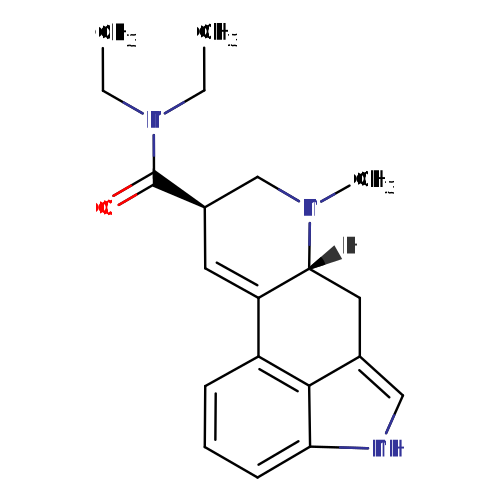
Lysergic acid diethylamide, abbreviated LSD or LSD-25, also known as lysergide and colloquially as acid, is a semisynthetic psychedelic drug of the ergoline family. It was first synthesized by Albert Hofmann in 1938 from ergot, a grain fungus that typically grows on rye. LSD is non-addictive and non-toxic. It is well known for its psychological effects which can include altered thinking processes, closed and open eye visuals, synaesthesia, a sense of time distortion, ego death and spiritual experiences, as well as for its key role in 1960s counterculture. It is used mainly by psychonauts as an entheogen, recreational drug and as an agent in psychedelic therapy. (9). Debate continues over the nature and causes of chronic flashbacks. Explanations in terms of LSD physically remaining in the body for months or years after consumption have been discounted by experimental evidence. Some say Hallucinogen persisting perception disorder (HPPD) is a manifestation of post-traumatic stress disorder, not related to the direct action of LSD on brain chemistry, and varies according to the susceptibility of the individual to the disorder. Many emotionally intense experiences can lead to flashbacks when a person is reminded acutely of the original experience. However, not all published case reports of chronic flashbacks appear to describe an anxious hyper-vigilant state reminiscent of post-traumatic stress disorder.
belongs to the class of organic compounds known as lysergic acids and derivatives. These are alkaloids with a structure based on the lysergic acid skeleton.
Rapidly absorbed. Oral (usually on a substrate such as absorbent blotter paper, a sugar cube, or gelatin) (9); Intramuscular or intravenous injection (9)
Mechanism of Toxicity
LSD preferentially inhibits serotonergic cell firing by acting as an agonist at the 5-HT1A receptors in the raphe nuclei, locus coeruleus, and cortex. It also acts as a partial agonist on the postsynaptic 5-HT1A site and has high affinity for the other 5-HT1 subtypes 5-HT1B, 5-HT1D, and 5-HT1E. LSD's hallucinogenic effects are caused by its ability to act as a partial agonist at the 5-HT2A receptor, especially on neocortical pyramidal cells. Activation of 5-HT2A also leads to increased cortical glutamate levels. Effects of LSD on 5-HT2C, 5-HT5A, 5-HT6, and 5-HT7 receptors have also been described, but their significance remains uncertain. In addition, LSD shows agonistic and antagonistic behavior at the central dopamine D1 and D2-receptors. (9, 8)
Metabolism
LSD's effects normally last from 6 - 12 hours depending on dosage, tolerance, body weight and age. Its half-life in humans is 175 min. It is metabolized in the liver by NADH-dependent microsomal enzymes and its metabolites may be quantified in the urine. The major metabolite is 2-oxy-3-hydroxy-LSD. Other metabolites include 2-oxy-LSD, LAE, nor-LSD, di-hydroxy-LSD, 13- and 14-hydroxy-LSD as glucoronides, lysergic acid ethyl-2-hydroxyethylamide (LEO), and trioxylated LSD. (9, 8)
Toxicity Values
Estimates for the lethal dosage (LD50) of LSD range from 200 ug/kg to more than 1 mg/kg of human body mass, though most sources report that there are no known human cases of such an overdose.
Lethal Dose
LSD has not been known to cause death on its own. (7)
No indication of carcinogenicity to humans (not listed by IARC).
Uses/Sources
Lysergic acid diethylamide, is one of the most widely known psychedelic drugs. It has been used mainly as an entheogen, a tool to supplement various practices for transcendence, including meditation, psychonautics, art projects, and (formerly legal) psychedelic therapy, and as a recreational drug. Formally, LSD is classified as a hallucinogen of the psychedelic type. (9)
Minimum Risk Level
Not Available
Health Effects
Chronic effects of LSD toxicity include flashbacks, psychosis, and exacerbation of latent mental disorders, particularly schizophrenia. Overdosage can result in “bad trips” that are characterized by intense anxiety, combativeness, confusion, and panic attacks. LSD is not considered to be addictive, and withdrawal syndrome are absent. Because of its relatively high therapeutic index, no deaths have been directly attributed to LSD use alone. (7, 9)
Symptoms
LSD reliably causes pupil dilation, reduced appetite, and wakefulness. Other physical reactions to LSD are highly variable and nonspecific, and some of these reactions may be secondary to the psychological effects of LSD. The following symptoms have been reported: numbness, weakness, nausea, hypothermia or hyperthermia, elevated blood sugar, goose bumps, increase in heart rate, jaw clenching, perspiration, saliva production, mucus production, sleeplessness, hyperreflexia, and tremors. LSD also causes expansion and an altered experience of senses, emotions, memories, time, and awareness. These psychological effects (colloquially called a "trip") vary greatly from person to person. Visual effects may include morphing objects, illusion of movement of static surfaces, after image-like trails of moving objects, the appearance of moving colored geometric patterns, an intensification of colors and brightness, new textures on objects, blurred vision, and shape suggestibility. The auditory effects of LSD may include echo-like distortions of sounds, changes in ability to discern concurrent auditory stimuli, and a general intensification of the experience of music. Higher doses often cause intense and fundamental distortions of sensory perception such as synaesthesia, the experience of additional spatial or temporal dimensions, and temporary dissociation. (9)
Treatment
Adverse effects of psychotropics are often treated with fast-acting benzodiazepines like diazepam or triazolam that have calming and antianxiety effects but do not directly affect the specific actions of psychotropics. Theoretically, specific 5-HT2A receptor antagonists, which most commonly means atypical antipsychotics (quetiapine, olanzapine, risperidone, etc.) or other 5-HT2A antagonist such as trazodone or mirtazapine, would be direct antidotes, although some anecdotal reports claim otherwise. (1, 9)
Jean-Luc Henri Sigier Emmanuel, “Device for maintaining the inner surface of gun barrels and method for producing same.” U.S. Patent US5657570, issued September, 1918.