Record Information
Version1.0
Creation Date2014-08-29 05:47:26 UTC
Update Date2026-03-31 17:39:28 UTC
Accession NumberCHEM003115
Identification
Common NameUric acid
ClassSmall Molecule
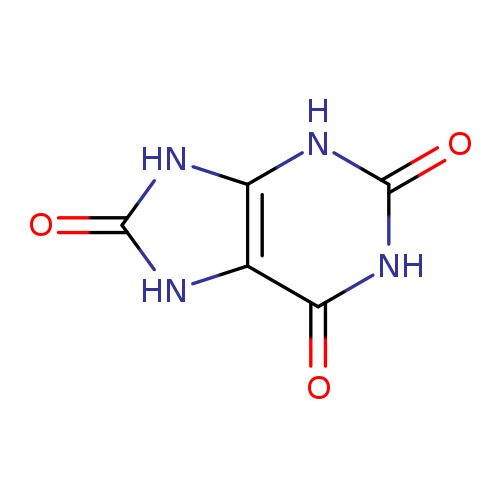
DescriptionUric acid is a uremic toxin. Uremic toxins can be subdivided into three major groups based upon their chemical and physical characteristics: 1) small, water-soluble, non-protein-bound compounds, such as urea; 2) small, lipid-soluble and/or protein-bound compounds, such as the phenols and 3) larger so-called middle-molecules, such as beta2-microglobulin. Chronic exposure of uremic toxins can lead to a number of conditions including renal damage, chronic kidney disease and cardiovascular disease. Uric acid is a heterocyclic purine derivative that is the final oxidation product of purine metabolism. It is produced by the enzyme xanthine oxidase, which oxidizes oxypurines such as xanthine into uric acid. In most mammals, except humans and higher primates, the enzyme uricase further oxidizes uric acid to allantoin. Uric acid is also the end product of nitrogen metabolism in birds and reptiles. In such species, it is excreted in feces as a dry mass. Humans produce only small quantities of uric acid with excess accumulation leading to a type of arthritis known as gout. The loss of uricase in higher primates parallels the similar loss of the ability to synthesize ascorbic acid vitamin C. This may be because in higher primates uric acid partially replaces ascorbic acid.
Contaminant Sources
  • FooDB Chemicals
  • HMDB Contaminants - Urine
  • STOFF IDENT Compounds
  • T3DB toxins
  • ToxCast & Tox21 Chemicals
Contaminant Type
  • Amide
  • Food Toxin
  • Metabolite
  • Natural Compound
  • Organic Compound
  • Uremic Toxin
Chemical Structure
Thumb
Synonyms
ValueSource
2,6,8-TrioxopurineChEBI
2,6,8-TrioxypurineChEBI
Purine-2,6,8(1H,3H,9H)-trioneChEBI
UrateChEBI
1H-Purine-2,6,8-triolHMDB
2,6,8-TrihydroxypurineHMDB
LithateHMDB
Lithic acidHMDB
Acid urate, ammoniumHMDB
Ammonium acid urateHMDB
Monohydrate, sodium urateHMDB
Urate, ammonium acidHMDB
Urate, monosodiumHMDB
Acid, uricHMDB
Monosodium urate monohydrateHMDB
Sodium acid urateHMDB
Sodium urateHMDB
TrioxopurineHMDB
Urate, sodium acidHMDB
Monohydrate, monosodium urateHMDB
Monosodium urateHMDB
Potassium urateHMDB
Sodium acid urate monohydrateHMDB
Urate monohydrate, sodiumHMDB
Acid urate, sodiumHMDB
Sodium urate monohydrateHMDB
Urate monohydrate, monosodiumHMDB
Urate, potassiumHMDB
Urate, sodiumHMDB
Chemical FormulaC5H4N4O3
Average Molecular Mass168.110 g/mol
Monoisotopic Mass168.028 g/mol
CAS Registry Number69-93-2
IUPAC Name2,3,6,7,8,9-hexahydro-1H-purine-2,6,8-trione
Traditional Nameuric acid
SMILESO=C1NC2=C(N1)C(=O)NC(=O)N2
InChI IdentifierInChI=1S/C5H4N4O3/c10-3-1-2(7-4(11)6-1)8-5(12)9-3/h(H4,6,7,8,9,10,11,12)
InChI KeyLEHOTFFKMJEONL-UHFFFAOYSA-N
Chemical Taxonomy
Description belongs to the class of organic compounds known as xanthines. These are purine derivatives with a ketone group conjugated at carbons 2 and 6 of the purine moiety.
KingdomOrganic compounds
Super ClassOrganoheterocyclic compounds
ClassImidazopyrimidines
Sub ClassPurines and purine derivatives
Direct ParentXanthines
Alternative Parents
Substituents
  • Xanthine
  • 6-oxopurine
  • Purinone
  • Alkaloid or derivatives
  • Pyrimidone
  • Pyrimidine
  • Azole
  • Imidazole
  • Heteroaromatic compound
  • Vinylogous amide
  • Lactam
  • Urea
  • Azacycle
  • Hydrocarbon derivative
  • Organic oxide
  • Organooxygen compound
  • Organonitrogen compound
  • Organic nitrogen compound
  • Organopnictogen compound
  • Organic oxygen compound
  • Aromatic heteropolycyclic compound
Molecular FrameworkAromatic heteropolycyclic compounds
External Descriptors
Biological Properties
StatusDetected and Not Quantified
OriginEndogenous
Cellular Locations
  • Cytoplasm
  • Extracellular
  • Peroxisome
Biofluid LocationsNot Available
Tissue Locations
  • Adipose Tissue
  • Bladder
  • Brain
  • Epidermis
  • Erythrocyte
  • Intestine
  • Kidney
  • Liver
  • Muscle
  • Placenta
  • Platelet
  • Prostate
  • Spleen
Pathways
NameSMPDB LinkKEGG Link
Purine MetabolismSMP00050 map00230
Gout or Kelley-Seegmiller SyndromeSMP00365 Not Available
Lesch-Nyhan Syndrome (LNS)SMP00364 Not Available
Methylmalonic AciduriaSMP00200 Not Available
Methylmalonic Aciduria Due to Cobalamin-Related DisordersSMP00201 Not Available
Purine Nucleoside Phosphorylase DeficiencySMP00210 Not Available
Xanthine Dehydrogenase Deficiency (Xanthinuria)SMP00220 Not Available
ApplicationsNot Available
Biological Roles
Chemical RolesNot Available
Physical Properties
StateSolid
AppearanceWhite powder.
Experimental Properties
PropertyValue
Melting Point> 300°C
Boiling PointNot Available
Solubility0.06 mg/mL
Predicted Properties
PropertyValueSource
Water Solubility1.76 g/LALOGPS
logP-1.1ALOGPS
logP-1.5ChemAxon
logS-2ALOGPS
pKa (Strongest Acidic)7.25ChemAxon
pKa (Strongest Basic)-6.5ChemAxon
Physiological Charge0ChemAxon
Hydrogen Acceptor Count3ChemAxon
Hydrogen Donor Count4ChemAxon
Polar Surface Area99.33 ŲChemAxon
Rotatable Bond Count0ChemAxon
Refractivity45.63 m³·mol⁻¹ChemAxon
Polarizability13.61 ųChemAxon
Number of Rings2ChemAxon
Bioavailability1ChemAxon
Rule of FiveYesChemAxon
Ghose FilterNoChemAxon
Veber's RuleNoChemAxon
MDDR-like RuleNoChemAxon
Spectra
Spectra
Spectrum TypeDescriptionSplash KeyView
GC-MSGC-MS Spectrum - GC-EI-TOF (Pegasus III TOF-MS system, Leco; GC 6890, Agilent Technologies) (Non-derivatized)splash10-0537-0913400000-bd24364053510c462adeSpectrum
GC-MSGC-MS Spectrum - GC-MS (4 TMS)splash10-052f-0603900000-8c1224738bed2608c262Spectrum
GC-MSGC-MS Spectrum - GC-MS (3 TMS)splash10-0g59-5917000000-4b28946431495667844bSpectrum
GC-MSGC-MS Spectrum - GC-EI-TOF (Non-derivatized)splash10-0537-0913400000-bd24364053510c462adeSpectrum
GC-MSGC-MS Spectrum - GC-MS (Non-derivatized)splash10-052f-0603900000-8c1224738bed2608c262Spectrum
GC-MSGC-MS Spectrum - GC-MS (Non-derivatized)splash10-0g59-5917000000-4b28946431495667844bSpectrum
GC-MSGC-MS Spectrum - GC-EI-TOF (Non-derivatized)splash10-052g-0902500000-05851611f4bbf0745b81Spectrum
Predicted GC-MSPredicted GC-MS Spectrum - GC-MS (Non-derivatized) - 70eV, Positivesplash10-00os-4900000000-54b6de73b60ab2faad65Spectrum
Predicted GC-MSPredicted GC-MS Spectrum - GC-MS (Non-derivatized) - 70eV, PositiveNot AvailableSpectrum
LC-MS/MSLC-MS/MS Spectrum - Quattro_QQQ 10V, Positive (Annotated)splash10-014i-0900000000-0525c12dc3951f55a2c8Spectrum
LC-MS/MSLC-MS/MS Spectrum - Quattro_QQQ 25V, Positive (Annotated)splash10-006w-9500000000-fe10d491ad634ca46332Spectrum
LC-MS/MSLC-MS/MS Spectrum - Quattro_QQQ 40V, Positive (Annotated)splash10-0gbd-9100000000-d48a3e7919c385949313Spectrum
LC-MS/MSLC-MS/MS Spectrum - , negativesplash10-01c0-3900000000-b3b3f0a20aaac71095d7Spectrum
LC-MS/MSLC-MS/MS Spectrum - LC-ESI-IT , positivesplash10-0f6x-0900000000-a6699ab18f69b21b3823Spectrum
LC-MS/MSLC-MS/MS Spectrum - 30V, Negativesplash10-0006-9000000000-ed929369da80ee084e89Spectrum
LC-MS/MSLC-MS/MS Spectrum - 40V, Negativesplash10-0006-9000000000-dae78aaa83fc4120e56fSpectrum
LC-MS/MSLC-MS/MS Spectrum - 20V, Negativesplash10-00r7-9500000000-120c639f57df45d23153Spectrum
LC-MS/MSLC-MS/MS Spectrum - 40V, Negativesplash10-0a4i-9000000000-96d2ee50d279f8056671Spectrum
LC-MS/MSLC-MS/MS Spectrum - 10V, Negativesplash10-00xr-4900000000-1d613278865ada2e6457Spectrum
LC-MS/MSLC-MS/MS Spectrum - 10V, Negativesplash10-01b9-2900000000-a8460af7fe6f1d23fbfeSpectrum
LC-MS/MSLC-MS/MS Spectrum - 40V, Positivesplash10-0btc-9000000000-d9b1f657e4c7e43bd776Spectrum
LC-MS/MSLC-MS/MS Spectrum - 20V, Negativesplash10-02na-9500000000-7dddbc2120455b19bba9Spectrum
LC-MS/MSLC-MS/MS Spectrum - 35V, Negativesplash10-01c0-3900000000-95ebf9c951d7085b85e3Spectrum
LC-MS/MSLC-MS/MS Spectrum - 20V, Positivesplash10-0gb9-1900000000-029e9b2adfbb2e0d26d8Spectrum
LC-MS/MSLC-MS/MS Spectrum - 10V, Positivesplash10-014i-0900000000-88f140dfad19d2f058f6Spectrum
LC-MS/MSLC-MS/MS Spectrum - 10V, Positivesplash10-0gcc-6900000000-d9540bd8f38fac1e92b0Spectrum
LC-MS/MSLC-MS/MS Spectrum - 20V, Positivesplash10-0bt9-9200000000-80997201350d0752fbbfSpectrum
Predicted LC-MS/MSPredicted LC-MS/MS Spectrum - 10V, Positivesplash10-014i-0900000000-971b5c8c5d975d306fedSpectrum
Predicted LC-MS/MSPredicted LC-MS/MS Spectrum - 20V, Positivesplash10-016r-1900000000-72edb3607fe9beb9b805Spectrum
Predicted LC-MS/MSPredicted LC-MS/MS Spectrum - 40V, Positivesplash10-0zgi-9500000000-753be769a0b48fc2960bSpectrum
Predicted LC-MS/MSPredicted LC-MS/MS Spectrum - 10V, Negativesplash10-014i-0900000000-a4f5b18495486c5a1d5aSpectrum
Predicted LC-MS/MSPredicted LC-MS/MS Spectrum - 20V, Negativesplash10-01b9-1900000000-bc9e45f168dafb0d874cSpectrum
Predicted LC-MS/MSPredicted LC-MS/MS Spectrum - 40V, Negativesplash10-0006-9100000000-e01e386869d687364c61Spectrum
Predicted LC-MS/MSPredicted LC-MS/MS Spectrum - 10V, Negativesplash10-014i-0900000000-e82d2b9a4cad815cef76Spectrum
MSMass Spectrum (Electron Ionization)splash10-002f-9200000000-e5abb655836214cc56b3Spectrum
1D NMR13C NMR SpectrumNot AvailableSpectrum
Toxicity Profile
Route of ExposureEndogenous, Ingestion, Dermal (contact)
Mechanism of ToxicityUremic toxins such as uric acid are actively transported into the kidneys via organic ion transporters (especially OAT3). Increased levels of uremic toxins can stimulate the production of reactive oxygen species. This seems to be mediated by the direct binding or inhibition by uremic toxins of the enzyme NADPH oxidase (especially NOX4 which is abundant in the kidneys and heart) (4). Reactive oxygen species can induce several different DNA methyltransferases (DNMTs) which are involved in the silencing of a protein known as KLOTHO. KLOTHO has been identified as having important roles in anti-aging, mineral metabolism, and vitamin D metabolism. A number of studies have indicated that KLOTHO mRNA and protein levels are reduced during acute or chronic kidney diseases in response to high local levels of reactive oxygen species (5).
MetabolismUric acid is a heterocyclic purine derivative that is the final oxidation product of purine metabolism. It is produced by the enzyme xanthine oxidase, which oxidizes oxypurines such as xanthine into uric acid.
Toxicity ValuesNot Available
Lethal DoseNot Available
Carcinogenicity (IARC Classification)No indication of carcinogenicity to humans (not listed by IARC).
Uses/SourcesNaturally produced by the body (endogenous).
Minimum Risk Level>450 uM in serum
Health EffectsExcess serum accumulation of uric acid in the blood can lead to a type of arthritis known as gout. This painful condition is the result of needle-like crystals of uric acid precipitating in joints, capillaries, skin, and other tissues. Kidney stones can also form through the process of formation and deposition of sodium urate microcrystals. Although uric acid can act as an antioxidant, excess serum accumulation is often associated with cardiovascular disease. High uric acid in the blood may cause kidney stones, which may advance to a more severe condition called chronic kidney failure. High serum uric acid is associated with higher risk of type 2 diabetes, independent of obesity, dyslipidemia, and hypertension. Chronically high levels of uric acid are associated with at least 6 inborn errors of metabolism including: Gout or Kelley-Seegmiller Syndrome, Lesch-Nyhan Syndrome, Methylmalonic Aciduria, Methylmalonic Aciduria Due to Cobalamin-Related Disorders, Purine nucleoside phosphorylase deficiency and Xanthinuria.
SymptomsAs a uremic toxin, uric acid can cause uremic syndrome. Uremic syndrome may affect any part of the body and can cause nausea, vomiting, loss of appetite, and weight loss. It can also cause changes in mental status, such as confusion, reduced awareness, agitation, psychosis, seizures, and coma. Abnormal bleeding, such as bleeding spontaneously or profusely from a very minor injury can also occur. Heart problems, such as an irregular heartbeat, inflammation in the sac that surrounds the heart (pericarditis), and increased pressure on the heart can be seen in patients with uremic syndrome. Shortness of breath from fluid buildup in the space between the lungs and the chest wall (pleural effusion) can also be present.
TreatmentChronic Exposure: Kidney dialysis is usually needed to relieve the symptoms of uremic syndrome until normal kidney function can be restored. Acute Exposure: EYES: irrigate opened eyes for several minutes under running water. INGESTION: do not induce vomiting. Rinse mouth with water (never give anything by mouth to an unconscious person). Seek immediate medical advice.
Concentrations
Not Available
DrugBank IDDB08844
HMDB IDHMDB0000289
FooDB IDFDB015350
Phenol Explorer IDNot Available
KNApSAcK IDC00007301
BiGG ID34768
BioCyc IDURATE
METLIN ID88
PDB IDNot Available
Wikipedia LinkUric_acid
Chemspider ID1142
ChEBI ID17775
PubChem Compound ID1175
Kegg Compound IDC00366
YMDB IDYMDB01494
ECMDB IDECMDB00289
References
Synthesis ReferenceNot Available
MSDSLink
General References
1. Brenner-Holzach, O.; Leuthardt, F. Uric acid formation from glucose carbon in Drosophila melanogaster. Preliminary report. Helvetica Chimica Acta (1963), 46(4), 1426-8.
2. Tiemeyer W, Stohrer M, Giesecke D: Metabolites of nucleic acids in bovine milk. J Dairy Sci. 1984 Apr;67(4):723-8. doi: 10.3168/jds.S0022-0302(84)81361-2.
3. Giesecke D, Ehrentreich L, Stangassinger M, Ahrens F: Mammary and renal excretion of purine metabolites in relation to energy intake and milk yield in dairy cows. J Dairy Sci. 1994 Aug;77(8):2376-81. doi: 10.3168/jds.S0022-0302(94)77180-0.
4. Indyk HE, Woollard DC: Determination of orotic acid, uric acid, and creatinine in milk by liquid chromatography. J AOAC Int. 2004 Jan-Feb;87(1):116-22.
5. Carbohydrate Polymers 37 (1998) 225-229
6. Kurt J. Boudonck, Matthew W. Mitchell, Jacob Wulff and John A. Ryals. Characterization of the biochemical variability of bovine milk using metabolomics. Metabolomics (2009) 5:375?386
7. Brenner-Holzach, O.; Leuthardt, F. Uric acid formation from glucose carbon in Drosophila melanogaster. Preliminary report. Helvetica Chimica Acta (1963), 46(4), 1426-8.
8. Kanbay M, Akcay A, Huddam B, Usluogullari CA, Arat Z, Ozdemir FN, Haberal M: Influence of cyclosporine and tacrolimus on serum uric acid levels in stable kidney transplant recipients. Transplant Proc. 2005 Sep;37(7):3119-20.
9. Marinaki AM, Champion M, Kurian MA, Simmonds HA, Marie S, Vincent MF, van den Berghe G, Duley JA, Fairbanks LD: Adenylosuccinate lyase deficiency--first British case. Nucleosides Nucleotides Nucleic Acids. 2004 Oct;23(8-9):1231-3.
10. Hanvivadhanakul P, Akkasilpa S, Deesomchok U: Efficacy of benzbromarone compared to allopurinol in lowering serum uric acid level in hyperuricemic patients. J Med Assoc Thai. 2002 Jun;85 Suppl 1:S40-7.
11. Kirschbaum B: Correlation studies of plasma paraoxonase activity and uric acid concentration with AAPH-Induced erythrocyte hemolysis in hemodialysis patients. Artif Organs. 2004 Mar;28(3):259-64.
12. Sysyn GD, Rozycki HJ: Lack of prognostic significance of early elevated serum uric acid levels in low birthweight infants. Biol Neonate. 2003;83(4):253-7.
13. Kastenbauer S, Koedel U, Becker BF, Pfister HW: Oxidative stress in bacterial meningitis in humans. Neurology. 2002 Jan 22;58(2):186-91.
14. Tumgor G, Arikan C, Kilic M, Aydogdu S: Frequency of hyperuricemia and effect of calcineurin inhibitors on serum uric acid levels in liver transplanted children. Pediatr Transplant. 2006 Sep;10(6):665-8.
15. Srinivasan S, Kalaiselvi P, Sakthivel R, Pragasam V, Muthu V, Varalakshmi P: Uric acid: an abettor or protector in calcium oxalate urolithiasis? Biochemical study in stone formers. Clin Chim Acta. 2005 Mar;353(1-2):45-51.
16. Puig JG, Torres R, Ruilope LM: AT1 blockers and uric acid metabolism: are there relevant differences? J Hypertens Suppl. 2002 Jun;20(5):S29-31.
17. Alderman M, Aiyer KJ: Uric acid: role in cardiovascular disease and effects of losartan. Curr Med Res Opin. 2004 Mar;20(3):369-79.
18. Iwai N, Mino Y, Hosoyamada M, Tago N, Kokubo Y, Endou H: A high prevalence of renal hypouricemia caused by inactive SLC22A12 in Japanese. Kidney Int. 2004 Sep;66(3):935-44.
19. Williams KP, Galerneau F: The role of serum uric acid as a prognostic indicator of the severity of maternal and fetal complications in hypertensive pregnancies. J Obstet Gynaecol Can. 2002 Aug;24(8):628-32.
20. Inoue K, Namiki T, Iwasaki Y, Yoshimura Y, Nakazawa H: Determination of uric acid in human saliva by high-performance liquid chromatography with amperometric electrochemical detection. J Chromatogr B Analyt Technol Biomed Life Sci. 2003 Feb 25;785(1):57-63.
21. Eells JT, Spector R: Purine and pyrimidine base and nucleoside concentrations in human cerebrospinal fluid and plasma. Neurochem Res. 1983 Nov;8(11):1451-7.
22. Cacabelos R, Fernandez-Novoa L, Corzo L, Pichel V, Lombardi V, Kubota Y: Genomics and phenotypic profiles in dementia: implications for pharmacological treatment. Methods Find Exp Clin Pharmacol. 2004 Jul-Aug;26(6):421-44.
23. Simkin PA, Hoover PL, Paxson CS, Wilson WF: Uric acid excretion: quantitative assessment from spot, midmorning serum and urine samples. Ann Intern Med. 1979 Jul;91(1):44-7.
24. Mazzali M: Uric acid and transplantation. Semin Nephrol. 2005 Jan;25(1):50-5.
25. Sreekumar A, Poisson LM, Rajendiran TM, Khan AP, Cao Q, Yu J, Laxman B, Mehra R, Lonigro RJ, Li Y, Nyati MK, Ahsan A, Kalyana-Sundaram S, Han B, Cao X, Byun J, Omenn GS, Ghosh D, Pennathur S, Alexander DC, Berger A, Shuster JR, Wei JT, Varambally S, Beecher C, Chinnaiyan AM: Metabolomic profiles delineate potential role for sarcosine in prostate cancer progression. Nature. 2009 Feb 12;457(7231):910-4. doi: 10.1038/nature07762.
26. Ames BN, Cathcart R, Schwiers E, Hochstein P: Uric acid provides an antioxidant defense in humans against oxidant- and radical-caused aging and cancer: a hypothesis. Proc Natl Acad Sci U S A. 1981 Nov;78(11):6858-62.
27. Kutzing MK, Firestein BL: Altered uric acid levels and disease states. J Pharmacol Exp Ther. 2008 Jan;324(1):1-7. doi: 10.1124/jpet.107.129031. Epub 2007 Sep 21.
28. Kool M, Willart MA, van Nimwegen M, Bergen I, Pouliot P, Virchow JC, Rogers N, Osorio F, Reis e Sousa C, Hammad H, Lambrecht BN: An unexpected role for uric acid as an inducer of T helper 2 cell immunity to inhaled antigens and inflammatory mediator of allergic asthma. Immunity. 2011 Apr 22;34(4):527-40. doi: 10.1016/j.immuni.2011.03.015. Epub 2011 Apr 7.
29. Duranton F, Cohen G, De Smet R, Rodriguez M, Jankowski J, Vanholder R, Argiles A: Normal and pathologic concentrations of uremic toxins. J Am Soc Nephrol. 2012 Jul;23(7):1258-70. doi: 10.1681/ASN.2011121175. Epub 2012 May 24.
30. Elshenawy S, Pinney SE, Stuart T, Doulias PT, Zura G, Parry S, Elovitz MA, Bennett MJ, Bansal A, Strauss JF 3rd, Ischiropoulos H, Simmons RA: The Metabolomic Signature of the Placenta in Spontaneous Preterm Birth. Int J Mol Sci. 2020 Feb 4;21(3). pii: ijms21031043. doi: 10.3390/ijms21031043.
31. https://www.ncbi.nlm.nih.gov/pubmed/?term=22770225