Record Information
Version1.0
Creation Date2014-08-29 05:47:41 UTC
Update Date2026-04-03 00:36:06 UTC
Accession NumberCHEM003118
Identification
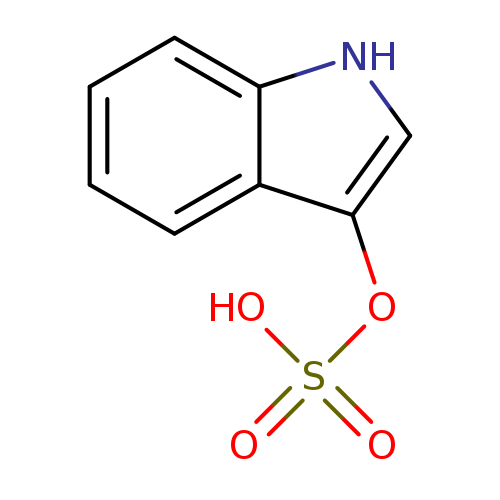
Common NameIndoxyl sulfate
ClassSmall Molecule
DescriptionIndoxyl sulfate is a uremic toxin. Uremic toxins can be subdivided into three major groups based upon their chemical and physical characteristics: 1) small, water-soluble, non-protein-bound compounds, such as urea; 2) small, lipid-soluble and/or protein-bound compounds, such as the phenols and 3) larger so-called middle-molecules, such as beta2-microglobulin. Chronic exposure of uremic toxins can lead to a number of conditions including renal damage, chronic kidney disease and cardiovascular disease. Indoxyl sulfate is a dietary protein metabolite, and also the metabolite of the common amino acid tryptophan. Indoxyl sulfate is a circulating uremic toxin stimulating glomerular sclerosis and interstitial fibrosis. Indoxyl sulfate is one of the well known substances of a group of protein-bound uremic retention solutes. Indoxyl sulfate increases the rate of progression of renal failure. In plasma, indoxyl sulfate is a protein-bound uremic solute that induces endothelial dysfunction by inhibiting endothelial proliferation and migration in vitro. Some studies suggest that indoxyl sulfate is also involved in oxidative stress. In hemodialyzed patients, serum levels of indoxyl sulfate are associated with levels of pentosidine, a marker of carbonyl and oxidative stress; in vitro, indoxyl sulfate increases reactive oxygen species (ROS) production in tubular cells, and increases NAD(P)H oxidase activity in endothelial cells. Indoxyl sulfate impairs osteoblst function and induces abnormalities of bone turnover. Indoxyl sulfate strongly decreases the levels of glutathione, one of the most active antioxidant systems of the cell. (2, 3, 4, 5).
Contaminant Sources
  • FooDB Chemicals
  • HMDB Contaminants - Urine
  • T3DB toxins
Contaminant Type
  • Ester
  • Food Toxin
  • Industrial/Workplace Toxin
  • Metabolite
  • Natural Compound
  • Organic Compound
  • Uremic Toxin
Chemical Structure
Thumb
Synonyms
ValueSource
3-Indolyl hydrogen sulfateChEBI
3-Indolyl sulfateChEBI
3-Indoxyl sulfateChEBI
3-Indoxylsulfuric acidChEBI
IndicanChEBI
indol-3-yl Hydrogen sulfateChEBI
indol-3-yl SulfateChEBI
indol-3-yl SulphateChEBI
Indoxyl sulfic acidChEBI
Indoxyl sulphateChEBI
Indoxyl-3-sulphateChEBI
Indoxylsulfuric acidChEBI
3-Indolyl hydrogen sulfuric acidGenerator
3-Indolyl hydrogen sulphateGenerator
3-Indolyl hydrogen sulphuric acidGenerator
3-Indolyl sulfuric acidGenerator
3-Indolyl sulphateGenerator
3-Indolyl sulphuric acidGenerator
3-Indoxyl sulfuric acidGenerator
3-Indoxyl sulphateGenerator
3-Indoxyl sulphuric acidGenerator
3-IndoxylsulfateGenerator
3-IndoxylsulphateGenerator
3-Indoxylsulphuric acidGenerator
indol-3-yl Hydrogen sulfuric acidGenerator
indol-3-yl Hydrogen sulphateGenerator
indol-3-yl Hydrogen sulphuric acidGenerator
indol-3-yl Sulfuric acidGenerator
indol-3-yl Sulphuric acidGenerator
Indoxyl sulfuric acidGenerator
Indoxyl sulphuric acidGenerator
Indoxyl-3-sulfateGenerator
Indoxyl-3-sulfuric acidGenerator
Indoxyl-3-sulphuric acidGenerator
IndoxylsulfateGenerator
IndoxylsulphateGenerator
Indoxylsulphuric acidGenerator
1H-indol-3-yl Hydrogen sulfateHMDB
1H-indol-3-yl Hydrogen sulphateHMDB
indol-3-OlHMDB
Indican monosodium saltHMDB
Monopotassium salt, indicanHMDB
Monosodium salt, indicanHMDB
Sulfate, indoxylHMDB
Indican monopotassium saltHMDB
1H-indol-3-Ol hydrogen sulfate esterHMDB
3-Sulphooxy-1H-indoleHMDB
Indoxyl sulfateGenerator
Chemical FormulaC8H7NO4S
Average Molecular Mass213.210 g/mol
Monoisotopic Mass213.010 g/mol
CAS Registry Number487-94-5
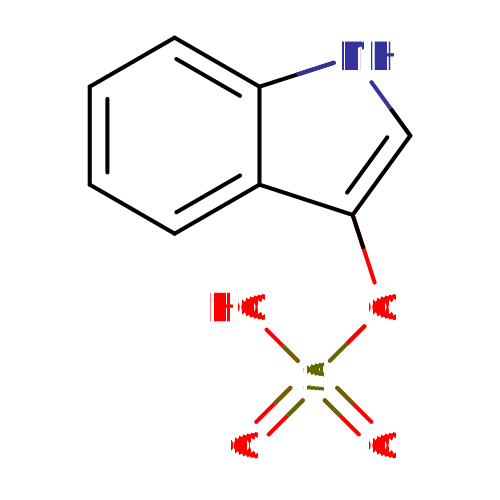
IUPAC Name(1H-indol-3-yl)oxidanesulfonic acid
Traditional Name3-sulfooxy-1H-indole
SMILESOS(=O)(=O)OC1=CNC2=CC=CC=C12
InChI IdentifierInChI=1S/C8H7NO4S/c10-14(11,12)13-8-5-9-7-4-2-1-3-6(7)8/h1-5,9H,(H,10,11,12)
InChI KeyBXFFHSIDQOFMLE-UHFFFAOYSA-N
Chemical Taxonomy
Description belongs to the class of organic compounds known as arylsulfates. These are organic compounds containing a sulfate group that carries an aryl group through an ether group.
KingdomOrganic compounds
Super ClassOrganic acids and derivatives
ClassOrganic sulfuric acids and derivatives
Sub ClassArylsulfates
Direct ParentArylsulfates
Alternative Parents
Substituents
  • Arylsulfate
  • Indole
  • Indole or derivatives
  • Substituted pyrrole
  • Sulfuric acid monoester
  • Sulfate-ester
  • Sulfuric acid ester
  • Benzenoid
  • Pyrrole
  • Heteroaromatic compound
  • Organoheterocyclic compound
  • Azacycle
  • Organooxygen compound
  • Organonitrogen compound
  • Organic oxygen compound
  • Organic nitrogen compound
  • Hydrocarbon derivative
  • Organopnictogen compound
  • Organic oxide
  • Aromatic heteropolycyclic compound
Molecular FrameworkAromatic heteropolycyclic compounds
External Descriptors
Biological Properties
StatusDetected and Not Quantified
OriginEndogenous
Cellular Locations
  • Cytoplasm
  • Extracellular
Biofluid LocationsNot Available
Tissue Locations
  • Kidney
  • Muscle
  • Prostate
PathwaysNot Available
ApplicationsNot Available
Biological Roles
Chemical RolesNot Available
Physical Properties
StateSolid
AppearanceWhite powder.
Experimental Properties
PropertyValue
Melting PointNot Available
Boiling PointNot Available
SolubilityNot Available
Predicted Properties
PropertyValueSource
Water Solubility0.79 g/LALOGPS
logP-0.48ALOGPS
logP1.29ChemAxon
logS-2.4ALOGPS
pKa (Strongest Acidic)-1.8ChemAxon
Physiological Charge-1ChemAxon
Hydrogen Acceptor Count3ChemAxon
Hydrogen Donor Count2ChemAxon
Polar Surface Area79.39 ŲChemAxon
Rotatable Bond Count2ChemAxon
Refractivity49.12 m³·mol⁻¹ChemAxon
Polarizability19.37 ųChemAxon
Number of Rings2ChemAxon
Bioavailability1ChemAxon
Rule of FiveYesChemAxon
Ghose FilterYesChemAxon
Veber's RuleNoChemAxon
MDDR-like RuleNoChemAxon
Spectra
Spectra
Spectrum TypeDescriptionSplash KeyView
GC-MSGC-MS Spectrum - GC-EI-TOF (Pegasus III TOF-MS system, Leco; GC 6890, Agilent Technologies) (Non-derivatized)splash10-0fk9-1890000000-1ccefb12c0ecb58cd51fSpectrum
GC-MSGC-MS Spectrum - GC-EI-TOF (Pegasus III TOF-MS system, Leco; GC 6890, Agilent Technologies) (Non-derivatized)splash10-0bu0-1940000000-990f3edaa0f09b455534Spectrum
GC-MSGC-MS Spectrum - GC-EI-TOF (Pegasus III TOF-MS system, Leco; GC 6890, Agilent Technologies) (Non-derivatized)splash10-004i-0790000000-bc45c54af242dc72b9dbSpectrum
Predicted GC-MSPredicted GC-MS Spectrum - GC-MS (Non-derivatized) - 70eV, Positivesplash10-01q9-1920000000-61513ebc6b785c807016Spectrum
Predicted GC-MSPredicted GC-MS Spectrum - GC-MS (Non-derivatized) - 70eV, PositiveNot AvailableSpectrum
LC-MS/MSLC-MS/MS Spectrum - Quattro_QQQ 10V, Negative (Annotated)splash10-03di-2090000000-53c9050daddd26dc4b7fSpectrum
LC-MS/MSLC-MS/MS Spectrum - Quattro_QQQ 25V, Negative (Annotated)splash10-001i-9200000000-2fa7a5fde4214df01ed2Spectrum
LC-MS/MSLC-MS/MS Spectrum - Quattro_QQQ 40V, Negative (Annotated)splash10-001i-9000000000-c9eec4c054ae464098edSpectrum
LC-MS/MSLC-MS/MS Spectrum - LC-ESI-QQ (API3000, Applied Biosystems) 10V, Negativesplash10-03di-0090000000-3cb045bd6bc8f7f8c2b0Spectrum
LC-MS/MSLC-MS/MS Spectrum - LC-ESI-QQ (API3000, Applied Biosystems) 20V, Negativesplash10-03e9-6290000000-83be1b2526f53131a6ebSpectrum
LC-MS/MSLC-MS/MS Spectrum - LC-ESI-QQ (API3000, Applied Biosystems) 30V, Negativesplash10-001i-9400000000-13c9487183bfd123ac3bSpectrum
LC-MS/MSLC-MS/MS Spectrum - LC-ESI-QQ (API3000, Applied Biosystems) 40V, Negativesplash10-001i-9100000000-cf4b2fd59d8e983cb538Spectrum
LC-MS/MSLC-MS/MS Spectrum - LC-ESI-QQ (API3000, Applied Biosystems) 50V, Negativesplash10-001i-9000000000-d0f51465d6c4ede36ea4Spectrum
LC-MS/MSLC-MS/MS Spectrum - LC-ESI-QTOF (UPLC Q-Tof Premier, Waters) , Negativesplash10-01si-9350000000-7227b62421572ea4e5f7Spectrum
LC-MS/MSLC-MS/MS Spectrum - LC-ESI-QQ , negativesplash10-03di-0090000000-8fc92d1f6e32863121d3Spectrum
LC-MS/MSLC-MS/MS Spectrum - LC-ESI-QQ , negativesplash10-03e9-6290000000-b9b7292552ce2dcfccffSpectrum
LC-MS/MSLC-MS/MS Spectrum - LC-ESI-QQ , negativesplash10-001i-9400000000-7348f8347e517b6e1de2Spectrum
LC-MS/MSLC-MS/MS Spectrum - LC-ESI-QQ , negativesplash10-001i-9100000000-e9a190cf92fcef264150Spectrum
LC-MS/MSLC-MS/MS Spectrum - LC-ESI-QQ , negativesplash10-001i-9000000000-d0f51465d6c4ede36ea4Spectrum
LC-MS/MSLC-MS/MS Spectrum - LC-ESI-QTOF , negativesplash10-01si-9350000000-7227b62421572ea4e5f7Spectrum
LC-MS/MSLC-MS/MS Spectrum - , positivesplash10-001i-0900000000-d5c9e813f433f6a44f0fSpectrum
LC-MS/MSLC-MS/MS Spectrum - 40V, Negativesplash10-004i-9000000000-2ada8a129d47cf18cf2fSpectrum
LC-MS/MSLC-MS/MS Spectrum - 10V, Negativesplash10-03e9-8190000000-b7fa2468dad04ce9cf7bSpectrum
LC-MS/MSLC-MS/MS Spectrum - 20V, Negativesplash10-0059-9300000000-4ef26d7f6ffd8a0309a8Spectrum
Predicted LC-MS/MSPredicted LC-MS/MS Spectrum - 10V, Positivesplash10-03di-0290000000-bcbb5c8a331119233939Spectrum
Predicted LC-MS/MSPredicted LC-MS/MS Spectrum - 20V, Positivesplash10-0159-0910000000-0d28f0b8a4ef10141bf2Spectrum
Predicted LC-MS/MSPredicted LC-MS/MS Spectrum - 40V, Positivesplash10-014i-2900000000-a394015845114b618d01Spectrum
Predicted LC-MS/MSPredicted LC-MS/MS Spectrum - 10V, Negativesplash10-03di-0190000000-6917b03dbdcafea36737Spectrum
Predicted LC-MS/MSPredicted LC-MS/MS Spectrum - 20V, Negativesplash10-001i-0930000000-6cb7fcdb7b15b9a9e80aSpectrum
Predicted LC-MS/MSPredicted LC-MS/MS Spectrum - 40V, Negativesplash10-001i-4900000000-3b57e4454fb97f3e1a1aSpectrum
1D NMR1H NMR SpectrumNot AvailableSpectrum
1D NMR13C NMR SpectrumNot AvailableSpectrum
1D NMR1H NMR SpectrumNot AvailableSpectrum
1D NMR13C NMR SpectrumNot AvailableSpectrum
1D NMR1H NMR SpectrumNot AvailableSpectrum
1D NMR13C NMR SpectrumNot AvailableSpectrum
1D NMR1H NMR SpectrumNot AvailableSpectrum
1D NMR13C NMR SpectrumNot AvailableSpectrum
1D NMR1H NMR SpectrumNot AvailableSpectrum
1D NMR13C NMR SpectrumNot AvailableSpectrum
1D NMR1H NMR SpectrumNot AvailableSpectrum
1D NMR13C NMR SpectrumNot AvailableSpectrum
1D NMR1H NMR SpectrumNot AvailableSpectrum
1D NMR13C NMR SpectrumNot AvailableSpectrum
1D NMR1H NMR SpectrumNot AvailableSpectrum
1D NMR13C NMR SpectrumNot AvailableSpectrum
1D NMR1H NMR SpectrumNot AvailableSpectrum
1D NMR13C NMR SpectrumNot AvailableSpectrum
1D NMR1H NMR SpectrumNot AvailableSpectrum
1D NMR13C NMR SpectrumNot AvailableSpectrum
2D NMR[1H,13C] 2D NMR SpectrumNot AvailableSpectrum
Toxicity Profile
Route of ExposureEndogenous, Ingestion, Dermal (contact)
Mechanism of ToxicityUremic toxins such as Indoxyl sulfate are actively transported into the kidneys via organic ion transporters (especially OAT3). Increased levels of uremic toxins can stimulate the production of reactive oxygen species. This seems to be mediated by the direct binding or inhibition by uremic toxins of the enzyme NADPH oxidase (especially NOX4 which is abundant in the kidneys and heart) (8). Reactive oxygen species can induce several different DNA methyltransferases (DNMTs) which are involved in the silencing of a protein known as KLOTHO. KLOTHO has been identified as having important roles in anti-aging, mineral metabolism, and vitamin D metabolism. A number of studies have indicated that KLOTHO mRNA and protein levels are reduced during acute or chronic kidney diseases in response to high local levels of reactive oxygen species (9).
MetabolismUremic toxins tend to accumulate in the blood either through dietary excess or through poor filtration by the kidneys. Most uremic toxins are metabolic waste products and are normally excreted in the urine or feces.
Toxicity ValuesNot Available
Lethal DoseNot Available
Carcinogenicity (IARC Classification)No indication of carcinogenicity to humans (not listed by IARC).
Uses/SourcesNaturally produced by the body (endogenous).
Minimum Risk LevelNot Available
Health EffectsChronic exposure to uremic toxins can lead to a number of conditions including renal damage, chronic kidney disease and cardiovascular disease.
SymptomsAs a uremic toxin, this compound can cause uremic syndrome. Uremic syndrome may affect any part of the body and can cause nausea, vomiting, loss of appetite, and weight loss. It can also cause changes in mental status, such as confusion, reduced awareness, agitation, psychosis, seizures, and coma. Abnormal bleeding, such as bleeding spontaneously or profusely from a very minor injury can also occur. Heart problems, such as an irregular heartbeat, inflammation in the sac that surrounds the heart (pericarditis), and increased pressure on the heart can be seen in patients with uremic syndrome. Shortness of breath from fluid buildup in the space between the lungs and the chest wall (pleural effusion) can also be present.
TreatmentKidney dialysis is usually needed to relieve the symptoms of uremic syndrome until normal kidney function can be restored.
Concentrations
Not Available
DrugBank IDDB07992
HMDB IDHMDB0000682
FooDB IDFDB022179
Phenol Explorer IDNot Available
KNApSAcK IDC00052323
BiGG IDNot Available
BioCyc IDNot Available
METLIN ID524
PDB IDNot Available
Wikipedia LinkIndoxyl sulfate
Chemspider ID9840
ChEBI ID43355
PubChem Compound ID10258
Kegg Compound IDNot Available
YMDB IDNot Available
ECMDB IDNot Available
References
Synthesis ReferenceNot Available
MSDSLink
General References
1. https://www.ncbi.nlm.nih.gov/pubmed/?term=17190852
2. https://www.ncbi.nlm.nih.gov/pubmed/?term=22056374
3. https://www.ncbi.nlm.nih.gov/pubmed/?term=22200421
4. https://www.ncbi.nlm.nih.gov/pubmed/?term=22200422
5. https://www.ncbi.nlm.nih.gov/pubmed/?term=22200425
6. https://www.ncbi.nlm.nih.gov/pubmed/?term=22200426
7. https://www.ncbi.nlm.nih.gov/pubmed/?term=22213462
8. https://www.ncbi.nlm.nih.gov/pubmed/?term=22231736
9. https://www.ncbi.nlm.nih.gov/pubmed/?term=22237753
10. https://www.ncbi.nlm.nih.gov/pubmed/?term=22318422
11. https://www.ncbi.nlm.nih.gov/pubmed/?term=22326498
12. https://www.ncbi.nlm.nih.gov/pubmed/?term=22389425
13. https://www.ncbi.nlm.nih.gov/pubmed/?term=22447217
14. https://www.ncbi.nlm.nih.gov/pubmed/?term=22483453
15. https://www.ncbi.nlm.nih.gov/pubmed/?term=22490877
16. https://www.ncbi.nlm.nih.gov/pubmed/?term=22513409
17. Robertson, Alexander. Synthesis of glucosides. I. Synthesis of indican. Journal of the Chemical Society (1927), 1937-43.
18. Sweatman BC, Farrant RD, Holmes E, Ghauri FY, Nicholson JK, Lindon JC: 600 MHz 1H-NMR spectroscopy of human cerebrospinal fluid: effects of sample manipulation and assignment of resonances. J Pharm Biomed Anal. 1993 Aug;11(8):651-64.
19. Bales JR, Higham DP, Howe I, Nicholson JK, Sadler PJ: Use of high-resolution proton nuclear magnetic resonance spectroscopy for rapid multi-component analysis of urine. Clin Chem. 1984 Mar;30(3):426-32.
20. Sreekumar A, Poisson LM, Rajendiran TM, Khan AP, Cao Q, Yu J, Laxman B, Mehra R, Lonigro RJ, Li Y, Nyati MK, Ahsan A, Kalyana-Sundaram S, Han B, Cao X, Byun J, Omenn GS, Ghosh D, Pennathur S, Alexander DC, Berger A, Shuster JR, Wei JT, Varambally S, Beecher C, Chinnaiyan AM: Metabolomic profiles delineate potential role for sarcosine in prostate cancer progression. Nature. 2009 Feb 12;457(7231):910-4. doi: 10.1038/nature07762.
21. Aoyama I, Miyazaki T, Niwa T: Preventive effects of an oral sorbent on nephropathy in rats. Miner Electrolyte Metab. 1999 Jul-Dec;25(4-6):365-72.
22. Brunet P, Dou L, Cerini C, Berland Y: Protein-bound uremic retention solutes. Adv Ren Replace Ther. 2003 Oct;10(4):310-20.
23. Iwasaki Y: [Uremic toxins and bone metabolism]. Clin Calcium. 2007 May;17(5):734-9.
24. Dou L, Jourde-Chiche N, Faure V, Cerini C, Berland Y, Dignat-George F, Brunet P: The uremic solute indoxyl sulfate induces oxidative stress in endothelial cells. J Thromb Haemost. 2007 Jun;5(6):1302-8.
25. Evenepoel P, Meijers BK, Bammens BR, Verbeke K: Uremic toxins originating from colonic microbial metabolism. Kidney Int Suppl. 2009 Dec;(114):S12-9. doi: 10.1038/ki.2009.402.
26. Duranton F, Cohen G, De Smet R, Rodriguez M, Jankowski J, Vanholder R, Argiles A: Normal and pathologic concentrations of uremic toxins. J Am Soc Nephrol. 2012 Jul;23(7):1258-70. doi: 10.1681/ASN.2011121175. Epub 2012 May 24.
27. Elshenawy S, Pinney SE, Stuart T, Doulias PT, Zura G, Parry S, Elovitz MA, Bennett MJ, Bansal A, Strauss JF 3rd, Ischiropoulos H, Simmons RA: The Metabolomic Signature of the Placenta in Spontaneous Preterm Birth. Int J Mol Sci. 2020 Feb 4;21(3). pii: ijms21031043. doi: 10.3390/ijms21031043.