Record Information
Version1.0
Creation Date2014-08-29 05:51:23 UTC
Update Date2026-04-17 17:21:59 UTC
Accession NumberCHEM003149
Identification
Common Name2-Hexenal
ClassSmall Molecule
Description2-Hexenal is a uremic toxin. Uremic toxins can be subdivided into three major groups based upon their chemical and physical characteristics: 1) small, water-soluble, non-protein-bound compounds, such as urea; 2) small, lipid-soluble and/or protein-bound compounds, such as the phenols and 3) larger so-called middle-molecules, such as beta2-microglobulin. Chronic exposure of uremic toxins can lead to a number of conditions including renal damage, chronic kidney disease and cardiovascular disease. 2-Hexenal is found in allspice. 2-Hexenal is used in perfumery and flavourings. 2-Hexenal belongs to the family of Medium-chain Aldehydes. These are An aldehyde with a chain length containing between 6 and 12 carbon atoms.
Contaminant Sources
  • Disinfection Byproducts
  • EAFUS Chemicals
  • FooDB Chemicals
  • HMDB Contaminants - Feces
  • T3DB toxins
  • ToxCast & Tox21 Chemicals
Contaminant Type
  • Aldehyde
  • Ester
  • Flavouring Agent
  • Food Toxin
  • Metabolite
  • Natural Compound
  • Organic Compound
  • Uremic Toxin
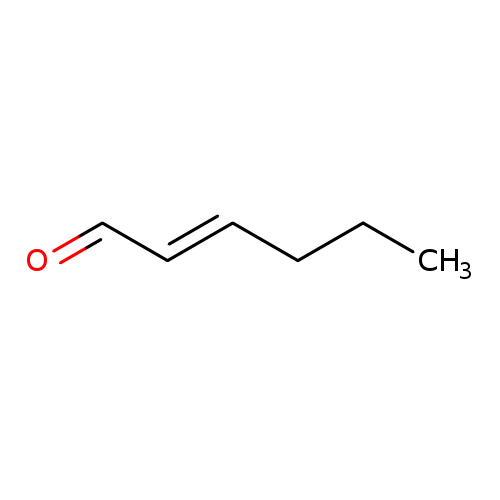
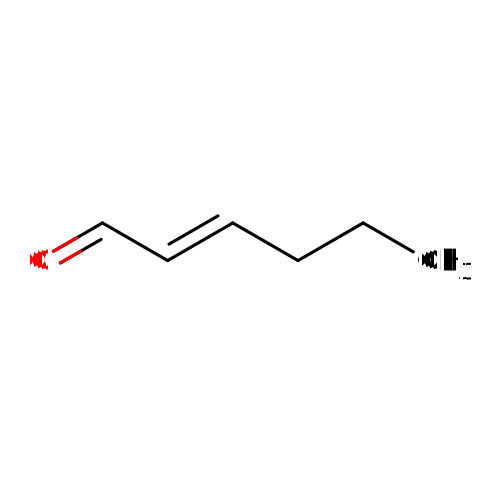
Chemical Structure
Thumb
Synonyms
ValueSource
(e)-2-HexenalChEBI
(e)-Hex--2-enalChEBI
(e)-Hex-2-enalChEBI
2-trans-HexenalChEBI
3-PropylacroleinChEBI
beta-Propyl acroleinChEBI
beta-PropylacroleinChEBI
Leaf aldehydeChEBI
trans-2-HexenalChEBI
b-Propyl acroleinGenerator
Β-propyl acroleinGenerator
b-PropylacroleinGenerator
Β-propylacroleinGenerator
Hex-2-en-1-alHMDB
2-Hexenal, eHMDB
(2E)-2-HexenalHMDB
(2E)-HexenalHMDB
(e)-2-Hexen-1-alHMDB
2-Hexen-1-alHMDB
Hex-2-enalHMDB
trans-2-Hexen-1-alHMDB
2-HexenaldehydeHMDB
3-Propyl-acroleinHMDB
Hexen-2-alHMDB
Hexen-2-en-1-alHMDB
Hexylenic aldehydeHMDB
alpha,beta-HexylenaldehydeHMDB
Α,β-hexylenaldehydeHMDB
Green leaf aldehydeHMDB
2-HexenalMeSH
Chemical FormulaC6H10O
Average Molecular Mass98.145 g/mol
Monoisotopic Mass98.073 g/mol
CAS Registry Number505-57-7
IUPAC Name(2E)-hex-2-enal
Traditional Name(E)-2-hexenal
SMILES[H]\C(CCC)=C(\[H])C=O
InChI IdentifierInChI=1S/C6H10O/c1-2-3-4-5-6-7/h4-6H,2-3H2,1H3/b5-4+
InChI KeyMBDOYVRWFFCFHM-SNAWJCMRSA-N
Chemical Taxonomy
Description belongs to the class of organic compounds known as medium-chain aldehydes. These are an aldehyde with a chain length containing between 6 and 12 carbon atoms.
KingdomOrganic compounds
Super ClassOrganic oxygen compounds
ClassOrganooxygen compounds
Sub ClassCarbonyl compounds
Direct ParentMedium-chain aldehydes
Alternative Parents
Substituents
  • Medium-chain aldehyde
  • Enal
  • Alpha,beta-unsaturated aldehyde
  • Organic oxide
  • Hydrocarbon derivative
  • Aliphatic acyclic compound
Molecular FrameworkAliphatic acyclic compounds
External Descriptors
Biological Properties
StatusDetected and Not Quantified
OriginEndogenous
Cellular Locations
  • Cytoplasm
  • Extracellular
Biofluid LocationsNot Available
Tissue LocationsNot Available
PathwaysNot Available
ApplicationsNot Available
Biological RolesNot Available
Chemical RolesNot Available
Physical Properties
StateSolid
AppearanceWhite powder.
Experimental Properties
PropertyValue
Melting PointNot Available
Boiling PointNot Available
SolubilityNot Available
Predicted Properties
PropertyValueSource
Water Solubility3.2 g/LALOGPS
logP1.8ALOGPS
logP1.65ChemAxon
logS-1.5ALOGPS
pKa (Strongest Basic)-4.2ChemAxon
Physiological Charge0ChemAxon
Hydrogen Acceptor Count1ChemAxon
Hydrogen Donor Count0ChemAxon
Polar Surface Area17.07 ŲChemAxon
Rotatable Bond Count3ChemAxon
Refractivity31.24 m³·mol⁻¹ChemAxon
Polarizability11.57 ųChemAxon
Number of Rings0ChemAxon
Bioavailability1ChemAxon
Rule of FiveYesChemAxon
Ghose FilterNoChemAxon
Veber's RuleYesChemAxon
MDDR-like RuleNoChemAxon
Spectra
Spectra
Spectrum TypeDescriptionSplash KeyView
Predicted GC-MSPredicted GC-MS Spectrum - GC-MS (Non-derivatized) - 70eV, Positivesplash10-00or-9000000000-ef8fb4a16f9e47588e24Spectrum
Predicted GC-MSPredicted GC-MS Spectrum - GC-MS (Non-derivatized) - 70eV, PositiveNot AvailableSpectrum
LC-MS/MSLC-MS/MS Spectrum - LC-ESI-QTOF 32V, positivesplash10-0002-9000000000-ea4667e9ee10cccddb24Spectrum
LC-MS/MSLC-MS/MS Spectrum - LC-ESI-QFT , positivesplash10-0a4j-9000000000-13fcd86dcfc328ec27a6Spectrum
Predicted LC-MS/MSPredicted LC-MS/MS Spectrum - 10V, Positivesplash10-0002-9000000000-db77fc4d5edd7bdc3907Spectrum
Predicted LC-MS/MSPredicted LC-MS/MS Spectrum - 20V, Positivesplash10-000t-9000000000-8c4cc267531a0c711b32Spectrum
Predicted LC-MS/MSPredicted LC-MS/MS Spectrum - 40V, Positivesplash10-0a4l-9000000000-1018f15c3b2d6e22c226Spectrum
Predicted LC-MS/MSPredicted LC-MS/MS Spectrum - 10V, Negativesplash10-0002-9000000000-9232ec723afab464ccc2Spectrum
Predicted LC-MS/MSPredicted LC-MS/MS Spectrum - 20V, Negativesplash10-0002-9000000000-a839e50ee7ad7503877eSpectrum
Predicted LC-MS/MSPredicted LC-MS/MS Spectrum - 40V, Negativesplash10-0006-9000000000-4a1d88a16ebce778de70Spectrum
Predicted LC-MS/MSPredicted LC-MS/MS Spectrum - 10V, Positivesplash10-0540-9000000000-6923af674dd120606957Spectrum
Predicted LC-MS/MSPredicted LC-MS/MS Spectrum - 20V, Positivesplash10-052r-9000000000-3ea4a5ca74032209afafSpectrum
Predicted LC-MS/MSPredicted LC-MS/MS Spectrum - 40V, Positivesplash10-0573-9000000000-b0552bcc819f05df9c04Spectrum
Predicted LC-MS/MSPredicted LC-MS/MS Spectrum - 10V, Negativesplash10-0002-9000000000-649f52184fb4997b20fbSpectrum
Predicted LC-MS/MSPredicted LC-MS/MS Spectrum - 20V, Negativesplash10-004i-9000000000-3e77d5cdc17bcd3c255eSpectrum
Predicted LC-MS/MSPredicted LC-MS/MS Spectrum - 40V, Negativesplash10-0n2d-9000000000-022c1508f6a2751bcc39Spectrum
1D NMR13C NMR SpectrumNot AvailableSpectrum
1D NMR1H NMR SpectrumNot AvailableSpectrum
1D NMR13C NMR SpectrumNot AvailableSpectrum
1D NMR1H NMR SpectrumNot AvailableSpectrum
1D NMR13C NMR SpectrumNot AvailableSpectrum
1D NMR1H NMR SpectrumNot AvailableSpectrum
1D NMR13C NMR SpectrumNot AvailableSpectrum
1D NMR1H NMR SpectrumNot AvailableSpectrum
1D NMR13C NMR SpectrumNot AvailableSpectrum
1D NMR1H NMR SpectrumNot AvailableSpectrum
1D NMR13C NMR SpectrumNot AvailableSpectrum
1D NMR1H NMR SpectrumNot AvailableSpectrum
1D NMR13C NMR SpectrumNot AvailableSpectrum
1D NMR1H NMR SpectrumNot AvailableSpectrum
1D NMR13C NMR SpectrumNot AvailableSpectrum
1D NMR1H NMR SpectrumNot AvailableSpectrum
1D NMR13C NMR SpectrumNot AvailableSpectrum
1D NMR1H NMR SpectrumNot AvailableSpectrum
1D NMR13C NMR SpectrumNot AvailableSpectrum
1D NMR1H NMR SpectrumNot AvailableSpectrum
Toxicity Profile
Route of ExposureEndogenous, Ingestion, Dermal (contact)
Mechanism of ToxicityUremic toxins such as 2-Hexenal are actively transported into the kidneys via organic ion transporters (especially OAT3). Increased levels of uremic toxins can stimulate the production of reactive oxygen species. This seems to be mediated by the direct binding or inhibition by uremic toxins of the enzyme NADPH oxidase (especially NOX4 which is abundant in the kidneys and heart) (2). Reactive oxygen species can induce several different DNA methyltransferases (DNMTs) which are involved in the silencing of a protein known as KLOTHO. KLOTHO has been identified as having important roles in anti-aging, mineral metabolism, and vitamin D metabolism. A number of studies have indicated that KLOTHO mRNA and protein levels are reduced during acute or chronic kidney diseases in response to high local levels of reactive oxygen species (3).
MetabolismUremic toxins tend to accumulate in the blood either through dietary excess or through poor filtration by the kidneys. Most uremic toxins are metabolic waste products and are normally excreted in the urine or feces.
Toxicity ValuesNot Available
Lethal DoseNot Available
Carcinogenicity (IARC Classification)No indication of carcinogenicity to humans (not listed by IARC).
Uses/SourcesNaturally produced by the body (endogenous).
Minimum Risk LevelNot Available
Health EffectsChronic exposure to uremic toxins can lead to a number of conditions including renal damage, chronic kidney disease and cardiovascular disease.
SymptomsAs a uremic toxin, this compound can cause uremic syndrome. Uremic syndrome may affect any part of the body and can cause nausea, vomiting, loss of appetite, and weight loss. It can also cause changes in mental status, such as confusion, reduced awareness, agitation, psychosis, seizures, and coma. Abnormal bleeding, such as bleeding spontaneously or profusely from a very minor injury can also occur. Heart problems, such as an irregular heartbeat, inflammation in the sac that surrounds the heart (pericarditis), and increased pressure on the heart can be seen in patients with uremic syndrome. Shortness of breath from fluid buildup in the space between the lungs and the chest wall (pleural effusion) can also be present.
TreatmentKidney dialysis is usually needed to relieve the symptoms of uremic syndrome until normal kidney function can be restored.
Concentrations
Not Available
DrugBank IDNot Available
HMDB IDHMDB0031496
FooDB IDFDB004502
Phenol Explorer IDNot Available
KNApSAcK IDC00000351
BiGG IDNot Available
BioCyc IDTRANS-2-HEXENAL
METLIN IDNot Available
PDB IDNot Available
Wikipedia LinkCis-3-Hexenal
Chemspider ID4444608
ChEBI ID28913
PubChem Compound ID5281168
Kegg Compound IDC08497
YMDB IDNot Available
ECMDB IDNot Available
References
Synthesis ReferenceNot Available
MSDSNot Available
General References
1. https://www.ncbi.nlm.nih.gov/pubmed/?term=21548650
2. https://www.ncbi.nlm.nih.gov/pubmed/?term=22177713
3. https://www.ncbi.nlm.nih.gov/pubmed/?term=22417509
4. https://www.ncbi.nlm.nih.gov/pubmed/?term=22420267
5. https://www.ncbi.nlm.nih.gov/pubmed/?term=22978292
6. https://www.ncbi.nlm.nih.gov/pubmed/?term=23047086
7. https://www.ncbi.nlm.nih.gov/pubmed/?term=23865451
8. https://www.ncbi.nlm.nih.gov/pubmed/?term=25842326
9. https://www.ncbi.nlm.nih.gov/pubmed/?term=26170398
10. https://www.ncbi.nlm.nih.gov/pubmed/?term=26475511
11. https://www.ncbi.nlm.nih.gov/pubmed/?term=26711914
12. https://www.ncbi.nlm.nih.gov/pubmed/?term=27031425
13. https://www.ncbi.nlm.nih.gov/pubmed/?term=27129773
14. https://www.ncbi.nlm.nih.gov/pubmed/?term=27414986
15. https://www.ncbi.nlm.nih.gov/pubmed/?term=27434044
16.
17. Duranton F, Cohen G, De Smet R, Rodriguez M, Jankowski J, Vanholder R, Argiles A: Normal and pathologic concentrations of uremic toxins. J Am Soc Nephrol. 2012 Jul;23(7):1258-70. doi: 10.1681/ASN.2011121175. Epub 2012 May 24.
18. Yannai, Shmuel. (2004) Dictionary of food compounds with CD-ROM: Additives, flavors, and ingredients. Boca Raton: Chapman & Hall/CRC.