Record Information
Version1.0
Creation Date2014-08-29 05:52:43 UTC
Update Date2026-03-31 17:27:15 UTC
Accession NumberCHEM003164
Identification
Common NameMechlorethamine
ClassSmall Molecule
DescriptionMechlorethamine is only found in individuals that have used or taken this drug. It is a vesicant and necrotizing irritant destructive to mucous membranes. It was formerly used as a war gas. The hydrochloride is used as an antineoplastic in Hodgkin's disease and lymphomas. It causes severe gastrointestinal and bone marrow damage. Alkylating agents work by three different mechanisms: 1) attachment of alkyl groups to DNA bases, resulting in the DNA being fragmented by repair enzymes in their attempts to replace the alkylated bases, preventing DNA synthesis and RNA transcription from the affected DNA, 2) DNA damage via the formation of cross-links (bonds between atoms in the DNA) which prevents DNA from being separated for synthesis or transcription, and 3) the induction of mispairing of the nucleotides leading to mutations. Mechlorethamine is cell cycle phase-nonspecific.
Contaminant Sources
  • Clean Air Act Chemicals
  • HMDB Contaminants - Urine
  • HPV EPA Chemicals
  • IARC Carcinogens Group 2A
  • STOFF IDENT Compounds
  • T3DB toxins
  • Tobacco Smoke Compounds
Contaminant Type
  • Alkylating Agent
  • Amine
  • Antineoplastic Agent, Alkylating
  • Chemical Warfare Agent
  • Cigarette Toxin
  • Drug
  • Irritant
  • Metabolite
  • Organic Compound
  • Organochloride
  • Synthetic Compound
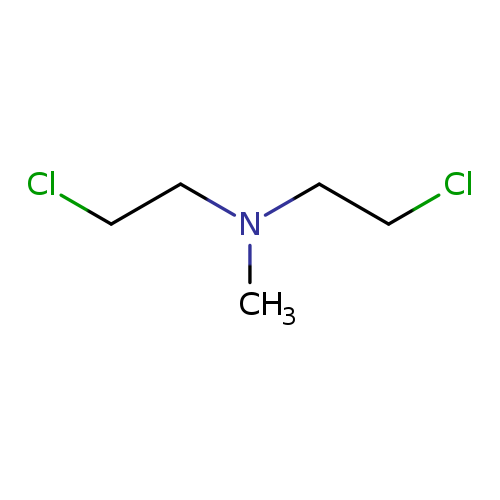
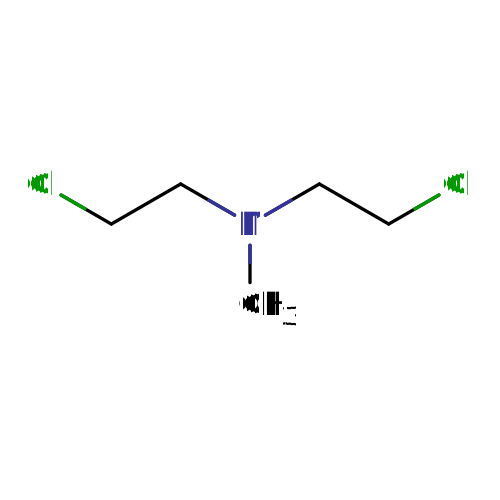
Chemical Structure
Thumb
Synonyms
ValueSource
2,2'-Dichloro-N-methyldiethylamineChEBI
beta,Beta'-dichlorodiethyl-N-methylamineChEBI
Bis(2-chloroethyl)methylamineChEBI
Bis(beta-chloroethyl)methylamineChEBI
ChlormethineChEBI
Methylbis(2-chloroethyl)amineChEBI
Methylbis(beta-chloroethyl)amineChEBI
N-Methyl-bis(2-chloroethyl)amineChEBI
N-Methyl-bis(beta-chloroethyl)amineChEBI
Nitrogen mustardChEBI
b,Beta'-dichlorodiethyl-N-methylamineGenerator
Β,beta'-dichlorodiethyl-N-methylamineGenerator
Bis(b-chloroethyl)methylamineGenerator
Bis(β-chloroethyl)methylamineGenerator
Methylbis(b-chloroethyl)amineGenerator
Methylbis(β-chloroethyl)amineGenerator
N-Methyl-bis(b-chloroethyl)amineGenerator
N-Methyl-bis(β-chloroethyl)amineGenerator
ChlorethazineHMDB
HN2HMDB
MBAHMDB
MechloroethamineHMDB
MecloretaminaHMDB
MustineHMDB
Mechlorethamine hydrochloride N oxideHMDB
Mechlorethamine hydrochloride N-oxideHMDB
Merck frosst brand OF mechlorethamine hydrochlorideHMDB
NSC-762HMDB
EmbichinHMDB
Hydrochloride N-oxide, mechlorethamineHMDB
Mechlorethamine N oxideHMDB
Mechlorethamine oxideHMDB
Merck brand OF mechlorethamine hydrochlorideHMDB
MitomenHMDB
Nitrogen mustard N oxideHMDB
CaryolysineHMDB
CloraminHMDB
Hydrochloride, mechlorethamineHMDB
MethylchlorethamineHMDB
N-Oxide, mechlorethamine hydrochlorideHMDB
N-Oxide, nitrogen mustardHMDB
Nitrogen mustard N-oxideHMDB
NitrogranulogenHMDB
NitrominHMDB
Mechlorethamine hydrochlorideHMDB
Mechlorethamine N-oxideHMDB
MustargenHMDB
NSC 762HMDB
Chemical FormulaC5H11Cl2N
Average Molecular Mass156.054 g/mol
Monoisotopic Mass155.027 g/mol
CAS Registry Number51-75-2
IUPAC Namebis(2-chloroethyl)(methyl)amine
Traditional Namemechlorethamine
SMILESCN(CCCl)CCCl
InChI IdentifierInChI=1S/C5H11Cl2N/c1-8(4-2-6)5-3-7/h2-5H2,1H3
InChI KeyHAWPXGHAZFHHAD-UHFFFAOYSA-N
Chemical Taxonomy
Description belongs to the class of organic compounds known as nitrogen mustard compounds. Nitrogen mustard compounds are compounds having two beta-haloalkyl groups bound to a nitrogen atom.
KingdomOrganic compounds
Super ClassOrganic nitrogen compounds
ClassOrganonitrogen compounds
Sub ClassNitrogen mustard compounds
Direct ParentNitrogen mustard compounds
Alternative Parents
Substituents
  • Nitrogen mustard
  • Tertiary aliphatic amine
  • Tertiary amine
  • Organopnictogen compound
  • Hydrocarbon derivative
  • Organochloride
  • Organohalogen compound
  • Amine
  • Alkyl halide
  • Alkyl chloride
  • Aliphatic acyclic compound
Molecular FrameworkAliphatic acyclic compounds
External Descriptors
Biological Properties
StatusDetected and Not Quantified
OriginExogenous
Cellular Locations
  • Cytoplasm
  • Extracellular
Biofluid LocationsNot Available
Tissue LocationsNot Available
PathwaysNot Available
ApplicationsNot Available
Biological Roles
Chemical RolesNot Available
Physical Properties
StateSolid
AppearanceWhite powder.
Experimental Properties
PropertyValue
Melting Point108 - 110°C
Boiling Point87°C at 1.80E+01 mm Hg
SolubilityVery soluble
Predicted Properties
PropertyValueSource
Water Solubility33.4 g/LALOGPS
logP1.31ALOGPS
logP1.52ChemAxon
logS-0.67ALOGPS
pKa (Strongest Basic)6.08ChemAxon
Physiological Charge0ChemAxon
Hydrogen Acceptor Count1ChemAxon
Hydrogen Donor Count0ChemAxon
Polar Surface Area3.24 ŲChemAxon
Rotatable Bond Count4ChemAxon
Refractivity38.67 m³·mol⁻¹ChemAxon
Polarizability15.84 ųChemAxon
Number of Rings0ChemAxon
Bioavailability1ChemAxon
Rule of FiveYesChemAxon
Ghose FilterNoChemAxon
Veber's RuleYesChemAxon
MDDR-like RuleNoChemAxon
Spectra
Spectra
Spectrum TypeDescriptionSplash KeyView
Predicted GC-MSPredicted GC-MS Spectrum - GC-MS (Non-derivatized) - 70eV, Positivesplash10-0a4l-9400000000-37f4081d8c3fd8e974c6Spectrum
Predicted GC-MSPredicted GC-MS Spectrum - GC-MS (Non-derivatized) - 70eV, PositiveNot AvailableSpectrum
Predicted LC-MS/MSPredicted LC-MS/MS Spectrum - 10V, Positivesplash10-0a4i-0900000000-2282bef263bfa8a41123Spectrum
Predicted LC-MS/MSPredicted LC-MS/MS Spectrum - 20V, Positivesplash10-0a4i-7900000000-b0b770790e86670fc2a5Spectrum
Predicted LC-MS/MSPredicted LC-MS/MS Spectrum - 40V, Positivesplash10-03di-9000000000-5d96975a96ed8783c02eSpectrum
Predicted LC-MS/MSPredicted LC-MS/MS Spectrum - 10V, Negativesplash10-0udi-1900000000-7801c92cb7dc490c200dSpectrum
Predicted LC-MS/MSPredicted LC-MS/MS Spectrum - 20V, Negativesplash10-0uxr-4900000000-0df7677828ba3d2293adSpectrum
Predicted LC-MS/MSPredicted LC-MS/MS Spectrum - 40V, Negativesplash10-08i3-9100000000-67d0e475a21ed8a44dcaSpectrum
Predicted LC-MS/MSPredicted LC-MS/MS Spectrum - 10V, Positivesplash10-0a4i-0900000000-b39c5053cfb605f67e08Spectrum
Predicted LC-MS/MSPredicted LC-MS/MS Spectrum - 20V, Positivesplash10-08fr-9400000000-9836caddbb3ebb21e8bbSpectrum
Predicted LC-MS/MSPredicted LC-MS/MS Spectrum - 40V, Positivesplash10-03di-9000000000-dcc5bf7c33b77979d5a5Spectrum
Predicted LC-MS/MSPredicted LC-MS/MS Spectrum - 10V, Negativesplash10-0ue9-8900000000-60357d33a598f0fa346fSpectrum
Predicted LC-MS/MSPredicted LC-MS/MS Spectrum - 20V, Negativesplash10-001i-9000000000-c2fa753da65a4bac80a1Spectrum
Predicted LC-MS/MSPredicted LC-MS/MS Spectrum - 40V, Negativesplash10-001i-9000000000-c2fa753da65a4bac80a1Spectrum
MSMass Spectrum (Electron Ionization)splash10-0a4i-7900000000-66a0ef3007bd03bd9367Spectrum
1D NMR1H NMR SpectrumNot AvailableSpectrum
1D NMR13C NMR SpectrumNot AvailableSpectrum
1D NMR1H NMR SpectrumNot AvailableSpectrum
1D NMR13C NMR SpectrumNot AvailableSpectrum
1D NMR1H NMR SpectrumNot AvailableSpectrum
1D NMR13C NMR SpectrumNot AvailableSpectrum
1D NMR1H NMR SpectrumNot AvailableSpectrum
1D NMR13C NMR SpectrumNot AvailableSpectrum
1D NMR1H NMR SpectrumNot AvailableSpectrum
1D NMR13C NMR SpectrumNot AvailableSpectrum
1D NMR1H NMR SpectrumNot AvailableSpectrum
1D NMR13C NMR SpectrumNot AvailableSpectrum
1D NMR1H NMR SpectrumNot AvailableSpectrum
1D NMR13C NMR SpectrumNot AvailableSpectrum
1D NMR1H NMR SpectrumNot AvailableSpectrum
1D NMR13C NMR SpectrumNot AvailableSpectrum
1D NMR1H NMR SpectrumNot AvailableSpectrum
1D NMR13C NMR SpectrumNot AvailableSpectrum
1D NMR1H NMR SpectrumNot AvailableSpectrum
1D NMR13C NMR SpectrumNot AvailableSpectrum
Toxicity Profile
Route of ExposurePartially absorbed following intracavitary administration, most likely due to rapid deactivation by body fluids. When it is topically administered, systemic exposure was undetectable.
Mechanism of ToxicityAlkylating agents work by three different mechanisms: 1) attachment of alkyl groups to DNA bases, resulting in the DNA being fragmented by repair enzymes in their attempts to replace the alkylated bases, preventing DNA synthesis and RNA transcription from the affected DNA, 2) DNA damage via the formation of cross-links (bonds between atoms in the DNA) which prevents DNA from being separated for synthesis or transcription, and 3) the induction of mispairing of the nucleotides leading to mutations. Mechlorethamine is cell cycle phase-nonspecific.
MetabolismUndergoes rapid chemical transformation and combines with water or reactive compounds of cells, so that the drug is no longer present in active form a few minutes after administration. Half Life: 15 minutes
Toxicity ValuesThe oral LD50 for a rat is 10 mg/kg.
Lethal DoseNot Available
Carcinogenicity (IARC Classification)Chlormethine is probably carcinogenic to humans (Group 2A). Chlormethine is part of MOPP, a combination chemotherapy regimen that is carcinogenic to humans (Group 1). (1)
Uses/SourcesFor the palliative treatment of Hodgkin's disease (Stages III and IV), lymphosarcoma, chronic myelocytic or chronic lymphocytic leukemia, polycythemia vera, mycosis fungoides, and bronchogenic carcinoma. Also for the palliative treatment of metastatic carcinoma resulting in effusion.
Minimum Risk LevelNot Available
Health EffectsNot Available
SymptomsNot Available
TreatmentNot Available
Concentrations
Not Available
DrugBank IDDB00888
HMDB IDHMDB0015025
FooDB IDNot Available
Phenol Explorer IDNot Available
KNApSAcK IDNot Available
BiGG IDNot Available
BioCyc IDNot Available
METLIN IDNot Available
PDB IDNot Available
Wikipedia LinkMechlorethamine
Chemspider ID3893
ChEBI ID28925
PubChem Compound ID4033
Kegg Compound IDC07115
YMDB IDNot Available
ECMDB IDNot Available
References
Synthesis Reference

Paul Siedlecki, “Preparation of nitrogen mustard derivatives.” U.S. Patent US20030162990, issued August 28, 2003.

MSDSLink
General ReferencesNot Available