Record Information
Version1.0
Creation Date2014-08-29 06:11:23 UTC
Update Date2026-04-02 23:56:01 UTC
Accession NumberCHEM003231
Identification
Common NameGamma-Glutamylcysteine
ClassSmall Molecule
DescriptionG-Glutamylcysteine is a product of enzyme glutamate-cysteine ligase [EC 6.3.2.2] and a substrate of enzyme glutathione synthase [EC 6.3.2.3] in glutamate metabolism pathway (KEGG).
Contaminant Sources
  • FooDB Chemicals
  • HMDB Contaminants - Urine
  • T3DB toxins
Contaminant Type
  • Amine
  • Animal Toxin
  • Food Toxin
  • Metabolite
  • Natural Compound
  • Organic Compound
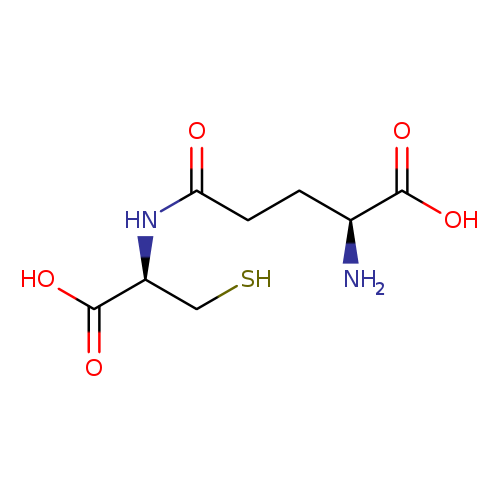
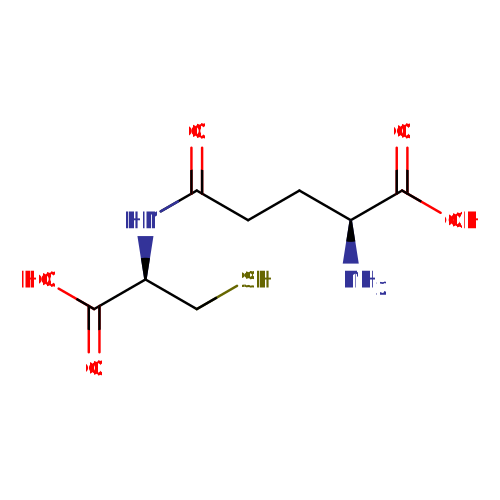
Chemical Structure
Thumb
Synonyms
ValueSource
5-L-Glutamyl-L-cysteineChEBI
gamma-Glu-cysChEBI
gamma-L-Glutamyl-L-cysteineChEBI
L-gamma-GlutamylcysteineChEBI
g-Glu-cysGenerator
Γ-glu-cysGenerator
g-L-Glutamyl-L-cysteineGenerator
Γ-L-glutamyl-L-cysteineGenerator
L-g-GlutamylcysteineGenerator
L-Γ-glutamylcysteineGenerator
g-GlutamylcysteineGenerator
Γ-glutamylcysteineGenerator
Γ-L-glu-L-cysHMDB
L-Γ-glutamyl-L-cysteineHMDB
N-Γ-glutamylcysteineHMDB
N-L-Γ-glutamylcysteineHMDB
N-L-Γ-glutamyl-L-cysteineHMDB
gamma-L-Glu-L-cysHMDB
L-gamma-Glutamyl-L-cysteineHMDB
N-gamma-GlutamylcysteineHMDB
N-L-gamma-GlutamylcysteineHMDB
N-L-gamma-Glutamyl-L-cysteineHMDB
5-L-GlutamylcysteineHMDB
H-gamma-Glu-cys-OHHMDB
L-g-Glutamyl-L-cysteineHMDB
N-Γ-L-glutamyl-L-cysteineHMDB
gamma-GlutamylcysteineHMDB
Chemical FormulaC8H14N2O5S
Average Molecular Mass250.272 g/mol
Monoisotopic Mass250.062 g/mol
CAS Registry Number636-58-8
IUPAC Name(2S)-2-amino-4-{[(1R)-1-carboxy-2-sulfanylethyl]carbamoyl}butanoic acid
Traditional Namegamma-glutamylcysteine
SMILESN[C@@H](CCC(=O)N[C@@H](CS)C(O)=O)C(O)=O
InChI IdentifierInChI=1S/C8H14N2O5S/c9-4(7(12)13)1-2-6(11)10-5(3-16)8(14)15/h4-5,16H,1-3,9H2,(H,10,11)(H,12,13)(H,14,15)/t4-,5-/m0/s1
InChI KeyRITKHVBHSGLULN-WHFBIAKZSA-N
Chemical Taxonomy
Description belongs to the class of organic compounds known as n-acyl-alpha amino acids. N-acyl-alpha amino acids are compounds containing an alpha amino acid which bears an acyl group at its terminal nitrogen atom.
KingdomOrganic compounds
Super ClassOrganic acids and derivatives
ClassCarboxylic acids and derivatives
Sub ClassAmino acids, peptides, and analogues
Direct ParentN-acyl-alpha amino acids
Alternative Parents
Substituents
  • N-acyl-alpha-amino acid
  • Cysteine or derivatives
  • Alpha-amino acid
  • L-alpha-amino acid
  • Fatty acid
  • Dicarboxylic acid or derivatives
  • Amino acid
  • Alkylthiol
  • Carboximidic acid
  • Carboximidic acid derivative
  • Carboxylic acid
  • Organic 1,3-dipolar compound
  • Propargyl-type 1,3-dipolar organic compound
  • Organic nitrogen compound
  • Organooxygen compound
  • Organonitrogen compound
  • Organosulfur compound
  • Primary aliphatic amine
  • Primary amine
  • Hydrocarbon derivative
  • Organic oxide
  • Organopnictogen compound
  • Carbonyl group
  • Amine
  • Organic oxygen compound
  • Aliphatic acyclic compound
Molecular FrameworkAliphatic acyclic compounds
External Descriptors
Biological Properties
StatusDetected and Not Quantified
OriginEndogenous
Cellular Locations
  • Cytoplasm
  • Membrane
Biofluid LocationsNot Available
Tissue Locations
  • Fibroblasts
  • Neuron
  • Prostate
Pathways
NameSMPDB LinkKEGG Link
Cysteine MetabolismSMP00013 map00270
Glutamate MetabolismSMP00072 map00250
Glutathione MetabolismSMP00015 map00480
5-OxoprolinuriaSMP00143 Not Available
Gamma-glutamyl-transpeptidase deficiencySMP00501 Not Available
Gamma-Glutamyltransferase DeficiencySMP00183 Not Available
Glutathione Synthetase DeficiencySMP00337 Not Available
ApplicationsNot Available
Biological Roles
Chemical RolesNot Available
Physical Properties
StateSolid
AppearanceWhite powder.
Experimental Properties
PropertyValue
Melting PointNot Available
Boiling PointNot Available
SolubilityNot Available
Predicted Properties
PropertyValueSource
Water Solubility2.62 g/LALOGPS
logP-2.5ALOGPS
logP-3.8ChemAxon
logS-2ALOGPS
pKa (Strongest Acidic)1.91ChemAxon
pKa (Strongest Basic)9.24ChemAxon
Physiological Charge-1ChemAxon
Hydrogen Acceptor Count6ChemAxon
Hydrogen Donor Count5ChemAxon
Polar Surface Area129.72 ŲChemAxon
Rotatable Bond Count7ChemAxon
Refractivity56.31 m³·mol⁻¹ChemAxon
Polarizability23.36 ųChemAxon
Number of Rings0ChemAxon
Bioavailability1ChemAxon
Rule of FiveYesChemAxon
Ghose FilterNoChemAxon
Veber's RuleNoChemAxon
MDDR-like RuleNoChemAxon
Spectra
Spectra
Spectrum TypeDescriptionSplash KeyView
GC-MSGC-MS Spectrum - GC-EI-TOF (Pegasus III TOF-MS system, Leco; GC 6890, Agilent Technologies) (Non-derivatized)splash10-054t-1920100000-5ce9a082971db6d9e2e9Spectrum
GC-MSGC-MS Spectrum - GC-EI-TOF (Non-derivatized)splash10-054t-1920100000-5ce9a082971db6d9e2e9Spectrum
Predicted GC-MSPredicted GC-MS Spectrum - GC-MS (Non-derivatized) - 70eV, Positivesplash10-053u-9630000000-344be03dbe2132b00c88Spectrum
Predicted GC-MSPredicted GC-MS Spectrum - GC-MS (2 TMS) - 70eV, Positivesplash10-00b9-8494000000-88b1eea1e1badaee084bSpectrum
Predicted GC-MSPredicted GC-MS Spectrum - GC-MS (Non-derivatized) - 70eV, PositiveNot AvailableSpectrum
LC-MS/MSLC-MS/MS Spectrum - Quattro_QQQ 10V, Positive (Annotated)splash10-0udi-0090000000-50bd1555ededc1afde80Spectrum
LC-MS/MSLC-MS/MS Spectrum - Quattro_QQQ 25V, Positive (Annotated)splash10-0udi-0290000000-385ca433f03af7530f47Spectrum
LC-MS/MSLC-MS/MS Spectrum - Quattro_QQQ 40V, Positive (Annotated)splash10-0ue9-5490000000-95d45a9cd2bb6249d3a2Spectrum
LC-MS/MSLC-MS/MS Spectrum - LC-ESI-QTOF (UPLC Q-Tof Premier, Waters) , Positivesplash10-001i-9510000000-5f29ca903abe05256c83Spectrum
LC-MS/MSLC-MS/MS Spectrum - LC-ESI-QTOF , positivesplash10-001i-9510000000-5f29ca903abe05256c83Spectrum
LC-MS/MSLC-MS/MS Spectrum - 20V, Negativesplash10-0002-1490000000-bfce673369358b8079e9Spectrum
LC-MS/MSLC-MS/MS Spectrum - 10V, Negativesplash10-0002-0690000000-c49357f0d28683125b6dSpectrum
LC-MS/MSLC-MS/MS Spectrum - 30V, Negativesplash10-002b-2490000000-41c54aabf6acd4d3b53eSpectrum
LC-MS/MSLC-MS/MS Spectrum - 40V, Negativesplash10-014j-9050000000-1137fb3c62232376669cSpectrum
Predicted LC-MS/MSPredicted LC-MS/MS Spectrum - 10V, Positivesplash10-05fr-1790000000-2aaa1344429a2297cc6bSpectrum
Predicted LC-MS/MSPredicted LC-MS/MS Spectrum - 20V, Positivesplash10-00di-4920000000-4ad42780853d5599c05bSpectrum
Predicted LC-MS/MSPredicted LC-MS/MS Spectrum - 40V, Positivesplash10-05fr-9400000000-b67fd0eaf646aa8f47b3Spectrum
Predicted LC-MS/MSPredicted LC-MS/MS Spectrum - 10V, Negativesplash10-000t-1390000000-e723899e4ca71bda7600Spectrum
Predicted LC-MS/MSPredicted LC-MS/MS Spectrum - 20V, Negativesplash10-00sj-3960000000-9a2f96ad7d24e7546315Spectrum
Predicted LC-MS/MSPredicted LC-MS/MS Spectrum - 40V, Negativesplash10-00e9-9300000000-e14b428bbb5b63d3ae06Spectrum
Predicted LC-MS/MSPredicted LC-MS/MS Spectrum - 10V, Negativesplash10-00b9-0910000000-302a05e4e453b27bad64Spectrum
Predicted LC-MS/MSPredicted LC-MS/MS Spectrum - 20V, Negativesplash10-004j-3900000000-da869ba294aa1d1e7c49Spectrum
Predicted LC-MS/MSPredicted LC-MS/MS Spectrum - 40V, Negativesplash10-000x-9100000000-4bc7ff3637ea175068f0Spectrum
Predicted LC-MS/MSPredicted LC-MS/MS Spectrum - 10V, Positivesplash10-0zmi-0960000000-675f718188f5caad73abSpectrum
Predicted LC-MS/MSPredicted LC-MS/MS Spectrum - 20V, Positivesplash10-001i-9600000000-13ddc5ab8de093dd11abSpectrum
Predicted LC-MS/MSPredicted LC-MS/MS Spectrum - 40V, Positivesplash10-001i-9100000000-8b8a5550fa1112649784Spectrum
1D NMR1H NMR SpectrumNot AvailableSpectrum
1D NMR13C NMR SpectrumNot AvailableSpectrum
1D NMR1H NMR SpectrumNot AvailableSpectrum
1D NMR13C NMR SpectrumNot AvailableSpectrum
1D NMR1H NMR SpectrumNot AvailableSpectrum
1D NMR13C NMR SpectrumNot AvailableSpectrum
1D NMR1H NMR SpectrumNot AvailableSpectrum
1D NMR13C NMR SpectrumNot AvailableSpectrum
1D NMR1H NMR SpectrumNot AvailableSpectrum
1D NMR13C NMR SpectrumNot AvailableSpectrum
1D NMR1H NMR SpectrumNot AvailableSpectrum
1D NMR13C NMR SpectrumNot AvailableSpectrum
1D NMR1H NMR SpectrumNot AvailableSpectrum
1D NMR13C NMR SpectrumNot AvailableSpectrum
1D NMR1H NMR SpectrumNot AvailableSpectrum
1D NMR13C NMR SpectrumNot AvailableSpectrum
1D NMR1H NMR SpectrumNot AvailableSpectrum
1D NMR13C NMR SpectrumNot AvailableSpectrum
1D NMR1H NMR SpectrumNot AvailableSpectrum
1D NMR13C NMR SpectrumNot AvailableSpectrum
1D NMR1H NMR SpectrumNot AvailableSpectrum
2D NMR[1H,13C] 2D NMR SpectrumNot AvailableSpectrum
Toxicity Profile
Route of ExposureNot Available
Mechanism of ToxicityNot Available
MetabolismNot Available
Toxicity ValuesNot Available
Lethal DoseNot Available
Carcinogenicity (IARC Classification)No indication of carcinogenicity to humans (not listed by IARC).
Uses/SourcesThis is an endogenously produced metabolite found in the human body. It is used in metabolic reactions, catabolic reactions or waste generation.
Minimum Risk LevelNot Available
Health EffectsNot Available
SymptomsNot Available
TreatmentNot Available
Concentrations
Not Available
DrugBank IDDB03408
HMDB IDHMDB0001049
FooDB IDFDB003603
Phenol Explorer IDNot Available
KNApSAcK IDC00007507
BiGG ID35655
BioCyc IDL-GAMMA-GLUTAMYLCYSTEINE
METLIN ID5966
PDB IDNot Available
Wikipedia LinkGamma-Glutamylcysteine
Chemspider ID110467
ChEBI ID17515
PubChem Compound ID123938
Kegg Compound IDC00669
YMDB IDYMDB00252
ECMDB IDECMDB01049
References
Synthesis Reference

Hiroaki Nishiuchi, “Method for producing gamma-glutamylcysteine.” U.S. Patent US20030124684, issued July 03, 2003.

MSDSLink
General References
1. Bridge, Wallace John; Zarka, Martin Hani. Enzymic production of g-glutamylcysteine. PCT Int. Appl. (2006), 76pp.
2. Atamna H, Ginsburg H: The malaria parasite supplies glutathione to its host cell--investigation of glutathione transport and metabolism in human erythrocytes infected with Plasmodium falciparum. Eur J Biochem. 1997 Dec 15;250(3):670-9.
3. Efferth T, Volm M: Glutathione-related enzymes contribute to resistance of tumor cells and low toxicity in normal organs to artesunate. In Vivo. 2005 Jan-Feb;19(1):225-32.
4. Lochman P, Adam T, Friedecky D, Hlidkova E, Skopkova Z: High-throughput capillary electrophoretic method for determination of total aminothiols in plasma and urine. Electrophoresis. 2003 Apr;24(7-8):1200-7.
5. Martensson J: Method for determination of free and total glutathione and gamma-glutamylcysteine concentrations in human leukocytes and plasma. J Chromatogr. 1987 Sep 4;420(1):152-7.
6. Andersson A, Isaksson A, Hultberg B: Homocysteine export from erythrocytes and its implication for plasma sampling. Clin Chem. 1992 Jul;38(7):1311-5.
7. Kaarteenaho-Wiik R, Kinnula VL: Distribution of antioxidant enzymes in developing human lung, respiratory distress syndrome, and bronchopulmonary dysplasia. J Histochem Cytochem. 2004 Sep;52(9):1231-40.
8. Iida M, Yasuhara T, Mochizuki H, Takakura H, Yanagisawa T, Kubo H: Two Japanese brothers with hereditary gamma-glutamyl transpeptidase deficiency. J Inherit Metab Dis. 2005;28(1):49-55.
9. Andersson A, Isaksson A, Brattstrom L, Hultberg B: Homocysteine and other thiols determined in plasma by HPLC and thiol-specific postcolumn derivatization. Clin Chem. 1993 Aug;39(8):1590-7.
10. Diaz-Hernandez JI, Almeida A, Delgado-Esteban M, Fernandez E, Bolanos JP: Knockdown of glutamate-cysteine ligase by small hairpin RNA reveals that both catalytic and modulatory subunits are essential for the survival of primary neurons. J Biol Chem. 2005 Nov 25;280(47):38992-9001. Epub 2005 Sep 23.
11. Levonen AL, Lapatto R, Saksela M, Raivio KO: Expression of gamma-glutamylcysteine synthetase during development. Pediatr Res. 2000 Feb;47(2):266-70.
12. Martensson J, Kagedal B, Larsson A: Sulphur amino-acid degradation in subjects with hereditary glutathione synthetase deficiency (5-oxoprolinuria). Eur J Clin Invest. 1985 Dec;15(6):371-4.
13. Zinellu A, Sotgia S, Posadino AM, Pasciu V, Perino MG, Tadolini B, Deiana L, Carru C: Highly sensitive simultaneous detection of cultured cellular thiols by laser induced fluorescence-capillary electrophoresis. Electrophoresis. 2005 Mar;26(6):1063-70.
14. Njalsson R, Ristoff E, Carlsson K, Winkler A, Larsson A, Norgren S: Genotype, enzyme activity, glutathione level, and clinical phenotype in patients with glutathione synthetase deficiency. Hum Genet. 2005 Apr;116(5):384-9. Epub 2005 Feb 17.
15. Lou MF, Dickerson JE Jr, Tung WH, Wolfe JK, Chylack LT Jr: Correlation of nuclear color and opalescence with protein S-thiolation in human lenses. Exp Eye Res. 1999 May;68(5):547-52.
16. Sreekumar A, Poisson LM, Rajendiran TM, Khan AP, Cao Q, Yu J, Laxman B, Mehra R, Lonigro RJ, Li Y, Nyati MK, Ahsan A, Kalyana-Sundaram S, Han B, Cao X, Byun J, Omenn GS, Ghosh D, Pennathur S, Alexander DC, Berger A, Shuster JR, Wei JT, Varambally S, Beecher C, Chinnaiyan AM: Metabolomic profiles delineate potential role for sarcosine in prostate cancer progression. Nature. 2009 Feb 12;457(7231):910-4. doi: 10.1038/nature07762.
17. Elshenawy S, Pinney SE, Stuart T, Doulias PT, Zura G, Parry S, Elovitz MA, Bennett MJ, Bansal A, Strauss JF 3rd, Ischiropoulos H, Simmons RA: The Metabolomic Signature of the Placenta in Spontaneous Preterm Birth. Int J Mol Sci. 2020 Feb 4;21(3). pii: ijms21031043. doi: 10.3390/ijms21031043.
18. https://www.ncbi.nlm.nih.gov/pubmed/?term=11409324