Record Information
Version1.0
Creation Date2014-08-29 06:12:10 UTC
Update Date2026-05-14 16:24:27 UTC
Accession NumberCHEM003236
Identification
Common NameAdenosine triphosphate
ClassSmall Molecule
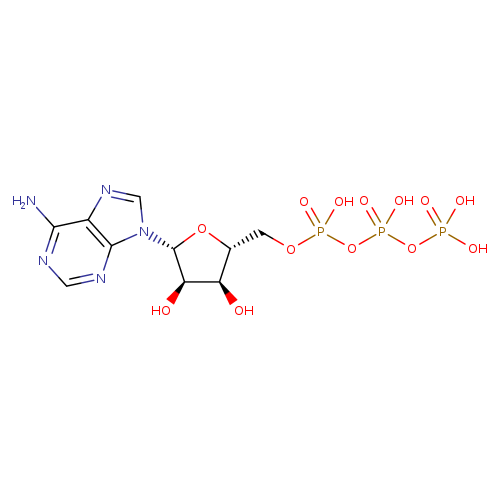
DescriptionAdenosine triphosphate (ATP) is a nucleotide consisting of a purine base (adenine) attached to the first carbon atom of ribose (a pentose sugar). Three phosphate groups are esterified at the fifth carbon atom of the ribose. ATP is incorporated into nucleic acids by polymerases in the processes of DNA replication and transcription. ATP contributes to cellular energy charge and participates in overall energy balance, maintaining cellular homeostasis. ATP can act as an extracellular signaling molecule via interactions with specific purinergic receptors to mediate a wide variety of processes as diverse as neurotransmission, inflammation, apoptosis, and bone remodelling. Extracellular ATP and its metabolite adenosine have also been shown to exert a variety of effects on nearly every cell type in human skin, and ATP seems to play a direct role in triggering skin inflammatory, regenerative, and fibrotic responses to mechanical injury, an indirect role in melanocyte proliferation and apoptosis, and a complex role in Langerhans cell-directed adaptive immunity. During exercise, intracellular homeostasis depends on the matching of adenosine triphosphate (ATP) supply and ATP demand. Metabolites play a useful role in communicating the extent of ATP demand to the metabolic supply pathways. Effects as different as proliferation or differentiation, chemotaxis, release of cytokines or lysosomal constituents, and generation of reactive oxygen or nitrogen species are elicited upon stimulation of blood cells with extracellular ATP. The increased concentration of adenosine triphosphate (ATP) in erythrocytes from patients with chronic renal failure (CRF) has been observed in many studies but the mechanism leading to these abnormalities still is controversial. (1, 2, 3, 4, 5).
Contaminant Sources
  • FooDB Chemicals
  • T3DB toxins
  • ToxCast & Tox21 Chemicals
Contaminant Type
  • Amine
  • Animal Toxin
  • Dietary Supplement
  • Drug
  • Ether
  • Food Toxin
  • Metabolite
  • Micronutrient
  • Natural Compound
  • Nutraceutical
  • Organic Compound
  • Supplement
Chemical Structure
Thumb
Synonyms
ValueSource
Adenosine 5'-triphosphateChEBI
Adenosine-5'-triphosphateChEBI
AdephosChEBI
AdetolChEBI
AdynolChEBI
AtipiChEBI
AtriphosChEBI
CardenosineChEBI
FosfobionChEBI
GlucobasinChEBI
H4ATPChEBI
MyotriphosChEBI
TriadenylChEBI
TriphosphadenChEBI
Adenosine 5'-triphosphoric acidGenerator
Adenosine triphosphoric acidGenerator
ADENOSINE-5'-triphosphoric acidGenerator
5'-(Tetrahydrogen triphosphate) adenosineHMDB
5'-ATPHMDB
Adenosine 5'-triphosphorateHMDB
AdenylpyrophosphorateHMDB
Adenylpyrophosphoric acidHMDB
ATPHMDB, KEGG
PhosphobionHMDB
StriadyneHMDB, MeSH
Triphosphoric acid adenosine esterHMDB
AdenylpyrophosphateMeSH, HMDB
5’-ATPHMDB
Adenosine 5’-triphosphateHMDB
Adenosine 5’-triphosphoric acidHMDB
Adenosine triphosphateHMDB
Adenosine-5’-triphosphateHMDB
Chemical FormulaC10H16N5O13P3
Average Molecular Mass507.181 g/mol
Monoisotopic Mass506.996 g/mol
CAS Registry Number56-65-5
IUPAC Name({[({[(2R,3S,4R,5R)-5-(6-amino-9H-purin-9-yl)-3,4-dihydroxyoxolan-2-yl]methoxy}(hydroxy)phosphoryl)oxy](hydroxy)phosphoryl}oxy)phosphonic acid
Traditional Nameadenosine triphosphate
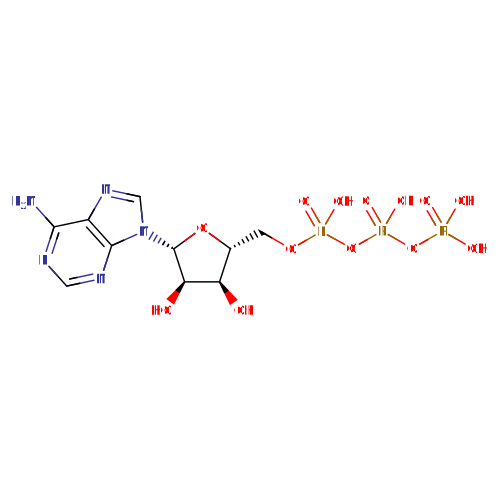
SMILESNC1=NC=NC2=C1N=CN2[C@@H]1O[C@H](COP(O)(=O)OP(O)(=O)OP(O)(O)=O)[C@@H](O)[C@H]1O
InChI IdentifierInChI=1S/C10H16N5O13P3/c11-8-5-9(13-2-12-8)15(3-14-5)10-7(17)6(16)4(26-10)1-25-30(21,22)28-31(23,24)27-29(18,19)20/h2-4,6-7,10,16-17H,1H2,(H,21,22)(H,23,24)(H2,11,12,13)(H2,18,19,20)/t4-,6-,7-,10-/m1/s1
InChI KeyZKHQWZAMYRWXGA-KQYNXXCUSA-N
Chemical Taxonomy
Description belongs to the class of organic compounds known as purine ribonucleoside triphosphates. These are purine ribobucleotides with a triphosphate group linked to the ribose moiety.
KingdomOrganic compounds
Super ClassNucleosides, nucleotides, and analogues
ClassPurine nucleotides
Sub ClassPurine ribonucleotides
Direct ParentPurine ribonucleoside triphosphates
Alternative Parents
Substituents
  • Purine ribonucleoside triphosphate
  • Purine ribonucleoside monophosphate
  • Pentose phosphate
  • Pentose-5-phosphate
  • Glycosyl compound
  • N-glycosyl compound
  • 6-aminopurine
  • Monosaccharide phosphate
  • Pentose monosaccharide
  • Imidazopyrimidine
  • Purine
  • Aminopyrimidine
  • Monoalkyl phosphate
  • Monosaccharide
  • N-substituted imidazole
  • Organic phosphoric acid derivative
  • Phosphoric acid ester
  • Imidolactam
  • Alkyl phosphate
  • Pyrimidine
  • Azole
  • Tetrahydrofuran
  • Imidazole
  • Heteroaromatic compound
  • Secondary alcohol
  • 1,2-diol
  • Organoheterocyclic compound
  • Azacycle
  • Oxacycle
  • Organooxygen compound
  • Hydrocarbon derivative
  • Organic nitrogen compound
  • Organic oxide
  • Organopnictogen compound
  • Amine
  • Primary amine
  • Organic oxygen compound
  • Alcohol
  • Organonitrogen compound
  • Aromatic heteropolycyclic compound
Molecular FrameworkAromatic heteropolycyclic compounds
External Descriptors
Biological Properties
StatusDetected and Not Quantified
OriginEndogenous
Cellular Locations
  • Cytoplasm
  • Endoplasmic reticulum
  • Extracellular
  • Membrane
  • Mitochondria
  • Nucleus
  • Peroxisome
Biofluid LocationsNot Available
Tissue Locations
  • Adipose Tissue
  • Bladder
  • Fibroblasts
  • Intestine
  • Kidney
  • Muscle
  • Myelin
  • Nerve Cells
  • Neuron
  • Pancreas
  • Platelet
  • Skeletal Muscle
Pathways
NameSMPDB LinkKEGG Link
Amino Sugar MetabolismSMP00045 map00520
Ammonia RecyclingSMP00009 map00910
Citric Acid CycleSMP00057 map00020
DNA Replication ForkSMP00477 Not Available
Ethanol DegradationSMP00449 Not Available
Folate MetabolismSMP00053 map00670
GluconeogenesisSMP00128 Not Available
Glycerolipid MetabolismSMP00039 map00561
Glycine and Serine MetabolismSMP00004 map00260
GlycolysisSMP00040 Not Available
Histidine MetabolismSMP00044 map00340
Inositol Phosphate MetabolismSMP00462 map00562
Lactose DegradationSMP00457 Not Available
Lactose SynthesisSMP00444 Not Available
Methionine MetabolismSMP00033 map00270
Mitochondrial Beta-Oxidation of Long Chain Saturated Fatty AcidsSMP00482 Not Available
Mitochondrial Beta-Oxidation of Medium Chain Saturated Fatty AcidsSMP00481 Not Available
Mitochondrial Beta-Oxidation of Short Chain Saturated Fatty AcidsSMP00480 Not Available
Mitochondrial Electron Transport ChainSMP00355 map00190
Phosphatidylinositol Phosphate MetabolismSMP00463 map00562
Phytanic Acid Peroxisomal OxidationSMP00450 Not Available
Purine MetabolismSMP00050 map00230
Spermidine and Spermine BiosynthesisSMP00445 Not Available
Threonine and 2-Oxobutanoate DegradationSMP00452 Not Available
Transcription/TranslationSMP00019 Not Available
Transfer of Acetyl Groups into MitochondriaSMP00466 Not Available
Trehalose DegradationSMP00467 Not Available
Urea CycleSMP00059 Not Available
Adenosine Deaminase DeficiencySMP00144 Not Available
Applications
Biological Roles
Chemical RolesNot Available
Physical Properties
StateSolid
AppearanceWhite powder.
Experimental Properties
PropertyValue
Melting Point176°C
Boiling PointNot Available
Solubility1E+006 mg/L
Predicted Properties
PropertyValueSource
Water Solubility4.49 g/LALOGPS
logP-0.84ALOGPS
logP-5.8ChemAxon
logS-2ALOGPS
pKa (Strongest Acidic)0.9ChemAxon
pKa (Strongest Basic)4.01ChemAxon
Physiological Charge-3ChemAxon
Hydrogen Acceptor Count14ChemAxon
Hydrogen Donor Count7ChemAxon
Polar Surface Area279.13 ŲChemAxon
Rotatable Bond Count8ChemAxon
Refractivity95.81 m³·mol⁻¹ChemAxon
Polarizability38.92 ųChemAxon
Number of Rings3ChemAxon
Bioavailability0ChemAxon
Rule of FiveNoChemAxon
Ghose FilterNoChemAxon
Veber's RuleNoChemAxon
MDDR-like RuleYesChemAxon
Spectra
Spectra
Spectrum TypeDescriptionSplash KeyView
Predicted GC-MSPredicted GC-MS Spectrum - GC-MS (Non-derivatized) - 70eV, Positivesplash10-004j-9785600000-9d385d54b8bf3d01c79aSpectrum
Predicted GC-MSPredicted GC-MS Spectrum - GC-MS (2 TMS) - 70eV, Positivesplash10-0f7a-2129514000-9059f6c87291f92b0cb5Spectrum
Predicted GC-MSPredicted GC-MS Spectrum - GC-MS (TMS_1_1) - 70eV, PositiveNot AvailableSpectrum
Predicted GC-MSPredicted GC-MS Spectrum - GC-MS (TMS_1_2) - 70eV, PositiveNot AvailableSpectrum
Predicted GC-MSPredicted GC-MS Spectrum - GC-MS (TMS_1_3) - 70eV, PositiveNot AvailableSpectrum
Predicted GC-MSPredicted GC-MS Spectrum - GC-MS (TMS_1_4) - 70eV, PositiveNot AvailableSpectrum
Predicted GC-MSPredicted GC-MS Spectrum - GC-MS (TMS_1_5) - 70eV, PositiveNot AvailableSpectrum
Predicted GC-MSPredicted GC-MS Spectrum - GC-MS (TMS_1_6) - 70eV, PositiveNot AvailableSpectrum
Predicted GC-MSPredicted GC-MS Spectrum - GC-MS (TMS_2_2) - 70eV, PositiveNot AvailableSpectrum
Predicted GC-MSPredicted GC-MS Spectrum - GC-MS (TMS_2_3) - 70eV, PositiveNot AvailableSpectrum
Predicted GC-MSPredicted GC-MS Spectrum - GC-MS (TMS_2_4) - 70eV, PositiveNot AvailableSpectrum
Predicted GC-MSPredicted GC-MS Spectrum - GC-MS (TMS_2_5) - 70eV, PositiveNot AvailableSpectrum
Predicted GC-MSPredicted GC-MS Spectrum - GC-MS (TMS_2_6) - 70eV, PositiveNot AvailableSpectrum
Predicted GC-MSPredicted GC-MS Spectrum - GC-MS (TMS_2_7) - 70eV, PositiveNot AvailableSpectrum
Predicted GC-MSPredicted GC-MS Spectrum - GC-MS (TMS_2_8) - 70eV, PositiveNot AvailableSpectrum
Predicted GC-MSPredicted GC-MS Spectrum - GC-MS (TMS_2_9) - 70eV, PositiveNot AvailableSpectrum
Predicted GC-MSPredicted GC-MS Spectrum - GC-MS (TMS_2_10) - 70eV, PositiveNot AvailableSpectrum
Predicted GC-MSPredicted GC-MS Spectrum - GC-MS (TMS_2_11) - 70eV, PositiveNot AvailableSpectrum
Predicted GC-MSPredicted GC-MS Spectrum - GC-MS (TMS_2_12) - 70eV, PositiveNot AvailableSpectrum
Predicted GC-MSPredicted GC-MS Spectrum - GC-MS (TMS_2_13) - 70eV, PositiveNot AvailableSpectrum
Predicted GC-MSPredicted GC-MS Spectrum - GC-MS (TMS_2_14) - 70eV, PositiveNot AvailableSpectrum
Predicted GC-MSPredicted GC-MS Spectrum - GC-MS (TMS_2_15) - 70eV, PositiveNot AvailableSpectrum
Predicted GC-MSPredicted GC-MS Spectrum - GC-MS (TMS_2_16) - 70eV, PositiveNot AvailableSpectrum
Predicted GC-MSPredicted GC-MS Spectrum - GC-MS (TMS_2_17) - 70eV, PositiveNot AvailableSpectrum
Predicted GC-MSPredicted GC-MS Spectrum - GC-MS (TBDMS_1_1) - 70eV, PositiveNot AvailableSpectrum
LC-MS/MSLC-MS/MS Spectrum - LC-ESI-ITFT (LTQ Orbitrap XL, Thermo Scientific ) , Negativesplash10-0a4i-0131190000-316dbdca27f38ad8ee57Spectrum
LC-MS/MSLC-MS/MS Spectrum - LC-ESI-ITFT (LTQ Orbitrap XL, Thermo Scientific ) , Negativesplash10-004i-0000900000-f5ffc4694dfd302fd52dSpectrum
LC-MS/MSLC-MS/MS Spectrum - LC-ESI-ITFT (LTQ Orbitrap XL, Thermo Scientific ) , Negativesplash10-0a4i-0000900000-e9a09b9360491c310280Spectrum
LC-MS/MSLC-MS/MS Spectrum - LC-ESI-ITFT , negativesplash10-004i-0000900000-f5ffc4694dfd302fd52dSpectrum
LC-MS/MSLC-MS/MS Spectrum - LC-ESI-ITFT , negativesplash10-0a4i-0000900000-e9a09b9360491c310280Spectrum
LC-MS/MSLC-MS/MS Spectrum - n/a 35V, positivesplash10-03di-0003900000-82c389314f7350fab875Spectrum
LC-MS/MSLC-MS/MS Spectrum - Orbitrap 14V, positivesplash10-0a4i-0100190000-922e5f751812c8bd89bcSpectrum
LC-MS/MSLC-MS/MS Spectrum - Orbitrap 20V, positivesplash10-000i-0901420000-44d898eb6218dc6e081fSpectrum
LC-MS/MSLC-MS/MS Spectrum - Orbitrap 30V, positivesplash10-000i-0900100000-b93a7d45ee103ceb59b6Spectrum
LC-MS/MSLC-MS/MS Spectrum - Orbitrap 40V, positivesplash10-000i-0900000000-296ded2a98ed98f22450Spectrum
LC-MS/MSLC-MS/MS Spectrum - Orbitrap 50V, positivesplash10-000i-0900000000-9349def51790b33b6323Spectrum
LC-MS/MSLC-MS/MS Spectrum - Orbitrap 66V, positivesplash10-000i-1900000000-049985fb880827a0d9a4Spectrum
LC-MS/MSLC-MS/MS Spectrum - Orbitrap 82V, positivesplash10-000i-1900000000-1d79fc72baa703a816cfSpectrum
LC-MS/MSLC-MS/MS Spectrum - Orbitrap 97V, positivesplash10-000i-2900000000-136ea397740616434de7Spectrum
LC-MS/MSLC-MS/MS Spectrum - Orbitrap 112V, positivesplash10-014r-4900000000-e53bae9d9851c94179c8Spectrum
LC-MS/MSLC-MS/MS Spectrum - Orbitrap 133V, positivesplash10-014i-9700000000-76dacfdda05972956c70Spectrum
LC-MS/MSLC-MS/MS Spectrum - Orbitrap 154V, positivesplash10-014i-9200000000-4ca00afb7e2831eedaa2Spectrum
LC-MS/MSLC-MS/MS Spectrum - Orbitrap 184V, positivesplash10-014i-9000000000-7208de8d2446aa0799e2Spectrum
LC-MS/MSLC-MS/MS Spectrum - n/a 35V, positivesplash10-03di-0002900000-39bf04fe36582d191561Spectrum
Predicted LC-MS/MSPredicted LC-MS/MS Spectrum - 10V, Positivesplash10-000i-0911310000-f883981fb555288ec858Spectrum
Predicted LC-MS/MSPredicted LC-MS/MS Spectrum - 20V, Positivesplash10-000i-0900000000-8ed3fe63c389ec26b73fSpectrum
Predicted LC-MS/MSPredicted LC-MS/MS Spectrum - 40V, Positivesplash10-000i-1900000000-96bc47060403ae952c30Spectrum
Predicted LC-MS/MSPredicted LC-MS/MS Spectrum - 10V, Negativesplash10-0a59-0830290000-0774525fed54afda165aSpectrum
Predicted LC-MS/MSPredicted LC-MS/MS Spectrum - 20V, Negativesplash10-001i-3930000000-a285e09b97437217cb03Spectrum
Predicted LC-MS/MSPredicted LC-MS/MS Spectrum - 40V, Negativesplash10-004i-9300000000-7648d24e56aa73a5feb0Spectrum
1D NMR13C NMR SpectrumNot AvailableSpectrum
1D NMR1H NMR SpectrumNot AvailableSpectrum
1D NMR13C NMR SpectrumNot AvailableSpectrum
1D NMR1H NMR SpectrumNot AvailableSpectrum
1D NMR13C NMR SpectrumNot AvailableSpectrum
1D NMR1H NMR SpectrumNot AvailableSpectrum
1D NMR13C NMR SpectrumNot AvailableSpectrum
1D NMR1H NMR SpectrumNot AvailableSpectrum
1D NMR13C NMR SpectrumNot AvailableSpectrum
1D NMR1H NMR SpectrumNot AvailableSpectrum
1D NMR13C NMR SpectrumNot AvailableSpectrum
1D NMR1H NMR SpectrumNot AvailableSpectrum
1D NMR13C NMR SpectrumNot AvailableSpectrum
1D NMR1H NMR SpectrumNot AvailableSpectrum
1D NMR13C NMR SpectrumNot AvailableSpectrum
1D NMR1H NMR SpectrumNot AvailableSpectrum
1D NMR13C NMR SpectrumNot AvailableSpectrum
1D NMR1H NMR SpectrumNot AvailableSpectrum
1D NMR13C NMR SpectrumNot AvailableSpectrum
1D NMR1H NMR SpectrumNot AvailableSpectrum
1D NMR13C NMR SpectrumNot AvailableSpectrum
1D NMR1H NMR SpectrumNot AvailableSpectrum
1D NMR13C NMR SpectrumNot AvailableSpectrum
2D NMR[1H,13C] 2D NMR SpectrumNot AvailableSpectrum
Toxicity Profile
Route of ExposureNot Available
Mechanism of ToxicityATP is able to store and transport chemical energy within cells. ATP also plays an important role in the synthesis of nucleic acids. ATP can be produced by various cellular processes, most typically in mitochondria by oxidative phosphorylation under the catalytic influence of ATP synthase. The total quantity of ATP in the human body is about 0.1 mole. The energy used by human cells requires the hydrolysis of 200 to 300 moles of ATP daily. This means that each ATP molecule is recycled 2000 to 3000 times during a single day. ATP cannot be stored, hence its consumption must closely follow its synthesis.
MetabolismMetabolism of organophosphates occurs principally by oxidation, by hydrolysis via esterases and by reaction with glutathione. Demethylation and glucuronidation may also occur. Oxidation of organophosphorus pesticides may result in moderately toxic products. In general, phosphorothioates are not directly toxic but require oxidative metabolism to the proximal toxin. The glutathione transferase reactions produce products that are, in most cases, of low toxicity. Paraoxonase (PON1) is a key enzyme in the metabolism of organophosphates. PON1 can inactivate some organophosphates through hydrolysis. PON1 hydrolyzes the active metabolites in several organophosphates insecticides as well as, nerve agents such as soman, sarin, and VX. The presence of PON1 polymorphisms causes there to be different enzyme levels and catalytic efficiency of this esterase, which in turn suggests that different individuals may be more susceptible to the toxic effect of organophosphate exposure.
Toxicity ValuesOral LD50 in rats is > 2 g/kg.
Lethal DoseNot Available
Carcinogenicity (IARC Classification)No indication of carcinogenicity to humans (not listed by IARC).
Uses/SourcesFor nutritional supplementation, also for treating dietary shortage or imbalance
Minimum Risk LevelNot Available
Health EffectsNot Available
SymptomsNot Available
TreatmentNot Available
Concentrations
Not Available
DrugBank IDDB00171
HMDB IDHMDB0000538
FooDB IDFDB030683
Phenol Explorer IDNot Available
KNApSAcK IDC00001491
BiGG ID33477
BioCyc IDATP
METLIN ID5523
PDB IDNot Available
Wikipedia LinkAdenosine_triphosphate
Chemspider ID5742
ChEBI ID15422
PubChem Compound ID5957
Kegg Compound IDC00002
YMDB IDYMDB00109
ECMDB IDECMDB00538
References
Synthesis Reference

George M. Whitesides, Patricia E. Garrett, Merrell G. Siegel, “Method for preparing adenosine triphosphate.” U.S. Patent US4164444, issued April, 1975.

MSDSLink
General References
1. Clark, V. M.; Kirby, G. W.; Todd, Alexander. Phosphorylation. XV. Use of phosphoramidic esters in acylation-new preparation of adenosine 5'-pyrophosphate and adenosine 5'-triphosphate. Journal of the Chemical Society (1957), 1497-1501.
2. Richardson T, McGann TC, Kearney RD: Levels and location of adenosine 5'-triphosphate in bovine milk. J Dairy Res. 1980 Feb;47(1):91-6.
3. Clark, V. M.; Kirby, G. W.; Todd, Alexander. Phosphorylation. XV. Use of phosphoramidic esters in acylation-new preparation of adenosine 5'-pyrophosphate and adenosine 5'-triphosphate. Journal of the Chemical Society (1957), 1497-1501.
4. Gottlieb C, Svanborg K, Eneroth P, Bygdeman M: Effect of prostaglandins on human sperm function in vitro and seminal adenosine triphosphate content. Fertil Steril. 1988 Feb;49(2):322-7.
5. Mahmoud AM, Comhaire FH, Vermeulen L, Andreou E: Comparison of the resazurin test, adenosine triphosphate in semen, and various sperm parameters. Hum Reprod. 1994 Sep;9(9):1688-93.
6. Kadmon M, Klunemann C, Bohme M, Ishikawa T, Gorgas K, Otto G, Herfarth C, Keppler D: Inhibition by cyclosporin A of adenosine triphosphate-dependent transport from the hepatocyte into bile. Gastroenterology. 1993 May;104(5):1507-14.
7. Sun Y, MaLossi J, Jacobs SC, Chai TC: Effect of doxazosin on stretch-activated adenosine triphosphate release in bladder urothelial cells from patients with benign prostatic hyperplasia. Urology. 2002 Aug;60(2):351-6.
8. Ryan LM, Rachow JW, McCarty BA, McCarty DJ: Adenosine triphosphate levels in human plasma. J Rheumatol. 1996 Feb;23(2):214-9.
9. Nakayama Y, Kinoshita A, Tomita M: Dynamic simulation of red blood cell metabolism and its application to the analysis of a pathological condition. Theor Biol Med Model. 2005 May 9;2:18.
10. Yoshida M, Miyamae K, Iwashita H, Otani M, Inadome A: Management of detrusor dysfunction in the elderly: changes in acetylcholine and adenosine triphosphate release during aging. Urology. 2004 Mar;63(3 Suppl 1):17-23.
11. Bar-Meir M, Elpeleg ON, Saada A: Effect of various agents on adenosine triphosphate synthesis in mitochondrial complex I deficiency. J Pediatr. 2001 Dec;139(6):868-70.
12. Mannucci L, Pastore A, Rizzo C, Piemonte F, Rizzoni G, Emma F: Impaired activity of the gamma-glutamyl cycle in nephropathic cystinosis fibroblasts. Pediatr Res. 2006 Feb;59(2):332-5.
13. Livingston JH, Brown JK, Harkness RA, McCreanor GM: Cerebrospinal fluid nucleotide metabolites following non-convulsive status epilepticus. Dev Med Child Neurol. 1989 Apr;31(2):168-73.
14. Rutkowski B, Swierczynski J, Slominska E, Szolkiewicz M, Smolenski RT, Marlewski M, Butto B, Rutkowski P: Disturbances of purine nucleotide metabolism in uremia. Semin Nephrol. 2004 Sep;24(5):479-83.
15. Holzer AM, Granstein RD: Role of extracellular adenosine triphosphate in human skin. J Cutan Med Surg. 2004 Mar-Apr;8(2):90-6. Epub 2004 May 3.
16. Myburgh KH: Can any metabolites partially alleviate fatigue manifestations at the cross-bridge? Med Sci Sports Exerc. 2004 Jan;36(1):20-7.
17. Gartland A, Buckley KA, Hipskind RA, Bowler WB, Gallagher JA: P2 receptors in bone--modulation of osteoclast formation and activity via P2X7 activation. Crit Rev Eukaryot Gene Expr. 2003;13(2-4):237-42.
18. Di Virgilio F, Chiozzi P, Ferrari D, Falzoni S, Sanz JM, Morelli A, Torboli M, Bolognesi G, Baricordi OR: Nucleotide receptors: an emerging family of regulatory molecules in blood cells. Blood. 2001 Feb 1;97(3):587-600.
19. Brunk E, Sahoo S, Zielinski DC, Altunkaya A, Drager A, Mih N, Gatto F, Nilsson A, Preciat Gonzalez GA, Aurich MK, Prlic A, Sastry A, Danielsdottir AD, Heinken A, Noronha A, Rose PW, Burley SK, Fleming RMT, Nielsen J, Thiele I, Palsson BO: Recon3D enables a three-dimensional view of gene variation in human metabolism. Nat Biotechnol. 2018 Mar;36(3):272-281. doi: 10.1038/nbt.4072. Epub 2018 Feb 19.