Record Information
Version1.0
Creation Date2014-08-29 06:12:34 UTC
Update Date2026-04-14 21:04:22 UTC
Accession NumberCHEM003237
Identification
Common NameADP
ClassSmall Molecule
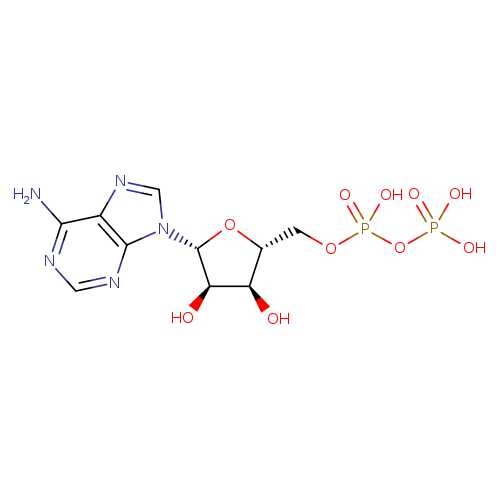
DescriptionAdenosine diphosphate, abbreviated ADP, is a nucleotide. It is an ester of pyrophosphoric acid with the nucleotide adenine. ADP consists of the pyrophosphate group, the pentose sugar ribose, and the nucleobase adenine. ADP is the product of ATP dephosphorylation by ATPases. ADP is converted back to ATP by ATP synthases.
Contaminant Sources
  • FooDB Chemicals
  • HMDB Contaminants - Urine
  • T3DB toxins
Contaminant Type
  • Amine
  • Animal Toxin
  • Ether
  • Food Toxin
  • Metabolite
  • Natural Compound
  • Organic Compound
Chemical Structure
Thumb
Synonyms
ValueSource
5'-Adenylphosphoric acidChEBI
Adenosine 5'-diphosphateChEBI
ADENOSINE-5'-diphosphATEChEBI
H3ADPChEBI
5'-AdenylphosphateGenerator
Adenosine 5'-diphosphoric acidGenerator
ADENOSINE-5'-diphosphoric acidGenerator
AdenosindiphosphorsaeureHMDB
Adenosine 5'-pyrophosphateHMDB
Adenosine diphosphateHMDB
Adenosine pyrophosphateHMDB
Adenosine-5-diphosphateHMDB
Adenosine-diphosphateHMDB
5'-Pyrophosphate, adenosineHMDB
Adenosine 5' pyrophosphateHMDB
Diphosphate, adenosineHMDB
Magnesium ADPHMDB
MgADPHMDB
Pyrophosphate, adenosineHMDB
ADP, MagnesiumHMDB
Adenosine diphosphoric acidHMDB
ADPMeSH
Chemical FormulaC10H15N5O10P2
Average Molecular Mass427.201 g/mol
Monoisotopic Mass427.029 g/mol
CAS Registry Number58-64-0
IUPAC Name[({[(2R,3S,4R,5R)-5-(6-amino-9H-purin-9-yl)-3,4-dihydroxyoxolan-2-yl]methoxy}(hydroxy)phosphoryl)oxy]phosphonic acid
Traditional Nameadenosine-diphosphate
SMILESNC1=NC=NC2=C1N=CN2[C@@H]1O[C@H](COP(O)(=O)OP(O)(O)=O)[C@@H](O)[C@H]1O
InChI IdentifierInChI=1S/C10H15N5O10P2/c11-8-5-9(13-2-12-8)15(3-14-5)10-7(17)6(16)4(24-10)1-23-27(21,22)25-26(18,19)20/h2-4,6-7,10,16-17H,1H2,(H,21,22)(H2,11,12,13)(H2,18,19,20)/t4-,6-,7-,10-/m1/s1
InChI KeyXTWYTFMLZFPYCI-KQYNXXCUSA-N
Chemical Taxonomy
Description belongs to the class of organic compounds known as purine ribonucleoside diphosphates. These are purine ribobucleotides with diphosphate group linked to the ribose moiety.
KingdomOrganic compounds
Super ClassNucleosides, nucleotides, and analogues
ClassPurine nucleotides
Sub ClassPurine ribonucleotides
Direct ParentPurine ribonucleoside diphosphates
Alternative Parents
Substituents
  • Purine ribonucleoside diphosphate
  • Purine ribonucleoside monophosphate
  • Pentose phosphate
  • Pentose-5-phosphate
  • Glycosyl compound
  • N-glycosyl compound
  • 6-aminopurine
  • Monosaccharide phosphate
  • Organic pyrophosphate
  • Pentose monosaccharide
  • Imidazopyrimidine
  • Purine
  • Monoalkyl phosphate
  • Aminopyrimidine
  • Alkyl phosphate
  • Monosaccharide
  • N-substituted imidazole
  • Organic phosphoric acid derivative
  • Phosphoric acid ester
  • Imidolactam
  • Pyrimidine
  • Azole
  • Heteroaromatic compound
  • Imidazole
  • Tetrahydrofuran
  • Secondary alcohol
  • 1,2-diol
  • Azacycle
  • Oxacycle
  • Organoheterocyclic compound
  • Alcohol
  • Organonitrogen compound
  • Organic oxide
  • Organic nitrogen compound
  • Organooxygen compound
  • Organopnictogen compound
  • Organic oxygen compound
  • Primary amine
  • Amine
  • Hydrocarbon derivative
  • Aromatic heteropolycyclic compound
Molecular FrameworkAromatic heteropolycyclic compounds
External Descriptors
Biological Properties
StatusDetected and Not Quantified
OriginEndogenous
Cellular Locations
  • Cytoplasm
  • Endoplasmic reticulum
  • Extracellular
  • Membrane
  • Mitochondria
  • Nucleus
  • Peroxisome
Biofluid LocationsNot Available
Tissue Locations
  • All Tissues
Pathways
NameSMPDB LinkKEGG Link
Amino Sugar MetabolismSMP00045 map00520
Ammonia RecyclingSMP00009 map00910
Citric Acid CycleSMP00057 map00020
Folate MetabolismSMP00053 map00670
GluconeogenesisSMP00128 Not Available
Glycerolipid MetabolismSMP00039 map00561
Glycine and Serine MetabolismSMP00004 map00260
GlycolysisSMP00040 Not Available
Histidine MetabolismSMP00044 map00340
Inositol Phosphate MetabolismSMP00462 map00562
Lactose DegradationSMP00457 Not Available
Lactose SynthesisSMP00444 Not Available
Mitochondrial Electron Transport ChainSMP00355 map00190
Phosphatidylinositol Phosphate MetabolismSMP00463 map00562
Phytanic Acid Peroxisomal OxidationSMP00450 Not Available
Purine MetabolismSMP00050 map00230
Threonine and 2-Oxobutanoate DegradationSMP00452 Not Available
Transfer of Acetyl Groups into MitochondriaSMP00466 Not Available
Trehalose DegradationSMP00467 Not Available
Urea CycleSMP00059 Not Available
Adenosine Deaminase DeficiencySMP00144 Not Available
ApplicationsNot Available
Biological Roles
Chemical RolesNot Available
Physical Properties
StateSolid
AppearanceWhite powder.
Experimental Properties
PropertyValue
Melting PointNot Available
Boiling PointNot Available
SolubilityNot Available
Predicted Properties
PropertyValueSource
Water Solubility3.27 g/LALOGPS
logP-1.6ALOGPS
logP-4.7ChemAxon
logS-2.1ALOGPS
pKa (Strongest Acidic)1.77ChemAxon
pKa (Strongest Basic)4ChemAxon
Physiological Charge-2ChemAxon
Hydrogen Acceptor Count12ChemAxon
Hydrogen Donor Count6ChemAxon
Polar Surface Area232.6 ŲChemAxon
Rotatable Bond Count6ChemAxon
Refractivity84.94 m³·mol⁻¹ChemAxon
Polarizability34.24 ųChemAxon
Number of Rings3ChemAxon
Bioavailability0ChemAxon
Rule of FiveNoChemAxon
Ghose FilterNoChemAxon
Veber's RuleNoChemAxon
MDDR-like RuleYesChemAxon
Spectra
Spectra
Spectrum TypeDescriptionSplash KeyView
Predicted GC-MSPredicted GC-MS Spectrum - GC-MS (Non-derivatized) - 70eV, Positivesplash10-004i-5931200000-d741fb674f63c06ad31cSpectrum
Predicted GC-MSPredicted GC-MS Spectrum - GC-MS (2 TMS) - 70eV, Positivesplash10-004j-9814310000-161f4ca9b901a0d2af95Spectrum
Predicted GC-MSPredicted GC-MS Spectrum - GC-MS (Non-derivatized) - 70eV, PositiveNot AvailableSpectrum
LC-MS/MSLC-MS/MS Spectrum - Quattro_QQQ 10V, Positive (Annotated)splash10-004i-0301900000-f65eba52a00479514d8eSpectrum
LC-MS/MSLC-MS/MS Spectrum - Quattro_QQQ 25V, Positive (Annotated)splash10-000i-0900000000-cdad0c415295c75e0b67Spectrum
LC-MS/MSLC-MS/MS Spectrum - Quattro_QQQ 40V, Positive (Annotated)splash10-000i-1900000000-1f27fdf6dbd77cbe927dSpectrum
LC-MS/MSLC-MS/MS Spectrum - LC-ESI-ITFT (LTQ Orbitrap XL, Thermo Scientfic) , Negativesplash10-004i-0102981000-79c6771fae3255f75825Spectrum
LC-MS/MSLC-MS/MS Spectrum - LC-ESI-ITFT (LTQ Orbitrap XL, Thermo Scientfic) , Negativesplash10-004i-0209000000-24c7ad0d0646786963beSpectrum
LC-MS/MSLC-MS/MS Spectrum - LC-ESI-ITFT (LTQ Orbitrap XL, Thermo Scientfic) , Negativesplash10-004i-0009000000-d266bbe08f0bcb8102b4Spectrum
LC-MS/MSLC-MS/MS Spectrum - LC-ESI-ITFT (LTQ Orbitrap XL, Thermo Scientfic) , Negativesplash10-001i-0000090000-8a788ef5a2c7ccc534e1Spectrum
LC-MS/MSLC-MS/MS Spectrum - LC-ESI-QTOF (UPLC Q-Tof Premier, Waters) , Negativesplash10-004i-6900600000-fe2194fd2a27df917e5bSpectrum
LC-MS/MSLC-MS/MS Spectrum - LC-ESI-ITFT , negativesplash10-004i-0209000000-24c7ad0d0646786963beSpectrum
LC-MS/MSLC-MS/MS Spectrum - LC-ESI-QTOF , negativesplash10-004i-6900600000-fe2194fd2a27df917e5bSpectrum
LC-MS/MSLC-MS/MS Spectrum - Linear Ion Trap , positivesplash10-002k-0809500000-7fdcfab442e6730d4feaSpectrum
LC-MS/MSLC-MS/MS Spectrum - Linear Ion Trap , positivesplash10-000b-0809400000-73322c322a5e1ac31635Spectrum
LC-MS/MSLC-MS/MS Spectrum - Linear Ion Trap , positivesplash10-000b-0809200000-2c8f8cd308e88cb92e57Spectrum
LC-MS/MSLC-MS/MS Spectrum - 30V, Negativesplash10-057i-4911200000-20884e27d643c976af4cSpectrum
LC-MS/MSLC-MS/MS Spectrum - 40V, Positivesplash10-000i-1900000000-a2612ac21c9094d3d4b1Spectrum
LC-MS/MSLC-MS/MS Spectrum - 30V, Positivesplash10-057i-4911100000-dd3ce00caeb0df03e97dSpectrum
LC-MS/MSLC-MS/MS Spectrum - 30V, Negativesplash10-057i-4911200000-e33065defe20ce4643d7Spectrum
LC-MS/MSLC-MS/MS Spectrum - 35V, Negativesplash10-057i-7900100000-d0630e8e3ad225b5f415Spectrum
LC-MS/MSLC-MS/MS Spectrum - 20V, Positivesplash10-000i-0910000000-164b37f4075a5627b64dSpectrum
Predicted LC-MS/MSPredicted LC-MS/MS Spectrum - 10V, Positivesplash10-000i-0911300000-0b0c309b755e7b5adfdbSpectrum
Predicted LC-MS/MSPredicted LC-MS/MS Spectrum - 20V, Positivesplash10-000i-0900000000-1d631dbd3ed3927f1194Spectrum
Predicted LC-MS/MSPredicted LC-MS/MS Spectrum - 40V, Positivesplash10-000i-1900000000-0e5039d8b3a6bd79b7d6Spectrum
Predicted LC-MS/MSPredicted LC-MS/MS Spectrum - 10V, Negativesplash10-0059-0900700000-ae031f4329b6e38885e8Spectrum
Predicted LC-MS/MSPredicted LC-MS/MS Spectrum - 20V, Negativesplash10-001i-3900000000-4c42d87cdde0e1918071Spectrum
Predicted LC-MS/MSPredicted LC-MS/MS Spectrum - 40V, Negativesplash10-004i-9200000000-3eb64003e08db733f0e2Spectrum
1D NMR1H NMR SpectrumNot AvailableSpectrum
1D NMR13C NMR SpectrumNot AvailableSpectrum
1D NMR1H NMR SpectrumNot AvailableSpectrum
1D NMR13C NMR SpectrumNot AvailableSpectrum
1D NMR1H NMR SpectrumNot AvailableSpectrum
1D NMR13C NMR SpectrumNot AvailableSpectrum
1D NMR1H NMR SpectrumNot AvailableSpectrum
1D NMR13C NMR SpectrumNot AvailableSpectrum
1D NMR1H NMR SpectrumNot AvailableSpectrum
1D NMR13C NMR SpectrumNot AvailableSpectrum
1D NMR1H NMR SpectrumNot AvailableSpectrum
1D NMR13C NMR SpectrumNot AvailableSpectrum
1D NMR1H NMR SpectrumNot AvailableSpectrum
1D NMR13C NMR SpectrumNot AvailableSpectrum
1D NMR1H NMR SpectrumNot AvailableSpectrum
1D NMR13C NMR SpectrumNot AvailableSpectrum
1D NMR1H NMR SpectrumNot AvailableSpectrum
1D NMR13C NMR SpectrumNot AvailableSpectrum
1D NMR1H NMR SpectrumNot AvailableSpectrum
1D NMR13C NMR SpectrumNot AvailableSpectrum
1D NMR1H NMR SpectrumNot AvailableSpectrum
2D NMR[1H,1H] 2D NMR SpectrumNot AvailableSpectrum
2D NMR[1H,13C] 2D NMR SpectrumNot AvailableSpectrum
Toxicity Profile
Route of ExposureNot Available
Mechanism of ToxicityNot Available
MetabolismMetabolism of organophosphates occurs principally by oxidation, by hydrolysis via esterases and by reaction with glutathione. Demethylation and glucuronidation may also occur. Oxidation of organophosphorus pesticides may result in moderately toxic products. In general, phosphorothioates are not directly toxic but require oxidative metabolism to the proximal toxin. The glutathione transferase reactions produce products that are, in most cases, of low toxicity. Paraoxonase (PON1) is a key enzyme in the metabolism of organophosphates. PON1 can inactivate some organophosphates through hydrolysis. PON1 hydrolyzes the active metabolites in several organophosphates insecticides as well as, nerve agents such as soman, sarin, and VX. The presence of PON1 polymorphisms causes there to be different enzyme levels and catalytic efficiency of this esterase, which in turn suggests that different individuals may be more susceptible to the toxic effect of organophosphate exposure.
Toxicity ValuesNot Available
Lethal DoseNot Available
Carcinogenicity (IARC Classification)No indication of carcinogenicity to humans (not listed by IARC).
Uses/SourcesThis is an endogenously produced metabolite found in the human body. It is used in metabolic reactions, catabolic reactions or waste generation.
Minimum Risk LevelNot Available
Health EffectsNot Available
SymptomsNot Available
TreatmentNot Available
Concentrations
Not Available
DrugBank IDNot Available
HMDB IDHMDB0001341
FooDB IDFDB021817
Phenol Explorer IDNot Available
KNApSAcK IDC00019353
BiGG ID33496
BioCyc IDADP
METLIN ID6175
PDB IDNot Available
Wikipedia LinkAdenosine_diphosphate
Chemspider ID5800
ChEBI ID16761
PubChem Compound ID6022
Kegg Compound IDC00008
YMDB IDYMDB00914
ECMDB IDECMDB01341
References
Synthesis ReferenceYamagata, Yukio. Prebiotic formation of ADP and ATP from AMP, calcium phosphates and cyanate in aqueous solution. Origins of Life and Evolution of the Biosphere (1999), 29(5), 511-520.
MSDSLink
General References
1. https://www.ncbi.nlm.nih.gov/pubmed/?term=16295522
2. Gil A, Sanchez-Medina F: Acid-soluble nucleotides of cow's, goat's and sheep's milks, at different stages of lactation. J Dairy Res. 1981 Feb;48(1):35-44.
3. Yamagata, Yukio. Prebiotic formation of ADP and ATP from AMP, calcium phosphates and cyanate in aqueous solution. Origins of Life and Evolution of the Biosphere (1999), 29(5), 511-520.
4. Quinton TM, Kim S, Jin J, Kunapuli SP: Lipid rafts are required in Galpha(i) signaling downstream of the P2Y12 receptor during ADP-mediated platelet activation. J Thromb Haemost. 2005 May;3(5):1036-41.
5. Saxena R, Gupta M, Gupta S, Kannan M, Ahmed RP, Choudhry VP: Inherited heterogenous defect in platelet aggregation selectively with ADP and epinephrine--a series of 25 cases. Indian J Pathol Microbiol. 2005 Jul;48(3):345-8.
6. Corsonello A, Malara A, De Domenico D, Damiano MC, Mirone S, Loddo S, Ientile R, Corica F: Effects of magnesium sulphate on leptin-dependent platelet aggregation: an ex vivo study. Magnes Res. 2005 Mar;18(1):7-11.
7. Cuisset T, Frere C, Quilici J, Barbou F, Morange PE, Hovasse T, Bonnet JL, Alessi MC: High post-treatment platelet reactivity identified low-responders to dual antiplatelet therapy at increased risk of recurrent cardiovascular events after stenting for acute coronary syndrome. J Thromb Haemost. 2006 Mar;4(3):542-9. Epub 2005 Dec 22.
8. Imura Y, Stassen JM, Bunting S, Stockmans F, Collen D: Antithrombotic properties of L-cysteine, N-(mercaptoacetyl)-D-Tyr-Arg-Gly-Asp-sulfoxide (G4120) in a hamster platelet-rich femoral vein thrombosis model. Blood. 1992 Sep 1;80(5):1247-53.
9. Cuisset T, Frere C, Quilici J, Morange PE, Nait-Saidi L, Carvajal J, Lehmann A, Lambert M, Bonnet JL, Alessi MC: Benefit of a 600-mg loading dose of clopidogrel on platelet reactivity and clinical outcomes in patients with non-ST-segment elevation acute coronary syndrome undergoing coronary stenting. J Am Coll Cardiol. 2006 Oct 3;48(7):1339-45. Epub 2006 Sep 12.
10. Vigue C, Vigue L, Huszar G: Adenosine triphosphate (ATP) concentrations and ATP/adenosine diphosphate ratios in human sperm of normospermic, oligospermic, and asthenospermic specimens and in their swim-up fractions: lack of correlation between ATP parameters and sperm creatine kinase concentrations. J Androl. 1992 Jul-Aug;13(4):305-11.
11. Smith SM, Judge HM, Peters G, Storey RF: Multiple antiplatelet effects of clopidogrel are not modulated by statin type in patients undergoing percutaneous coronary intervention. Platelets. 2004 Dec;15(8):465-74.
12. Ji Q, Ghaly M, Hjemdahl P, Tornvall P, Li N: Contrast medium attenuates platelet activation and platelet-leukocyte cross-talk. Thromb Haemost. 2005 May;93(5):922-6.
13. Nakayama Y, Kinoshita A, Tomita M: Dynamic simulation of red blood cell metabolism and its application to the analysis of a pathological condition. Theor Biol Med Model. 2005 May 9;2:18.
14. Morshedi M, Oehninger S, Blackmore P, Bocca S, Coddington C, Hodgen G: Investigation of some biochemical and functional effects of cryopreservation of human spermatozoa using an automated freezing-quick-thawing method. Int J Androl. 1995 Dec;18(6):279-86.
15. Hua J, Suguro S, Iwabuchi K, Tsutsumi-Ishii Y, Sakamoto K, Nagaoka I: Glucosamine, a naturally occurring amino monosaccharide, suppresses the ADP-mediated platelet activation in humans. Inflamm Res. 2004 Dec;53(12):680-8.
16. Shabanova EY, Mindukshev IV, Malakhovskaya EA, Vivulanets EV, Petrishchev NN, Krivchenko AI: Cooperative type of platelet hypersensitivity to ADP. Bull Exp Biol Med. 2005 Sep;140(3):282-4.