Record Information
Version1.0
Creation Date2014-08-29 06:14:49 UTC
Update Date2026-04-04 19:16:02 UTC
Accession NumberCHEM003244
Identification
Common Name18-Hydroxycorticosterone
ClassSmall Molecule
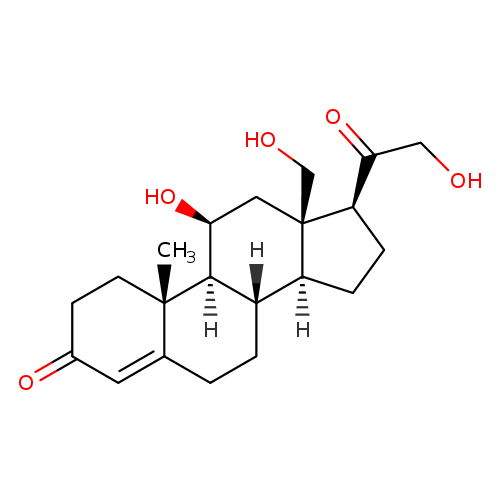
Description11 beta,18,21-Trihydroxypregn-4-ene-3,20-dione. 18-Hydroxycorticosterone is a derivative of corticosterone. It serves as an intermediate in the synthesis of aldosterone by the enzyme aldosterone synthase in the zona glomerulosa.
Contaminant Sources
  • FooDB Chemicals
  • T3DB toxins
Contaminant Type
  • Animal Toxin
  • Ester
  • Food Toxin
  • Metabolite
  • Natural Compound
  • Organic Compound
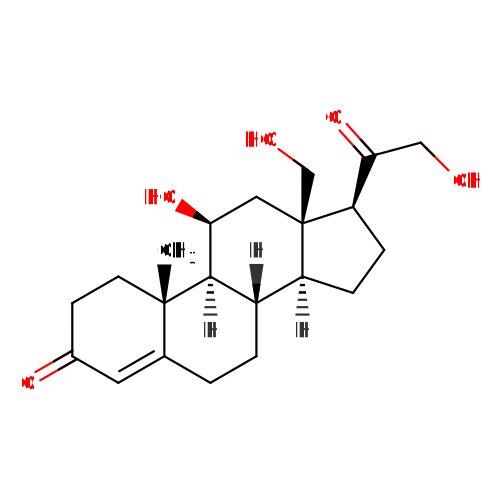
Chemical Structure
Thumb
Synonyms
ValueSource
11b,18,21-Trihydroxy-pregn-4-ene-3,20-dioneHMDB
18 HydrocorticosteroneMeSH, HMDB
18 HydroxycorticosteroneMeSH, HMDB
18-HydrocorticosteroneMeSH, HMDB
Hydroxycorticosterone, 18MeSH, HMDB
(11β)-11,18,21-Trihydroxypregn-4-ene-3,20-dioneHMDB
(11beta)-11,18,21-Trihydroxypregn-4-ene-3,20-dioneHMDB
Chemical FormulaC21H30O5
Average Molecular Mass362.460 g/mol
Monoisotopic Mass362.209 g/mol
CAS Registry Number561-65-9
IUPAC Name(1S,2R,10S,11S,14S,15R,17S)-17-hydroxy-14-(2-hydroxyacetyl)-15-(hydroxymethyl)-2-methyltetracyclo[8.7.0.0^{2,7}.0^{11,15}]heptadec-6-en-5-one
Traditional Name(1S,2R,10S,11S,14S,15R,17S)-17-hydroxy-14-(2-hydroxyacetyl)-15-(hydroxymethyl)-2-methyltetracyclo[8.7.0.0^{2,7}.0^{11,15}]heptadec-6-en-5-one
SMILES[H][C@@]12CC[C@H](C(=O)CO)[C@@]1(CO)C[C@H](O)[C@@]1([H])[C@@]2([H])CCC2=CC(=O)CC[C@]12C
InChI IdentifierInChI=1S/C21H30O5/c1-20-7-6-13(24)8-12(20)2-3-14-15-4-5-16(18(26)10-22)21(15,11-23)9-17(25)19(14)20/h8,14-17,19,22-23,25H,2-7,9-11H2,1H3/t14-,15-,16+,17-,19+,20-,21+/m0/s1
InChI KeyHFSXHZZDNDGLQN-ZVIOFETBSA-N
Chemical Taxonomy
Description belongs to the class of organic compounds known as 21-hydroxysteroids. These are steroids carrying a hydroxyl group at the 21-position of the steroid backbone.
KingdomOrganic compounds
Super ClassLipids and lipid-like molecules
ClassSteroids and steroid derivatives
Sub ClassHydroxysteroids
Direct Parent21-hydroxysteroids
Alternative Parents
Substituents
  • Progestogin-skeleton
  • 21-hydroxysteroid
  • Pregnane-skeleton
  • 20-oxosteroid
  • 18-hydroxysteroid
  • 3-oxo-delta-4-steroid
  • 3-oxosteroid
  • 11-hydroxysteroid
  • 11-beta-hydroxysteroid
  • Oxosteroid
  • Delta-4-steroid
  • Cyclohexenone
  • Alpha-hydroxy ketone
  • Cyclic alcohol
  • Ketone
  • Secondary alcohol
  • Cyclic ketone
  • Hydrocarbon derivative
  • Organic oxide
  • Carbonyl group
  • Organic oxygen compound
  • Alcohol
  • Organooxygen compound
  • Primary alcohol
  • Aliphatic homopolycyclic compound
Molecular FrameworkAliphatic homopolycyclic compounds
External Descriptors
Biological Properties
StatusDetected and Not Quantified
OriginEndogenous
Cellular Locations
  • Cytoplasm
  • Extracellular
  • Membrane
Biofluid LocationsNot Available
Tissue Locations
  • Adrenal Gland
Pathways
NameSMPDB LinkKEGG Link
SteroidogenesisSMP00130 map00140
Adrenal Hyperplasia Type 5 or Congenital Adrenal Hyperplasia due to 17 Alpha-hydroxylase DeficiencySMP00372 Not Available
Corticosterone methyl oxidase I deficiency (CMO I)SMP00577 Not Available
Corticosterone methyl oxidase II deficiency - CMO IISMP00578 Not Available
ApplicationsNot Available
Biological RolesNot Available
Chemical RolesNot Available
Physical Properties
StateSolid
AppearanceWhite powder.
Experimental Properties
PropertyValue
Melting PointNot Available
Boiling PointNot Available
SolubilityNot Available
Predicted Properties
PropertyValueSource
Water Solubility0.15 g/LALOGPS
logP1.28ALOGPS
logP0.74ChemAxon
logS-3.4ALOGPS
pKa (Strongest Acidic)13.8ChemAxon
pKa (Strongest Basic)-2.8ChemAxon
Physiological Charge0ChemAxon
Hydrogen Acceptor Count5ChemAxon
Hydrogen Donor Count3ChemAxon
Polar Surface Area94.83 ŲChemAxon
Rotatable Bond Count3ChemAxon
Refractivity97.77 m³·mol⁻¹ChemAxon
Polarizability39.77 ųChemAxon
Number of Rings4ChemAxon
Bioavailability1ChemAxon
Rule of FiveYesChemAxon
Ghose FilterYesChemAxon
Veber's RuleNoChemAxon
MDDR-like RuleNoChemAxon
Spectra
Spectra
Spectrum TypeDescriptionSplash KeyView
Predicted GC-MSPredicted GC-MS Spectrum - GC-MS (Non-derivatized) - 70eV, Positivesplash10-001i-1639000000-7012f18a6579e07dc571Spectrum
Predicted GC-MSPredicted GC-MS Spectrum - GC-MS (3 TMS) - 70eV, Positivesplash10-03di-1410290000-5789e767e5a0058f10edSpectrum
Predicted GC-MSPredicted GC-MS Spectrum - GC-MS (Non-derivatized) - 70eV, PositiveNot AvailableSpectrum
Predicted GC-MSPredicted GC-MS Spectrum - GC-MS (TMS_1_1) - 70eV, PositiveNot AvailableSpectrum
Predicted GC-MSPredicted GC-MS Spectrum - GC-MS (TMS_1_2) - 70eV, PositiveNot AvailableSpectrum
Predicted GC-MSPredicted GC-MS Spectrum - GC-MS (TMS_1_3) - 70eV, PositiveNot AvailableSpectrum
Predicted GC-MSPredicted GC-MS Spectrum - GC-MS (TMS_1_4) - 70eV, PositiveNot AvailableSpectrum
Predicted GC-MSPredicted GC-MS Spectrum - GC-MS (TMS_1_5) - 70eV, PositiveNot AvailableSpectrum
Predicted GC-MSPredicted GC-MS Spectrum - GC-MS (TMS_1_6) - 70eV, PositiveNot AvailableSpectrum
Predicted GC-MSPredicted GC-MS Spectrum - GC-MS (TMS_2_1) - 70eV, PositiveNot AvailableSpectrum
Predicted GC-MSPredicted GC-MS Spectrum - GC-MS (TMS_2_2) - 70eV, PositiveNot AvailableSpectrum
Predicted GC-MSPredicted GC-MS Spectrum - GC-MS (TMS_2_3) - 70eV, PositiveNot AvailableSpectrum
Predicted GC-MSPredicted GC-MS Spectrum - GC-MS (TMS_2_4) - 70eV, PositiveNot AvailableSpectrum
Predicted GC-MSPredicted GC-MS Spectrum - GC-MS (TMS_2_5) - 70eV, PositiveNot AvailableSpectrum
Predicted GC-MSPredicted GC-MS Spectrum - GC-MS (TMS_2_6) - 70eV, PositiveNot AvailableSpectrum
Predicted GC-MSPredicted GC-MS Spectrum - GC-MS (TMS_2_7) - 70eV, PositiveNot AvailableSpectrum
Predicted GC-MSPredicted GC-MS Spectrum - GC-MS (TMS_2_8) - 70eV, PositiveNot AvailableSpectrum
Predicted GC-MSPredicted GC-MS Spectrum - GC-MS (TMS_2_9) - 70eV, PositiveNot AvailableSpectrum
Predicted GC-MSPredicted GC-MS Spectrum - GC-MS (TMS_2_10) - 70eV, PositiveNot AvailableSpectrum
Predicted GC-MSPredicted GC-MS Spectrum - GC-MS (TMS_2_11) - 70eV, PositiveNot AvailableSpectrum
Predicted GC-MSPredicted GC-MS Spectrum - GC-MS (TMS_2_12) - 70eV, PositiveNot AvailableSpectrum
Predicted GC-MSPredicted GC-MS Spectrum - GC-MS (TMS_2_13) - 70eV, PositiveNot AvailableSpectrum
Predicted GC-MSPredicted GC-MS Spectrum - GC-MS (TMS_2_14) - 70eV, PositiveNot AvailableSpectrum
Predicted GC-MSPredicted GC-MS Spectrum - GC-MS (TMS_3_2) - 70eV, PositiveNot AvailableSpectrum
Predicted LC-MS/MSPredicted LC-MS/MS Spectrum - 10V, Positivesplash10-01r2-0019000000-8a12570d1c1a01069d09Spectrum
Predicted LC-MS/MSPredicted LC-MS/MS Spectrum - 20V, Positivesplash10-004j-0119000000-2b8864299061070cced5Spectrum
Predicted LC-MS/MSPredicted LC-MS/MS Spectrum - 40V, Positivesplash10-0019-3494000000-ebcb1ff70c533c4c9459Spectrum
Predicted LC-MS/MSPredicted LC-MS/MS Spectrum - 10V, Negativesplash10-03di-0009000000-0a027947a1d058fb84b7Spectrum
Predicted LC-MS/MSPredicted LC-MS/MS Spectrum - 20V, Negativesplash10-03dl-1019000000-cb3605cb617647c036e0Spectrum
Predicted LC-MS/MSPredicted LC-MS/MS Spectrum - 40V, Negativesplash10-05fr-5094000000-8d05b88622baf6731c7fSpectrum
Predicted LC-MS/MSPredicted LC-MS/MS Spectrum - 10V, Negativesplash10-03di-0009000000-0a10b570836098a58b85Spectrum
Predicted LC-MS/MSPredicted LC-MS/MS Spectrum - 20V, Negativesplash10-0zms-3096000000-ebde4d06599fa6ba99f8Spectrum
Predicted LC-MS/MSPredicted LC-MS/MS Spectrum - 40V, Negativesplash10-05fr-1092000000-b70b721681bcc4b0bc16Spectrum
Predicted LC-MS/MSPredicted LC-MS/MS Spectrum - 10V, Positivesplash10-03di-0009000000-728e8f7001bf77edf34eSpectrum
Predicted LC-MS/MSPredicted LC-MS/MS Spectrum - 20V, Positivesplash10-032j-0279000000-46ba785eff196ea28ae2Spectrum
Predicted LC-MS/MSPredicted LC-MS/MS Spectrum - 40V, Positivesplash10-11b9-2690000000-6b57d5653347024bee7aSpectrum
Toxicity Profile
Route of ExposureNot Available
Mechanism of Toxicity18-Hydroxycorticosterone is a derivative of corticosterone. It serves as an intermediate in the synthesis of aldosterone by the enzyme aldosterone synthase in the zona glomerulosa. (Wikipedia) 18-Hydroxycorticosterone (18OHB) has low affinity for the mineralocorticoid receptor and mainly originates from the conversion of corticosterone by the aldosterone synthase, although small amounts may be produced by the 11β-hydroxylase. Serum concentrations of 18OHB increase with increased aldosterone synthesis due to sodium depletion and angiotensin II infusion. (7) Accumulation of 18-hydroxycorticosterone in a given organ has been shown to be toxic for the body.
MetabolismNot Available
Toxicity ValuesNot Available
Lethal DoseNot Available
Carcinogenicity (IARC Classification)No indication of carcinogenicity to humans (not listed by IARC).
Uses/SourcesThis is an endogenously produced metabolite found in the human body. It is used in metabolic reactions, catabolic reactions or waste generation.
Minimum Risk LevelNot Available
Health EffectsChronically high levels of 18-hydroxycorticosterone are associated with at least 3 inborn errors of metabolism including: Adrenal hyperplasia type 5, Corticosterone methyl oxidase I deficiency and Corticosterone methyl oxidase II deficiency.
SymptomsNot Available
TreatmentNot Available
Concentrations
Not Available
DrugBank IDNot Available
HMDB IDHMDB0000319
FooDB IDFDB021945
Phenol Explorer IDNot Available
KNApSAcK IDNot Available
BiGG IDNot Available
BioCyc ID18-HYDROXYCORTICOSTERONE
METLIN ID5308
PDB IDNot Available
Wikipedia Link18-Hydroxycorticosterone
Chemspider ID10748
ChEBI ID16485
PubChem Compound ID11222
Kegg Compound IDC01124
YMDB IDNot Available
ECMDB IDNot Available
References
Synthesis ReferenceBoudi, Ahmed; Lemoine, Pascale; Viossat, Bernard; Tomas, Alain; Fiet, Jean; Galons, Herve. A convenient synthesis of 18-hydroxycorticosterone and 18-hydroxy-11-desoxycorticosterone via stereospecific hypoiodination of 20-hydroxysteroids. Tetrahedron (1999), 55(16), 5171-5176.
MSDSNot Available
General References
1. https://www.ncbi.nlm.nih.gov/pubmed/?term=12505784
2. https://www.ncbi.nlm.nih.gov/pubmed/?term=22238407
3. Boudi, Ahmed; Lemoine, Pascale; Viossat, Bernard; Tomas, Alain; Fiet, Jean; Galons, Herve. A convenient synthesis of 18-hydroxycorticosterone and 18-hydroxy-11-desoxycorticosterone via stereospecific hypoiodination of 20-hydroxysteroids. Tetrahedron (1999), 55(16), 5171-5176.
4. Sonino N, Chow D, Levine LS, New MI: Clinical response to metyrapone as indicated by measurement of mineralocorticoids and glucocorticoids in normal children. Clin Endocrinol (Oxf). 1981 Jan;14(1):31-9.
5. Vecsei P, Abdelhamid S, Mittelstadt GV, Lichtwald K, Haack D, Lewicka S: Aldosterone metabolites and possible aldosterone precursors in hypertension. J Steroid Biochem. 1983 Jul;19(1A):345-51.
6. Kooner JS, Few JD, Lee CY, Taylor GM, James VH: Investigation of the salivary 18-hydroxycorticosterone:aldosterone ratio in man using a direct assay. J Steroid Biochem Mol Biol. 1991 Mar;38(3):377-82.
7. Gomez-Sanchez CE, Clore JN, Estep HL, Watlington CO: Effect of chronic adrenocorticotropin stimulation on the excretion of 18-hydroxycortisol and 18-oxocortisol. J Clin Endocrinol Metab. 1988 Aug;67(2):322-6.
8. Honda M, Tsuchiya M, Tamura H, Watanabe H, Izumi Y, Hatano M, Shiratsuchi T, Den K, Kawaoi A, Okano T: In vivo and in vitro studies on steroid metabolism in a case of primary aldosteronism with multiple lesions of adenoma and nodular hyperplasia. Endocrinol Jpn. 1982 Oct;29(5):529-40.
9. Vecsei P, Benraad TJ, Hofman J, Abdelhamid S, Haack D, Lichtwald K: Direct radioimmunoassays for "aldosterone" and "18-hydroxycorticosterone" in unprocessed urine, and their use in screening to distinguish primary aldosteronism from hypertension. Clin Chem. 1982 Mar;28(3):453-6.