Record Information
Version1.0
Creation Date2014-08-29 06:15:36 UTC
Update Date2026-04-03 00:35:15 UTC
Accession NumberCHEM003247
Identification
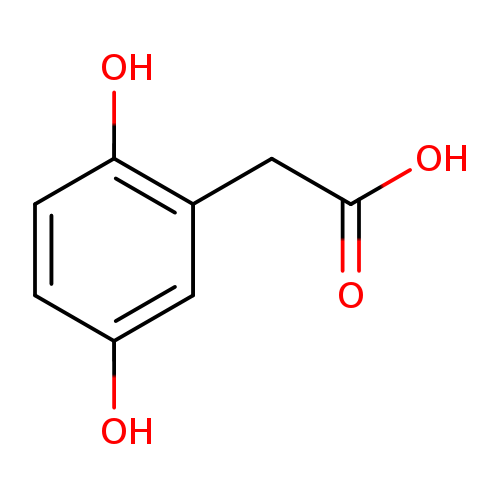
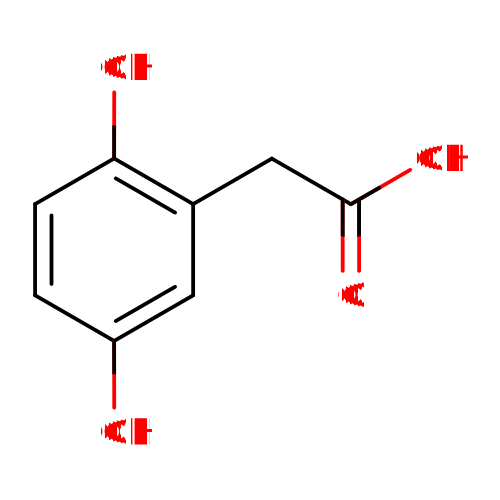
Common NameHomogentisic acid
ClassSmall Molecule
DescriptionHomogentisic acid is an intermediate of the metabolic breakdown of tyrosine and phenylalanine; it occurs in the urine in cases of alkaptonuria. (OMIN 203500) Homogentisic acid is the primary precursor of melanin synthesis in Vibrio cholerae.
Contaminant Sources
  • FooDB Chemicals
  • HMDB Contaminants - Feces
  • HMDB Contaminants - Urine
  • T3DB toxins
Contaminant Type
  • Animal Toxin
  • Food Toxin
  • Metabolite
  • Natural Compound
  • Organic Compound
Chemical Structure
Thumb
Synonyms
ValueSource
2,5-Dihydroxyphenylacetic acidChEBI
2-(3,6-DIHYDROXYPHENYL)acetIC ACIDChEBI
2,5-DihydroxyphenylacetateKegg
2-(3,6-DIHYDROXYPHENYL)acetateGenerator
HomogentisateGenerator
(2,5-Dihydroxyphenyl)-acetateHMDB
(2,5-Dihydroxyphenyl)-acetic acidHMDB
2,5-Dihydroxy-a-toluateHMDB
2,5-Dihydroxy-a-toluic acidHMDB
2,5-Dihydroxy-alpha-toluateHMDB
2,5-Dihydroxy-alpha-toluic acidHMDB
2,5-Dihydroxy-benzeneacetateHMDB
2,5-Dihydroxy-benzeneacetic acidHMDB
AlcaptonHMDB
Homogentisate acidHMDB
HomogentisinateHMDB
Homogentisinic acidHMDB
Melanic acidHMDB
Acid, homogentisicHMDB
Chemical FormulaC8H8O4
Average Molecular Mass168.147 g/mol
Monoisotopic Mass168.042 g/mol
CAS Registry Number451-13-8
IUPAC Name2-(2,5-dihydroxyphenyl)acetic acid
Traditional Namehomogentisic acid
SMILESOC(=O)CC1=C(O)C=CC(O)=C1
InChI IdentifierInChI=1S/C8H8O4/c9-6-1-2-7(10)5(3-6)4-8(11)12/h1-3,9-10H,4H2,(H,11,12)
InChI KeyIGMNYECMUMZDDF-UHFFFAOYSA-N
Chemical Taxonomy
Description belongs to the class of organic compounds known as 2(hydroxyphenyl)acetic acids. These are phenylacetic acids that carry a hydroxyl group at the 2-position.
KingdomOrganic compounds
Super ClassBenzenoids
ClassBenzene and substituted derivatives
Sub ClassPhenylacetic acids
Direct Parent2(hydroxyphenyl)acetic acids
Alternative Parents
Substituents
  • 2(hydroxyphenyl)acetic acid
  • Hydroquinone
  • 1-hydroxy-2-unsubstituted benzenoid
  • Phenol
  • Monocarboxylic acid or derivatives
  • Carboxylic acid
  • Carboxylic acid derivative
  • Organic oxygen compound
  • Organic oxide
  • Hydrocarbon derivative
  • Organooxygen compound
  • Carbonyl group
  • Aromatic homomonocyclic compound
Molecular FrameworkAromatic homomonocyclic compounds
External Descriptors
Biological Properties
StatusDetected and Not Quantified
OriginEndogenous
Cellular Locations
  • Cytoplasm
  • Extracellular
Biofluid LocationsNot Available
Tissue Locations
  • Cartilage
  • Connective Tissue
  • Kidney
Pathways
NameSMPDB LinkKEGG Link
Phenylalanine and Tyrosine MetabolismSMP00008 map00360
Tyrosine MetabolismSMP00006 map00350
AlkaptonuriaSMP00169 Not Available
ApplicationsNot Available
Biological Roles
Chemical RolesNot Available
Physical Properties
StateSolid
AppearanceWhite powder.
Experimental Properties
PropertyValue
Melting Point153°C
Boiling PointNot Available
Solubility850 mg/mL at 25°C
Predicted Properties
PropertyValueSource
Water Solubility8.1 g/LALOGPS
logP0.81ALOGPS
logP1ChemAxon
logS-1.3ALOGPS
pKa (Strongest Acidic)3.57ChemAxon
pKa (Strongest Basic)-5.9ChemAxon
Physiological Charge-1ChemAxon
Hydrogen Acceptor Count4ChemAxon
Hydrogen Donor Count3ChemAxon
Polar Surface Area77.76 ŲChemAxon
Rotatable Bond Count2ChemAxon
Refractivity41.33 m³·mol⁻¹ChemAxon
Polarizability15.57 ųChemAxon
Number of Rings1ChemAxon
Bioavailability1ChemAxon
Rule of FiveYesChemAxon
Ghose FilterYesChemAxon
Veber's RuleNoChemAxon
MDDR-like RuleNoChemAxon
Spectra
Spectra
Spectrum TypeDescriptionSplash KeyView
GC-MSGC-MS Spectrum - GC-EI-TOF (Pegasus III TOF-MS system, Leco; GC 6890, Agilent Technologies) (Non-derivatized)splash10-000t-0945000000-2f4b9ef9c9ee6e7cd1edSpectrum
GC-MSGC-MS Spectrum - GC-MS (3 TMS)splash10-0016-3955000000-1cdc64ab3032ff29df29Spectrum
GC-MSGC-MS Spectrum - EI-B (Non-derivatized)splash10-0a5c-0679000000-97890865f85a79efa2e6Spectrum
GC-MSGC-MS Spectrum - GC-EI-TOF (Non-derivatized)splash10-000t-0945000000-2f4b9ef9c9ee6e7cd1edSpectrum
GC-MSGC-MS Spectrum - GC-MS (Non-derivatized)splash10-0016-3955000000-1cdc64ab3032ff29df29Spectrum
GC-MSGC-MS Spectrum - GC-EI-TOF (Non-derivatized)splash10-0002-0944000000-fd48cc27da661ce24833Spectrum
Predicted GC-MSPredicted GC-MS Spectrum - GC-MS (Non-derivatized) - 70eV, Positivesplash10-00di-4900000000-ea40fc8d43156151710cSpectrum
Predicted GC-MSPredicted GC-MS Spectrum - GC-MS (3 TMS) - 70eV, Positivesplash10-014i-5093000000-c342ba08a9bff049fc1cSpectrum
Predicted GC-MSPredicted GC-MS Spectrum - GC-MS (Non-derivatized) - 70eV, PositiveNot AvailableSpectrum
Predicted GC-MSPredicted GC-MS Spectrum - GC-MS (TMS_1_1) - 70eV, PositiveNot AvailableSpectrum
Predicted GC-MSPredicted GC-MS Spectrum - GC-MS (TMS_1_2) - 70eV, PositiveNot AvailableSpectrum
Predicted GC-MSPredicted GC-MS Spectrum - GC-MS (TMS_1_3) - 70eV, PositiveNot AvailableSpectrum
Predicted GC-MSPredicted GC-MS Spectrum - GC-MS (TMS_2_1) - 70eV, PositiveNot AvailableSpectrum
Predicted GC-MSPredicted GC-MS Spectrum - GC-MS (TMS_2_2) - 70eV, PositiveNot AvailableSpectrum
Predicted GC-MSPredicted GC-MS Spectrum - GC-MS (TMS_2_3) - 70eV, PositiveNot AvailableSpectrum
Predicted GC-MSPredicted GC-MS Spectrum - GC-MS (TBDMS_1_1) - 70eV, PositiveNot AvailableSpectrum
Predicted GC-MSPredicted GC-MS Spectrum - GC-MS (TBDMS_1_2) - 70eV, PositiveNot AvailableSpectrum
Predicted GC-MSPredicted GC-MS Spectrum - GC-MS (TBDMS_1_3) - 70eV, PositiveNot AvailableSpectrum
Predicted GC-MSPredicted GC-MS Spectrum - GC-MS (TBDMS_2_1) - 70eV, PositiveNot AvailableSpectrum
Predicted GC-MSPredicted GC-MS Spectrum - GC-MS (TBDMS_2_2) - 70eV, PositiveNot AvailableSpectrum
Predicted GC-MSPredicted GC-MS Spectrum - GC-MS (TBDMS_2_3) - 70eV, PositiveNot AvailableSpectrum
Predicted GC-MSPredicted GC-MS Spectrum - GC-MS (TBDMS_3_1) - 70eV, PositiveNot AvailableSpectrum
LC-MS/MSLC-MS/MS Spectrum - Quattro_QQQ 10V, Positive (Annotated)splash10-00di-0900000000-9c395aa569b4b54f8681Spectrum
LC-MS/MSLC-MS/MS Spectrum - Quattro_QQQ 25V, Positive (Annotated)splash10-00xs-9500000000-ab92286f0d5bc843814bSpectrum
LC-MS/MSLC-MS/MS Spectrum - Quattro_QQQ 40V, Positive (Annotated)splash10-014l-9000000000-35740a40f4fdf3e84c3cSpectrum
LC-MS/MSLC-MS/MS Spectrum - LC-ESI-QQ (API3000, Applied Biosystems) 10V, Negativesplash10-014i-0900000000-f4eba60d63bd99e18b8bSpectrum
LC-MS/MSLC-MS/MS Spectrum - LC-ESI-QQ (API3000, Applied Biosystems) 20V, Negativesplash10-00di-0900000000-12e330dc18f0b128b961Spectrum
LC-MS/MSLC-MS/MS Spectrum - LC-ESI-QQ (API3000, Applied Biosystems) 30V, Negativesplash10-00di-0900000000-4bd53b0472edd31e8609Spectrum
LC-MS/MSLC-MS/MS Spectrum - LC-ESI-QQ (API3000, Applied Biosystems) 40V, Negativesplash10-00di-0900000000-7121173193a9ba3751a4Spectrum
LC-MS/MSLC-MS/MS Spectrum - LC-ESI-QQ (API3000, Applied Biosystems) 50V, Negativesplash10-00di-1900000000-04eca21bf25c671b8b6eSpectrum
LC-MS/MSLC-MS/MS Spectrum - LC-ESI-QTOF (UPLC Q-Tof Premier, Waters) , Negativesplash10-00di-0900000000-780d3740762c2ff89d9aSpectrum
LC-MS/MSLC-MS/MS Spectrum - LC-ESI-QQ , negativesplash10-014i-0900000000-f4eba60d63bd99e18b8bSpectrum
LC-MS/MSLC-MS/MS Spectrum - LC-ESI-QQ , negativesplash10-00di-0900000000-12e330dc18f0b128b961Spectrum
LC-MS/MSLC-MS/MS Spectrum - LC-ESI-QQ , negativesplash10-00di-0900000000-4bd53b0472edd31e8609Spectrum
LC-MS/MSLC-MS/MS Spectrum - LC-ESI-QQ , negativesplash10-00di-0900000000-7121173193a9ba3751a4Spectrum
LC-MS/MSLC-MS/MS Spectrum - LC-ESI-QQ , negativesplash10-00di-1900000000-04eca21bf25c671b8b6eSpectrum
LC-MS/MSLC-MS/MS Spectrum - LC-ESI-QTOF , negativesplash10-00di-0900000000-9c85164306514c6d4c4bSpectrum
LC-MS/MSLC-MS/MS Spectrum - , negativesplash10-00di-0900000000-867a4e32ba2d14fd0aadSpectrum
LC-MS/MSLC-MS/MS Spectrum - 10V, Negativesplash10-00di-0900000000-ac8e05a9300b51b24e77Spectrum
LC-MS/MSLC-MS/MS Spectrum - 40V, Negativesplash10-00di-1900000000-eeb664cef1197d609735Spectrum
LC-MS/MSLC-MS/MS Spectrum - 20V, Negativesplash10-00di-0900000000-1d890267ec7f3a5843b3Spectrum
Predicted LC-MS/MSPredicted LC-MS/MS Spectrum - 10V, Positivesplash10-0gb9-0900000000-a650bbb95019f3305d03Spectrum
Predicted LC-MS/MSPredicted LC-MS/MS Spectrum - 20V, Positivesplash10-00di-1900000000-94f13b2c7b9726353701Spectrum
Predicted LC-MS/MSPredicted LC-MS/MS Spectrum - 40V, Positivesplash10-05tf-9300000000-968a6390a00dcd77e566Spectrum
Predicted LC-MS/MSPredicted LC-MS/MS Spectrum - 10V, Negativesplash10-01b9-0900000000-0f9d5926d702af7d4d63Spectrum
Predicted LC-MS/MSPredicted LC-MS/MS Spectrum - 20V, Negativesplash10-01b9-1900000000-7f257033d3b1952b3c27Spectrum
Predicted LC-MS/MSPredicted LC-MS/MS Spectrum - 40V, Negativesplash10-0a4i-9800000000-bbcb0f0d7348cd1663b1Spectrum
1D NMR1H NMR SpectrumNot AvailableSpectrum
1D NMR13C NMR SpectrumNot AvailableSpectrum
1D NMR1H NMR SpectrumNot AvailableSpectrum
1D NMR13C NMR SpectrumNot AvailableSpectrum
1D NMR1H NMR SpectrumNot AvailableSpectrum
1D NMR13C NMR SpectrumNot AvailableSpectrum
1D NMR1H NMR SpectrumNot AvailableSpectrum
1D NMR13C NMR SpectrumNot AvailableSpectrum
1D NMR1H NMR SpectrumNot AvailableSpectrum
1D NMR13C NMR SpectrumNot AvailableSpectrum
1D NMR1H NMR SpectrumNot AvailableSpectrum
1D NMR13C NMR SpectrumNot AvailableSpectrum
1D NMR1H NMR SpectrumNot AvailableSpectrum
1D NMR13C NMR SpectrumNot AvailableSpectrum
1D NMR1H NMR SpectrumNot AvailableSpectrum
1D NMR13C NMR SpectrumNot AvailableSpectrum
1D NMR1H NMR SpectrumNot AvailableSpectrum
1D NMR13C NMR SpectrumNot AvailableSpectrum
1D NMR1H NMR SpectrumNot AvailableSpectrum
1D NMR13C NMR SpectrumNot AvailableSpectrum
1D NMR1H NMR SpectrumNot AvailableSpectrum
2D NMR[1H,1H] 2D NMR SpectrumNot AvailableSpectrum
2D NMR[1H,13C] 2D NMR SpectrumNot AvailableSpectrum
Toxicity Profile
Route of ExposureNot Available
Mechanism of ToxicityExtremely high levels of homogentisic acid are found in patients with the inborn error of metabolism (IEM) called Alkaptonuria. Homogentisic acid spontaneously undergoes oxidation into benzoquinone acetic acid (BQA), which polymerizes forming plasma soluble melanins (PSM). The PSM darkens many tissues (ochronosis - as the tissue looks like ochre), and produces widespread degenerative changes in cartilage and other connective tissues, joints, blood vessels, heart valves and the kidneys. Ochronotic tissue is stiff and unusually brittle. The accumulation of PSM in chondrocytes (the cells that form cartilage) leads to profound alterations in the levels of proteins involved in cell defense, protein folding, and cell organization. An increased post-translational oxidation of proteins, which also involved high molecular weight protein aggregates, has been found to be particularly evident in chondrocytes from patients with alkaptonuria.
MetabolismNot Available
Toxicity ValuesNot Available
Lethal DoseNot Available
Carcinogenicity (IARC Classification)No indication of carcinogenicity to humans (not listed by IARC).
Uses/SourcesNot Available
Minimum Risk LevelNot Available
Health EffectsHomogentisic acid is only toxic under chronic exposure. One of the first symptoms of alkaptonuria is darkening of urine on standing (due to the oxidation of homogentisic acid). In most pediatric patients, darkening of urine is the only feature suggesting alkaptonuria. Most patients are usually asymptomatic until age 30. Scleral pigmentation usually starts around age 30. Skin pigmentation becomes obvious by the time patients reach age 40. One of the first sites to be affected is the ear cartilage. There may be discoloration of the forehead, cheeks, axilla, genitalia, palms, nails and soles. Ochronotic arthropathy starts around the 4th decade. Weight-bearing joints like the knees and the intervertebral joints in the spine, as well as the shoulder joints, are involved, with narrowing of joint spaces and disc calcifications. Arthritis is the only disabling effect of this condition and occurs in almost all patients as age advances. Ochronotic arthropathy can be so severe as to require total joint replacement. Pigment deposits can be seen in the larynx, tonsils, esophagus, dura mater, eardrums, trachea, and bronchi. Aortic or mitral valvulitis, calcification of coronary arteries and atherosclerotic plaques are seen after the age of 50 years.
SymptomsNot Available
TreatmentApart from treatment of the complications (such as pain relief using NSAIDs and joint replacement for the cartilage damage), vitamin C has been used to reduce the ochronosis and lowering of the homogentisic acid levels may be attempted with a low-protein diet. Recently the drug nitisinone has been found to suppress homogentisic acid production. Nitrisinone inhibits the enzyme, 4-hydroxyphenylpyruvate dioxygenase, responsible for converting tyrosine to homogentisic acid, thereby blocking the production and accumulation of homogentisic acid. Nitisinone treatment has been shown to cause a 95% reduction in plasma and urinary homogentisic acid.
Concentrations
Not Available
DrugBank IDDB08327
HMDB IDHMDB0000130
FooDB IDFDB030907
Phenol Explorer IDNot Available
KNApSAcK IDC00007309
BiGG ID1485308
BioCyc IDHOMOGENTISATE
METLIN ID331
PDB IDNot Available
Wikipedia LinkHomogentisic_acid
Chemspider ID759
ChEBI ID44747
PubChem Compound ID780
Kegg Compound IDC00544
YMDB IDNot Available
ECMDB IDM2MDB004749
References
Synthesis ReferenceNot Available
MSDSLink
General References
1. Mung D, Li L: Development of Chemical Isotope Labeling LC-MS for Milk Metabolomics: Comprehensive and Quantitative Profiling of the Amine/Phenol Submetabolome. Anal Chem. 2017 Apr 18;89(8):4435-4443. doi: 10.1021/acs.analchem.6b03737. Epub 2017 Mar 28.
2. Phornphutkul C, Introne WJ, Perry MB, Bernardini I, Murphey MD, Fitzpatrick DL, Anderson PD, Huizing M, Anikster Y, Gerber LH, Gahl WA: Natural history of alkaptonuria. N Engl J Med. 2002 Dec 26;347(26):2111-21.
3. La Du BN Jr: Are we ready to try to cure alkaptonuria? Am J Hum Genet. 1998 Apr;62(4):765-7.
4. Concepcion Masip T, Banares Baudet F, Traba ML, Rodriguez de Minon Cifuentes JL: [Alkaptonuria, prostatic calculi, and ectopic ureter]. Actas Urol Esp. 1997 Feb;21(2):167-70.
5. Ehongo A, Schrooyen M, Pereleux A: [Important bilateral corneal astigmatism in a case of ocular ochronosis]. Bull Soc Belge Ophtalmol. 2005;(295):17-21.
6. Deutsch JC, Santhosh-Kumar CR: Quantitation of homogentisic acid in normal human plasma. J Chromatogr B Biomed Appl. 1996 Feb 23;677(1):147-51.
7. Shoemaker JD, Elliott WH: Automated screening of urine samples for carbohydrates, organic and amino acids after treatment with urease. J Chromatogr. 1991 Jan 2;562(1-2):125-38.
8. Janocha S, Wolz W, Srsen S, Srsnova K, Montagutelli X, Guenet JL, Grimm T, Kress W, Muller CR: The human gene for alkaptonuria (AKU) maps to chromosome 3q. Genomics. 1994 Jan 1;19(1):5-8.
9. de Haas V, Carbasius Weber EC, de Klerk JB, Bakker HD, Smit GP, Huijbers WA, Duran M, Poll-The BT: The success of dietary protein restriction in alkaptonuria patients is age-dependent. J Inherit Metab Dis. 1998 Dec;21(8):791-8.
10. Hegedus ZL, Nayak U: Homogentisic acid and structurally related compounds as intermediates in plasma soluble melanin formation and in tissue toxicities. Arch Int Physiol Biochim Biophys. 1994 May-Jun;102(3):175-81.
11. Venkataseshan VS, Chandra B, Graziano V, Steinlauf P, Marquet E, Irmiere V, Needle MA: Alkaptonuria and renal failure: a case report and review of the literature. Mod Pathol. 1992 Jul;5(4):464-71.
12. Bory C, Boulieu R, Chantin C, Mathieu M: Diagnosis of alcaptonuria: rapid analysis of homogentisic acid by HPLC. Clin Chim Acta. 1990 Jul;189(1):7-11.
13. https://www.ncbi.nlm.nih.gov/pubmed/?term=16196135
14. https://www.ncbi.nlm.nih.gov/pubmed/?term=19919097
15. https://www.ncbi.nlm.nih.gov/pubmed/?term=22850426
16. https://www.ncbi.nlm.nih.gov/pubmed/?term=23486607
17. https://www.ncbi.nlm.nih.gov/pubmed/?term=23511227
18. https://www.ncbi.nlm.nih.gov/pubmed/?term=23879342
19. https://www.ncbi.nlm.nih.gov/pubmed/?term=24373924