Record Information
Version1.0
Creation Date2014-08-29 06:16:24 UTC
Update Date2026-04-13 22:19:04 UTC
Accession NumberCHEM003253
Identification
Common NameUracil
ClassSmall Molecule
DescriptionUracil is a common naturally occurring pyrimidine found in RNA, it base pairs with adenine and is replaced by thymine in DNA. Methylation of uracil produces thymine. Uracil's use in the body is to help carry out the synthesis of many enzymes necessary for cell function through bonding with riboses and phosphates. Uracil serves as allosteric regulator and coenzyme for many important biochemical reactions. UDP and UTP regulate CPSase II activity in animals. UDP-glucose regulates the conversion of glucose to galactose in the liver and other tissues in the process of carbohydrate metabolism. Uracil is also involved in the biosynthesis of polysaccharides and the transportation of sugars containing aldehydes.
Contaminant Sources
  • FooDB Chemicals
  • HMDB Contaminants - Feces
  • HMDB Contaminants - Urine
  • STOFF IDENT Compounds
  • T3DB toxins
  • ToxCast & Tox21 Chemicals
Contaminant Type
  • Amide
  • Animal Toxin
  • Food Toxin
  • Metabolite
  • Natural Compound
  • Organic Compound
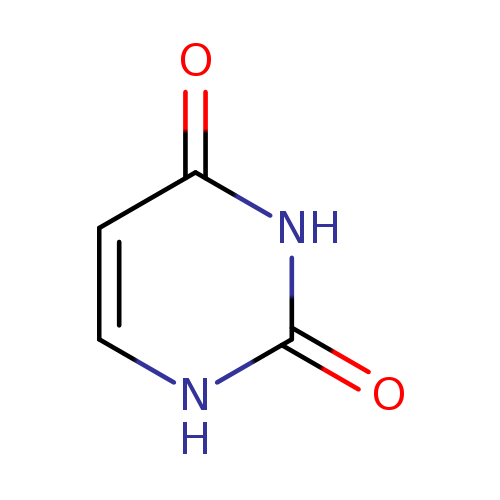
Chemical Structure
Thumb
Synonyms
ValueSource
2,4(1H,3H)-PyrimidinedioneChEBI
2,4-DioxopyrimidineChEBI
2,4-PyrimidinedioneChEBI
UChEBI
UraChEBI
UrazilChEBI
2,4-DihydroxypyrimidineHMDB
2,4-PyrimidinediolHMDB
Hybar XHMDB
PirodHMDB
PyrodHMDB
Chemical FormulaC4H4N2O2
Average Molecular Mass112.087 g/mol
Monoisotopic Mass112.027 g/mol
CAS Registry Number66-22-8
IUPAC Name1,2,3,4-tetrahydropyrimidine-2,4-dione
Traditional Nameuracil
SMILESO=C1NC=CC(=O)N1
InChI IdentifierInChI=1S/C4H4N2O2/c7-3-1-2-5-4(8)6-3/h1-2H,(H2,5,6,7,8)
InChI KeyISAKRJDGNUQOIC-UHFFFAOYSA-N
Chemical Taxonomy
Description belongs to the class of organic compounds known as pyrimidones. Pyrimidones are compounds that contain a pyrimidine ring, which bears a ketone. Pyrimidine is a 6-membered ring consisting of four carbon atoms and two nitrogen centers at the 1- and 3- ring positions.
KingdomOrganic compounds
Super ClassOrganoheterocyclic compounds
ClassDiazines
Sub ClassPyrimidines and pyrimidine derivatives
Direct ParentPyrimidones
Alternative Parents
Substituents
  • Pyrimidone
  • Hydropyrimidine
  • Heteroaromatic compound
  • Vinylogous amide
  • Urea
  • Lactam
  • Azacycle
  • Organic nitrogen compound
  • Organic oxygen compound
  • Organopnictogen compound
  • Organic oxide
  • Hydrocarbon derivative
  • Organooxygen compound
  • Organonitrogen compound
  • Aromatic heteromonocyclic compound
Molecular FrameworkAromatic heteromonocyclic compounds
External Descriptors
Biological Properties
StatusDetected and Not Quantified
OriginEndogenous
Cellular Locations
  • Cytoplasm
  • Extracellular
Biofluid LocationsNot Available
Tissue Locations
  • All Tissues
  • Prostate
Pathways
NameSMPDB LinkKEGG Link
Beta-Alanine MetabolismSMP00007 map00410
Pyrimidine MetabolismSMP00046 map00240
ArgininemiaSMP00357 Not Available
Dihydropyrimidinase DeficiencySMP00178 Not Available
Dihydropyrimidine Dehydrogenase Deficiency (DHPD)SMP00179 Not Available
MNGIE (Mitochondrial Neurogastrointestinal Encephalopathy)SMP00202 Not Available
UMP Synthase Deiciency (Orotic Aciduria)SMP00219 Not Available
Applications
Biological Roles
Chemical RolesNot Available
Physical Properties
StateSolid
AppearanceWhite powder.
Experimental Properties
PropertyValue
Melting Point330°C
Boiling PointNot Available
Solubility3.6 mg/mL
Predicted Properties
PropertyValueSource
Water Solubility26.5 g/LALOGPS
logP-1.2ALOGPS
logP-0.86ChemAxon
logS-0.63ALOGPS
pKa (Strongest Acidic)8.8ChemAxon
pKa (Strongest Basic)-5.5ChemAxon
Physiological Charge0ChemAxon
Hydrogen Acceptor Count2ChemAxon
Hydrogen Donor Count2ChemAxon
Polar Surface Area58.2 ŲChemAxon
Rotatable Bond Count0ChemAxon
Refractivity25.97 m³·mol⁻¹ChemAxon
Polarizability9.37 ųChemAxon
Number of Rings1ChemAxon
Bioavailability1ChemAxon
Rule of FiveYesChemAxon
Ghose FilterNoChemAxon
Veber's RuleNoChemAxon
MDDR-like RuleNoChemAxon
Spectra
Spectra
Spectrum TypeDescriptionSplash KeyView
GC-MSGC-MS Spectrum - GC-EI-TOF (Pegasus III TOF-MS system, Leco; GC 6890, Agilent Technologies) (Non-derivatized)splash10-0002-5950000000-18425875415ad150c4fcSpectrum
GC-MSGC-MS Spectrum - GC-EI-TOF (Pegasus III TOF-MS system, Leco; GC 6890, Agilent Technologies) (2 TMS)splash10-006t-9740000000-e884a4b98e7e9dc75e5fSpectrum
GC-MSGC-MS Spectrum - GC-MS (2 TMS)splash10-052e-7790000000-026cb6beb5cde6a61b80Spectrum
GC-MSGC-MS Spectrum - EI-B (Non-derivatized)splash10-02tc-9200000000-4a57c4e06fd552d6a9bfSpectrum
GC-MSGC-MS Spectrum - EI-B (Non-derivatized)splash10-03xu-9400000000-1c29f070a8135b06f88bSpectrum
GC-MSGC-MS Spectrum - GC-EI-TOF (Non-derivatized)splash10-0002-5950000000-18425875415ad150c4fcSpectrum
GC-MSGC-MS Spectrum - GC-EI-TOF (Non-derivatized)splash10-006t-9740000000-e884a4b98e7e9dc75e5fSpectrum
GC-MSGC-MS Spectrum - GC-MS (Non-derivatized)splash10-052e-7790000000-026cb6beb5cde6a61b80Spectrum
GC-MSGC-MS Spectrum - GC-EI-TOF (Non-derivatized)splash10-0002-6940000000-a726178341f6443e60ccSpectrum
Predicted GC-MSPredicted GC-MS Spectrum - GC-MS (Non-derivatized) - 70eV, Positivesplash10-03xu-9300000000-6a96f6ce1ef731689107Spectrum
Predicted GC-MSPredicted GC-MS Spectrum - GC-MS (Non-derivatized) - 70eV, PositiveNot AvailableSpectrum
LC-MS/MSLC-MS/MS Spectrum - Quattro_QQQ 10V, Positive (Annotated)splash10-03di-3900000000-e422eda255a4b6414f86Spectrum
LC-MS/MSLC-MS/MS Spectrum - Quattro_QQQ 25V, Positive (Annotated)splash10-006y-9000000000-130eb5f4414426e03667Spectrum
LC-MS/MSLC-MS/MS Spectrum - Quattro_QQQ 40V, Positive (Annotated)splash10-0006-9100000000-c096d08ca715d97cd732Spectrum
LC-MS/MSLC-MS/MS Spectrum - EI-B (HITACHI M-60) , Positivesplash10-02tc-9200000000-83a0a6ad4fc1b407e570Spectrum
LC-MS/MSLC-MS/MS Spectrum - EI-B (HITACHI M-80) , Positivesplash10-03xu-9400000000-acd0cfd54af7d6a55283Spectrum
LC-MS/MSLC-MS/MS Spectrum - LC-ESI-QQ (API3000, Applied Biosystems) 10V, Negativesplash10-03di-0900000000-309fe212c929f3c6a930Spectrum
LC-MS/MSLC-MS/MS Spectrum - LC-ESI-QQ (API3000, Applied Biosystems) 20V, Negativesplash10-03di-6900000000-55a7de75a40eab61da8bSpectrum
LC-MS/MSLC-MS/MS Spectrum - LC-ESI-QQ (API3000, Applied Biosystems) 30V, Negativesplash10-0006-9000000000-1c3caab26eb7e359db92Spectrum
LC-MS/MSLC-MS/MS Spectrum - LC-ESI-QQ (API3000, Applied Biosystems) 40V, Negativesplash10-0006-9000000000-7494d4e611a73ecb79eaSpectrum
LC-MS/MSLC-MS/MS Spectrum - LC-ESI-QQ (API3000, Applied Biosystems) 50V, Negativesplash10-0006-9000000000-ed4046b040337db620d8Spectrum
LC-MS/MSLC-MS/MS Spectrum - LC-ESI-QTOF (UPLC Q-Tof Premier, Waters) , Positivesplash10-03di-0900000000-ff54f3083ce4ccccfd95Spectrum
LC-MS/MSLC-MS/MS Spectrum - LC-ESI-QTOF (UPLC Q-Tof Premier, Waters) , Negativesplash10-03di-0900000000-6728c1eb6f68b40c09f8Spectrum
LC-MS/MSLC-MS/MS Spectrum - LC-ESI-QQ , negativesplash10-03di-0900000000-309fe212c929f3c6a930Spectrum
LC-MS/MSLC-MS/MS Spectrum - LC-ESI-QQ , negativesplash10-03di-6900000000-55a7de75a40eab61da8bSpectrum
LC-MS/MSLC-MS/MS Spectrum - LC-ESI-QQ , negativesplash10-0006-9000000000-1c3caab26eb7e359db92Spectrum
LC-MS/MSLC-MS/MS Spectrum - LC-ESI-QQ , negativesplash10-0006-9000000000-7494d4e611a73ecb79eaSpectrum
LC-MS/MSLC-MS/MS Spectrum - LC-ESI-QQ , negativesplash10-0006-9000000000-ed4046b040337db620d8Spectrum
LC-MS/MSLC-MS/MS Spectrum - LC-ESI-QTOF , negativesplash10-03di-0900000000-6728c1eb6f68b40c09f8Spectrum
LC-MS/MSLC-MS/MS Spectrum - , negativesplash10-03di-0900000000-a21102c708f8d5eaf262Spectrum
Predicted LC-MS/MSPredicted LC-MS/MS Spectrum - 10V, Positivesplash10-03di-1900000000-0029cbdcaa1377a4d03eSpectrum
Predicted LC-MS/MSPredicted LC-MS/MS Spectrum - 20V, Positivesplash10-0229-9400000000-c227e1deb392170cb323Spectrum
Predicted LC-MS/MSPredicted LC-MS/MS Spectrum - 40V, Positivesplash10-0006-9000000000-3cf6f9fc3ab6890266acSpectrum
Predicted LC-MS/MSPredicted LC-MS/MS Spectrum - 10V, Negativesplash10-03di-4900000000-67a3d94ab649e28bda13Spectrum
Predicted LC-MS/MSPredicted LC-MS/MS Spectrum - 20V, Negativesplash10-0006-9100000000-bbf50de54fc413b6588eSpectrum
Predicted LC-MS/MSPredicted LC-MS/MS Spectrum - 40V, Negativesplash10-0006-9000000000-98042b91f1087b0c2563Spectrum
MSMass Spectrum (Electron Ionization)splash10-03xu-9400000000-d7ffe72f606f1af3349bSpectrum
1D NMR13C NMR SpectrumNot AvailableSpectrum
1D NMR1H NMR SpectrumNot AvailableSpectrum
1D NMR13C NMR SpectrumNot AvailableSpectrum
1D NMR1H NMR SpectrumNot AvailableSpectrum
1D NMR13C NMR SpectrumNot AvailableSpectrum
1D NMR1H NMR SpectrumNot AvailableSpectrum
1D NMR13C NMR SpectrumNot AvailableSpectrum
1D NMR1H NMR SpectrumNot AvailableSpectrum
1D NMR13C NMR SpectrumNot AvailableSpectrum
1D NMR1H NMR SpectrumNot AvailableSpectrum
1D NMR13C NMR SpectrumNot AvailableSpectrum
1D NMR1H NMR SpectrumNot AvailableSpectrum
1D NMR13C NMR SpectrumNot AvailableSpectrum
1D NMR1H NMR SpectrumNot AvailableSpectrum
1D NMR13C NMR SpectrumNot AvailableSpectrum
1D NMR1H NMR SpectrumNot AvailableSpectrum
1D NMR13C NMR SpectrumNot AvailableSpectrum
1D NMR1H NMR SpectrumNot AvailableSpectrum
1D NMR13C NMR SpectrumNot AvailableSpectrum
1D NMR1H NMR SpectrumNot AvailableSpectrum
1D NMR13C NMR SpectrumNot AvailableSpectrum
1D NMR1H NMR SpectrumNot AvailableSpectrum
1D NMR13C NMR SpectrumNot AvailableSpectrum
1D NMR1H NMR SpectrumNot AvailableSpectrum
2D NMR[1H,1H] 2D NMR SpectrumNot AvailableSpectrum
2D NMR[1H,13C] 2D NMR SpectrumNot AvailableSpectrum
Toxicity Profile
Route of ExposureNot Available
Mechanism of ToxicityNot Available
MetabolismNot Available
Toxicity ValuesNot Available
Lethal DoseNot Available
Carcinogenicity (IARC Classification)No indication of carcinogenicity to humans (not listed by IARC).
Uses/SourcesThis is an endogenously produced metabolite found in the human body. It is used in metabolic reactions, catabolic reactions or waste generation.
Minimum Risk LevelNot Available
Health EffectsNot Available
SymptomsNot Available
TreatmentNot Available
Concentrations
Not Available
DrugBank IDDB03419
HMDB IDHMDB0000300
FooDB IDFDB006426
Phenol Explorer IDNot Available
KNApSAcK IDC00001513
BiGG ID33879
BioCyc IDURACIL
METLIN ID258
PDB IDNot Available
Wikipedia LinkUracil
Chemspider ID1141
ChEBI ID17568
PubChem Compound ID1174
Kegg Compound IDC00106
YMDB IDYMDB00098
ECMDB IDECMDB00300
References
Synthesis Reference

Kurt Klemm, Wolfgang Schoetensack, Wolfgang Prusse, “Aryl-substituted piperazinyl-alkylamino-uracils, -uracil ethers and -uracil thioethers and method for their production.” U.S. Patent US3957786, issued September, 1951.

MSDSLink
General References
1. Burckhalter, J. H.; Scarborough, Homer C. The synthesis of uracils as anticonvulsants. Journal of the American Pharmaceutical Association (1912-1977) (1955), 44 545-50.
2. Melzer N, Wittenburg D, Hartwig S, Jakubowski S, Kesting U, Willmitzer L, Lisec J, Reinsch N, Repsilber D: Investigating associations between milk metabolite profiles and milk traits of Holstein cows. J Dairy Sci. 2013 Mar;96(3):1521-34. doi: 10.3168/jds.2012-5743.
3. Mung D, Li L: Development of Chemical Isotope Labeling LC-MS for Milk Metabolomics: Comprehensive and Quantitative Profiling of the Amine/Phenol Submetabolome. Anal Chem. 2017 Apr 18;89(8):4435-4443. doi: 10.1021/acs.analchem.6b03737. Epub 2017 Mar 28.
4. Kurt J. Boudonck, Matthew W. Mitchell, Jacob Wulff and John A. Ryals. Characterization of the biochemical variability of bovine milk using metabolomics. Metabolomics (2009) 5:375?386
5. Burckhalter, J. H.; Scarborough, Homer C. The synthesis of uracils as anticonvulsants. Journal of the American Pharmaceutical Association (1912-1977) (1955), 44 545-50.
6. Spector T, Harrington JA, Porter DJ: 5-Ethynyluracil (776C85): inactivation of dihydropyrimidine dehydrogenase in vivo. Biochem Pharmacol. 1993 Dec 14;46(12):2243-8.
7. Hofmann U, Schwab M, Seefried S, Marx C, Zanger UM, Eichelbaum M, Murdter TE: Sensitive method for the quantification of urinary pyrimidine metabolites in healthy adults by gas chromatography-tandem mass spectrometry. J Chromatogr B Analyt Technol Biomed Life Sci. 2003 Jul 5;791(1-2):371-80.
8. Mani S, Kugler JW, Sciortino DF, Garcia JC, Ansari RH, Humerickhouse R, Michelassi F, Posner MC, Shulman KL, Schilsky RL, List M, Vokes EE, Benner S: Phase II trial of uracil/tegafur (UFT) plus leucovorin in patients with advanced pancreatic carcinoma: a University of Chicago phase II consortium study. Ann Oncol. 1998 Sep;9(9):1035-7.
9. Tomita T, Tajima T, Ishibashi M, Tagaya N, Aoki H, Itoh S, Kadowaki A, Kogure H, Tajima Y: [Study on the concentrations of 5-fluorouracil (5-FU), tegafur (ET) and uracil in bile: comparison of UFT or FT]. Gan To Kagaku Ryoho. 1989 Dec;16(12):3755-62.
10. Duthie SJ, McMillan P: Uracil misincorporation in human DNA detected using single cell gel electrophoresis. Carcinogenesis. 1997 Sep;18(9):1709-14.
11. Bayer AS, Galpin JE, Theofilopoulos AN, Guze LB: Neurological disease associated with Mycoplasma pneumoniae pneumonitis: demonstration of viable Mycoplasma pneumoniae in cerebrospinal fluid and blood by radioisotopic and immunofluorescent tissue culture techniques. Ann Intern Med. 1981 Jan;94(1):15-20.
12. Feliu J, Mel R, Borrega P, Lopez Gomez L, Escudero P, Dorta J, Castro J, Vazquez-Estevez SE, Bolanos M, Espinosa E, Gonzalez Baron M: Phase II study of a fixed dose-rate infusion of gemcitabine associated with uracil/tegafur in advanced carcinoma of the pancreas. Ann Oncol. 2002 Nov;13(11):1756-62.
13. Jakobs C, Sweetman L, Nyhan WL, Gruenke L, Craig JC, Wadman SK: Stable isotope dilution analysis of orotic acid and uracil in amniotic fluid. Clin Chim Acta. 1984 Nov 15;143(2):123-33.
14. van Lenthe H, van Kuilenburg AB, Ito T, Bootsma AH, van Cruchten A, Wada Y, van Gennip AH: Defects in pyrimidine degradation identified by HPLC-electrospray tandem mass spectrometry of urine specimens or urine-soaked filter paper strips. Clin Chem. 2000 Dec;46(12):1916-22.
15. Mashiyama ST, Courtemanche C, Elson-Schwab I, Crott J, Lee BL, Ong CN, Fenech M, Ames BN: Uracil in DNA, determined by an improved assay, is increased when deoxynucleosides are added to folate-deficient cultured human lymphocytes. Anal Biochem. 2004 Jul 1;330(1):58-69.
16. DeAngelis LM, Kreis W, Chan K, Dantis E, Akerman S: Pharmacokinetics of ara-C and ara-U in plasma and CSF after high-dose administration of cytosine arabinoside. Cancer Chemother Pharmacol. 1992;29(3):173-7.
17. Stover PJ, Garza C: Bringing individuality to public health recommendations. J Nutr. 2002 Aug;132(8 Suppl):2476S-2480S.
18. Sweatman BC, Farrant RD, Holmes E, Ghauri FY, Nicholson JK, Lindon JC: 600 MHz 1H-NMR spectroscopy of human cerebrospinal fluid: effects of sample manipulation and assignment of resonances. J Pharm Biomed Anal. 1993 Aug;11(8):651-64.
19. Allgayer H, Kolb M, Stuber V, Kruis W: Effects of bile acids on base hydroxylation in a model of human colonic mucosal DNA. Cancer Detect Prev. 2002;26(1):85-9.
20. Duthie SJ, Hawdon A: DNA instability (strand breakage, uracil misincorporation, and defective repair) is increased by folic acid depletion in human lymphocytes in vitro. FASEB J. 1998 Nov;12(14):1491-7.
21. van Kuilenburg AB, van Lenthe H, Loffler M, van Gennip AH: Analysis of pyrimidine synthesis "de novo" intermediates in urine and dried urine filter- paper strips with HPLC-electrospray tandem mass spectrometry. Clin Chem. 2004 Nov;50(11):2117-24. Epub 2004 Sep 16.
22. Hanaue H, Kurosawa T, Kitano Y, Miyakawa S, Nemoto A, Yamamoto H, Asagoe T, Takada T, Yasuda H, Shikata J: Anticancer drug distribution in lymph and blood during adjuvant chemotherapy after surgery for gastric carcinoma. A study with a combined preparation of 1-(2-tetrahydrofuryl)-5-fluorouracil and uracil. Cancer. 1987 May 1;59(9):1571-6.
23. Jiang H, Jiang J, Hu P, Hu Y: Measurement of endogenous uracil and dihydrouracil in plasma and urine of normal subjects by liquid chromatography-tandem mass spectrometry. J Chromatogr B Analyt Technol Biomed Life Sci. 2002 Mar 25;769(1):169-76.
24. Sreekumar A, Poisson LM, Rajendiran TM, Khan AP, Cao Q, Yu J, Laxman B, Mehra R, Lonigro RJ, Li Y, Nyati MK, Ahsan A, Kalyana-Sundaram S, Han B, Cao X, Byun J, Omenn GS, Ghosh D, Pennathur S, Alexander DC, Berger A, Shuster JR, Wei JT, Varambally S, Beecher C, Chinnaiyan AM: Metabolomic profiles delineate potential role for sarcosine in prostate cancer progression. Nature. 2009 Feb 12;457(7231):910-4. doi: 10.1038/nature07762.
25. Elshenawy S, Pinney SE, Stuart T, Doulias PT, Zura G, Parry S, Elovitz MA, Bennett MJ, Bansal A, Strauss JF 3rd, Ischiropoulos H, Simmons RA: The Metabolomic Signature of the Placenta in Spontaneous Preterm Birth. Int J Mol Sci. 2020 Feb 4;21(3). pii: ijms21031043. doi: 10.3390/ijms21031043.
26. https://www.ncbi.nlm.nih.gov/pubmed/?term=11279060
27. https://www.ncbi.nlm.nih.gov/pubmed/?term=12855717
28. https://www.ncbi.nlm.nih.gov/pubmed/?term=15274295
29. https://www.ncbi.nlm.nih.gov/pubmed/?term=16834123
30. https://www.ncbi.nlm.nih.gov/pubmed/?term=17439666
31. https://www.ncbi.nlm.nih.gov/pubmed/?term=18533995
32. https://www.ncbi.nlm.nih.gov/pubmed/?term=18815805
33. https://www.ncbi.nlm.nih.gov/pubmed/?term=19175333
34. https://www.ncbi.nlm.nih.gov/pubmed/?term=22020693
35. https://www.ncbi.nlm.nih.gov/pubmed/?term=22074393
36. https://www.ncbi.nlm.nih.gov/pubmed/?term=22120518
37. https://www.ncbi.nlm.nih.gov/pubmed/?term=22171528
38. https://www.ncbi.nlm.nih.gov/pubmed/?term=22237209
39. https://www.ncbi.nlm.nih.gov/pubmed/?term=22299724
40. https://www.ncbi.nlm.nih.gov/pubmed/?term=22356544
41. https://www.ncbi.nlm.nih.gov/pubmed/?term=22447672
42. https://www.ncbi.nlm.nih.gov/pubmed/?term=22483865
43. https://www.ncbi.nlm.nih.gov/pubmed/?term=22567906
44. https://www.ncbi.nlm.nih.gov/pubmed/?term=22685418
45. https://www.ncbi.nlm.nih.gov/pubmed/?term=3654008