Record Information
Version1.0
Creation Date2014-08-29 06:16:49 UTC
Update Date2016-11-09 01:09:06 UTC
Accession NumberCHEM003257
Identification
Common Name3-Methoxytyrosine
ClassSmall Molecule
Description3-Methoxytyrosine is one of the main biochemical markers for Aromatic L-amino acid decarboxylase (AADC, EC 4.1.1.28) deficiency, an inborn error of metabolism that affects serotonin and dopamine biosynthesis. Patients are usually detected in infancy due to developmental delay, hypotonia, and extrapyramidal movements. Diagnosis is based on an abnormal neurotransmitter metabolite profile in CSF and reduced AADC activity in plasma. 3-methoxytyrosine is elevated in CSF, plasma, and urine. (1, 2, 3).
Contaminant Sources
  • FooDB Chemicals
  • HMDB Contaminants - Urine
  • T3DB toxins
Contaminant Type
  • Amine
  • Animal Toxin
  • Ether
  • Food Toxin
  • Metabolite
  • Natural Compound
  • Organic Compound
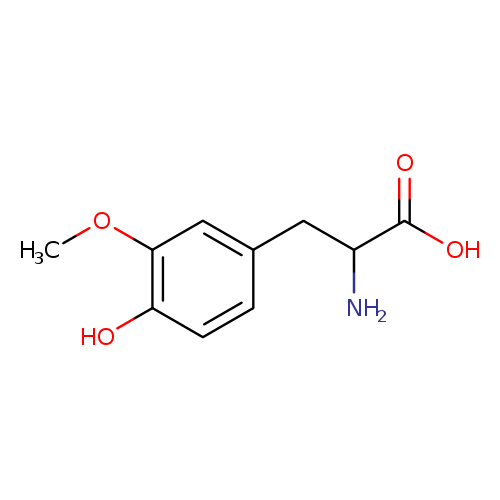
Chemical Structure
Thumb
Synonyms
ValueSource
3-Methoxy-tyrosineHMDB
3-O-MethyldopaHMDB, MeSH
L-3-Methoxy tyrosineHMDB
L-3-MethoxytyrosineHMDB, MeSH
L-4-Hydroxy-3-methoxyphenylalanineHMDB
VanilalanineHMDB
3-Methoxytyrosine, (L-tyr)-isomerMeSH, HMDB
3-Methoxytyrosine, (D-tyr)-isomerMeSH, HMDB
3-Methoxytyrosine, (L-tyr)-isomer, alpha-(14)C-labeledMeSH, HMDB
3-Methoxytyrosine, (DL-tyr)-isomerMeSH, HMDB
2-Amino-3-(4-hydroxy-3-methoxyphenyl)propanoateGenerator, HMDB
3-O-Methyl-dopaMeSH, HMDB
3-OMD CPDMeSH, HMDB
3-MethoxydopaMeSH, HMDB
3-MethoxytyrosineMeSH
Chemical FormulaC10H13NO4
Average Molecular Mass211.215 g/mol
Monoisotopic Mass211.084 g/mol
CAS Registry Number7636-26-2
IUPAC Name2-amino-3-(4-hydroxy-3-methoxyphenyl)propanoic acid
Traditional Name3-O-methyldopa
SMILESCOC1=CC(CC(N)C(O)=O)=CC=C1O
InChI IdentifierInChI=1S/C10H13NO4/c1-15-9-5-6(2-3-8(9)12)4-7(11)10(13)14/h2-3,5,7,12H,4,11H2,1H3,(H,13,14)
InChI KeyPFDUUKDQEHURQC-UHFFFAOYSA-N
Chemical Taxonomy
Description belongs to the class of organic compounds known as tyrosine and derivatives. Tyrosine and derivatives are compounds containing tyrosine or a derivative thereof resulting from reaction of tyrosine at the amino group or the carboxy group, or from the replacement of any hydrogen of glycine by a heteroatom.
KingdomOrganic compounds
Super ClassOrganic acids and derivatives
ClassCarboxylic acids and derivatives
Sub ClassAmino acids, peptides, and analogues
Direct ParentTyrosine and derivatives
Alternative Parents
Substituents
  • Tyrosine or derivatives
  • Phenylalanine or derivatives
  • 3-phenylpropanoic-acid
  • Alpha-amino acid
  • Amphetamine or derivatives
  • Methoxyphenol
  • Phenoxy compound
  • Anisole
  • Phenol ether
  • Methoxybenzene
  • Alkyl aryl ether
  • 1-hydroxy-2-unsubstituted benzenoid
  • Phenol
  • Aralkylamine
  • Benzenoid
  • Monocyclic benzene moiety
  • Amino acid
  • Carboxylic acid
  • Ether
  • Monocarboxylic acid or derivatives
  • Hydrocarbon derivative
  • Primary aliphatic amine
  • Organopnictogen compound
  • Organonitrogen compound
  • Organooxygen compound
  • Carbonyl group
  • Organic oxide
  • Organic oxygen compound
  • Primary amine
  • Amine
  • Organic nitrogen compound
  • Aromatic homomonocyclic compound
Molecular FrameworkAromatic homomonocyclic compounds
External Descriptors
Biological Properties
StatusDetected and Not Quantified
OriginEndogenous
Cellular Locations
  • Cytoplasm
  • Extracellular
Biofluid LocationsNot Available
Tissue LocationsNot Available
Pathways
NameSMPDB LinkKEGG Link
Aromatic L-Aminoacid Decarboxylase DeficiencySMP00170 Not Available
ApplicationsNot Available
Biological RolesNot Available
Chemical RolesNot Available
Physical Properties
StateSolid
AppearanceWhite powder.
Experimental Properties
PropertyValue
Melting PointNot Available
Boiling PointNot Available
SolubilityNot Available
Predicted Properties
PropertyValueSource
Water Solubility2.96 g/LALOGPS
logP-2.1ALOGPS
logP-1.6ChemAxon
logS-1.8ALOGPS
pKa (Strongest Acidic)1.75ChemAxon
pKa (Strongest Basic)9.33ChemAxon
Physiological Charge0ChemAxon
Hydrogen Acceptor Count5ChemAxon
Hydrogen Donor Count3ChemAxon
Polar Surface Area92.78 ŲChemAxon
Rotatable Bond Count4ChemAxon
Refractivity53.56 m³·mol⁻¹ChemAxon
Polarizability21.01 ųChemAxon
Number of Rings1ChemAxon
Bioavailability1ChemAxon
Rule of FiveYesChemAxon
Ghose FilterNoChemAxon
Veber's RuleNoChemAxon
MDDR-like RuleNoChemAxon
Spectra
Spectra
Spectrum TypeDescriptionSplash KeyView
Predicted GC-MSPredicted GC-MS Spectrum - GC-MS (Non-derivatized) - 70eV, Positivesplash10-014u-3900000000-eb354ce752704e5a36ddSpectrum
Predicted GC-MSPredicted GC-MS Spectrum - GC-MS (2 TMS) - 70eV, Positivesplash10-007c-9472000000-abcc1fa0d3b31f69223eSpectrum
Predicted GC-MSPredicted GC-MS Spectrum - GC-MS (Non-derivatized) - 70eV, PositiveNot AvailableSpectrum
Predicted GC-MSPredicted GC-MS Spectrum - GC-MS (TMS_1_1) - 70eV, PositiveNot AvailableSpectrum
Predicted GC-MSPredicted GC-MS Spectrum - GC-MS (TMS_1_2) - 70eV, PositiveNot AvailableSpectrum
Predicted GC-MSPredicted GC-MS Spectrum - GC-MS (TMS_1_3) - 70eV, PositiveNot AvailableSpectrum
Predicted GC-MSPredicted GC-MS Spectrum - GC-MS (TMS_2_2) - 70eV, PositiveNot AvailableSpectrum
Predicted GC-MSPredicted GC-MS Spectrum - GC-MS (TMS_2_3) - 70eV, PositiveNot AvailableSpectrum
Predicted GC-MSPredicted GC-MS Spectrum - GC-MS (TMS_2_4) - 70eV, PositiveNot AvailableSpectrum
Predicted GC-MSPredicted GC-MS Spectrum - GC-MS (TBDMS_1_1) - 70eV, PositiveNot AvailableSpectrum
Predicted GC-MSPredicted GC-MS Spectrum - GC-MS (TBDMS_1_2) - 70eV, PositiveNot AvailableSpectrum
Predicted GC-MSPredicted GC-MS Spectrum - GC-MS (TBDMS_1_3) - 70eV, PositiveNot AvailableSpectrum
Predicted GC-MSPredicted GC-MS Spectrum - GC-MS (TBDMS_2_1) - 70eV, PositiveNot AvailableSpectrum
Predicted GC-MSPredicted GC-MS Spectrum - GC-MS (TBDMS_2_2) - 70eV, PositiveNot AvailableSpectrum
Predicted GC-MSPredicted GC-MS Spectrum - GC-MS (TBDMS_2_3) - 70eV, PositiveNot AvailableSpectrum
Predicted GC-MSPredicted GC-MS Spectrum - GC-MS (TBDMS_2_4) - 70eV, PositiveNot AvailableSpectrum
LC-MS/MSLC-MS/MS Spectrum - 6V, Negativesplash10-00di-1920000000-7d54920357df11daddb1Spectrum
Predicted LC-MS/MSPredicted LC-MS/MS Spectrum - 10V, Positivesplash10-02t9-0930000000-c2ec893f0b2d690b8149Spectrum
Predicted LC-MS/MSPredicted LC-MS/MS Spectrum - 20V, Positivesplash10-014i-0900000000-a91930d8f8538ef1574fSpectrum
Predicted LC-MS/MSPredicted LC-MS/MS Spectrum - 40V, Positivesplash10-000i-3900000000-1cea4dc97d1eb674a768Spectrum
Predicted LC-MS/MSPredicted LC-MS/MS Spectrum - 10V, Negativesplash10-03di-0290000000-37322740518e056012f1Spectrum
Predicted LC-MS/MSPredicted LC-MS/MS Spectrum - 20V, Negativesplash10-03di-1950000000-7d97cb07b9e8e3079548Spectrum
Predicted LC-MS/MSPredicted LC-MS/MS Spectrum - 40V, Negativesplash10-00di-7900000000-e99315a95aa2bdd3c30cSpectrum
Predicted LC-MS/MSPredicted LC-MS/MS Spectrum - 10V, Negativesplash10-03di-0090000000-78e52f9c7af96bfee33aSpectrum
Predicted LC-MS/MSPredicted LC-MS/MS Spectrum - 20V, Negativesplash10-00di-6900000000-70c616cb8fba2824ccdfSpectrum
Predicted LC-MS/MSPredicted LC-MS/MS Spectrum - 40V, Negativesplash10-0fkc-9500000000-4e3895853fa75df2bcb1Spectrum
Predicted LC-MS/MSPredicted LC-MS/MS Spectrum - 10V, Positivesplash10-03xr-0980000000-e506ae114e636e7fe4a5Spectrum
Predicted LC-MS/MSPredicted LC-MS/MS Spectrum - 20V, Positivesplash10-03di-1910000000-edbdead984fe371e39deSpectrum
Predicted LC-MS/MSPredicted LC-MS/MS Spectrum - 40V, Positivesplash10-052r-4900000000-7cc4de1760e6f692036fSpectrum
1D NMR1H NMR SpectrumNot AvailableSpectrum
1D NMR13C NMR SpectrumNot AvailableSpectrum
1D NMR1H NMR SpectrumNot AvailableSpectrum
1D NMR13C NMR SpectrumNot AvailableSpectrum
1D NMR1H NMR SpectrumNot AvailableSpectrum
1D NMR13C NMR SpectrumNot AvailableSpectrum
1D NMR1H NMR SpectrumNot AvailableSpectrum
1D NMR13C NMR SpectrumNot AvailableSpectrum
1D NMR1H NMR SpectrumNot AvailableSpectrum
1D NMR13C NMR SpectrumNot AvailableSpectrum
1D NMR1H NMR SpectrumNot AvailableSpectrum
1D NMR13C NMR SpectrumNot AvailableSpectrum
1D NMR1H NMR SpectrumNot AvailableSpectrum
1D NMR13C NMR SpectrumNot AvailableSpectrum
1D NMR1H NMR SpectrumNot AvailableSpectrum
1D NMR13C NMR SpectrumNot AvailableSpectrum
1D NMR1H NMR SpectrumNot AvailableSpectrum
1D NMR13C NMR SpectrumNot AvailableSpectrum
1D NMR1H NMR SpectrumNot AvailableSpectrum
1D NMR13C NMR SpectrumNot AvailableSpectrum
2D NMR[1H,13C] 2D NMR SpectrumNot AvailableSpectrum
Toxicity Profile
Route of ExposureNot Available
Mechanism of ToxicityMethoxytyrosine is one of the main biochemical markers for aromatic L-amino acid decarboxylase deficiency, an inborn error of metabolism that affects serotonin and dopamine biosynthesis. 3-Methoxytyrosine is elevated in CSF, plasma, and urine. Catechol-O-methyl transferase is the enzyme in charge of 3-methoxytyrosine formation, which is produced from L-DOPA in many organs. Nevertheless, its half-life (15 hours approximately) is longer than the L-DOPA 's half-life, which is about one hour. This means that it is accumulated in the plasma and the brain of chronic L-DOPA therapy patients such as people suffering from Parkinson's disease. 3-Methoxytyrosine has some effects on L-DOPA related motor dysfunction, inhibition of striatal uptake of tyrosine, competition with L-DOPA for the blood–brain barrier transporter system and inhibition of dopamine release. 3-Methoxytyrosine increases homocysteine levels, and this amino acid induces cardiovascular disease and neuronal damage. Some other toxic effects could be oxidative DNA damage which can cause cell death, a decrease in locomotor activities and diminishment in mitochondrial membrane potential. (Wikipedia)
MetabolismNot Available
Toxicity ValuesNot Available
Lethal DoseNot Available
Carcinogenicity (IARC Classification)No indication of carcinogenicity to humans (not listed by IARC).
Uses/SourcesThis is an endogenously produced metabolite found in the human body. It is used in metabolic reactions, catabolic reactions or waste generation.
Minimum Risk LevelNot Available
Health EffectsChronically high levels of 3-methoxytyrosine are associated with Aromatic L-Amino acid Decarboxylase Deficiency.
SymptomsNot Available
TreatmentNot Available
Concentrations
Not Available
DrugBank IDNot Available
HMDB IDHMDB0259656
FooDB IDFDB022620
Phenol Explorer IDNot Available
KNApSAcK IDNot Available
BiGG IDNot Available
BioCyc IDNot Available
METLIN IDNot Available
PDB IDNot Available
Wikipedia LinkNot Available
Chemspider ID1607
ChEBI IDNot Available
PubChem Compound IDNot Available
Kegg Compound IDNot Available
YMDB IDNot Available
ECMDB IDNot Available
References
Synthesis ReferenceZampella Angela; D'Orsi Rosa; Sepe Valentina; Casapullo Agostino; Monti Maria Chiara; D'Auria Maria Valeria Concise synthesis of all stereoisomers of beta-methoxytyrosine and determination of the absolute configuration of the residue in callipeltin A. Organic letters (2005), 7(16), 3585-8.
MSDSLink
General ReferencesNot Available