Record Information
Version1.0
Creation Date2014-08-29 06:26:09 UTC
Update Date2016-11-09 01:09:06 UTC
Accession NumberCHEM003283
Identification
Common NameCoproporphyrin III
ClassSmall Molecule
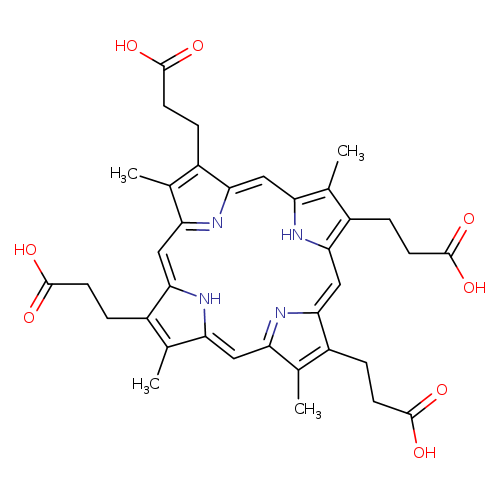
DescriptionCoproporphyrin III is a porphyrin metabolite arising from heme synthesis. Porphyrins are pigments found in both animal and plant life. Coproporphyrin III is a tetrapyrrole dead-end product from the spontaneous oxidation of the methylene bridges of coproporphynogen, arising from heme synthesis and secreted in feces and urine. Increased levels of coproporphyrins can indicate congenital erythropoietic porphyria or sideroblastic anaemia. Porphyria is a pathological state characterised by abnormalities of porphyrin metabolism and results in the excretion of large quantities of porphyrins in the urine and in extreme sensitivity to light. A large number of factors are capable of increasing porphyrin excretion, owing to different and multiple causes and etiologies: 1) the main site of the chronic hepatic porphyria disease process concentrates on the liver, 2) a functional and morphologic liver injury is almost regularly associated with this chronic porphyria, 3) the toxic form due to occupational and environmental exposure takes mainly a subclinical course. Hepatic factors includes disturbance in coproporphyrinogen metabolism, which results from inhibition of coproporphyrinogen oxidase as well as from the rapid loss from, and diminished utilization of coproporphyrinogen in the hepatocytes, which may also explain why coproporphyrin, its autoxidation product, predominates physiologically in the urine; decreased biliary excretion of coproporphyrin leading to a compensatory urinary excretion, so that the coproporphyrin ring isomer ratio (1:III) becomes a sensitive index for impaired liver function and intrahepatic cholestasis; and disturbed activity of hepatic uroporphyrinogen decarboxylase. In itself, secondary coproporphyrinuria is not associated with porphyria symptoms of a hepatologic-gastroenterologic, neurologic, or dermatologic order, even though coproporphyrinuria can occur with such symptoms. (1).
Contaminant Sources
  • FooDB Chemicals
  • HMDB Contaminants - Urine
  • T3DB toxins
Contaminant Type
  • Animal Toxin
  • Food Toxin
  • Metabolite
  • Natural Compound
  • Organic Compound
  • Plant Toxin
Chemical Structure
Thumb
Synonyms
ValueSource
3,8,13,17-Tetramethylporphyrin-2,7,12,18-tetrapropanoic acidChEBI
3,8,13,17-Tetramethylporphyrin-2,7,12,18-tetrapropanoateGenerator
Chemical FormulaC36H38N4O8
Average Molecular Mass654.709 g/mol
Monoisotopic Mass654.269 g/mol
CAS Registry Number14643-66-4
IUPAC Name3-[9,15,19-tris(2-carboxyethyl)-5,10,14,20-tetramethyl-21,22,23,24-tetraazapentacyclo[16.2.1.1^{3,6}.1^{8,11}.1^{13,16}]tetracosa-1(20),2,4,6(24),7,9,11,13(22),14,16,18-undecaen-4-yl]propanoic acid
Traditional Name3-[9,15,19-tris(2-carboxyethyl)-5,10,14,20-tetramethyl-21,22,23,24-tetraazapentacyclo[16.2.1.1^{3,6}.1^{8,11}.1^{13,16}]tetracosa-1(20),2,4,6(24),7,9,11,13(22),14,16,18-undecaen-4-yl]propanoic acid
SMILESCC1=C(CCC(O)=O)/C2=C/C3=N/C(=C\C4=C(C)C(CCC(O)=O)=C(N4)/C=C4\N=C(\C=C\1/N\2)C(C)=C4CCC(O)=O)/C(CCC(O)=O)=C3C
InChI IdentifierInChI=1S/C36H38N4O8/c1-17-21(5-9-33(41)42)29-14-27-19(3)22(6-10-34(43)44)30(39-27)15-28-20(4)24(8-12-36(47)48)32(40-28)16-31-23(7-11-35(45)46)18(2)26(38-31)13-25(17)37-29/h13-16,37,40H,5-12H2,1-4H3,(H,41,42)(H,43,44)(H,45,46)(H,47,48)/b25-13-,26-13-,27-14-,28-15-,29-14-,30-15-,31-16-,32-16-
InChI KeyJWFCYWSMNRLXLX-UJJXFSCMSA-N
Chemical Taxonomy
Description belongs to the class of organic compounds known as porphyrins. Porphyrins are compounds containing a fundamental skeleton of four pyrrole nuclei united through the alpha-positions by four methine groups to form a macrocyclic structure.
KingdomOrganic compounds
Super ClassOrganoheterocyclic compounds
ClassTetrapyrroles and derivatives
Sub ClassPorphyrins
Direct ParentPorphyrins
Alternative ParentsNot Available
SubstituentsNot Available
Molecular FrameworkNot Available
External DescriptorsNot Available
Biological Properties
StatusDetected and Not Quantified
OriginEndogenous
Cellular Locations
  • Cytoplasm
  • Membrane
  • Mitochondria
Biofluid LocationsNot Available
Tissue Locations
  • Liver
Pathways
NameSMPDB LinkKEGG Link
Porphyrin MetabolismSMP00024 map00860
Congenital Erythropoietic Porphyria (CEP) or Gunther DiseaseSMP00345 Not Available
Porphyria Variegata (PV)SMP00346 Not Available
ApplicationsNot Available
Biological Roles
Chemical RolesNot Available
Physical Properties
StateSolid
AppearanceWhite powder.
Experimental Properties
PropertyValue
Melting PointNot Available
Boiling PointNot Available
SolubilityNot Available
Predicted Properties
PropertyValueSource
Water Solubility0.031 g/LALOGPS
logP2.53ALOGPS
logP4.95ChemAxon
logS-4.3ALOGPS
pKa (Strongest Acidic)3.52ChemAxon
pKa (Strongest Basic)5.16ChemAxon
Physiological Charge-4ChemAxon
Hydrogen Acceptor Count10ChemAxon
Hydrogen Donor Count6ChemAxon
Polar Surface Area206.56 ŲChemAxon
Rotatable Bond Count12ChemAxon
Refractivity176.26 m³·mol⁻¹ChemAxon
Polarizability73.93 ųChemAxon
Number of Rings5ChemAxon
Bioavailability0ChemAxon
Rule of FiveNoChemAxon
Ghose FilterNoChemAxon
Veber's RuleNoChemAxon
MDDR-like RuleYesChemAxon
Spectra
Spectra
Spectrum TypeDescriptionSplash KeyView
Predicted GC-MSPredicted GC-MS Spectrum - GC-MS (Non-derivatized) - 70eV, Positivesplash10-052g-2000089000-f03a7599281003918c9dSpectrum
Predicted GC-MSPredicted GC-MS Spectrum - GC-MS (TMS_1_1) - 70eV, PositiveNot AvailableSpectrum
Predicted GC-MSPredicted GC-MS Spectrum - GC-MS (TMS_1_2) - 70eV, PositiveNot AvailableSpectrum
Predicted GC-MSPredicted GC-MS Spectrum - GC-MS (TMS_1_3) - 70eV, PositiveNot AvailableSpectrum
Predicted GC-MSPredicted GC-MS Spectrum - GC-MS (TMS_1_4) - 70eV, PositiveNot AvailableSpectrum
Predicted GC-MSPredicted GC-MS Spectrum - GC-MS (TMS_1_5) - 70eV, PositiveNot AvailableSpectrum
Predicted GC-MSPredicted GC-MS Spectrum - GC-MS (TMS_1_6) - 70eV, PositiveNot AvailableSpectrum
Predicted GC-MSPredicted GC-MS Spectrum - GC-MS (TMS_2_1) - 70eV, PositiveNot AvailableSpectrum
Predicted GC-MSPredicted GC-MS Spectrum - GC-MS (TMS_2_2) - 70eV, PositiveNot AvailableSpectrum
Predicted GC-MSPredicted GC-MS Spectrum - GC-MS (TMS_2_3) - 70eV, PositiveNot AvailableSpectrum
Predicted GC-MSPredicted GC-MS Spectrum - GC-MS (TMS_2_4) - 70eV, PositiveNot AvailableSpectrum
Predicted GC-MSPredicted GC-MS Spectrum - GC-MS (TMS_2_5) - 70eV, PositiveNot AvailableSpectrum
Predicted GC-MSPredicted GC-MS Spectrum - GC-MS (TMS_2_6) - 70eV, PositiveNot AvailableSpectrum
Predicted GC-MSPredicted GC-MS Spectrum - GC-MS (TMS_2_7) - 70eV, PositiveNot AvailableSpectrum
Predicted GC-MSPredicted GC-MS Spectrum - GC-MS (TMS_2_8) - 70eV, PositiveNot AvailableSpectrum
Predicted GC-MSPredicted GC-MS Spectrum - GC-MS (TMS_2_9) - 70eV, PositiveNot AvailableSpectrum
Predicted GC-MSPredicted GC-MS Spectrum - GC-MS (TMS_2_10) - 70eV, PositiveNot AvailableSpectrum
Predicted GC-MSPredicted GC-MS Spectrum - GC-MS (TMS_2_11) - 70eV, PositiveNot AvailableSpectrum
Predicted GC-MSPredicted GC-MS Spectrum - GC-MS (TMS_2_12) - 70eV, PositiveNot AvailableSpectrum
Predicted GC-MSPredicted GC-MS Spectrum - GC-MS (TMS_2_13) - 70eV, PositiveNot AvailableSpectrum
Predicted GC-MSPredicted GC-MS Spectrum - GC-MS (TMS_2_14) - 70eV, PositiveNot AvailableSpectrum
Predicted GC-MSPredicted GC-MS Spectrum - GC-MS (TMS_2_15) - 70eV, PositiveNot AvailableSpectrum
Predicted GC-MSPredicted GC-MS Spectrum - GC-MS (TMS_3_1) - 70eV, PositiveNot AvailableSpectrum
Predicted GC-MSPredicted GC-MS Spectrum - GC-MS (TMS_3_2) - 70eV, PositiveNot AvailableSpectrum
Predicted GC-MSPredicted GC-MS Spectrum - GC-MS (TMS_3_3) - 70eV, PositiveNot AvailableSpectrum
Predicted LC-MS/MSPredicted LC-MS/MS Spectrum - 10V, Positivesplash10-00kr-0000059000-ee622066b0f73e50cf91Spectrum
Predicted LC-MS/MSPredicted LC-MS/MS Spectrum - 20V, Positivesplash10-00kp-0000094000-ee6c72d818b957fec0b6Spectrum
Predicted LC-MS/MSPredicted LC-MS/MS Spectrum - 40V, Positivesplash10-01ot-0000090000-87edb6484e1fd9c98561Spectrum
Predicted LC-MS/MSPredicted LC-MS/MS Spectrum - 10V, Negativesplash10-0f79-0000029000-08747adb62bb52441aebSpectrum
Predicted LC-MS/MSPredicted LC-MS/MS Spectrum - 20V, Negativesplash10-052u-1000079000-d36d808ce647034f9109Spectrum
Predicted LC-MS/MSPredicted LC-MS/MS Spectrum - 40V, Negativesplash10-052f-7000094000-b86bf714ce0924edc701Spectrum
Predicted LC-MS/MSPredicted LC-MS/MS Spectrum - 10V, Positivesplash10-05n0-0000019000-dbabbc75ab65e178136eSpectrum
Predicted LC-MS/MSPredicted LC-MS/MS Spectrum - 20V, Positivesplash10-05p6-0000079000-ce9c57417ac25b4744d6Spectrum
Predicted LC-MS/MSPredicted LC-MS/MS Spectrum - 40V, Positivesplash10-00kf-1000091000-12a4e59244652240a7d0Spectrum
Predicted LC-MS/MSPredicted LC-MS/MS Spectrum - 10V, Negativesplash10-0udr-0000029000-acad21a4e05418a58cecSpectrum
Predicted LC-MS/MSPredicted LC-MS/MS Spectrum - 20V, Negativesplash10-00kf-0000094000-84fc3e3b8cde3d282f7eSpectrum
Predicted LC-MS/MSPredicted LC-MS/MS Spectrum - 40V, Negativesplash10-03di-0000090000-26e94889c74c71b9b237Spectrum
1D NMR13C NMR SpectrumNot AvailableSpectrum
1D NMR1H NMR SpectrumNot AvailableSpectrum
1D NMR13C NMR SpectrumNot AvailableSpectrum
1D NMR1H NMR SpectrumNot AvailableSpectrum
1D NMR13C NMR SpectrumNot AvailableSpectrum
1D NMR1H NMR SpectrumNot AvailableSpectrum
1D NMR13C NMR SpectrumNot AvailableSpectrum
1D NMR1H NMR SpectrumNot AvailableSpectrum
1D NMR13C NMR SpectrumNot AvailableSpectrum
1D NMR1H NMR SpectrumNot AvailableSpectrum
1D NMR13C NMR SpectrumNot AvailableSpectrum
1D NMR1H NMR SpectrumNot AvailableSpectrum
1D NMR13C NMR SpectrumNot AvailableSpectrum
1D NMR1H NMR SpectrumNot AvailableSpectrum
1D NMR13C NMR SpectrumNot AvailableSpectrum
1D NMR1H NMR SpectrumNot AvailableSpectrum
1D NMR13C NMR SpectrumNot AvailableSpectrum
1D NMR1H NMR SpectrumNot AvailableSpectrum
1D NMR13C NMR SpectrumNot AvailableSpectrum
1D NMR1H NMR SpectrumNot AvailableSpectrum
Toxicity Profile
Route of ExposureNot Available
Mechanism of ToxicityNot Available
MetabolismNot Available
Toxicity ValuesNot Available
Lethal DoseNot Available
Carcinogenicity (IARC Classification)No indication of carcinogenicity to humans (not listed by IARC).
Uses/SourcesThis is an endogenously produced metabolite found in the human body. It is used in metabolic reactions, catabolic reactions or waste generation.
Minimum Risk LevelNot Available
Health EffectsChronically high levels of porophyrins are associated with porphyrias such as Porphyria variegate, Acute Intermittent Porphyria and Hereditary Coproporphyria (HCP).
SymptomsNot Available
TreatmentNot Available
Concentrations
Not Available
DrugBank IDNot Available
HMDB IDHMDB0000570
FooDB IDFDB005557
Phenol Explorer IDNot Available
KNApSAcK IDNot Available
BiGG IDNot Available
BioCyc IDCOPROPORPHYRIN_III
METLIN ID5553
PDB IDNot Available
Wikipedia LinkNot Available
Chemspider ID16736509
ChEBI ID27609
PubChem Compound IDNot Available
Kegg Compound IDC05770
YMDB IDYMDB16116
ECMDB IDECMDB00570
References
Synthesis Reference

Ichiro Kojima, Kenji Maruhashi, Yasuo Fujiwara, “Process for producing coproporphyrin III.” U.S. Patent US4334021, issued September, 1978.

MSDSNot Available
General References
1. Minoda, Taiji; Takada, Toshihiro; Horii, Shinichi. Coproporphyrin III. Jpn. Kokai Tokkyo Koho (1979), 3 pp.
2. Doss MO: Porphyrinurias and occupational disease. Ann N Y Acad Sci. 1987;514:204-18.