Record Information
Version1.0
Creation Date2014-08-29 06:27:15 UTC
Update Date2026-05-14 16:24:02 UTC
Accession NumberCHEM003285
Identification
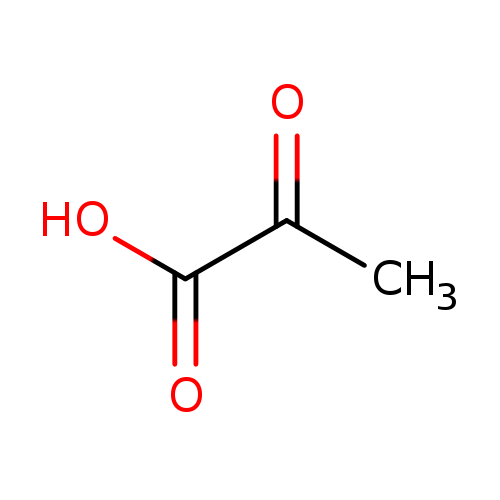
Common NamePyruvic acid
ClassSmall Molecule
DescriptionPyruvic acid is an intermediate compound in the metabolism of carbohydrates, proteins, and fats. In thiamine deficiency, its oxidation is retarded and it accumulates in the tissues, especially in nervous structures. (From Stedman, 26th ed.) Biological Source: Intermediate in primary metabolism including fermentation processes. Present in muscle in redox equilibrium with Lactic acid. A common constituent, as a chiral cyclic acetal linked to saccharide residues, of bacterial polysaccharides. Isolated from cane sugar fermentation broth and peppermint. Constituent of Bauhinia purpurea, Cicer arietinum (chickpea), Delonix regia, Pisum sativum (pea) and Trigonella caerulea (sweet trefoil) Use/Importance: Reagent for regeneration of carbonyl compdounds from semicarbazones, phenylhydrazones and oximes.
Contaminant Sources
  • EAFUS Chemicals
  • FooDB Chemicals
  • HMDB Contaminants - Feces
  • HMDB Contaminants - Urine
  • HPV EPA Chemicals
  • STOFF IDENT Compounds
  • T3DB toxins
  • ToxCast & Tox21 Chemicals
Contaminant Type
  • Animal Toxin
  • Dietary Supplement
  • Drug
  • Food Toxin
  • Metabolite
  • Micronutrient
  • Natural Compound
  • Nutraceutical
  • Organic Compound
  • Supplement
Chemical Structure
Thumb
Synonyms
ValueSource
2-Ketopropionic acidChEBI
2-Oxopropanoic acidChEBI
2-OxopropansaeureChEBI
2-OxopropionsaeureChEBI
Acetylformic acidChEBI
Acide pyruviqueChEBI
alpha-Ketopropionic acidChEBI
alpha-OxopropionsaeureChEBI
BrenztraubensaeureChEBI
BTSChEBI
CH3COCOOHChEBI
Pyroracemic acidChEBI
2-OxopropanoateKegg
2-KetopropionateGenerator
AcetylformateGenerator
a-KetopropionateGenerator
a-Ketopropionic acidGenerator
alpha-KetopropionateGenerator
Α-ketopropionateGenerator
Α-ketopropionic acidGenerator
a-OxopropionsaeureGenerator
Α-oxopropionsaeureGenerator
PyroracemateGenerator
PyruvateGenerator
2-OxopropionateHMDB
2-Oxopropionic acidHMDB
Acid, pyruvicMeSH, HMDB
Pyruvic acidHMDB
alpha-Ketopropanoic acidHMDB
α-Ketopropanoic acidHMDB
Chemical FormulaC3H4O3
Average Molecular Mass88.062 g/mol
Monoisotopic Mass88.016 g/mol
CAS Registry Number127-17-3
IUPAC Name2-oxopropanoic acid
Traditional Namepyruvic acid
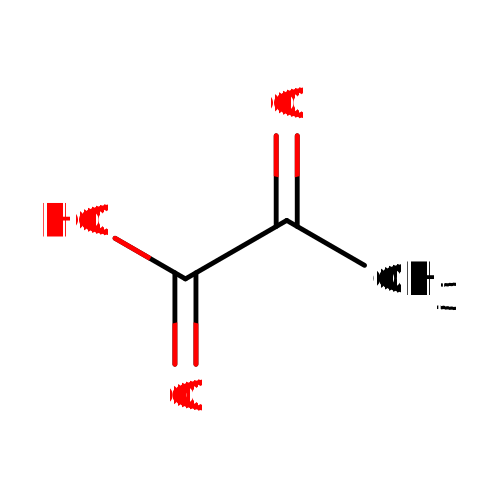
SMILESCC(=O)C(O)=O
InChI IdentifierInChI=1S/C3H4O3/c1-2(4)3(5)6/h1H3,(H,5,6)
InChI KeyLCTONWCANYUPML-UHFFFAOYSA-N
Chemical Taxonomy
Description belongs to the class of organic compounds known as alpha-keto acids and derivatives. These are organic compounds containing an aldehyde substituted with a keto group on the adjacent carbon.
KingdomOrganic compounds
Super ClassOrganic acids and derivatives
ClassKeto acids and derivatives
Sub ClassAlpha-keto acids and derivatives
Direct ParentAlpha-keto acids and derivatives
Alternative Parents
Substituents
  • Alpha-keto acid
  • Alpha-hydroxy ketone
  • Ketone
  • Monocarboxylic acid or derivatives
  • Carboxylic acid
  • Carboxylic acid derivative
  • Organic oxygen compound
  • Organic oxide
  • Hydrocarbon derivative
  • Organooxygen compound
  • Carbonyl group
  • Aliphatic acyclic compound
Molecular FrameworkAliphatic acyclic compounds
External Descriptors
Biological Properties
StatusDetected and Not Quantified
OriginEndogenous
Cellular Locations
  • Cytoplasm
  • Extracellular
  • Mitochondria
  • Peroxisome
Biofluid LocationsNot Available
Tissue Locations
  • Adipose Tissue
  • Brain
  • Fibroblasts
  • Kidney
  • Liver
  • Muscle
  • Myocardium
  • Neuron
  • Pancreas
  • Skeletal Muscle
  • Spleen
  • Testes
  • Thyroid Gland
Pathways
NameSMPDB LinkKEGG Link
Alanine MetabolismSMP00055 map00250
Amino Sugar MetabolismSMP00045 map00520
Ammonia RecyclingSMP00009 map00910
Citric Acid CycleSMP00057 map00020
Cysteine MetabolismSMP00013 map00270
GluconeogenesisSMP00128 Not Available
Glucose-Alanine CycleSMP00127 Not Available
Glycine and Serine MetabolismSMP00004 map00260
GlycolysisSMP00040 Not Available
Pyruvaldehyde DegradationSMP00459 Not Available
Pyruvate MetabolismSMP00060 map00620
Transfer of Acetyl Groups into MitochondriaSMP00466 Not Available
Urea CycleSMP00059 Not Available
Congenital lactic acidosisSMP00546 Not Available
Pyruvate Carboxylase DeficiencySMP00350 Not Available
Pyruvate Decarboxylase E1 Component Deficiency (PDHE1 Deficiency)SMP00334 Not Available
Pyruvate Dehydrogenase Complex DeficiencySMP00212 Not Available
Pyruvate dehydrogenase deficiency (E3)SMP00550 Not Available
ApplicationsNot Available
Biological Roles
Chemical RolesNot Available
Physical Properties
StateLiquid
AppearanceNot Available
Experimental Properties
PropertyValue
Melting Point13.8°C
Boiling Point54°C at 1.00E+01 mm Hg
Solubility1E+006 mg/L (at 20°C)
Predicted Properties
PropertyValueSource
Water Solubility134 g/LALOGPS
logP-0.38ALOGPS
logP0.066ChemAxon
logS0.18ALOGPS
pKa (Strongest Acidic)2.93ChemAxon
pKa (Strongest Basic)-9.6ChemAxon
Physiological Charge-1ChemAxon
Hydrogen Acceptor Count3ChemAxon
Hydrogen Donor Count1ChemAxon
Polar Surface Area54.37 ŲChemAxon
Rotatable Bond Count1ChemAxon
Refractivity17.99 m³·mol⁻¹ChemAxon
Polarizability7.31 ųChemAxon
Number of Rings0ChemAxon
Bioavailability1ChemAxon
Rule of FiveYesChemAxon
Ghose FilterNoChemAxon
Veber's RuleNoChemAxon
MDDR-like RuleNoChemAxon
Spectra
Spectra
Spectrum TypeDescriptionSplash KeyView
GC-MSGC-MS Spectrum - GC-EI-TOF (Pegasus III TOF-MS system, Leco; GC 6890, Agilent Technologies) (Non-derivatized)splash10-00dr-4900000000-f26ef76666e40ab9fe61Spectrum
GC-MSGC-MS Spectrum - GC-MS (1 MEOX; 1 TMS)splash10-00di-5900000000-b8e81f82572d4796e944Spectrum
GC-MSGC-MS Spectrum - GC-MS (2 TMS)splash10-014i-5970000000-154bf9ad168a12593fccSpectrum
GC-MSGC-MS Spectrum - EI-B (Non-derivatized)splash10-0006-9000000000-a2cf85a5e1d2379d26dfSpectrum
GC-MSGC-MS Spectrum - GC-EI-TOF (Non-derivatized)splash10-00dr-4900000000-f26ef76666e40ab9fe61Spectrum
GC-MSGC-MS Spectrum - GC-MS (Non-derivatized)splash10-00di-5900000000-b8e81f82572d4796e944Spectrum
GC-MSGC-MS Spectrum - GC-MS (Non-derivatized)splash10-014i-5970000000-154bf9ad168a12593fccSpectrum
GC-MSGC-MS Spectrum - GC-EI-TOF (Non-derivatized)splash10-00dr-5900000000-5b1f470d4ff91420618cSpectrum
Predicted GC-MSPredicted GC-MS Spectrum - GC-MS (Non-derivatized) - 70eV, Positivesplash10-0006-9000000000-5417b44aa241a7ba27e8Spectrum
Predicted GC-MSPredicted GC-MS Spectrum - GC-MS (1 TMS) - 70eV, Positivesplash10-00dm-9400000000-6db65a709bdc47e3adf7Spectrum
Predicted GC-MSPredicted GC-MS Spectrum - GC-MS (Non-derivatized) - 70eV, PositiveNot AvailableSpectrum
Predicted GC-MSPredicted GC-MS Spectrum - GC-MS (TMS_1_2) - 70eV, PositiveNot AvailableSpectrum
Predicted GC-MSPredicted GC-MS Spectrum - GC-MS (TBDMS_1_1) - 70eV, PositiveNot AvailableSpectrum
Predicted GC-MSPredicted GC-MS Spectrum - GC-MS (TBDMS_1_2) - 70eV, PositiveNot AvailableSpectrum
LC-MS/MSLC-MS/MS Spectrum - EI-B (HITACHI M-80B) , Positivesplash10-0006-9000000000-a2cf85a5e1d2379d26dfSpectrum
LC-MS/MSLC-MS/MS Spectrum - LC-ESI-QQ (API3000, Applied Biosystems) 10V, Negativesplash10-000i-9000000000-dd49835da8355fb6e625Spectrum
LC-MS/MSLC-MS/MS Spectrum - LC-ESI-QQ (API3000, Applied Biosystems) 20V, Negativesplash10-000i-9000000000-f09d8e3d7a774b255d89Spectrum
LC-MS/MSLC-MS/MS Spectrum - LC-ESI-QQ (API3000, Applied Biosystems) 30V, Negativesplash10-0006-9000000000-7d91f6f626cab1a366fdSpectrum
LC-MS/MSLC-MS/MS Spectrum - LC-ESI-QQ (API3000, Applied Biosystems) 40V, Negativesplash10-0006-9000000000-8ae98cdb3e142034e52aSpectrum
LC-MS/MSLC-MS/MS Spectrum - LC-ESI-QQ (API3000, Applied Biosystems) 50V, Negativesplash10-0006-9000000000-e04e6c68013983e1b6dcSpectrum
LC-MS/MSLC-MS/MS Spectrum - LC-ESI-QQ , negativesplash10-000i-9000000000-dd49835da8355fb6e625Spectrum
LC-MS/MSLC-MS/MS Spectrum - LC-ESI-QQ , negativesplash10-000i-9000000000-f09d8e3d7a774b255d89Spectrum
LC-MS/MSLC-MS/MS Spectrum - LC-ESI-QQ , negativesplash10-0006-9000000000-7d91f6f626cab1a366fdSpectrum
LC-MS/MSLC-MS/MS Spectrum - LC-ESI-QQ , negativesplash10-0006-9000000000-8ae98cdb3e142034e52aSpectrum
LC-MS/MSLC-MS/MS Spectrum - LC-ESI-QQ , negativesplash10-0006-9000000000-e04e6c68013983e1b6dcSpectrum
LC-MS/MSLC-MS/MS Spectrum - 10V, Negativesplash10-000f-9000000000-f24c93ecfd3928827154Spectrum
LC-MS/MSLC-MS/MS Spectrum - 40V, Negativesplash10-0udj-9000000000-fc3b9ad0c57f44261fbaSpectrum
LC-MS/MSLC-MS/MS Spectrum - 20V, Negativesplash10-014i-9000000000-f3444f8b94ee5a0a9f74Spectrum
LC-MS/MSLC-MS/MS Spectrum - 33V, Negativesplash10-0avr-9000000000-dc40a6a1b9b166d6e68aSpectrum
LC-MS/MSLC-MS/MS Spectrum - 33V, Negativesplash10-016r-9000000000-efac7b176bb77118ecb8Spectrum
Predicted LC-MS/MSPredicted LC-MS/MS Spectrum - 10V, Positivesplash10-000i-9000000000-d0defa72b09503c6d6d1Spectrum
Predicted LC-MS/MSPredicted LC-MS/MS Spectrum - 20V, Positivesplash10-000f-9000000000-c25fa150e9c490319a2aSpectrum
Predicted LC-MS/MSPredicted LC-MS/MS Spectrum - 40V, Positivesplash10-0006-9000000000-ccb42b4c05ddd001990fSpectrum
Predicted LC-MS/MSPredicted LC-MS/MS Spectrum - 10V, Negativesplash10-000i-9000000000-faf36ff70d6205370270Spectrum
Predicted LC-MS/MSPredicted LC-MS/MS Spectrum - 20V, Negativesplash10-000i-9000000000-60c1a02aabf80f51050fSpectrum
Predicted LC-MS/MSPredicted LC-MS/MS Spectrum - 40V, Negativesplash10-000f-9000000000-ca5f4a2f06787d8b62a0Spectrum
Predicted LC-MS/MSPredicted LC-MS/MS Spectrum - 10V, Positivesplash10-0006-9000000000-0eb1fb2cdd24bdc78601Spectrum
Predicted LC-MS/MSPredicted LC-MS/MS Spectrum - 20V, Positivesplash10-0006-9000000000-87bbaed151efac084591Spectrum
Predicted LC-MS/MSPredicted LC-MS/MS Spectrum - 40V, Positivesplash10-0006-9000000000-87bbaed151efac084591Spectrum
MSMass Spectrum (Electron Ionization)splash10-0006-9000000000-f315d0752893e7d0c657Spectrum
1D NMR13C NMR SpectrumNot AvailableSpectrum
1D NMR1H NMR SpectrumNot AvailableSpectrum
1D NMR13C NMR SpectrumNot AvailableSpectrum
1D NMR1H NMR SpectrumNot AvailableSpectrum
1D NMR13C NMR SpectrumNot AvailableSpectrum
1D NMR1H NMR SpectrumNot AvailableSpectrum
1D NMR13C NMR SpectrumNot AvailableSpectrum
1D NMR1H NMR SpectrumNot AvailableSpectrum
1D NMR13C NMR SpectrumNot AvailableSpectrum
1D NMR1H NMR SpectrumNot AvailableSpectrum
1D NMR13C NMR SpectrumNot AvailableSpectrum
1D NMR1H NMR SpectrumNot AvailableSpectrum
1D NMR13C NMR SpectrumNot AvailableSpectrum
1D NMR1H NMR SpectrumNot AvailableSpectrum
1D NMR13C NMR SpectrumNot AvailableSpectrum
1D NMR1H NMR SpectrumNot AvailableSpectrum
1D NMR13C NMR SpectrumNot AvailableSpectrum
1D NMR1H NMR SpectrumNot AvailableSpectrum
1D NMR13C NMR SpectrumNot AvailableSpectrum
1D NMR1H NMR SpectrumNot AvailableSpectrum
1D NMR13C NMR SpectrumNot AvailableSpectrum
1D NMR1H NMR SpectrumNot AvailableSpectrum
2D NMR[1H,13C] 2D NMR SpectrumNot AvailableSpectrum
Toxicity Profile
Route of ExposurePyruvate is absorbed from the gastrointestinal tract from whence it is transported to the liver via the portal circulation.
Mechanism of ToxicityPyruvate serves as a biological fuel by being converted to acetyl coenzyme A, which enters the tricarboxylic acid or Krebs cycle where it is metabolized to produce ATP aerobically. Energy can also be obtained anaerobically from pyruvate via its conversion to lactate. Pyruvate injections or perfusions increase contractile function of hearts when metabolizing glucose or fatty acids. This inotropic effect is striking in hearts stunned by ischemia/reperfusion. The inotropic effect of pyruvate requires intracoronary infusion. Among possible mechanisms for this effect are increased generation of ATP and an increase in ATP phosphorylation potential. Another is activation of pyruvate dehydrogenase, promoting its own oxidation by inhibiting pyruvate dehydrogenase kinase. Pyruvate dehydrogenase is inactivated in ischemia myocardium. Yet another is reduction of cytosolic inorganic phosphate concentration. Pyruvate, as an antioxidant, is known to scavenge such reactive oxygen species as hydrogen peroxide and lipid peroxides. Indirectly, supraphysiological levels of pyruvate may increase cellular reduced glutathione.
MetabolismIn the liver, pyruvate is metabolized via several pathways.
Toxicity ValuesNot Available
Lethal DoseNot Available
Carcinogenicity (IARC Classification)No indication of carcinogenicity to humans (not listed by IARC).
Uses/SourcesFor nutritional supplementation, also for treating dietary shortage or imbalance
Minimum Risk LevelNot Available
Health EffectsNot Available
SymptomsNot Available
TreatmentNot Available
Concentrations
Not Available
DrugBank IDDB00119
HMDB IDHMDB0000243
FooDB IDFDB031141
Phenol Explorer IDNot Available
KNApSAcK IDC00001200
BiGG IDNot Available
BioCyc IDPYRUVATE
METLIN IDNot Available
PDB IDNot Available
Wikipedia LinkPyruvic_acid
Chemspider IDNot Available
ChEBI ID32816
PubChem Compound ID1060
Kegg Compound IDC00022
YMDB IDYMDB00175
ECMDB IDECMDB00243
References
Synthesis Reference

Tadamitsu Kiyoura, “Process for producing salts of pyruvic acid.” U.S. Patent US4242525, issued December, 1965.

MSDSLink
General References
1. https://www.ncbi.nlm.nih.gov/pubmed/?term=11762589
2. https://www.ncbi.nlm.nih.gov/pubmed/?term=19260671
3. https://www.ncbi.nlm.nih.gov/pubmed/?term=22150460
4. https://www.ncbi.nlm.nih.gov/pubmed/?term=22233273
5. https://www.ncbi.nlm.nih.gov/pubmed/?term=22735334
6. https://www.ncbi.nlm.nih.gov/pubmed/?term=22770225