Record Information
Version1.0
Creation Date2014-08-29 06:50:53 UTC
Update Date2026-04-06 11:09:23 UTC
Accession NumberCHEM003357
Identification
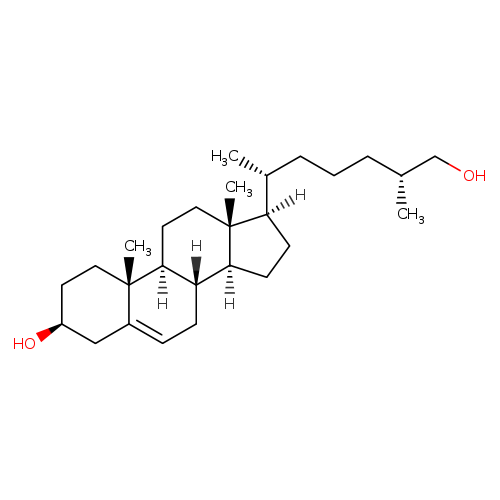
Common Name27-Hydroxycholesterol
ClassSmall Molecule
Description27-Hydroxycholesterol (C27H46O2) is an endogenous compound with an average molecular weight of 402.65 g/mol. It exists as a solid at room temperature. 27-Hydroxycholesterol belongs to the bile acids, alcohols and derivatives, a subclass of steroids and steroid derivatives within the organic compounds. This metabolite is found in humans and mice and has been detected in fibroblasts, neurons, and the brain. Biologically, it acts as an agonist (PMC10153636) and an inhibitor (PMC4087164). Specifically, it functions as an inhibitor of carboxylesterase (EC 3.1.1.1) and serves as an inducer of apoptosis. Its recorded protein targets include the estrogen receptor beta (ESR2) and the estrogen receptor (ESR1). Additionally, 27-hydroxycholesterol is utilized as a neuroprotective agent.
Contaminant Sources
  • FooDB Chemicals
  • T3DB toxins
Contaminant Type
  • Animal Toxin
  • Food Toxin
  • Industrial/Workplace Toxin
  • Metabolite
  • Natural Compound
  • Organic Compound
Chemical Structure
Thumb
Synonyms
ValueSource
(25R)-26-HydroxycholesterolChEBI
5-Cholestene-3beta,27-diolChEBI
Cholest-5-ene-3beta,27-diolChEBI
5-Cholestene-3b,27-diolGenerator
5-Cholestene-3β,27-diolGenerator
Cholest-5-ene-3b,27-diolGenerator
Cholest-5-ene-3β,27-diolGenerator
(25R)-Cholest-5-ene-3b,26-diolHMDB
(25R)-Cholest-5-ene-3beta,26-diolHMDB
(3-beta)-Cholest-5-ene-3,26-diolHMDB
(3b,25R)-Cholest-5-ene-3,26-diolHMDB
(3beta,25R)-Cholest-5-ene-3,26,diolHMDB
26-Hydroxycholesterol(25R)HMDB
Cholest-(25R)-5-en-3beta,26-diolHMDB
Cholest-5-ene-3-b,27-diolHMDB
Cholest-5-ene-3-beta,26-diolHMDB
Cholest-5-ene-3-beta,27-diolHMDB
Cholest-5-ene-3beta,26-diolHMDB
Cholest-5-ene-3 beta,27-diolHMDB
5-Cholestene-3 beta,27-diolHMDB
(25R)-Cholest-5-ene-3β,26-diolHMDB
(3Β,25R)-cholest-5-ene-3,26-diolHMDB
(3beta,25R)-Cholest-5-ene-3,26-diolHMDB
Cholest-5-ene-3β,26-diolHMDB
(3Β)-cholest-5-ene-3,26-diolHMDB
(3beta)-Cholest-5-ene-3,26-diolHMDB
26-HydroxycholesterolHMDB
(3 beta,25R)-Cholest-5-ene-3,26-diolHMDB
26-Hydroxycholesterol, (25R)HMDB
(25R)-Cholest-5-ene-3 beta,26-diolHMDB
Chemical FormulaC27H46O2
Average Molecular Mass402.653 g/mol
Monoisotopic Mass402.350 g/mol
CAS Registry Number20380-11-4
IUPAC NameNot Available
Traditional Name(1S,2R,5S,10S,11S,14R,15R)-14-[(2R,6R)-7-hydroxy-6-methylheptan-2-yl]-2,15-dimethyltetracyclo[8.7.0.0^{2,7}.0^{11,15}]heptadec-7-en-5-ol
SMILES[H][C@@]12CC[C@H]([C@H](C)CCC[C@@H](C)CO)[C@@]1(C)CC[C@@]1([H])[C@@]2([H])CC=C2C[C@@H](O)CC[C@]12C
InChI IdentifierInChI=1S/C27H46O2/c1-18(17-28)6-5-7-19(2)23-10-11-24-22-9-8-20-16-21(29)12-14-26(20,3)25(22)13-15-27(23,24)4/h8,18-19,21-25,28-29H,5-7,9-17H2,1-4H3/t18-,19-,21+,22+,23-,24+,25+,26+,27-/m1/s1
InChI KeyFYHRJWMENCALJY-YSQMORBQSA-N
Chemical Taxonomy
Description belongs to the class of organic compounds known as dihydroxy bile acids, alcohols and derivatives. Dihydroxy bile acids, alcohols and derivatives are compounds containing or derived from a bile acid or alcohol, and which bears exactly two carboxylic acid groups.

KingdomOrganic compounds
Super ClassLipids and lipid-like molecules
ClassSteroids and steroid derivatives
Sub ClassBile acids, alcohols and derivatives
Direct ParentDihydroxy bile acids, alcohols and derivatives
Alternative Parents
Substituents
  • 26-hydroxysteroid
  • Dihydroxy bile acid, alcohol, or derivatives
  • 3-hydroxy-delta-5-steroid
  • 3-hydroxysteroid
  • Hydroxysteroid
  • 3-beta-hydroxy-delta-5-steroid
  • 3-beta-hydroxysteroid
  • Delta-5-steroid
  • Fatty alcohol
  • Fatty acyl
  • Cyclic alcohol
  • Secondary alcohol
  • Organooxygen compound
  • Alcohol
  • Hydrocarbon derivative
  • Organic oxygen compound
  • Primary alcohol
  • Aliphatic homopolycyclic compound
Molecular FrameworkAliphatic homopolycyclic compounds
External Descriptors
Biological Properties
StatusDetected and Not Quantified
OriginEndogenous
Cellular Locations
  • Extracellular
  • Membrane
Biofluid LocationsNot Available
Tissue Locations
  • Brain
  • Fibroblasts
  • Neuron
Pathways
NameSMPDB LinkKEGG Link
Bile Acid BiosynthesisSMP00035 Not Available
Congenital Bile Acid Synthesis Defect Type IIISMP00318 Not Available
Bile Acid BiosynthesisSMP0000035 Not Available
Congenital Bile Acid Synthesis Defect Type IISMP0000314 Not Available
Congenital Bile Acid Synthesis Defect Type IIISMP0000318 Not Available
Zellweger SyndromeSMP0000316 Not Available
Cerebrotendinous Xanthomatosis (CTX)SMP0000315 Not Available
27-Hydroxylase DeficiencySMP0000720 Not Available
Congenital Bile Acid Synthesis Defect Type IISMP0125689 Not Available
Congenital Bile Acid Synthesis Defect Type IIISMP0125690 Not Available
Familial Hypercholanemia (FHCA)SMP0125695 Not Available
Zellweger SyndromeSMP0125696 Not Available
Cerebrotendinous Xanthomatosis (CTX)SMP0125697 Not Available
Applications
Biological Roles
Chemical Roles
Physical Properties
StateSolid
AppearanceWhite powder.
Experimental Properties
PropertyValue
Melting PointNot Available
Boiling PointNot Available
SolubilityNot Available
Predicted Properties
PropertyValueSource
Water Solubility0.00021 g/LALOGPS
logP6.21ALOGPS
logP5.75ChemAxon
logS-6.3ALOGPS
pKa (Strongest Acidic)17.42ChemAxon
pKa (Strongest Basic)-1.2ChemAxon
Physiological Charge0ChemAxon
Hydrogen Acceptor Count2ChemAxon
Hydrogen Donor Count2ChemAxon
Polar Surface Area40.46 ŲChemAxon
Rotatable Bond Count6ChemAxon
Refractivity122.47 m³·mol⁻¹ChemAxon
Polarizability51.56 ųChemAxon
Number of Rings4ChemAxon
Bioavailability1ChemAxon
Rule of FiveNoChemAxon
Ghose FilterNoChemAxon
Veber's RuleNoChemAxon
MDDR-like RuleYesChemAxon
Spectra
Spectra
Spectrum TypeDescriptionSplash KeyView
Predicted GC-MSPredicted GC-MS Spectrum - GC-MS (Non-derivatized) - 70eV, Positivesplash10-00du-0009000000-c409240ea9f4c08e2ba0Spectrum
Predicted GC-MSPredicted GC-MS Spectrum - GC-MS (2 TMS) - 70eV, Positivesplash10-001i-1211490000-d6f5e80defdccceda31cSpectrum
Predicted GC-MSPredicted GC-MS Spectrum - GC-MS (Non-derivatized) - 70eV, PositiveNot AvailableSpectrum
Predicted LC-MS/MSPredicted LC-MS/MS Spectrum - 10V, Positivesplash10-0f79-0009200000-9ee1df2377674be6691cSpectrum
Predicted LC-MS/MSPredicted LC-MS/MS Spectrum - 20V, Positivesplash10-00kr-2109000000-2471d899cb75de6d3684Spectrum
Predicted LC-MS/MSPredicted LC-MS/MS Spectrum - 40V, Positivesplash10-0r29-3139000000-969ef6deb6437f21d9adSpectrum
Predicted LC-MS/MSPredicted LC-MS/MS Spectrum - 10V, Negativesplash10-0udi-0004900000-2045d37649040dcd2d05Spectrum
Predicted LC-MS/MSPredicted LC-MS/MS Spectrum - 20V, Negativesplash10-0ue9-0009500000-ac02d066655429b00b85Spectrum
Predicted LC-MS/MSPredicted LC-MS/MS Spectrum - 40V, Negativesplash10-0a4r-3009000000-8b6280720e1ee0be80b4Spectrum
Predicted LC-MS/MSPredicted LC-MS/MS Spectrum - 10V, Positivesplash10-0f79-1209500000-a16dd407d41c22cc3144Spectrum
Predicted LC-MS/MSPredicted LC-MS/MS Spectrum - 20V, Positivesplash10-0cdr-6479100000-db657345009052fe71e1Spectrum
Predicted LC-MS/MSPredicted LC-MS/MS Spectrum - 40V, Positivesplash10-0a4i-5910000000-84a62c4f6410b3c0eda9Spectrum
Predicted LC-MS/MSPredicted LC-MS/MS Spectrum - 10V, Negativesplash10-0udi-0001900000-8975f0b18ceee10bde58Spectrum
Predicted LC-MS/MSPredicted LC-MS/MS Spectrum - 20V, Negativesplash10-0udi-0004900000-459f540b58ddc4074d2aSpectrum
Predicted LC-MS/MSPredicted LC-MS/MS Spectrum - 40V, Negativesplash10-0002-0009000000-8268359a5f25a118a8c6Spectrum
Toxicity Profile
Route of ExposureNot Available
Mechanism of ToxicityNot Available
MetabolismNot Available
Toxicity ValuesNot Available
Lethal DoseNot Available
Carcinogenicity (IARC Classification)No indication of carcinogenicity to humans (not listed by IARC).
Uses/SourcesThis is an endogenously produced metabolite found in the human body. It is used in metabolic reactions, catabolic reactions or waste generation.
Minimum Risk LevelNot Available
Health EffectsNot Available
SymptomsNot Available
TreatmentNot Available
Concentrations
Not Available
DrugBank IDNot Available
HMDB IDHMDB0002103
FooDB IDFDB022846
Phenol Explorer IDNot Available
KNApSAcK IDNot Available
BiGG ID48021
BioCyc IDNot Available
METLIN ID6487
PDB IDNot Available
Wikipedia Link27-Hydroxycholesterol
Chemspider ID110495
ChEBI ID76591
PubChem Compound ID123976
Kegg Compound IDC06340
YMDB IDNot Available
ECMDB IDNot Available
References
Synthesis ReferenceHausheer, Frederick H.; Haridas, Kochat. Process for preparing 27-hydroxycholesterol and related derivatives. PCT Int. Appl. (1997), 38 pp.
MSDSNot Available
General References
1. https://www.ncbi.nlm.nih.gov/pubmed/?term=21546230
2. https://www.ncbi.nlm.nih.gov/pubmed/?term=22281802
3. https://www.ncbi.nlm.nih.gov/pubmed/?term=22652365
4. https://www.ncbi.nlm.nih.gov/pubmed/?term=22884615
5. https://www.ncbi.nlm.nih.gov/pubmed/?term=23041327
6. https://www.ncbi.nlm.nih.gov/pubmed/?term=23111110
7. https://www.ncbi.nlm.nih.gov/pubmed/?term=23168292
8. https://www.ncbi.nlm.nih.gov/pubmed/?term=23246833
9. https://www.ncbi.nlm.nih.gov/pubmed/?term=23850851
10. https://www.ncbi.nlm.nih.gov/pubmed/?term=23951005
11. https://www.ncbi.nlm.nih.gov/pubmed/?term=24210818
12. https://www.ncbi.nlm.nih.gov/pubmed/?term=24269812
13. https://www.ncbi.nlm.nih.gov/pubmed/?term=24288332
14. https://www.ncbi.nlm.nih.gov/pubmed/?term=24370436
15. Hausheer, Frederick H.; Haridas, Kochat. Process for preparing 27-hydroxycholesterol and related derivatives. PCT Int. Appl. (1997), 38 pp.
16. Burkard I, Rentsch KM, von Eckardstein A: Determination of 24S- and 27-hydroxycholesterol in plasma by high-performance liquid chromatography-mass spectrometry. J Lipid Res. 2004 Apr;45(4):776-81. Epub 2004 Jan 16.
17. Fu X, Menke JG, Chen Y, Zhou G, MacNaul KL, Wright SD, Sparrow CP, Lund EG: 27-hydroxycholesterol is an endogenous ligand for liver X receptor in cholesterol-loaded cells. J Biol Chem. 2001 Oct 19;276(42):38378-87. Epub 2001 Aug 14.
18. Rajagopalon I, Kok E, Cohen BI, Javitt NB: 26-Hydroxycholesterol disulfate: metabolism and excretion in the normal neonate. J Steroid Biochem. 1986 Dec;25(6):991-4.
19. Li S, Pang J, Jackson EM, Wilson WK, Mott GE, Schroepfer GJ Jr: Kinetics and plasma concentrations of 26-hydroxycholesterol in baboons. Biochim Biophys Acta. 2000 May 31;1485(2-3):173-84.
20. Frolov A, Zielinski SE, Crowley JR, Dudley-Rucker N, Schaffer JE, Ory DS: NPC1 and NPC2 regulate cellular cholesterol homeostasis through generation of low density lipoprotein cholesterol-derived oxysterols. J Biol Chem. 2003 Jul 11;278(28):25517-25. Epub 2003 Apr 28.
21. Brown J 3rd, Theisler C, Silberman S, Magnuson D, Gottardi-Littell N, Lee JM, Yager D, Crowley J, Sambamurti K, Rahman MM, Reiss AB, Eckman CB, Wolozin B: Differential expression of cholesterol hydroxylases in Alzheimer's disease. J Biol Chem. 2004 Aug 13;279(33):34674-81. Epub 2004 May 17.
22. Leoni V, Masterman T, Mousavi FS, Wretlind B, Wahlund LO, Diczfalusy U, Hillert J, Bjorkhem I: Diagnostic use of cerebral and extracerebral oxysterols. Clin Chem Lab Med. 2004 Feb;42(2):186-91.
23. Bellosta S, Corsini A, Bernini F, Granata A, Didoni G, Mazzotti M, Fumagalli R: 27-Hydroxycholesterol modulation of low density lipoprotein metabolism in cultured human hepatic and extrahepatic cells. FEBS Lett. 1993 Oct 11;332(1-2):115-8.
24. Heverin M, Bogdanovic N, Lutjohann D, Bayer T, Pikuleva I, Bretillon L, Diczfalusy U, Winblad B, Bjorkhem I: Changes in the levels of cerebral and extracerebral sterols in the brain of patients with Alzheimer's disease. J Lipid Res. 2004 Jan;45(1):186-93. Epub 2003 Oct 1.
25. Shoda J, Toll A, Axelson M, Pieper F, Wikvall K, Sjovall J: Formation of 7 alpha- and 7 beta-hydroxylated bile acid precursors from 27-hydroxycholesterol in human liver microsomes and mitochondria. Hepatology. 1993 Mar;17(3):395-403.
26. Goldman M, Vlahcevic ZR, Schwartz CC, Gustafsson J, Swell L: Bile acid metabolism in cirrhosis. VIII. Quantitative evaluation of bile acid synthesis from [7 beta-3H]7 alpha-hydroxycholesterol and [G-3H]26-hydroxycholesterol. Hepatology. 1982 Jan-Feb;2(1):59-66.
27. Summerfield JA, Billing BH, Shackleton CH: Identification of bile acids in the serum and urine in cholestasis. Evidence for 6alpha-hydroxylation of bile acids in man. Biochem J. 1976 Feb 15;154(2):507-16.
28. Lala DS, Syka PM, Lazarchik SB, Mangelsdorf DJ, Parker KL, Heyman RA: Activation of the orphan nuclear receptor steroidogenic factor 1 by oxysterols. Proc Natl Acad Sci U S A. 1997 May 13;94(10):4895-900.
29. Norlin M, Andersson U, Bjorkhem I, Wikvall K: Oxysterol 7 alpha-hydroxylase activity by cholesterol 7 alpha-hydroxylase (CYP7A). J Biol Chem. 2000 Nov 3;275(44):34046-53.
30. Babiker A, Dzeletovic S, Wiklund B, Pettersson N, Salonen J, Nyyssonen K, Eriksson M, Diczfalusy U, Bjorkhem I: Patients with atherosclerosis may have increased circulating levels of 27-hydroxycholesterol and cholestenoic acid. Scand J Clin Lab Invest. 2005;65(5):365-75.
31. Luomala M, Paiva H, Laaksonen R, Thelen K, Lutjohann D, Peltonen N, Lehtimaki T: Plasma-soluble CD40 is related to cholesterol metabolism in patients with moderate hypercholesterolemia. Scand Cardiovasc J. 2006 Oct;40(5):280-4.
32. Simons K, Toomre D: Lipid rafts and signal transduction. Nat Rev Mol Cell Biol. 2000 Oct;1(1):31-9.
33. Watson AD: Thematic review series: systems biology approaches to metabolic and cardiovascular disorders. Lipidomics: a global approach to lipid analysis in biological systems. J Lipid Res. 2006 Oct;47(10):2101-11. Epub 2006 Aug 10.
34. Sethi JK, Vidal-Puig AJ: Thematic review series: adipocyte biology. Adipose tissue function and plasticity orchestrate nutritional adaptation. J Lipid Res. 2007 Jun;48(6):1253-62. Epub 2007 Mar 20.
35. Lingwood D, Simons K: Lipid rafts as a membrane-organizing principle. Science. 2010 Jan 1;327(5961):46-50. doi: 10.1126/science.1174621.
36. Corsini A, Verri D, Raiteri M, Quarato P, Paoletti R, Fumagalli R: Effects of 26-aminocholesterol, 27-hydroxycholesterol, and 25-hydroxycholesterol on proliferation and cholesterol homeostasis in arterial myocytes. Arterioscler Thromb Vasc Biol. 1995 Mar;15(3):420-8.
37. The lipid handbook with CD-ROM