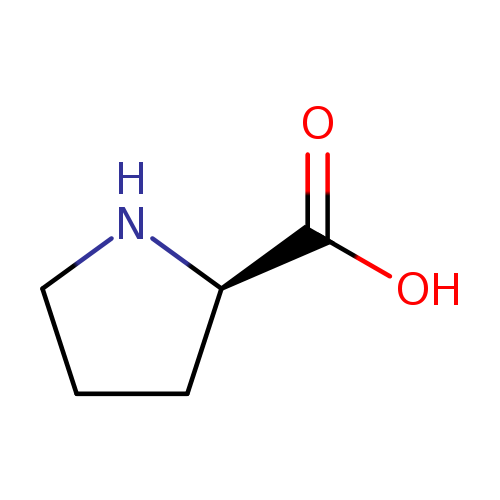
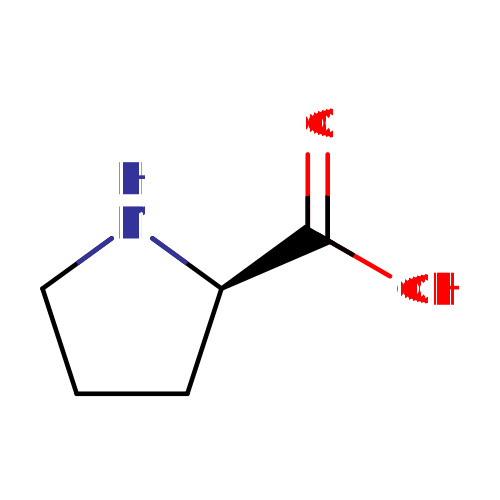
Record Information
Version1.0
Creation Date2014-08-29 06:51:04 UTC
Update Date2026-04-13 21:59:41 UTC
Accession NumberCHEM003370
Identification
Common NameD-Proline
ClassSmall Molecule
DescriptionD-proline is an isomer of the naturally occurring amino acid, L-Proline. D-amino acids have been found in relatively high abundance in human plasma and saliva These amino acids may be of bacterial origin, but there is also evidence that they are endogenously produced through amino acid racemase activity. (1, 2).
Contaminant Sources
  • FooDB Chemicals
  • HMDB Contaminants - Urine
  • T3DB toxins
Contaminant Type
  • Amine
  • Animal Toxin
  • Food Toxin
  • Metabolite
  • Natural Compound
  • Organic Compound
Chemical Structure
Thumb
Synonyms
ValueSource
(2R)-Pyrrolidine-2-carboxylic acidChEBI
(R)-2-CarboxypyrrolidineChEBI
(R)-Pyrrolidine-2-carboxylic acidChEBI
D-ProlinChEBI
DPRChEBI
(2R)-Pyrrolidine-2-carboxylateGenerator
(R)-Pyrrolidine-2-carboxylateGenerator
R)-2-CarboxypyrrolidineHMDB
R-ProlineHMDB
ProlineHMDB
Chemical FormulaC5H9NO2
Average Molecular Mass115.131 g/mol
Monoisotopic Mass115.063 g/mol
CAS Registry Number344-25-2
IUPAC Name(2R)-pyrrolidine-2-carboxylic acid
Traditional NameD-proline
SMILESOC(=O)[C@H]1CCCN1
InChI IdentifierInChI=1S/C5H9NO2/c7-5(8)4-2-1-3-6-4/h4,6H,1-3H2,(H,7,8)/t4-/m1/s1
InChI KeyONIBWKKTOPOVIA-SCSAIBSYSA-N
Chemical Taxonomy
Description belongs to the class of organic compounds known as proline and derivatives. Proline and derivatives are compounds containing proline or a derivative thereof resulting from reaction of proline at the amino group or the carboxy group, or from the replacement of any hydrogen of glycine by a heteroatom.
KingdomOrganic compounds
Super ClassOrganic acids and derivatives
ClassCarboxylic acids and derivatives
Sub ClassAmino acids, peptides, and analogues
Direct ParentProline and derivatives
Alternative Parents
Substituents
  • Proline or derivatives
  • Alpha-amino acid
  • D-alpha-amino acid
  • Pyrrolidine carboxylic acid
  • Pyrrolidine carboxylic acid or derivatives
  • Pyrrolidine
  • Amino acid
  • Carboxylic acid
  • Secondary aliphatic amine
  • Monocarboxylic acid or derivatives
  • Secondary amine
  • Organoheterocyclic compound
  • Azacycle
  • Organic oxygen compound
  • Organooxygen compound
  • Organonitrogen compound
  • Amine
  • Organopnictogen compound
  • Organic oxide
  • Carbonyl group
  • Organic nitrogen compound
  • Hydrocarbon derivative
  • Aliphatic heteromonocyclic compound
Molecular FrameworkAliphatic heteromonocyclic compounds
External Descriptors
Biological Properties
StatusDetected and Not Quantified
OriginExogenous
Cellular Locations
  • Extracellular
  • Lysosome
  • Membrane
  • Peroxisome
Biofluid LocationsNot Available
Tissue LocationsNot Available
Pathways
NameSMPDB LinkKEGG Link
Arginine and Proline MetabolismSMP00020 map00330
Hyperprolinemia Type ISMP00361 Not Available
Hyperprolinemia Type IISMP00360 Not Available
Prolinemia Type IISMP00208 Not Available
ApplicationsNot Available
Biological Roles
Chemical RolesNot Available
Physical Properties
StateSolid
AppearanceWhite powder.
Experimental Properties
PropertyValue
Melting Point221°C
Boiling PointNot Available
SolubilityNot Available
Predicted Properties
PropertyValueSource
Water Solubility365 g/LALOGPS
logP-2.7ALOGPS
logP-2.6ChemAxon
logS0.5ALOGPS
pKa (Strongest Acidic)1.94ChemAxon
pKa (Strongest Basic)11.33ChemAxon
Physiological Charge0ChemAxon
Hydrogen Acceptor Count3ChemAxon
Hydrogen Donor Count2ChemAxon
Polar Surface Area49.33 ŲChemAxon
Rotatable Bond Count1ChemAxon
Refractivity28.06 m³·mol⁻¹ChemAxon
Polarizability11.39 ųChemAxon
Number of Rings1ChemAxon
Bioavailability1ChemAxon
Rule of FiveYesChemAxon
Ghose FilterNoChemAxon
Veber's RuleNoChemAxon
MDDR-like RuleNoChemAxon
Spectra
Spectra
Spectrum TypeDescriptionSplash KeyView
Predicted GC-MSPredicted GC-MS Spectrum - GC-MS (Non-derivatized) - 70eV, Positivesplash10-00fu-9000000000-d203e3dfb0701403a75bSpectrum
Predicted GC-MSPredicted GC-MS Spectrum - GC-MS (1 TMS) - 70eV, Positivesplash10-00di-9000000000-56471980a375d26046caSpectrum
Predicted GC-MSPredicted GC-MS Spectrum - GC-MS (Non-derivatized) - 70eV, PositiveNot AvailableSpectrum
LC-MS/MSLC-MS/MS Spectrum - 20V, Positivesplash10-00di-9000000000-d3689ce7d1b666093d7fSpectrum
LC-MS/MSLC-MS/MS Spectrum - 10V, Positivesplash10-00di-9200000000-0ff57624fa424cf13f20Spectrum
LC-MS/MSLC-MS/MS Spectrum - 10V, Negativesplash10-03di-3900000000-01469d0f80dcbecd0185Spectrum
LC-MS/MSLC-MS/MS Spectrum - 40V, Positivesplash10-00di-9000000000-b429bf31961274bc04e3Spectrum
LC-MS/MSLC-MS/MS Spectrum - 20V, Negativesplash10-0bt9-9600000000-5d761bf19a4ea84edc9cSpectrum
Predicted LC-MS/MSPredicted LC-MS/MS Spectrum - 10V, Positivesplash10-014i-6900000000-eba8ceb2a71d2726acd0Spectrum
Predicted LC-MS/MSPredicted LC-MS/MS Spectrum - 20V, Positivesplash10-00di-9200000000-c52871a4097a833a301aSpectrum
Predicted LC-MS/MSPredicted LC-MS/MS Spectrum - 40V, Positivesplash10-006x-9000000000-50a811fa0506a025048aSpectrum
Predicted LC-MS/MSPredicted LC-MS/MS Spectrum - 10V, Negativesplash10-03di-3900000000-ba371efbf747c7eed1a7Spectrum
Predicted LC-MS/MSPredicted LC-MS/MS Spectrum - 20V, Negativesplash10-03k9-9600000000-f8a0815fbf4d1b2713afSpectrum
Predicted LC-MS/MSPredicted LC-MS/MS Spectrum - 40V, Negativesplash10-0006-9000000000-133753f87329f1da7d39Spectrum
Predicted LC-MS/MSPredicted LC-MS/MS Spectrum - 10V, Negativesplash10-03di-3900000000-2d7e8539e5f8306d0afeSpectrum
Predicted LC-MS/MSPredicted LC-MS/MS Spectrum - 20V, Negativesplash10-01ot-9400000000-b7d551a4cee7688ee082Spectrum
Predicted LC-MS/MSPredicted LC-MS/MS Spectrum - 40V, Negativesplash10-0006-9000000000-a4e2ca2cba04978b1bf6Spectrum
Predicted LC-MS/MSPredicted LC-MS/MS Spectrum - 10V, Positivesplash10-00di-9000000000-97990d3a6f4d86f2e35eSpectrum
Predicted LC-MS/MSPredicted LC-MS/MS Spectrum - 20V, Positivesplash10-00di-9000000000-6af75747a42ba65860f4Spectrum
Predicted LC-MS/MSPredicted LC-MS/MS Spectrum - 40V, Positivesplash10-00di-9000000000-4d5b790a456b8349d65bSpectrum
1D NMR13C NMR SpectrumNot AvailableSpectrum
1D NMR1H NMR SpectrumNot AvailableSpectrum
1D NMR13C NMR SpectrumNot AvailableSpectrum
1D NMR1H NMR SpectrumNot AvailableSpectrum
1D NMR13C NMR SpectrumNot AvailableSpectrum
1D NMR1H NMR SpectrumNot AvailableSpectrum
1D NMR13C NMR SpectrumNot AvailableSpectrum
1D NMR1H NMR SpectrumNot AvailableSpectrum
1D NMR13C NMR SpectrumNot AvailableSpectrum
1D NMR1H NMR SpectrumNot AvailableSpectrum
1D NMR13C NMR SpectrumNot AvailableSpectrum
1D NMR1H NMR SpectrumNot AvailableSpectrum
1D NMR13C NMR SpectrumNot AvailableSpectrum
1D NMR1H NMR SpectrumNot AvailableSpectrum
1D NMR13C NMR SpectrumNot AvailableSpectrum
1D NMR1H NMR SpectrumNot AvailableSpectrum
1D NMR13C NMR SpectrumNot AvailableSpectrum
1D NMR1H NMR SpectrumNot AvailableSpectrum
1D NMR13C NMR SpectrumNot AvailableSpectrum
1D NMR1H NMR SpectrumNot AvailableSpectrum
Toxicity Profile
Route of ExposureNot Available
Mechanism of ToxicityNot Available
MetabolismNot Available
Toxicity ValuesNot Available
Lethal DoseNot Available
Carcinogenicity (IARC Classification)No indication of carcinogenicity to humans (not listed by IARC).
Uses/SourcesD-amino acids have been found in relatively high abundance in human plasma and saliva These amino acids may be of bacterial origin, but there is also evidence that they are endogenously produced through amino acid racemase activity.
Minimum Risk LevelNot Available
Health EffectsNot Available
SymptomsNot Available
TreatmentNot Available
Concentrations
Not Available
DrugBank IDDB02853
HMDB IDHMDB0003411
FooDB IDFDB023166
Phenol Explorer IDNot Available
KNApSAcK IDNot Available
BiGG ID35916
BioCyc IDD-PROLINE
METLIN IDNot Available
PDB IDNot Available
Wikipedia LinkD-proline
Chemspider ID8640
ChEBI ID16313
PubChem Compound ID8988
Kegg Compound IDC00763
YMDB IDYMDB00903
ECMDB IDM2MDB004624
References
Synthesis Reference

MARTIN SAUTER, “PROCESS FOR PRODUCING N-PROTECTED D-PROLINE DERIVATIVES.” U.S. Patent US20020037559, issued March 28, 2002.

MSDSLink
General References
1. Goan SR, Junghahn I, Wissler M, Becker M, Aumann J, Just U, Martiny-Baron G, Fichtner I, Henschler R: Donor stromal cells from human blood engraft in NOD/SCID mice. Blood. 2000 Dec 1;96(12):3971-8.
2. Rhaleb NE, Peng H, Harding P, Tayeh M, LaPointe MC, Carretero OA: Effect of N-acetyl-seryl-aspartyl-lysyl-proline on DNA and collagen synthesis in rat cardiac fibroblasts. Hypertension. 2001 Mar;37(3):827-32.
3. Clayton PT, Eaton S, Aynsley-Green A, Edginton M, Hussain K, Krywawych S, Datta V, Malingre HE, Berger R, van den Berg IE: Hyperinsulinism in short-chain L-3-hydroxyacyl-CoA dehydrogenase deficiency reveals the importance of beta-oxidation in insulin secretion. J Clin Invest. 2001 Aug;108(3):457-65.
4. Humbertclaude V, Rivier F, Roubertie A, Echenne B, Bellet H, Vallat C, Morin D: Is hyperprolinemia type I actually a benign trait? Report of a case with severe neurologic involvement and vigabatrin intolerance. J Child Neurol. 2001 Aug;16(8):622-3.
5. Watkins NA, Smethurst PA, Allen D, Smith GA, Ouwehand WH: Platelet alphaIIbbeta3 recombinant autoantibodies from the B-cell repertoire of a post-transfusion purpura patient. Br J Haematol. 2002 Mar;116(3):677-85.
6. Lalko CC, Deppe E, Ulatowski D, Lutgen A, Hart AP, Patton EA, Lunn DP, Suresh M, Darien BJ: Equine platelet CD62P (P-selectin) expression: a phenotypic and morphologic study. Vet Immunol Immunopathol. 2003 Jan 30;91(2):119-34.
7. Ozyurt H, Totan A, Sahin S, Kilinc C, Sogut S, Akyol O: Maternal serum and amniotic fluid hydroxyproline levels in neural tube defects. Fetal Diagn Ther. 2003 Sep-Oct;18(5):321-3.
8. Schwan WR, Wetzel KJ, Gomez TS, Stiles MA, Beitlich BD, Grunwald S: Low-proline environments impair growth, proline transport and in vivo survival of Staphylococcus aureus strain-specific putP mutants. Microbiology. 2004 Apr;150(Pt 4):1055-61.
9. Bonafe M, Salvioli S, Barbi C, Trapassi C, Tocco F, Storci G, Invidia L, Vannini I, Rossi M, Marzi E, Mishto M, Capri M, Olivieri F, Antonicelli R, Memo M, Uberti D, Nacmias B, Sorbi S, Monti D, Franceschi C: The different apoptotic potential of the p53 codon 72 alleles increases with age and modulates in vivo ischaemia-induced cell death. Cell Death Differ. 2004 Sep;11(9):962-73.
10. Sarkar A, Caamano S, Fernandez JM: The elasticity of individual titin PEVK exons measured by single molecule atomic force microscopy. J Biol Chem. 2005 Feb 25;280(8):6261-4. Epub 2005 Jan 4.
11. Babraj JA, Cuthbertson DJ, Smith K, Langberg H, Miller B, Krogsgaard MR, Kjaer M, Rennie MJ: Collagen synthesis in human musculoskeletal tissues and skin. Am J Physiol Endocrinol Metab. 2005 Nov;289(5):E864-9. Epub 2005 Jun 21.
12. Vitari AC, Deak M, Morrice NA, Alessi DR: The WNK1 and WNK4 protein kinases that are mutated in Gordon's hypertension syndrome phosphorylate and activate SPAK and OSR1 protein kinases. Biochem J. 2005 Oct 1;391(Pt 1):17-24.
13. Metzner L, Kottra G, Neubert K, Daniel H, Brandsch M: Serotonin, L-tryptophan, and tryptamine are effective inhibitors of the amino acid transport system PAT1. FASEB J. 2005 Sep;19(11):1468-73.
14. Nagata Y, Higashi M, Ishii Y, Sano H, Tanigawa M, Nagata K, Noguchi K, Urade M: The presence of high concentrations of free D-amino acids in human saliva. Life Sci. 2006 Mar 6;78(15):1677-81. Epub 2006 Feb 9.
15. Broer S: The SLC6 orphans are forming a family of amino acid transporters. Neurochem Int. 2006 May-Jun;48(6-7):559-67. Epub 2006 Mar 15.
16. Meyer W, Poehling HM, Neurand K: Intraepidermal distribution of free amino acids in porcine skin. J Dermatol Sci. 1991 Sep;2(5):383-92.
17. Corfield AP, Clamp JR, Casey AD, Paraskeva C: Characterization of a sialic-acid-rich mucus glycoprotein secreted by a premalignant human colorectal adenoma cell line. Int J Cancer. 1990 Dec 15;46(6):1059-65.
18. Wolf GC, Hilton CW, Prasad C, Miller JM Jr, Thorneycroft IH: The neuropeptide histidyl proline diketopiperazine throughout human pregnancy: an inverse correlation with amniotic fluid prolactin. Am J Obstet Gynecol. 1990 Mar;162(3):740-5.
19. Prasad C: Cyclo(His-Pro): its distribution, origin and function in the human. Neurosci Biobehav Rev. 1988 Spring;12(1):19-22.
20. Chambers ST, Kunin CM: Osmoprotective activity for Escherichia coli in mammalian renal inner medulla and urine. Correlation of glycine and proline betaines and sorbitol with response to osmotic loads. J Clin Invest. 1987 Nov;80(5):1255-60.
21. Roesel RA, Blankenship PR, Mobley EB, Coryell ME: Increased excretion of histidyl-L-proline diketopiperazine by infants receiving Pregestimil and Nutramigen formulas. Clin Chem. 1986 May;32(5):865-7.
22. Linkosalo E, Markkanen H, Syrjanen S: Effects of a lacto-ovo-vegetarian diet on the free amino acid composition of wax-stimulated whole human saliva. J Nutr. 1985 May;115(5):588-92.
23. Kubilus J, MacDonald MJ, Baden HP: Epidermal proteins of cultured human and bovine keratinocytes. Biochim Biophys Acta. 1979 Jun 19;578(2):484-92.
24. Manicourt D, Brauman H, Orloff S: Synovial fluid beta 2 microglobulin and hydroxyproline fractions in rheumatoid arthritis and nonautoimmune arthropathies. Ann Rheum Dis. 1980 Jun;39(3):207-16.
25. Miller DR, Mankin HJ, Shoji H, D'Ambrosia RD: Identification of fibronectin in preparations of osteoarthritic human cartilage. Connect Tissue Res. 1984;12(3-4):267-75.
26. Bogovski PA, Rooma MA, Kann JM: Studies on the excretion of endogenously formed N-nitrosoproline. I. Percutaneous excretion of N-nitrosoproline in humans. IARC Sci Publ. 1984;(57):199-204.
27. Maurer G, Schreier E, Delaborde S, Nufer R, Shukla AP: Fate and disposition of bromocriptine in animals and man. II: Absorption, elimination and metabolism. Eur J Drug Metab Pharmacokinet. 1983;8(1):51-62.
28. Levison PR, Tomalin G: The kinetics of hydrolysis of some extended N-aminoacyl-L-arginine methyl esters by human plasma kallikrein. Evidence for subsites S2 and S3. Biochem J. 1982 Apr 1;203(1):149-53.
29. Canalis E, Raisz LG: Effect of fibroblast growth factor on cultured fetal rat calvaria. Metabolism. 1980 Feb;29(2):108-14.
30. Whiteley J, Francis MJ, Walton RJ, Smith R: Serum proline imino-peptidase activity in normal adult subjects and in patients with Paget's disease of bone. Clin Chim Acta. 1976 Sep 6;71(2):157-63.
31. Nakamura M, Zhang ZQ, Shan L, Hisa T, Sasaki M, Tsukino R, Yokoi T, Kaname A, Kakudo K: Allelic variants of human calcitonin receptor in the Japanese population. Hum Genet. 1997 Jan;99(1):38-41.
32. Nagata Y, Masui R, Akino T: The presence of free D-serine, D-alanine and D-proline in human plasma. Experientia. 1992 Oct 15;48(10):986-8.
33. https://www.ncbi.nlm.nih.gov/pubmed/?term=19023642
34. https://www.ncbi.nlm.nih.gov/pubmed/?term=20023020
35. https://www.ncbi.nlm.nih.gov/pubmed/?term=20959625
36. https://www.ncbi.nlm.nih.gov/pubmed/?term=21374575
37. https://www.ncbi.nlm.nih.gov/pubmed/?term=21563681
38. https://www.ncbi.nlm.nih.gov/pubmed/?term=22475019
39. https://www.ncbi.nlm.nih.gov/pubmed/?term=22479580