Record Information
Version1.0
Creation Date2014-08-29 06:51:09 UTC
Update Date2026-04-14 18:26:08 UTC
Accession NumberCHEM003376
Identification
Common NameCreatinine
ClassSmall Molecule
DescriptionCreatinine or creatine anhydride, is a breakdown product of creatine phosphate in muscle. The loss of water molecule from creatine results in the formation of creatinine. Creatinine is transferred to the kidneys by blood plasma, whereupon it is eliminated from the body by glomerular filtration and partial tubular excretion. Creatinine is usually produced at a fairly constant rate by the body. Measuring serum creatinine is a simple test and it is the most commonly used indicator of renal function. A rise in blood creatinine levels is observed only with marked damage to functioning nephrons; therefore this test is not suitable for detecting early kidney disease. The typical reference range for women is considered about 45-90 umol/l, for men 60-110 umol/l. Creatine and creatinine are metabolized in the kidneys, muscle, liver and pancreas.
Contaminant Sources
  • Cosmetic Chemicals
  • FooDB Chemicals
  • HMDB Contaminants - Urine
  • T3DB toxins
  • ToxCast & Tox21 Chemicals
Contaminant Type
  • Amide
  • Amine
  • Animal Toxin
  • Food Toxin
  • Metabolite
  • Natural Compound
  • Organic Compound
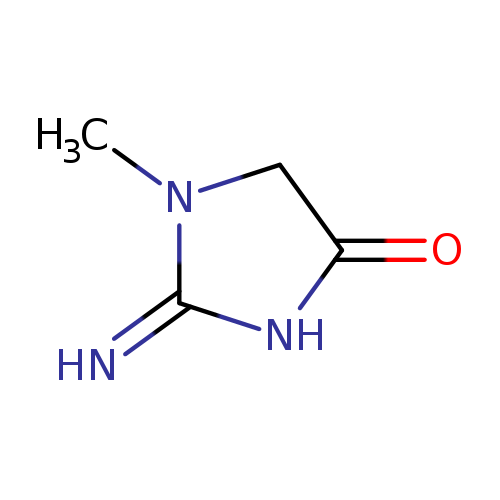
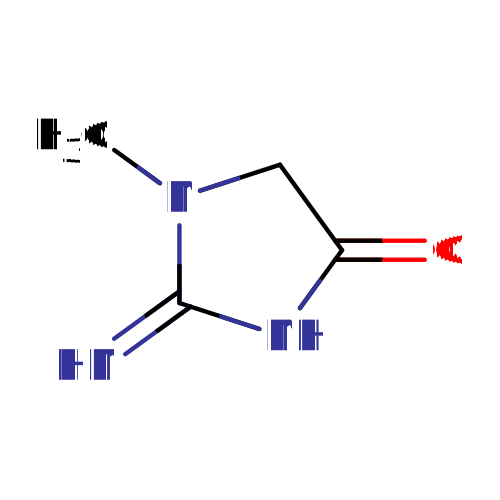
Chemical Structure
Thumb
Synonyms
ValueSource
1-MethylglycocyamidineChEBI
1-Methylhydantoin-2-imideChEBI
2-Amino-1,5-dihydro-1-methyl-4H-imidazol-4-oneChEBI
2-Amino-1-methylimidazolin-4-oneChEBI
Creatine anhydrideChEBI
CreatininaChEBI
KreatininChEBI
2-Amino-1-methyl-1,5-dihydroimidazol-4-oneHMDB
KrebiozenHMDB
Sulfate salt, creatinineHMDB
Creatinine sulfate saltHMDB
Salt, creatinine sulfateHMDB
Chemical FormulaC4H7N3O
Average Molecular Mass113.118 g/mol
Monoisotopic Mass113.059 g/mol
CAS Registry Number60-27-5
IUPAC Name2-imino-1-methylimidazolidin-4-one
Traditional Namecreatinina
SMILESCN1CC(=O)NC1=N
InChI IdentifierInChI=1S/C4H7N3O/c1-7-2-3(8)6-4(7)5/h2H2,1H3,(H2,5,6,8)
InChI KeyDDRJAANPRJIHGJ-UHFFFAOYSA-N
Chemical Taxonomy
Description belongs to the class of organic compounds known as alpha amino acids and derivatives. These are amino acids in which the amino group is attached to the carbon atom immediately adjacent to the carboxylate group (alpha carbon), or a derivative thereof.
KingdomOrganic compounds
Super ClassOrganic acids and derivatives
ClassCarboxylic acids and derivatives
Sub ClassAmino acids, peptides, and analogues
Direct ParentAlpha amino acids and derivatives
Alternative Parents
Substituents
  • Alpha-amino acid or derivatives
  • Imidazolinone
  • 2-imidazoline
  • Guanidine
  • N-acylimine
  • Carboximidamide
  • Propargyl-type 1,3-dipolar organic compound
  • Organic 1,3-dipolar compound
  • Organoheterocyclic compound
  • Azacycle
  • Hydrocarbon derivative
  • Organooxygen compound
  • Organonitrogen compound
  • Organic oxide
  • Organic nitrogen compound
  • Carbonyl group
  • Organic oxygen compound
  • Organopnictogen compound
  • Aliphatic heteromonocyclic compound
Molecular FrameworkAliphatic heteromonocyclic compounds
External Descriptors
Biological Properties
StatusDetected and Not Quantified
OriginEndogenous
Cellular Locations
  • Cytoplasm
  • Membrane
Biofluid LocationsNot Available
Tissue Locations
  • Adipose Tissue
  • Bladder
  • Fibroblasts
  • Kidney
  • Liver
  • Muscle
  • Nerve Cells
  • Pancreas
  • Placenta
  • Platelet
  • Prostate
  • Skeletal Muscle
  • Spleen
  • Testes
  • Thyroid Gland
Pathways
NameSMPDB LinkKEGG Link
Isovaleric AciduriaSMP00238 Not Available
Malonic AciduriaSMP00198 Not Available
Methylmalonic AciduriaSMP00200 Not Available
Methylmalonic Aciduria Due to Cobalamin-Related DisordersSMP00201 Not Available
Applications
Biological Roles
Chemical RolesNot Available
Physical Properties
StateSolid
AppearanceWhite powder.
Experimental Properties
PropertyValue
Melting Point303°C (decomposes)
Boiling PointNot Available
Solubility80.1 mg/mL at 16°C
Predicted Properties
PropertyValueSource
Water Solubility9.92 g/LALOGPS
logP-1.6ALOGPS
logP-1.1ChemAxon
logS-1.1ALOGPS
pKa (Strongest Acidic)9.21ChemAxon
pKa (Strongest Basic)4.96ChemAxon
Physiological Charge0ChemAxon
Hydrogen Acceptor Count3ChemAxon
Hydrogen Donor Count2ChemAxon
Polar Surface Area56.19 ŲChemAxon
Rotatable Bond Count0ChemAxon
Refractivity38.81 m³·mol⁻¹ChemAxon
Polarizability10.74 ųChemAxon
Number of Rings1ChemAxon
Bioavailability1ChemAxon
Rule of FiveYesChemAxon
Ghose FilterNoChemAxon
Veber's RuleNoChemAxon
MDDR-like RuleNoChemAxon
Spectra
Spectra
Spectrum TypeDescriptionSplash KeyView
GC-MSGC-MS Spectrum - GC-EI-TOF (Pegasus III TOF-MS system, Leco; GC 6890, Agilent Technologies) (Non-derivatized)splash10-014i-0900000000-434db9fb715c467d6e22Spectrum
GC-MSGC-MS Spectrum - GC-MS (2 TMS)splash10-0l05-3930000000-0efef64758a717fd8a7bSpectrum
GC-MSGC-MS Spectrum - GC-MS (3 TMS)splash10-014i-0901000000-bd882951c92733ecbc9eSpectrum
GC-MSGC-MS Spectrum - GC-EI-TOF (Non-derivatized)splash10-014i-0900000000-434db9fb715c467d6e22Spectrum
GC-MSGC-MS Spectrum - GC-MS (Non-derivatized)splash10-0l05-3930000000-0efef64758a717fd8a7bSpectrum
GC-MSGC-MS Spectrum - GC-MS (Non-derivatized)splash10-014i-0901000000-bd882951c92733ecbc9eSpectrum
Predicted GC-MSPredicted GC-MS Spectrum - GC-MS (Non-derivatized) - 70eV, Positivesplash10-0006-9100000000-2c788893921faeaa6548Spectrum
Predicted GC-MSPredicted GC-MS Spectrum - GC-MS (Non-derivatized) - 70eV, PositiveNot AvailableSpectrum
LC-MS/MSLC-MS/MS Spectrum - Quattro_QQQ 10V, Positive (Annotated)splash10-03di-5900000000-9a1d9dadbe33ae2d1306Spectrum
LC-MS/MSLC-MS/MS Spectrum - Quattro_QQQ 25V, Positive (Annotated)splash10-0006-9000000000-e79b269b74d9c6e99118Spectrum
LC-MS/MSLC-MS/MS Spectrum - Quattro_QQQ 40V, Positive (Annotated)splash10-0006-9000000000-bfa35af1a437cbc8b5ecSpectrum
LC-MS/MSLC-MS/MS Spectrum - LC-ESI-QQ (API3000, Applied Biosystems) 10V, Negativesplash10-03di-0900000000-57f60152c562a170b9fcSpectrum
LC-MS/MSLC-MS/MS Spectrum - LC-ESI-QQ (API3000, Applied Biosystems) 20V, Negativesplash10-03di-1900000000-ef69e2d63505f5b30467Spectrum
LC-MS/MSLC-MS/MS Spectrum - LC-ESI-QQ (API3000, Applied Biosystems) 30V, Negativesplash10-01ox-9500000000-88d102c7e4686e30b719Spectrum
LC-MS/MSLC-MS/MS Spectrum - LC-ESI-QQ (API3000, Applied Biosystems) 40V, Negativesplash10-0006-9000000000-f87b49f5a20f18c9f6f3Spectrum
LC-MS/MSLC-MS/MS Spectrum - LC-ESI-QQ (API3000, Applied Biosystems) 50V, Negativesplash10-0006-9000000000-1498f1dfaa82105e4414Spectrum
LC-MS/MSLC-MS/MS Spectrum - LC-ESI-QQ (API3000, Applied Biosystems) 10V, Positivesplash10-03di-0900000000-87b686020b9ef983648cSpectrum
LC-MS/MSLC-MS/MS Spectrum - LC-ESI-QQ (API3000, Applied Biosystems) 20V, Positivesplash10-03di-5900000000-5ac55d9993e2227ed724Spectrum
LC-MS/MSLC-MS/MS Spectrum - LC-ESI-QQ (API3000, Applied Biosystems) 30V, Positivesplash10-0006-9000000000-ed919da9ef2eaa0e3b24Spectrum
LC-MS/MSLC-MS/MS Spectrum - LC-ESI-QQ (API3000, Applied Biosystems) 40V, Positivesplash10-0006-9000000000-e0fbc3bd29181697fb8aSpectrum
LC-MS/MSLC-MS/MS Spectrum - LC-ESI-QQ (API3000, Applied Biosystems) 50V, Positivesplash10-0006-9000000000-445863d7d688052704e5Spectrum
LC-MS/MSLC-MS/MS Spectrum - LC-ESI-QTOF (UPLC Q-Tof Premier, Waters) , Positivesplash10-03di-0900000000-844659480059fd60d69fSpectrum
LC-MS/MSLC-MS/MS Spectrum - LC-ESI-QQ , negativesplash10-03di-0900000000-57f60152c562a170b9fcSpectrum
LC-MS/MSLC-MS/MS Spectrum - LC-ESI-QQ , negativesplash10-03di-1900000000-ef69e2d63505f5b30467Spectrum
LC-MS/MSLC-MS/MS Spectrum - LC-ESI-QQ , negativesplash10-01ox-9500000000-73580fadf144622204c8Spectrum
LC-MS/MSLC-MS/MS Spectrum - LC-ESI-QQ , negativesplash10-0006-9000000000-f87b49f5a20f18c9f6f3Spectrum
LC-MS/MSLC-MS/MS Spectrum - LC-ESI-QQ , negativesplash10-0006-9000000000-1498f1dfaa82105e4414Spectrum
Predicted LC-MS/MSPredicted LC-MS/MS Spectrum - 10V, Positivesplash10-03di-0900000000-41e3cbcd832bbcfa8cd8Spectrum
Predicted LC-MS/MSPredicted LC-MS/MS Spectrum - 20V, Positivesplash10-03di-6900000000-557a2affe27acf1b78f8Spectrum
Predicted LC-MS/MSPredicted LC-MS/MS Spectrum - 40V, Positivesplash10-0006-9000000000-daa2222b345889ef7eceSpectrum
Predicted LC-MS/MSPredicted LC-MS/MS Spectrum - 10V, Negativesplash10-03di-3900000000-233fc8a5c8c5754cc3f9Spectrum
Predicted LC-MS/MSPredicted LC-MS/MS Spectrum - 20V, Negativesplash10-0006-9000000000-11990e8b9bad7fdbeb0aSpectrum
Predicted LC-MS/MSPredicted LC-MS/MS Spectrum - 40V, Negativesplash10-0006-9000000000-c4791b13b30e29c01832Spectrum
MSMass Spectrum (Electron Ionization)splash10-01ox-9400000000-fc8e70dbbe2575dc0957Spectrum
1D NMR13C NMR SpectrumNot AvailableSpectrum
1D NMR1H NMR SpectrumNot AvailableSpectrum
1D NMR13C NMR SpectrumNot AvailableSpectrum
1D NMR1H NMR SpectrumNot AvailableSpectrum
1D NMR13C NMR SpectrumNot AvailableSpectrum
1D NMR1H NMR SpectrumNot AvailableSpectrum
1D NMR13C NMR SpectrumNot AvailableSpectrum
1D NMR1H NMR SpectrumNot AvailableSpectrum
1D NMR13C NMR SpectrumNot AvailableSpectrum
1D NMR1H NMR SpectrumNot AvailableSpectrum
1D NMR13C NMR SpectrumNot AvailableSpectrum
1D NMR1H NMR SpectrumNot AvailableSpectrum
1D NMR13C NMR SpectrumNot AvailableSpectrum
1D NMR1H NMR SpectrumNot AvailableSpectrum
1D NMR13C NMR SpectrumNot AvailableSpectrum
1D NMR1H NMR SpectrumNot AvailableSpectrum
1D NMR13C NMR SpectrumNot AvailableSpectrum
1D NMR1H NMR SpectrumNot AvailableSpectrum
1D NMR13C NMR SpectrumNot AvailableSpectrum
1D NMR1H NMR SpectrumNot AvailableSpectrum
1D NMR13C NMR SpectrumNot AvailableSpectrum
1D NMR1H NMR SpectrumNot AvailableSpectrum
1D NMR13C NMR SpectrumNot AvailableSpectrum
1D NMR1H NMR SpectrumNot AvailableSpectrum
2D NMR[1H,1H] 2D NMR SpectrumNot AvailableSpectrum
2D NMR[1H,13C] 2D NMR SpectrumNot AvailableSpectrum
Toxicity Profile
Route of ExposureNot Available
Mechanism of ToxicityNot Available
MetabolismNot Available
Toxicity ValuesNot Available
Lethal DoseNot Available
Carcinogenicity (IARC Classification)No indication of carcinogenicity to humans (not listed by IARC).
Uses/SourcesThis is an endogenously produced metabolite found in the human body. It is used in metabolic reactions, catabolic reactions or waste generation.
Minimum Risk LevelNot Available
Health EffectsNot Available
SymptomsNot Available
TreatmentNot Available
Concentrations
Not Available
DrugBank IDDB11846
HMDB IDHMDB0000562
FooDB IDFDB021814
Phenol Explorer IDNot Available
KNApSAcK IDC00052251
BiGG ID36009
BioCyc IDCREATININE
METLIN ID8
PDB IDNot Available
Wikipedia LinkCreatinine
Chemspider ID568
ChEBI ID16737
PubChem Compound ID588
Kegg Compound IDC00791
YMDB IDNot Available
ECMDB IDM2MDB004303
References
Synthesis ReferenceReddick, Rebecca E.; Kenyon, George L. Syntheses and NMR studies of specifically labeled [2-15N]phosphocreatine, [2-15N]creatinine, and related 15N-labeled compounds. Journal of the American Chemical Society (1987), 109(14), 4380-7.
MSDSLink
General References
1. https://www.ncbi.nlm.nih.gov/pubmed/?term=11256540
2. https://www.ncbi.nlm.nih.gov/pubmed/?term=11981083
3. https://www.ncbi.nlm.nih.gov/pubmed/?term=17190852
4. https://www.ncbi.nlm.nih.gov/pubmed/?term=17422601
5. https://www.ncbi.nlm.nih.gov/pubmed/?term=18182718
6. https://www.ncbi.nlm.nih.gov/pubmed/?term=19236048
7. https://www.ncbi.nlm.nih.gov/pubmed/?term=19715855
8. https://www.ncbi.nlm.nih.gov/pubmed/?term=19968328
9. https://www.ncbi.nlm.nih.gov/pubmed/?term=21775764
10. https://www.ncbi.nlm.nih.gov/pubmed/?term=22047975
11. https://www.ncbi.nlm.nih.gov/pubmed/?term=22121923
12. https://www.ncbi.nlm.nih.gov/pubmed/?term=22166252
13. https://www.ncbi.nlm.nih.gov/pubmed/?term=22207347
14. https://www.ncbi.nlm.nih.gov/pubmed/?term=22212624
15. https://www.ncbi.nlm.nih.gov/pubmed/?term=22223530
16. https://www.ncbi.nlm.nih.gov/pubmed/?term=22331238
17. https://www.ncbi.nlm.nih.gov/pubmed/?term=22338083
18. https://www.ncbi.nlm.nih.gov/pubmed/?term=22349552
19. https://www.ncbi.nlm.nih.gov/pubmed/?term=22390548
20. https://www.ncbi.nlm.nih.gov/pubmed/?term=22432114
21. https://www.ncbi.nlm.nih.gov/pubmed/?term=22441184
22. https://www.ncbi.nlm.nih.gov/pubmed/?term=22459582
23. https://www.ncbi.nlm.nih.gov/pubmed/?term=22498455
24. Reddick, Rebecca E.; Kenyon, George L. Syntheses and NMR studies of specifically labeled [2-15N]phosphocreatine, [2-15N]creatinine, and related 15N-labeled compounds. Journal of the American Chemical Society (1987), 109(14), 4380-7.
25. Mori A, Watanabe Y, Fujimoto N: Fluorometrical analysis of guanidino compounds in human cerebrospinal fluid. J Neurochem. 1982 Feb;38(2):448-50.
26. Ullmann AJ, Sanz MA, Tramarin A, Barnes RA, Wu W, Gerlach BA, Krobot KJ, Gerth WC: Prospective study of amphotericin B formulations in immunocompromised patients in 4 European countries. Clin Infect Dis. 2006 Aug 15;43(4):e29-38. Epub 2006 Jul 10.
27. Vaidya VS, Bonventre JV: Mechanistic biomarkers for cytotoxic acute kidney injury. Expert Opin Drug Metab Toxicol. 2006 Oct;2(5):697-713.
28. Lebkowska U, Malyszko J, Brzosko S, Lebkowski W, Malyszko JS, Janica J, Kowalewski R, Gacko M, Mysliwiec M, Walecki J: Renal artery resistance index, thyroid hormones, and thyroid volume in the early kidney transplants recipients. Transplant Proc. 2006 Jan-Feb;38(1):62-5.
29. Bairaktari E, Katopodis K, Siamopoulos KC, Tsolas O: Paraquat-induced renal injury studied by 1H nuclear magnetic resonance spectroscopy of urine. Clin Chem. 1998 Jun;44(6 Pt 1):1256-61.
30. Sarnak MJ, Katz R, Stehman-Breen CO, Fried LF, Jenny NS, Psaty BM, Newman AB, Siscovick D, Shlipak MG: Cystatin C concentration as a risk factor for heart failure in older adults. Ann Intern Med. 2005 Apr 5;142(7):497-505.
31. Mancini GM, Catsman-Berrevoets CE, de Coo IF, Aarsen FK, Kamphoven JH, Huijmans JG, Duran M, van der Knaap MS, Jakobs C, Salomons GS: Two novel mutations in SLC6A8 cause creatine transporter defect and distinctive X-linked mental retardation in two unrelated Dutch families. Am J Med Genet A. 2005 Jan 30;132A(3):288-95.
32. Kohnle M, Pietruck F, Kribben A, Philipp T, Heemann U, Witzke O: Ezetimibe for the treatment of uncontrolled hypercholesterolemia in patients with high-dose statin therapy after renal transplantation. Am J Transplant. 2006 Jan;6(1):205-8.
33. Shlipak MG, Katz R, Fried LF, Jenny NS, Stehman-Breen C, Newman AB, Siscovick D, Psaty BM, Sarnak MJ: Cystatin-C and mortality in elderly persons with heart failure. J Am Coll Cardiol. 2005 Jan 18;45(2):268-71.
34. Rule AD, Larson TS, Bergstralh EJ, Slezak JM, Jacobsen SJ, Cosio FG: Using serum creatinine to estimate glomerular filtration rate: accuracy in good health and in chronic kidney disease. Ann Intern Med. 2004 Dec 21;141(12):929-37.
35. Silwood CJ, Lynch E, Claxson AW, Grootveld MC: 1H and (13)C NMR spectroscopic analysis of human saliva. J Dent Res. 2002 Jun;81(6):422-7.
36. Sherman DS, Fish DN, Teitelbaum I: Assessing renal function in cirrhotic patients: problems and pitfalls. Am J Kidney Dis. 2003 Feb;41(2):269-78.
37. Benohr P, Grenz A, Hartmann JT, Muller GA, Blaschke S: Cystatin C--a marker for assessment of the glomerular filtration rate in patients with cisplatin chemotherapy. Kidney Blood Press Res. 2006;29(1):32-5. Epub 2006 Mar 2.
38. Szmidt J, Galazka Z, Frunze S, Grochowiecki T, Nazarewski S, Durlik M, Jakimowicz T, Wojtaszek M, Grygiel K, Paczek L: Secondary kidney transplantation in a patient 16 years after simultaneous pancreas and kidney transplantation--a case report. Ann Transplant. 2006;11(1):40-2.
39. A J, Trygg J, Gullberg J, Johansson AI, Jonsson P, Antti H, Marklund SL, Moritz T: Extraction and GC/MS analysis of the human blood plasma metabolome. Anal Chem. 2005 Dec 15;77(24):8086-94.
40. Bengtsson C, Lapidus L, Stendahl C, Waldenstrom J: Hyperuricaemia and risk of cardiovascular disease and overall death. A 12-year follow-up of participants in the population study of women in Gothenburg, Sweden. Acta Med Scand. 1988;224(6):549-55.
41. Fostel J, Boneva R, Lloyd A: Exploration of the gene expression correlates of chronic unexplained fatigue using factor analysis. Pharmacogenomics. 2006 Apr;7(3):441-54.
42. Sreekumar A, Poisson LM, Rajendiran TM, Khan AP, Cao Q, Yu J, Laxman B, Mehra R, Lonigro RJ, Li Y, Nyati MK, Ahsan A, Kalyana-Sundaram S, Han B, Cao X, Byun J, Omenn GS, Ghosh D, Pennathur S, Alexander DC, Berger A, Shuster JR, Wei JT, Varambally S, Beecher C, Chinnaiyan AM: Metabolomic profiles delineate potential role for sarcosine in prostate cancer progression. Nature. 2009 Feb 12;457(7231):910-4. doi: 10.1038/nature07762.
43. Elshenawy S, Pinney SE, Stuart T, Doulias PT, Zura G, Parry S, Elovitz MA, Bennett MJ, Bansal A, Strauss JF 3rd, Ischiropoulos H, Simmons RA: The Metabolomic Signature of the Placenta in Spontaneous Preterm Birth. Int J Mol Sci. 2020 Feb 4;21(3). pii: ijms21031043. doi: 10.3390/ijms21031043.