Record Information
Version1.0
Creation Date2014-08-29 06:51:28 UTC
Update Date2026-04-17 18:30:44 UTC
Accession NumberCHEM003418
Identification
Common NameSarcosine
ClassSmall Molecule
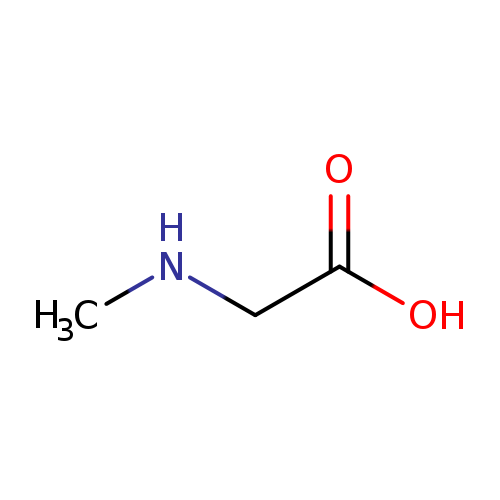
DescriptionSarcosine is the N-methyl derivative of glycine. Sarcosine is metabolized to glycine by the enzyme sarcosine dehydrogenase, while glycine-N-methyl transferase generates sarcosine from glycine. Sarcosine is a natural amino acid found in muscles and other body tissues. In the laboratory it may be synthesized from chloroacetic acid and methylamine. Sarcosine is naturally found in the metabolism of choline to glycine. Sarcosine is sweet to the taste and dissolves in water. It is used in manufacturing biodegradable surfactants and toothpastes as well as in other applications. Sarcosine is ubiquitous in biological materials and is present in such foods as egg yolks, turkey, ham, vegetables, legumes, etc. Sarcosine is formed from dietary intake of choline and from the metabolism of methionine, and is rapidly degraded to glycine. Sarcosine has no known toxicity, as evidenced by the lack of phenotypic manifestations of sarcosinemia, an inborn error of sarcosine metabolism. Sarcosinemia can result from severe folate deficiency because of the folate requirement for the conversion of sarcosine to glycine (Wikipedia). Sarcosine has recently been identified as a biomarker for invasive prostate cancer. It was found to be greatly increased during prostate cancer progression to metastasis and could be detected in urine. Sarcosine levels were also increased in invasive prostate cancer cell lines relative to benign prostate epithelial cells (2).
Contaminant Sources
  • FooDB Chemicals
  • HMDB Contaminants - Feces
  • HMDB Contaminants - Urine
  • HPV EPA Chemicals
  • STOFF IDENT Compounds
  • T3DB toxins
Contaminant Type
  • Amine
  • Animal Toxin
  • Food Toxin
  • Industrial/Workplace Toxin
  • Lachrymator
  • Metabolite
  • Natural Compound
  • Organic Compound
Chemical Structure
Thumb
Synonyms
ValueSource
(Methylamino)acetic acidChEBI
(Methylamino)ethanoic acidChEBI
L-SarcosineChEBI
MeGlyChEBI
Methylaminoacetic acidChEBI
N-Methylaminoacetic acidChEBI
N-MethylglycineChEBI
SarChEBI
Sarcosinic acidChEBI
(Methylamino)acetateGenerator
(Methylamino)ethanoateGenerator
MethylaminoacetateGenerator
N-MethylaminoacetateGenerator
SarcosinateGenerator
(Methylamino)-acetateHMDB
(Methylamino)-acetic acidHMDB
MethylglycineHMDB
N-Methyl-glycineHMDB
SarcosinHMDB
Sodium sarcosinateHMDB
Magnesium sarcosylateHMDB
Sarcosinate, sodiumHMDB
Sarcosine hydrochlorideHMDB
Sarcosylate, magnesiumHMDB
N MethylglycineHMDB
Sarcosine monosodium saltHMDB
Chemical FormulaC3H7NO2
Average Molecular Mass89.093 g/mol
Monoisotopic Mass89.048 g/mol
CAS Registry Number107-97-1
IUPAC Name2-(methylamino)acetic acid
Traditional Namesarcosine
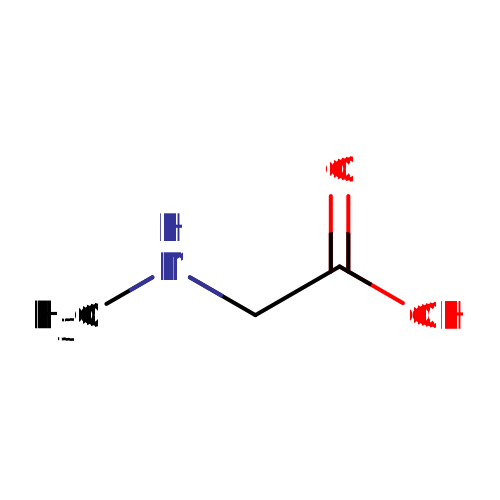
SMILESCNCC(O)=O
InChI IdentifierInChI=1S/C3H7NO2/c1-4-2-3(5)6/h4H,2H2,1H3,(H,5,6)
InChI KeyFSYKKLYZXJSNPZ-UHFFFAOYSA-N
Chemical Taxonomy
Description belongs to the class of organic compounds known as alpha amino acids. These are amino acids in which the amino group is attached to the carbon atom immediately adjacent to the carboxylate group (alpha carbon).
KingdomOrganic compounds
Super ClassOrganic acids and derivatives
ClassCarboxylic acids and derivatives
Sub ClassAmino acids, peptides, and analogues
Direct ParentAlpha amino acids
Alternative Parents
Substituents
  • Alpha-amino acid
  • Amino acid
  • Carboxylic acid
  • Secondary aliphatic amine
  • Monocarboxylic acid or derivatives
  • Secondary amine
  • Organic nitrogen compound
  • Hydrocarbon derivative
  • Organooxygen compound
  • Organonitrogen compound
  • Organic oxide
  • Organopnictogen compound
  • Organic oxygen compound
  • Carbonyl group
  • Amine
  • Aliphatic acyclic compound
Molecular FrameworkAliphatic acyclic compounds
External Descriptors
Biological Properties
StatusDetected and Not Quantified
OriginEndogenous
Cellular Locations
  • Cytoplasm
  • Extracellular
Biofluid LocationsNot Available
Tissue Locations
  • All Tissues
Pathways
NameSMPDB LinkKEGG Link
Glycine and Serine MetabolismSMP00004 map00260
SarcosinemiaSMP00244 Not Available
ApplicationsNot Available
Biological Roles
Chemical Roles
Physical Properties
StateSolid
AppearanceWhite crystalline powder
Experimental Properties
PropertyValue
Melting Point210°C
Boiling PointNot Available
Solubility89.1 g/L
Predicted Properties
PropertyValueSource
Water Solubility308 g/LALOGPS
logP-3.1ALOGPS
logP-3.2ChemAxon
logS0.54ALOGPS
pKa (Strongest Acidic)2.06ChemAxon
pKa (Strongest Basic)10.35ChemAxon
Physiological Charge0ChemAxon
Hydrogen Acceptor Count3ChemAxon
Hydrogen Donor Count2ChemAxon
Polar Surface Area49.33 ŲChemAxon
Rotatable Bond Count2ChemAxon
Refractivity20.78 m³·mol⁻¹ChemAxon
Polarizability8.66 ųChemAxon
Number of Rings0ChemAxon
Bioavailability1ChemAxon
Rule of FiveYesChemAxon
Ghose FilterNoChemAxon
Veber's RuleNoChemAxon
MDDR-like RuleNoChemAxon
Spectra
Spectra
Spectrum TypeDescriptionSplash KeyView
GC-MSGC-MS Spectrum - GC-EI-TOF (Pegasus III TOF-MS system, Leco; GC 6890, Agilent Technologies) (Non-derivatized)splash10-014i-0900000000-3703e9255c5a3d53576eSpectrum
GC-MSGC-MS Spectrum - GC-EI-TOF (Pegasus III TOF-MS system, Leco; GC 6890, Agilent Technologies) (2 TMS)splash10-00xr-9800000000-b066cf015be7d1b1ec05Spectrum
GC-MSGC-MS Spectrum - GC-MS (2 TMS)splash10-014i-0900000000-73acbf4b13dbcd53efe1Spectrum
GC-MSGC-MS Spectrum - EI-B (Non-derivatized)splash10-014i-0900000000-22864bae97055c3845b6Spectrum
GC-MSGC-MS Spectrum - GC-EI-TOF (Non-derivatized)splash10-014i-0900000000-3703e9255c5a3d53576eSpectrum
GC-MSGC-MS Spectrum - GC-EI-TOF (Non-derivatized)splash10-00xr-9800000000-b066cf015be7d1b1ec05Spectrum
GC-MSGC-MS Spectrum - GC-MS (Non-derivatized)splash10-014i-0900000000-73acbf4b13dbcd53efe1Spectrum
GC-MSGC-MS Spectrum - GC-EI-TOF (Non-derivatized)splash10-014i-0900000000-9559630483fd184becb6Spectrum
Predicted GC-MSPredicted GC-MS Spectrum - GC-MS (Non-derivatized) - 70eV, Positivesplash10-0006-9000000000-7a4141479c88d11af74aSpectrum
Predicted GC-MSPredicted GC-MS Spectrum - GC-MS (1 TMS) - 70eV, Positivesplash10-0006-9000000000-847886894070391d8fddSpectrum
Predicted GC-MSPredicted GC-MS Spectrum - GC-MS (Non-derivatized) - 70eV, PositiveNot AvailableSpectrum
Predicted GC-MSPredicted GC-MS Spectrum - GC-MS (TMS_1_2) - 70eV, PositiveNot AvailableSpectrum
Predicted GC-MSPredicted GC-MS Spectrum - GC-MS (TBDMS_1_1) - 70eV, PositiveNot AvailableSpectrum
Predicted GC-MSPredicted GC-MS Spectrum - GC-MS (TBDMS_1_2) - 70eV, PositiveNot AvailableSpectrum
LC-MS/MSLC-MS/MS Spectrum - Quattro_QQQ 10V, Positive (Annotated)splash10-0006-9000000000-da0fd904589ef164065aSpectrum
LC-MS/MSLC-MS/MS Spectrum - Quattro_QQQ 25V, Positive (Annotated)splash10-0006-9000000000-6b30a9c471d171cacad9Spectrum
LC-MS/MSLC-MS/MS Spectrum - Quattro_QQQ 40V, Positive (Annotated)splash10-0006-9000000000-851a04dbd34e75febf9dSpectrum
LC-MS/MSLC-MS/MS Spectrum - LC-ESI-QQ (API3000, Applied Biosystems) 10V, Negativesplash10-000i-9000000000-86301ee1b7f5d158901eSpectrum
LC-MS/MSLC-MS/MS Spectrum - LC-ESI-QQ (API3000, Applied Biosystems) 20V, Negativesplash10-000i-9000000000-32b1ca1874d0fcb3f9c7Spectrum
LC-MS/MSLC-MS/MS Spectrum - LC-ESI-QQ (API3000, Applied Biosystems) 30V, Negativesplash10-000i-9000000000-37db595fcf7364600bc9Spectrum
LC-MS/MSLC-MS/MS Spectrum - LC-ESI-QQ (API3000, Applied Biosystems) 10V, Positivesplash10-0006-9000000000-0b3e92ad374e013024eaSpectrum
LC-MS/MSLC-MS/MS Spectrum - LC-ESI-QQ (API3000, Applied Biosystems) 20V, Positivesplash10-0006-9000000000-ef853c67634f1a7da8f5Spectrum
LC-MS/MSLC-MS/MS Spectrum - LC-ESI-QQ (API3000, Applied Biosystems) 30V, Positivesplash10-0006-9000000000-63e1ee6f897ea7a61e52Spectrum
LC-MS/MSLC-MS/MS Spectrum - LC-ESI-QQ (API3000, Applied Biosystems) 40V, Positivesplash10-0006-9000000000-bab0ab3587973d3ad4aaSpectrum
LC-MS/MSLC-MS/MS Spectrum - LC-ESI-QQ (API3000, Applied Biosystems) 50V, Positivesplash10-0006-9000000000-d017a51a9abbbcf31dceSpectrum
LC-MS/MSLC-MS/MS Spectrum - LC-ESI-QQ , negativesplash10-000i-9000000000-86301ee1b7f5d158901eSpectrum
LC-MS/MSLC-MS/MS Spectrum - LC-ESI-QQ , negativesplash10-000i-9000000000-645df370acbb7cac5322Spectrum
LC-MS/MSLC-MS/MS Spectrum - LC-ESI-QQ , negativesplash10-000i-9000000000-37db595fcf7364600bc9Spectrum
LC-MS/MSLC-MS/MS Spectrum - LC-ESI-QQ , positivesplash10-0006-9000000000-0b3e92ad374e013024eaSpectrum
LC-MS/MSLC-MS/MS Spectrum - LC-ESI-QQ , positivesplash10-0006-9000000000-ef853c67634f1a7da8f5Spectrum
LC-MS/MSLC-MS/MS Spectrum - LC-ESI-QQ , positivesplash10-0006-9000000000-5701e8afc0a34aa34653Spectrum
LC-MS/MSLC-MS/MS Spectrum - LC-ESI-QQ , positivesplash10-0006-9000000000-bab0ab3587973d3ad4aaSpectrum
LC-MS/MSLC-MS/MS Spectrum - LC-ESI-QQ , positivesplash10-0006-9000000000-d017a51a9abbbcf31dceSpectrum
Predicted LC-MS/MSPredicted LC-MS/MS Spectrum - 10V, Positivesplash10-0006-9000000000-5fd27462e0d106e4c5a6Spectrum
Predicted LC-MS/MSPredicted LC-MS/MS Spectrum - 20V, Positivesplash10-0006-9000000000-4f822ba462b1fbffce17Spectrum
Predicted LC-MS/MSPredicted LC-MS/MS Spectrum - 40V, Positivesplash10-0006-9000000000-4125b1890cbe03ae7283Spectrum
Predicted LC-MS/MSPredicted LC-MS/MS Spectrum - 10V, Negativesplash10-000i-9000000000-c7e62ee2909dfb0a067cSpectrum
Predicted LC-MS/MSPredicted LC-MS/MS Spectrum - 20V, Negativesplash10-000i-9000000000-8d4f2d4c6d399cbf0c9fSpectrum
Predicted LC-MS/MSPredicted LC-MS/MS Spectrum - 40V, Negativesplash10-052f-9000000000-c8a4e61d51664ed38b96Spectrum
MSMass Spectrum (Electron Ionization)splash10-0006-9000000000-335905bb8c6b7e52ff70Spectrum
1D NMR13C NMR SpectrumNot AvailableSpectrum
1D NMR1H NMR SpectrumNot AvailableSpectrum
1D NMR13C NMR SpectrumNot AvailableSpectrum
1D NMR1H NMR SpectrumNot AvailableSpectrum
1D NMR13C NMR SpectrumNot AvailableSpectrum
1D NMR1H NMR SpectrumNot AvailableSpectrum
1D NMR13C NMR SpectrumNot AvailableSpectrum
1D NMR1H NMR SpectrumNot AvailableSpectrum
1D NMR13C NMR SpectrumNot AvailableSpectrum
1D NMR1H NMR SpectrumNot AvailableSpectrum
1D NMR13C NMR SpectrumNot AvailableSpectrum
1D NMR1H NMR SpectrumNot AvailableSpectrum
1D NMR13C NMR SpectrumNot AvailableSpectrum
1D NMR1H NMR SpectrumNot AvailableSpectrum
1D NMR13C NMR SpectrumNot AvailableSpectrum
1D NMR1H NMR SpectrumNot AvailableSpectrum
1D NMR13C NMR SpectrumNot AvailableSpectrum
1D NMR1H NMR SpectrumNot AvailableSpectrum
1D NMR13C NMR SpectrumNot AvailableSpectrum
1D NMR1H NMR SpectrumNot AvailableSpectrum
1D NMR13C NMR SpectrumNot AvailableSpectrum
1D NMR1H NMR SpectrumNot AvailableSpectrum
1D NMR13C NMR SpectrumNot AvailableSpectrum
2D NMR[1H,1H] 2D NMR SpectrumNot AvailableSpectrum
2D NMR[1H,13C] 2D NMR SpectrumNot AvailableSpectrum
Toxicity Profile
Route of ExposureEndogenous, Eye contact, Ingestion.
Mechanism of ToxicitySarcosine is an oncometabolite. Sarcosine appears to upregulate the expression of the potent oncoprotein called human epidermal growth factor receptor 2 (HER2/neu) in androgen-dependent prostate cancer cells upon exposure to exogenous sarcosine. Thus, sarcosine may induce prostate cancer progression by increased HER2/neu expression.
MetabolismSarcosine is metabolized to glycine by the enzyme sarcosine dehydrogenase, while glycine-N-methyl transferase generates sarcosine from glycine.
Toxicity ValuesNA
Lethal DoseNot Available
Carcinogenicity (IARC Classification)Not listed by IARC. Has been implicated in oncogenesis (12).
Uses/SourcesSarcosine can be used as a cognitive enhancer and to treat schizophrenia.
Minimum Risk LevelNot Available
Health EffectsAcute Exposure: Can lead to eye and skin irritation. Chronic Exposure: High levels of sarcosine in prostate tissues are associated with aggressive prostate tumors. In this regard, sarcosine appears to function as an oncometabolite. High levels of sarcosine are also seen in patients with sarcosinemia. Sarcosinemia is a rare inborn error of metabolism that is characterized by an increased level of sarcosine (N-methylglycine) in the plasma and urine. The enzymatic block results from a deficiency of sarcosine dehydrogenase (SarDH), a liver mitochondrial matrix enzyme that converts sarcosine into glycine. The disease is mostly characterized by mental delay, cardiomyopathy, deafness and visual disturbance.
SymptomsAcute Exposure: eye irritation and skin irritation Chronic Exposure: sarcosinemia is associated with mental delay, cardiomyopathy, deafness and visual disturbance. In individuals with prostate cancer, high prostate tissue levels of sarcosine promote aggressive, rapidly growing prostate tumors.
TreatmentAcute Exposure: EYES: irrigate opened eyes for several minutes under running water. INGESTION: do not induce vomiting. Rinse mouth with water (never give anything by mouth to an unconscious person). Seek immediate medical advice. SKIN: should be treated immediately by rinsing the affected parts in cold running water for at least 15 minutes, followed by thorough washing with soap and water. If necessary, the person should shower and change contaminated clothing and shoes, and then must seek medical attention. INHALATION: supply fresh air. If required provide artificial respiration.
Concentrations
Not Available
DrugBank IDDB12519
HMDB IDHMDB0000271
FooDB IDFDB004048
Phenol Explorer IDNot Available
KNApSAcK IDNot Available
BiGG ID34275
BioCyc IDSARCOSINE
METLIN ID51
PDB IDNot Available
Wikipedia LinkSarcosine
Chemspider ID1057
ChEBI ID15611
PubChem Compound ID1088
Kegg Compound IDC00213
YMDB IDNot Available
ECMDB IDECMDB00271
References
Synthesis ReferenceCipens, G.; Slavinska, V.; Sile, D.; Kreile, D.; Strautina, A.; Krikis, A.; Gutmanis, A. Synthesis of sarcosine and its use. Latvijas PSR Zinatnu Akademijas Vestis, Kimijas Serija (1986), (5), 515-24.
MSDSLink
General References
1. Cipens, G.; Slavinska, V.; Sile, D.; Kreile, D.; Strautina, A.; Krikis, A.; Gutmanis, A. Synthesis of sarcosine and its use. Latvijas PSR Zinatnu Akademijas Vestis, Kimijas Serija (1986), (5), 515-24.
2. Melzer N, Wittenburg D, Hartwig S, Jakubowski S, Kesting U, Willmitzer L, Lisec J, Reinsch N, Repsilber D: Investigating associations between milk metabolite profiles and milk traits of Holstein cows. J Dairy Sci. 2013 Mar;96(3):1521-34. doi: 10.3168/jds.2012-5743.
3. Mung D, Li L: Applying quantitative metabolomics based on chemical isotope labeling LC-MS for detecting potential milk adulterant in human milk. Anal Chim Acta. 2018 Feb 25;1001:78-85. doi: 10.1016/j.aca.2017.11.019. Epub 2017 Nov 14.
4. Cipens, G.; Slavinska, V.; Sile, D.; Kreile, D.; Strautina, A.; Krikis, A.; Gutmanis, A. Synthesis of sarcosine and its use. Latvijas PSR Zinatnu Akademijas Vestis, Kimijas Serija (1986), (5), 515-24.
5. Boulat O, Gradwohl M, Matos V, Guignard JP, Bachmann C: Organic acids in the second morning urine in a healthy Swiss paediatric population. Clin Chem Lab Med. 2003 Dec;41(12):1642-58.
6. Akare S, Martinez JD: Bile acid induces hydrophobicity-dependent membrane alterations. Biochim Biophys Acta. 2005 Jun 15;1735(1):59-67.
7. Lim DS, Roberts R, Marian AJ: Expression profiling of cardiac genes in human hypertrophic cardiomyopathy: insight into the pathogenesis of phenotypes. J Am Coll Cardiol. 2001 Oct;38(4):1175-80.
8. Bales JR, Sadler PJ, Nicholson JK, Timbrell JA: Urinary excretion of acetaminophen and its metabolites as studied by proton NMR spectroscopy. Clin Chem. 1984 Oct;30(10):1631-6.
9. Heil M, Podebrad F, Prado E, Beck T, Mosand A, Sewell AC, Bohles H, Lehnert W: Enantioselective analysis of ketone bodies in patients with beta-ketothiolase deficiency, medium-chain acyl coenzyme A dehydrogenase deficiency and ketonemic vomiting. J Chromatogr B Biomed Sci Appl. 2000 Mar 10;739(2):313-24.
10. Kang ES, Seyer J, Todd TA, Herrera C: Variability in the phenotypic expression of abnormal sarcosine metabolism in a family. Hum Genet. 1983;64(1):80-5.
11. Vallera DA, Todhunter DA, Kuroki DW, Shu Y, Sicheneder A, Chen H: A bispecific recombinant immunotoxin, DT2219, targeting human CD19 and CD22 receptors in a mouse xenograft model of B-cell leukemia/lymphoma. Clin Cancer Res. 2005 May 15;11(10):3879-88.
12. Silwood CJ, Lynch E, Claxson AW, Grootveld MC: 1H and (13)C NMR spectroscopic analysis of human saliva. J Dent Res. 2002 Jun;81(6):422-7.
13. Shoemaker JD, Elliott WH: Automated screening of urine samples for carbohydrates, organic and amino acids after treatment with urease. J Chromatogr. 1991 Jan 2;562(1-2):125-38.
14. Hitomi J, Yamaguchi K, Kikuchi Y, Kimura T, Maruyama K, Nagasaki K: A novel calcium-binding protein in amniotic fluid, CAAF1: its molecular cloning and tissue distribution. J Cell Sci. 1996 Apr;109 ( Pt 4):805-15.
15. Sreekumar A, Poisson LM, Rajendiran TM, Khan AP, Cao Q, Yu J, Laxman B, Mehra R, Lonigro RJ, Li Y, Nyati MK, Ahsan A, Kalyana-Sundaram S, Han B, Cao X, Byun J, Omenn GS, Ghosh D, Pennathur S, Alexander DC, Berger A, Shuster JR, Wei JT, Varambally S, Beecher C, Chinnaiyan AM: Metabolomic profiles delineate potential role for sarcosine in prostate cancer progression. Nature. 2009 Feb 12;457(7231):910-4. doi: 10.1038/nature07762.
16. https://www.ncbi.nlm.nih.gov/pubmed/?term=11272730
17. https://www.ncbi.nlm.nih.gov/pubmed/?term=11850512
18. https://www.ncbi.nlm.nih.gov/pubmed/?term=15023571
19. https://www.ncbi.nlm.nih.gov/pubmed/?term=15331688
20. https://www.ncbi.nlm.nih.gov/pubmed/?term=16154544
21. https://www.ncbi.nlm.nih.gov/pubmed/?term=17095900
22. https://www.ncbi.nlm.nih.gov/pubmed/?term=17190852
23. https://www.ncbi.nlm.nih.gov/pubmed/?term=17901997
24. https://www.ncbi.nlm.nih.gov/pubmed/?term=19433577
25. https://www.ncbi.nlm.nih.gov/pubmed/?term=19577367
26. https://www.ncbi.nlm.nih.gov/pubmed/?term=19619564
27. https://www.ncbi.nlm.nih.gov/pubmed/?term=19944746