Record Information
Version1.0
Creation Date2014-08-30 21:03:50 UTC
Update Date2026-05-14 16:50:45 UTC
Accession NumberCHEM003515
Identification
Common NamePseudoephedrine
ClassSmall Molecule
DescriptionPseudoephedrine (C10H15NO) is an organic compound with an average molecular weight of 165.23 g/mol. It exists as a solid at room temperature and is exogenous in origin. Pseudoephedrine belongs to the phenylpropanes, a subclass of benzene and substituted derivatives within the organic compounds. This compound functions as a sympathomimetic agent, vasoconstrictor agent, and bronchodilator agent. Its applications include use as a nasal decongestant, an anti-asthmatic drug, and a central nervous system drug. It has a recorded therapeutic effect on asthma (PMC6430238). Among its protein targets are the Alpha-1A adrenergic receptor (ADRA1A), Alpha-2A adrenergic receptor (ADRA2A), Beta-1 adrenergic receptor (ADRB1), and Beta-2 adrenergic receptor (ADRB2), along with 18 other proteins. Pseudoephedrine is found in or released from 36 recorded sources. These include healthcare, pharmaceuticals, and veterinary products such as medical devices and nasal preparations; food, food processing, and cookware, including food preservation, food packaging, and the preparation of wort, wine, or sparkling wine, as well as fermentation processes for beer; household cleaning and consumer products, including perfumes within detergents and soaps, bleaching agents, cigar cigarettes, other smoking requisites, and non-electric simulated smoking devices; textiles, leather, and furnishings, including synthetic textiles and carpets and rugs; drinking water and water supply; and electrical and electronic equipment, including batteries, capacitors, printed circuit boards, cell phones, and wires and cables. Recorded routes of exposure include oral, nasal, inhalation, and touch.
Contaminant Sources
  • DEA Chemicals
  • FooDB Chemicals
  • STOFF IDENT Compounds
  • T3DB toxins
Contaminant Type
  • Amine
  • Drug
  • Food Toxin
  • Human Neurotoxin
  • Organic Compound
  • PFAS
  • Phytotoxin
  • Synthetic Compound
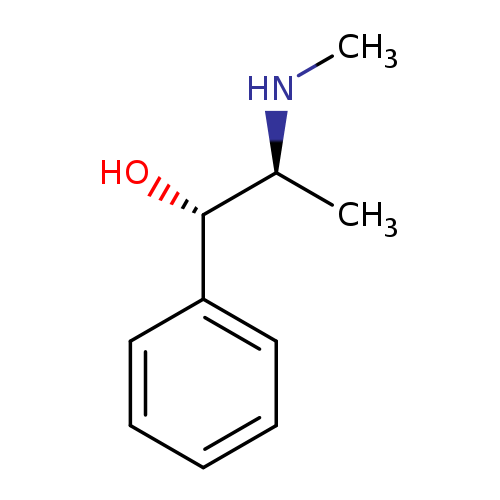
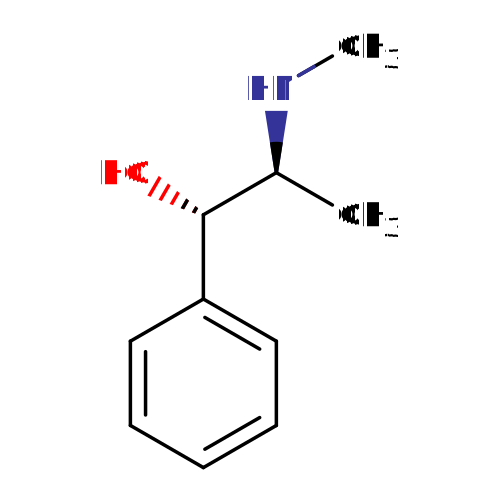
Chemical Structure
Thumb
Synonyms
ValueSource
(+) Threo-2-(methylamino)-1-phenyl-1-propanolChEBI
(+)-(1S,2S)-PseudoephedrineChEBI
(+)-PseudoephedrineChEBI
(+)-Psi-ephedrineChEBI
(+)-Threo-ephedrineChEBI
(1S,2S)-(+)-PseudoephedrineChEBI
(1S,2S)-PseudoephedrineChEBI
2-(Methylamino)-1-phenyl-1-propanolChEBI
D-IsoephedrineChEBI
D-PseudoephedrineChEBI
D-Psi-2-methylamino-1-phenyl-1-propanolChEBI
D-Psi-ephedrineChEBI
IsoephedrineChEBI
L(+)-Psi-ephedrineChEBI
L-(+)-PseudoephedrineChEBI
PseudoefedrinaChEBI
Pseudoephedrine D-formChEBI
PseudoephedrinumChEBI
Psi-ephedrinChEBI
Psi-ephedrineChEBI
trans-EphedrineChEBI
NeodurasinaKegg
AcunasoKegg
1-EphedrineHMDB
BesanHMDB
D-Pseudoephedrine baseHMDB
NovafedHMDB
Pseudoephedrine ephedrineHMDB
SudafedHMDB
Ephedrine threo isomerHMDB
Pseudoephedrine HCLHMDB
Threo isomer OF ephedrineHMDB
Pseudoephedrine hydrochlorideHMDB
Chemical FormulaC10H15NO
Average Molecular Mass165.232 g/mol
Monoisotopic Mass165.115 g/mol
CAS Registry Number90-82-4
IUPAC Name(1S,2S)-2-(methylamino)-1-phenylpropan-1-ol
Traditional Namepseudoephedrine
SMILESCN[C@@H](C)[C@@H](O)C1=CC=CC=C1
InChI IdentifierInChI=1S/C10H15NO/c1-8(11-2)10(12)9-6-4-3-5-7-9/h3-8,10-12H,1-2H3/t8-,10+/m0/s1
InChI KeyKWGRBVOPPLSCSI-WCBMZHEXSA-N
Chemical Taxonomy
Description belongs to the class of organic compounds known as phenylpropanes. These are organic compounds containing a phenylpropane moiety.
KingdomOrganic compounds
Super ClassBenzenoids
ClassBenzene and substituted derivatives
Sub ClassPhenylpropanes
Direct ParentPhenylpropanes
Alternative Parents
Substituents
  • Phenylpropane
  • Aralkylamine
  • 1,2-aminoalcohol
  • Secondary alcohol
  • Secondary aliphatic amine
  • Secondary amine
  • Alcohol
  • Organopnictogen compound
  • Organic oxygen compound
  • Organooxygen compound
  • Organonitrogen compound
  • Organic nitrogen compound
  • Amine
  • Aromatic alcohol
  • Hydrocarbon derivative
  • Aromatic homomonocyclic compound
Molecular FrameworkAromatic homomonocyclic compounds
External Descriptors
Biological Properties
StatusDetected and Not Quantified
OriginExogenous
Cellular Locations
  • Cytoplasm
  • Extracellular
Biofluid LocationsNot Available
Tissue LocationsNot Available
Pathways
NameSMPDB LinkKEGG Link
Pseudoephedrine Action PathwaySMP0125255 Not Available
Pseudoephedrine MetabolismSMP0125256 Not Available
Pseudoephedrine Drug Metabolism Action PathwaySMP0143289 Not Available
Applications
Biological Roles
Chemical RolesNot Available
Physical Properties
StateSolid
AppearanceWhite powder.
Experimental Properties
PropertyValue
Melting Point119 °C
Boiling PointNot Available
Solubility7 mg/L
Predicted Properties
PropertyValueSource
Water Solubility8.26 g/LALOGPS
logP1ALOGPS
logP1.32ChemAxon
logS-1.3ALOGPS
pKa (Strongest Acidic)13.89ChemAxon
pKa (Strongest Basic)9.52ChemAxon
Physiological Charge1ChemAxon
Hydrogen Acceptor Count2ChemAxon
Hydrogen Donor Count2ChemAxon
Polar Surface Area32.26 ŲChemAxon
Rotatable Bond Count3ChemAxon
Refractivity49.69 m³·mol⁻¹ChemAxon
Polarizability18.83 ųChemAxon
Number of Rings1ChemAxon
Bioavailability1ChemAxon
Rule of FiveYesChemAxon
Ghose FilterYesChemAxon
Veber's RuleYesChemAxon
MDDR-like RuleNoChemAxon
Spectra
Spectra
Spectrum TypeDescriptionSplash KeyView
Predicted GC-MSPredicted GC-MS Spectrum - GC-MS (Non-derivatized) - 70eV, Positivesplash10-0a4i-9200000000-0c3fe6959703a851b9ccSpectrum
Predicted GC-MSPredicted GC-MS Spectrum - GC-MS (1 TMS) - 70eV, Positivesplash10-05cr-4900000000-d9ac11e33b32a9e427adSpectrum
Predicted GC-MSPredicted GC-MS Spectrum - GC-MS (Non-derivatized) - 70eV, PositiveNot AvailableSpectrum
LC-MS/MSLC-MS/MS Spectrum - Quattro_QQQ 10V, N/A (Annotated)splash10-016s-3900000000-868bf4bba93d8b4be696Spectrum
LC-MS/MSLC-MS/MS Spectrum - Quattro_QQQ 25V, N/A (Annotated)splash10-0159-2900000000-6c55fc67b7576cb42a8aSpectrum
LC-MS/MSLC-MS/MS Spectrum - Quattro_QQQ 40V, N/A (Annotated)splash10-0006-9700000000-459686cbaf7d3b59c202Spectrum
Predicted LC-MS/MSPredicted LC-MS/MS Spectrum - 10V, Positivesplash10-00kb-0900000000-677d622716b4c2545f16Spectrum
Predicted LC-MS/MSPredicted LC-MS/MS Spectrum - 20V, Positivesplash10-00kb-2900000000-416def0e527ddf116a39Spectrum
Predicted LC-MS/MSPredicted LC-MS/MS Spectrum - 40V, Positivesplash10-0aou-9500000000-155625a572f19610e138Spectrum
Predicted LC-MS/MSPredicted LC-MS/MS Spectrum - 10V, Negativesplash10-03di-0900000000-ea7e1b550b5dc0d6d41dSpectrum
Predicted LC-MS/MSPredicted LC-MS/MS Spectrum - 20V, Negativesplash10-03dj-2900000000-f4de25860574bb60daf1Spectrum
Predicted LC-MS/MSPredicted LC-MS/MS Spectrum - 40V, Negativesplash10-0a6r-9600000000-62e375458e5f83795e90Spectrum
Predicted LC-MS/MSPredicted LC-MS/MS Spectrum - 10V, Negativesplash10-0297-3900000000-4496fbcd8548f7ccc58aSpectrum
Predicted LC-MS/MSPredicted LC-MS/MS Spectrum - 20V, Negativesplash10-014i-1900000000-03e637debccd8d202e3cSpectrum
Predicted LC-MS/MSPredicted LC-MS/MS Spectrum - 40V, Negativesplash10-004i-9100000000-7ead088c2f003219a1cfSpectrum
Predicted LC-MS/MSPredicted LC-MS/MS Spectrum - 10V, Positivesplash10-0002-0900000000-0282f3e8fc4bf9296a38Spectrum
Predicted LC-MS/MSPredicted LC-MS/MS Spectrum - 20V, Positivesplash10-014m-3900000000-8ee8987e88c6a5601ef7Spectrum
Predicted LC-MS/MSPredicted LC-MS/MS Spectrum - 40V, Positivesplash10-0006-9300000000-e3932e53d7936649b8dbSpectrum
MSMass Spectrum (Electron Ionization)splash10-0a4i-9000000000-8f0484f72b48017f1f2eSpectrum
1D NMR1H NMR SpectrumNot AvailableSpectrum
1D NMR13C NMR SpectrumNot AvailableSpectrum
1D NMR1H NMR SpectrumNot AvailableSpectrum
1D NMR13C NMR SpectrumNot AvailableSpectrum
1D NMR1H NMR SpectrumNot AvailableSpectrum
1D NMR13C NMR SpectrumNot AvailableSpectrum
1D NMR1H NMR SpectrumNot AvailableSpectrum
1D NMR13C NMR SpectrumNot AvailableSpectrum
1D NMR1H NMR SpectrumNot AvailableSpectrum
1D NMR13C NMR SpectrumNot AvailableSpectrum
1D NMR1H NMR SpectrumNot AvailableSpectrum
1D NMR13C NMR SpectrumNot AvailableSpectrum
1D NMR1H NMR SpectrumNot AvailableSpectrum
1D NMR13C NMR SpectrumNot AvailableSpectrum
1D NMR1H NMR SpectrumNot AvailableSpectrum
1D NMR13C NMR SpectrumNot AvailableSpectrum
1D NMR1H NMR SpectrumNot AvailableSpectrum
1D NMR13C NMR SpectrumNot AvailableSpectrum
1D NMR1H NMR SpectrumNot AvailableSpectrum
1D NMR13C NMR SpectrumNot AvailableSpectrum
2D NMR[1H,13C] 2D NMR SpectrumNot AvailableSpectrum
Toxicity Profile
Route of ExposurePseudoephedrine is readily and almost completely absorbed from the GI tract and there is no evidence of first-pass metabolism.
Mechanism of ToxicityPseudoephedrine acts directly on both alpha- and, to a lesser degree, beta-adrenergic receptors. Through direct action on alpha-adrenergic receptors in the mucosa of the respiratory tract, pseudoephedrine produces vasoconstriction. Pseudoephedrine relaxes bronchial smooth muscle by stimulating beta2-adrenergic receptors. Like ephedrine, pseudoephedrine releasing norepinephrine from its storage sites, an indirect effect. This is its main and direct mechanism of action. The displaced noradrenaline is released into the neuronal synapse where it is free to activate the postsynaptic adrenergic receptors.
MetabolismHepatic. Half Life: 9-16 hours
Toxicity ValuesNot Available
Lethal DoseNot Available
Carcinogenicity (IARC Classification)No indication of carcinogenicity to humans (not listed by IARC).
Uses/SourcesFor the treatment of nasal congestion, sinus congestion, Eustachian tube congestion, and vasomotor rhinitis, and as an adjunct to other agents in the optimum treatment of allergic rhinitis, croup, sinusitis, otitis media, and tracheobronchitis. Also used as first-line therapy of priapism.
Minimum Risk LevelNot Available
Health EffectsNot Available
SymptomsCommon adverse reactions include nervousness, restlessness, and insomnia. Rare adverse reactions include difficult/painful urination, dizziness/lightheadedness, heart palpitations, headache, increased sweating, nausea/vomiting, trembling, troubled breathing, unusual paleness, and weakness.
TreatmentNot Available
Concentrations
Not Available
DrugBank IDDB00852
HMDB IDHMDB0001943
FooDB IDFDB022758
Phenol Explorer IDNot Available
KNApSAcK IDC00031097
BiGG IDNot Available
BioCyc IDCPD-9954
METLIN ID2189
PDB IDNot Available
Wikipedia LinkPseudoephedrine
Chemspider ID6761
ChEBI ID51209
PubChem Compound ID7028
Kegg Compound IDC02765
YMDB IDNot Available
ECMDB IDNot Available
References
Synthesis Reference

Andrew G. Myers, “Synthesis of l-azatyrosine using pseudoephedrine as a chiral auxiliary.” U.S. Patent US5760237, issued June, 1991.

MSDSNot Available
General References
1. https://www.ncbi.nlm.nih.gov/pubmed/?term=11153535
2. https://www.ncbi.nlm.nih.gov/pubmed/?term=12199969
3. https://www.ncbi.nlm.nih.gov/pubmed/?term=15532139
4. https://www.ncbi.nlm.nih.gov/pubmed/?term=16410207
5. https://www.ncbi.nlm.nih.gov/pubmed/?term=16531903
6. https://www.ncbi.nlm.nih.gov/pubmed/?term=16965375
7. https://www.ncbi.nlm.nih.gov/pubmed/?term=17230461
8. https://www.ncbi.nlm.nih.gov/pubmed/?term=17316256
9. https://www.ncbi.nlm.nih.gov/pubmed/?term=26708626
10. https://www.ncbi.nlm.nih.gov/pubmed/?term=26762956
11. https://www.ncbi.nlm.nih.gov/pubmed/?term=26888635
12. https://www.ncbi.nlm.nih.gov/pubmed/?term=27168748
13. https://www.ncbi.nlm.nih.gov/pubmed/?term=27179610