Record Information
Version1.0
Creation Date2014-08-30 21:04:24 UTC
Update Date2026-03-31 19:07:59 UTC
Accession NumberCHEM003520
Identification
Common NamePromethazine
ClassSmall Molecule
DescriptionA phenothiazine derivative with histamine H1-blocking, antimuscarinic, and sedative properties. It is used as an antiallergic, in pruritus, for motion sickness and sedation, and also in animals. [PubChem]
Contaminant Sources
  • HMDB Contaminants - Urine
  • STOFF IDENT Compounds
  • T3DB toxins
  • ToxCast & Tox21 Chemicals
Contaminant Type
  • Amine
  • Anti-Allergic Agent
  • Antipruritic
  • Drug
  • Ether
  • Histamine H1 Antagonist
  • Organic Compound
  • Synthetic Compound
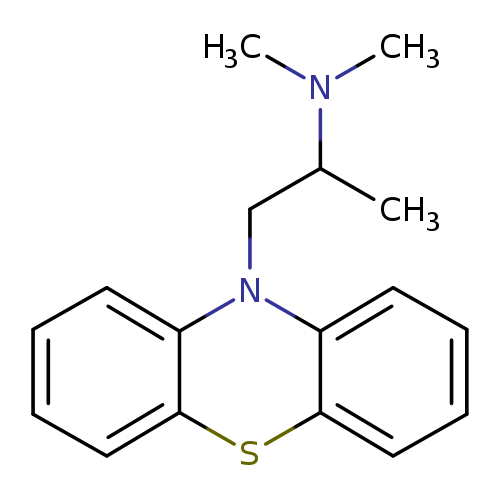
Chemical Structure
Thumb
Synonyms
ValueSource
(2-Dimethylamino-2-methyl)ethyl-N-dibenzoparathiazineChEBI
10-(2-Dimethylaminopropyl)phenothiazineChEBI
10-[2-(Dimethylamino)propyl]phenothiazineChEBI
N,N,alpha-Trimethyl-10H-phenothiazine-10-ethanamineChEBI
N-(2'-Dimethylamino-2'-methyl)ethylphenothiazineChEBI
ProazamineChEBI
PrometazinaChEBI
PromethazinumChEBI
N,N,a-Trimethyl-10H-phenothiazine-10-ethanamineGenerator
N,N,Α-trimethyl-10H-phenothiazine-10-ethanamineGenerator
IsopromethazineHMDB
Lilly 1516HMDB
ProazaimineHMDB
PromazinamideHMDB
PrometazineHMDB
PromethazinHMDB
PromethiazineHMDB
PromezathineHMDB
ProthazinHMDB
ProthazineHMDB
DiprazinHMDB
RumerganHMDB
PhenarganHMDB
PhensedylHMDB
PrometHMDB
Promethazine hydrochlorideHMDB
RemsedHMDB
PrometazinHMDB
PyrethiaHMDB
AtosilHMDB
DipherganHMDB
Hydrochloride, promethazineHMDB
PhenerganHMDB
PipolfenHMDB
PipolphenHMDB
Chemical FormulaC17H20N2S
Average Molecular Mass284.419 g/mol
Monoisotopic Mass284.135 g/mol
CAS Registry Number60-87-7
IUPAC Namedimethyl[1-(10H-phenothiazin-10-yl)propan-2-yl]amine
Traditional Namepromethazine
SMILESCC(CN1C2=CC=CC=C2SC2=CC=CC=C12)N(C)C
InChI IdentifierInChI=1S/C17H20N2S/c1-13(18(2)3)12-19-14-8-4-6-10-16(14)20-17-11-7-5-9-15(17)19/h4-11,13H,12H2,1-3H3
InChI KeyPWWVAXIEGOYWEE-UHFFFAOYSA-N
Chemical Taxonomy
Description belongs to the class of organic compounds known as phenothiazines. These are polycyclic aromatic compounds containing a phenothiazine moiety, which is a linear tricyclic system that consists of a two benzene rings joined by a para-thiazine ring.
KingdomOrganic compounds
Super ClassOrganoheterocyclic compounds
ClassBenzothiazines
Sub ClassPhenothiazines
Direct ParentPhenothiazines
Alternative Parents
Substituents
  • Phenothiazine
  • Alkyldiarylamine
  • Diarylthioether
  • Aryl thioether
  • Tertiary aliphatic/aromatic amine
  • Para-thiazine
  • Benzenoid
  • Tertiary amine
  • Tertiary aliphatic amine
  • Thioether
  • Azacycle
  • Organic nitrogen compound
  • Hydrocarbon derivative
  • Organopnictogen compound
  • Organonitrogen compound
  • Amine
  • Aromatic heteropolycyclic compound
Molecular FrameworkAromatic heteropolycyclic compounds
External Descriptors
Biological Properties
StatusDetected and Not Quantified
OriginExogenous
Cellular Locations
  • Membrane
Biofluid LocationsNot Available
Tissue LocationsNot Available
PathwaysNot Available
Applications
Biological Roles
Chemical RolesNot Available
Physical Properties
StateSolid
AppearanceWhite powder.
Experimental Properties
PropertyValue
Melting Point60 °C
Boiling Point190-192 °C at 3.00E+00 mm Hg
Solubility15.6 mg/L (at 24 °C)
Predicted Properties
PropertyValueSource
Water Solubility0.024 g/LALOGPS
logP4.52ALOGPS
logP4.29ChemAxon
logS-4.1ALOGPS
pKa (Strongest Basic)9.05ChemAxon
Physiological Charge1ChemAxon
Hydrogen Acceptor Count2ChemAxon
Hydrogen Donor Count0ChemAxon
Polar Surface Area6.48 ŲChemAxon
Rotatable Bond Count3ChemAxon
Refractivity88.5 m³·mol⁻¹ChemAxon
Polarizability32.38 ųChemAxon
Number of Rings3ChemAxon
Bioavailability1ChemAxon
Rule of FiveYesChemAxon
Ghose FilterYesChemAxon
Veber's RuleYesChemAxon
MDDR-like RuleNoChemAxon
Spectra
Spectra
Spectrum TypeDescriptionSplash KeyView
GC-MSGC-MS Spectrum - CI-B (Non-derivatized)splash10-000i-0090000000-f1fe9756bed13819bbb4Spectrum
GC-MSGC-MS Spectrum - EI-B (Non-derivatized)splash10-00di-9000000000-abbdf5514dccef4821b2Spectrum
GC-MSGC-MS Spectrum - EI-B (Non-derivatized)splash10-00di-9100000000-9bef9a6b83d662fc7e2cSpectrum
GC-MSGC-MS Spectrum - CI-B (Non-derivatized)splash10-0079-8290000000-fe5d6b4e9f62b7270798Spectrum
GC-MSGC-MS Spectrum - CI-B (Non-derivatized)splash10-000i-0090000000-f1fe9756bed13819bbb4Spectrum
GC-MSGC-MS Spectrum - EI-B (Non-derivatized)splash10-00di-9000000000-abbdf5514dccef4821b2Spectrum
GC-MSGC-MS Spectrum - EI-B (Non-derivatized)splash10-00di-9100000000-9bef9a6b83d662fc7e2cSpectrum
GC-MSGC-MS Spectrum - CI-B (Non-derivatized)splash10-0079-8290000000-fe5d6b4e9f62b7270798Spectrum
Predicted GC-MSPredicted GC-MS Spectrum - GC-MS (Non-derivatized) - 70eV, Positivesplash10-0229-9150000000-19753aa755aa19143e9bSpectrum
Predicted GC-MSPredicted GC-MS Spectrum - GC-MS (Non-derivatized) - 70eV, PositiveNot AvailableSpectrum
LC-MS/MSLC-MS/MS Spectrum - , positivesplash10-000j-0690000000-0b4dfbac9712d2e36046Spectrum
LC-MS/MSLC-MS/MS Spectrum - LC-ESI-QFT , positivesplash10-000i-9220000000-9d761be1437f10dcc94bSpectrum
LC-MS/MSLC-MS/MS Spectrum - 35V, Positivesplash10-000i-9120000000-53ae2d83de014d922ec7Spectrum
LC-MS/MSLC-MS/MS Spectrum - 30V, Positivesplash10-0002-0920000000-c051699dc72e950f2e98Spectrum
LC-MS/MSLC-MS/MS Spectrum - 50V, Positivesplash10-0002-0910000000-e92aacd8ca86df8a0e18Spectrum
LC-MS/MSLC-MS/MS Spectrum - 40V, Positivesplash10-0002-0910000000-0ce89af1c9b2c4633edaSpectrum
LC-MS/MSLC-MS/MS Spectrum - 20V, Positivesplash10-0002-0950000000-70d959c63d9e713a865aSpectrum
LC-MS/MSLC-MS/MS Spectrum - 10V, Positivesplash10-000i-0090000000-842e411dfa4c9fad1f7fSpectrum
Predicted LC-MS/MSPredicted LC-MS/MS Spectrum - 10V, Positivesplash10-000i-2090000000-76a910470a52a47a6757Spectrum
Predicted LC-MS/MSPredicted LC-MS/MS Spectrum - 20V, Positivesplash10-000f-8090000000-d597b4b7604e8276f449Spectrum
Predicted LC-MS/MSPredicted LC-MS/MS Spectrum - 40V, Positivesplash10-00dr-9110000000-cbed4a551fc77cf0e5b9Spectrum
Predicted LC-MS/MSPredicted LC-MS/MS Spectrum - 10V, Negativesplash10-001i-0090000000-e24a248a31f0e31f1ec5Spectrum
Predicted LC-MS/MSPredicted LC-MS/MS Spectrum - 20V, Negativesplash10-009t-0940000000-afb556a81c40edffb9a1Spectrum
Predicted LC-MS/MSPredicted LC-MS/MS Spectrum - 40V, Negativesplash10-0002-3910000000-3daef27d94a5cac7d4a7Spectrum
Predicted LC-MS/MSPredicted LC-MS/MS Spectrum - 10V, Positivesplash10-000i-9070000000-e74135a63711b2ca001fSpectrum
Predicted LC-MS/MSPredicted LC-MS/MS Spectrum - 20V, Positivesplash10-000i-9020000000-25ad7e0e10410cbe88c3Spectrum
Predicted LC-MS/MSPredicted LC-MS/MS Spectrum - 40V, Positivesplash10-000j-9610000000-32a1e6113f4291e6a186Spectrum
Predicted LC-MS/MSPredicted LC-MS/MS Spectrum - 10V, Negativesplash10-001i-0090000000-a26692bb509bb9fc8701Spectrum
Predicted LC-MS/MSPredicted LC-MS/MS Spectrum - 20V, Negativesplash10-000t-0590000000-3a84419d780b185fa21aSpectrum
Predicted LC-MS/MSPredicted LC-MS/MS Spectrum - 40V, Negativesplash10-01ot-0940000000-7c01990eb3e291008595Spectrum
MSMass Spectrum (Electron Ionization)splash10-00di-9210000000-7167670dff3395a6ade2Spectrum
Toxicity Profile
Route of ExposureOn average, 88% of a promethazine dose is absorbed after oral administration; however, the absolute bioavailability is only 25% because of first-pass clearance.
Mechanism of ToxicityLike other H1-antagonists, promethazine competes with free histamine for binding at H1-receptor sites in the GI tract, uterus, large blood vessels, and bronchial muscle. The relief of nausea appears to be related to central anticholinergic actions and may implicate activity on the medullary chemoreceptor trigger zone.
MetabolismHepatic Route of Elimination: Promethazine hydrochloride is metabolized in the liver, with the sulfoxides of promethazine and N-desmethylpromethazine being the predominant metabolites appearing in the urine. Half Life: 16-19 hours
Toxicity ValuesIV, Mouse: LD50=55mg/kg
Lethal DoseNot Available
Carcinogenicity (IARC Classification)No indication of carcinogenicity to humans (not listed by IARC).
Uses/SourcesFor the treatment of allergic disorders, and nausea/vomiting.
Minimum Risk LevelNot Available
Health EffectsNot Available
SymptomsSymptoms of overdose include mild depression of the central nervous system and cardiovascular system to profound hypotension, respiratory depression, unconsciousness, and sudden death. Other reported reactions include hyperreflexia, hypertonia, ataxia, athetosis, and extensor-plantar reflexes (Babinski reflex).
TreatmentNot Available
Concentrations
Not Available
DrugBank IDDB01069
HMDB IDHMDB0015202
FooDB IDNot Available
Phenol Explorer IDNot Available
KNApSAcK IDNot Available
BiGG IDNot Available
BioCyc IDNot Available
METLIN IDNot Available
PDB IDNot Available
Wikipedia LinkPromethazine
Chemspider ID4758
ChEBI ID8461
PubChem Compound ID4927
Kegg Compound IDC07404
YMDB IDNot Available
ECMDB IDNot Available
References
Synthesis Reference

DrugSyn.org

MSDSNot Available
General References
1. Peters RJ Jr, Kelder SH, Markham CM, Yacoubian GS Jr, Peters LA, Ellis A: Beliefs and social norms about codeine and promethazine hydrochloride cough syrup (CPHCS) onset and perceived addiction among urban Houstonian adolescents: an addiction trend in the city of lean. J Drug Educ. 2003;33(4):415-25.