Record Information
Version1.0
Creation Date2014-09-11 02:05:38 UTC
Update Date2026-04-05 10:47:27 UTC
Accession NumberCHEM003660
Identification
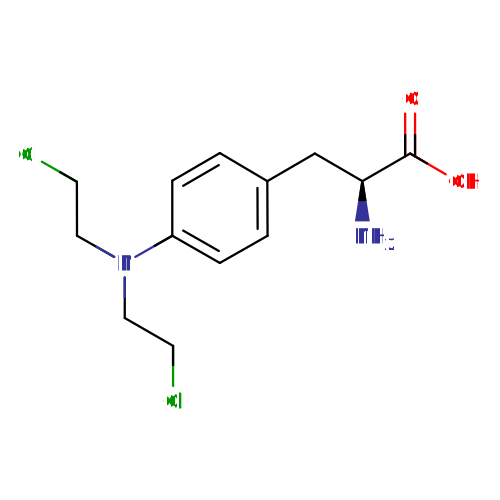
Common NameMelphalan
ClassSmall Molecule
DescriptionAn alkylating nitrogen mustard that is used as an antineoplastic in the form of the levo isomer - melphalan, the racemic mixture - merphalan, and the dextro isomer - medphalan; toxic to bone marrow, but little vesicant action; potential carcinogen.
Contaminant Sources
  • Clean Air Act Chemicals
  • HMDB Contaminants - Urine
  • IARC Carcinogens Group 1
  • IARC Carcinogens Group 2B
  • STOFF IDENT Compounds
  • T3DB toxins
  • ToxCast & Tox21 Chemicals
Contaminant Type
  • Amine
  • Drug
  • Metabolite
  • Organic Compound
  • Organochloride
  • Synthetic Compound
Chemical Structure
Thumb
Synonyms
ValueSource
3-(p-(Bis(2-chloroethyl)amino)phenyl)-L-alanineChEBI
3-p-(Di(2-chloroethyl)amino)-phenyl-L-alanineChEBI
4-(Bis(2-chloroethyl)amino)-L-phenylalanineChEBI
L-3-(p-(Bis(2-chloroethyl)amino)phenyl)alanineChEBI
L-PAMChEBI
L-Phenylalanine mustardChEBI
L-SarcolysineChEBI
MelfalanoChEBI
MelphalanumChEBI
p-Bis(beta-chloroethyl)aminophenylalanineChEBI
p-Di-(2-chloroethyl)amino-L-phenylalanineChEBI
p-L-SarcolysinChEBI
p-N,N-Bis(2-chloroethyl)amino-L-phenylalanineChEBI
p-N-Bis(2-chloroethyl)amino-L-phenylalanineChEBI
Phenylalanine mustardChEBI
Phenylalanine nitrogen mustardChEBI
AlkeranKegg
p-Bis(b-chloroethyl)aminophenylalanineGenerator
p-Bis(β-chloroethyl)aminophenylalanineGenerator
4-(Bis(2-chloroethyl)amino)phenylalanineHMDB
MedphalanHMDB
MerphalanHMDB
SarcolysineHMDB
SarkolysinHMDB
Mustard, phenylalanineHMDB
Chemical FormulaC13H18Cl2N2O2
Average Molecular Mass305.200 g/mol
Monoisotopic Mass304.075 g/mol
CAS Registry Number148-82-3
IUPAC Name(2S)-2-amino-3-{4-[bis(2-chloroethyl)amino]phenyl}propanoic acid
Traditional Namemelphalan
SMILESN[C@@H](CC1=CC=C(C=C1)N(CCCl)CCCl)C(O)=O
InChI IdentifierInChI=1S/C13H18Cl2N2O2/c14-5-7-17(8-6-15)11-3-1-10(2-4-11)9-12(16)13(18)19/h1-4,12H,5-9,16H2,(H,18,19)/t12-/m0/s1
InChI KeySGDBTWWWUNNDEQ-LBPRGKRZSA-N
Chemical Taxonomy
Description belongs to the class of organic compounds known as phenylalanine and derivatives. Phenylalanine and derivatives are compounds containing phenylalanine or a derivative thereof resulting from reaction of phenylalanine at the amino group or the carboxy group, or from the replacement of any hydrogen of glycine by a heteroatom.
KingdomOrganic compounds
Super ClassOrganic acids and derivatives
ClassCarboxylic acids and derivatives
Sub ClassAmino acids, peptides, and analogues
Direct ParentPhenylalanine and derivatives
Alternative Parents
Substituents
  • Phenylalanine or derivatives
  • 3-phenylpropanoic-acid
  • Alpha-amino acid
  • Amphetamine or derivatives
  • L-alpha-amino acid
  • Nitrogen mustard
  • Tertiary aliphatic/aromatic amine
  • Aniline or substituted anilines
  • Dialkylarylamine
  • Aralkylamine
  • Monocyclic benzene moiety
  • Benzenoid
  • Amino acid
  • Tertiary amine
  • Carboxylic acid
  • Monocarboxylic acid or derivatives
  • Organic oxide
  • Organooxygen compound
  • Organonitrogen compound
  • Organochloride
  • Organohalogen compound
  • Hydrocarbon derivative
  • Organic nitrogen compound
  • Primary aliphatic amine
  • Primary amine
  • Carbonyl group
  • Organopnictogen compound
  • Alkyl halide
  • Amine
  • Organic oxygen compound
  • Alkyl chloride
  • Aromatic homomonocyclic compound
Molecular FrameworkAromatic homomonocyclic compounds
External Descriptors
Biological Properties
StatusDetected and Not Quantified
OriginExogenous
Cellular Locations
  • Cytoplasm
  • Extracellular
  • Membrane
Biofluid LocationsNot Available
Tissue LocationsNot Available
PathwaysNot Available
ApplicationsNot Available
Biological RolesNot Available
Chemical RolesNot Available
Physical Properties
StateSolid
AppearanceWhite powder.
Experimental Properties
PropertyValue
Melting Point182.5°C
Boiling PointNot Available
Solubility< 0.1 g/100 mL at 22°C
Predicted Properties
PropertyValueSource
Water Solubility0.36 g/LALOGPS
logP-0.22ALOGPS
logP0.25ChemAxon
logS-2.9ALOGPS
pKa (Strongest Acidic)1.29ChemAxon
pKa (Strongest Basic)9.51ChemAxon
Physiological Charge0ChemAxon
Hydrogen Acceptor Count4ChemAxon
Hydrogen Donor Count2ChemAxon
Polar Surface Area66.56 ŲChemAxon
Rotatable Bond Count8ChemAxon
Refractivity78.23 m³·mol⁻¹ChemAxon
Polarizability31.38 ųChemAxon
Number of Rings1ChemAxon
Bioavailability1ChemAxon
Rule of FiveYesChemAxon
Ghose FilterYesChemAxon
Veber's RuleNoChemAxon
MDDR-like RuleNoChemAxon
Spectra
Spectra
Spectrum TypeDescriptionSplash KeyView
Predicted GC-MSPredicted GC-MS Spectrum - GC-MS (Non-derivatized) - 70eV, Positivesplash10-052f-3890000000-153ff87813e7a797c73bSpectrum
Predicted GC-MSPredicted GC-MS Spectrum - GC-MS (1 TMS) - 70eV, Positivesplash10-01c3-8295000000-421b0e52574345db725fSpectrum
Predicted GC-MSPredicted GC-MS Spectrum - GC-MS (Non-derivatized) - 70eV, PositiveNot AvailableSpectrum
LC-MS/MSLC-MS/MS Spectrum - LC-ESI-qTof , Positivesplash10-000w-2930000000-b95beb5e9c3e61b7687fSpectrum
LC-MS/MSLC-MS/MS Spectrum - , positivesplash10-000w-2930000000-b95beb5e9c3e61b7687fSpectrum
Predicted LC-MS/MSPredicted LC-MS/MS Spectrum - 10V, Positivesplash10-0a4i-0093000000-78045bae5e6c1e79e22dSpectrum
Predicted LC-MS/MSPredicted LC-MS/MS Spectrum - 20V, Positivesplash10-0a4i-1490000000-3b1f7009692b1139989bSpectrum
Predicted LC-MS/MSPredicted LC-MS/MS Spectrum - 40V, Positivesplash10-02t9-3930000000-b0f45ffda87388d4384aSpectrum
Predicted LC-MS/MSPredicted LC-MS/MS Spectrum - 10V, Negativesplash10-0udi-0049000000-8c401366ace5d7fc1f08Spectrum
Predicted LC-MS/MSPredicted LC-MS/MS Spectrum - 20V, Negativesplash10-0v4i-1192000000-fd136d877921c8afed95Spectrum
Predicted LC-MS/MSPredicted LC-MS/MS Spectrum - 40V, Negativesplash10-00di-9530000000-511158435cb1ef063085Spectrum
Predicted LC-MS/MSPredicted LC-MS/MS Spectrum - 10V, Positivesplash10-0a4i-0095000000-3f3242a1d9debe0c8315Spectrum
Predicted LC-MS/MSPredicted LC-MS/MS Spectrum - 20V, Positivesplash10-00bi-0090000000-91067233804f48cd760aSpectrum
Predicted LC-MS/MSPredicted LC-MS/MS Spectrum - 40V, Positivesplash10-014j-0930000000-af3e37be6b85ec7f144bSpectrum
Predicted LC-MS/MSPredicted LC-MS/MS Spectrum - 10V, Negativesplash10-001i-7090000000-6793f4f7ed0a2c22f972Spectrum
Predicted LC-MS/MSPredicted LC-MS/MS Spectrum - 20V, Negativesplash10-001i-9000000000-c2fa753da65a4bac80a1Spectrum
Predicted LC-MS/MSPredicted LC-MS/MS Spectrum - 40V, Negativesplash10-001i-9000000000-ed9c052b92676bc8a30bSpectrum
1D NMR13C NMR SpectrumNot AvailableSpectrum
1D NMR1H NMR SpectrumNot AvailableSpectrum
1D NMR13C NMR SpectrumNot AvailableSpectrum
1D NMR1H NMR SpectrumNot AvailableSpectrum
1D NMR13C NMR SpectrumNot AvailableSpectrum
1D NMR1H NMR SpectrumNot AvailableSpectrum
1D NMR13C NMR SpectrumNot AvailableSpectrum
1D NMR1H NMR SpectrumNot AvailableSpectrum
1D NMR13C NMR SpectrumNot AvailableSpectrum
1D NMR1H NMR SpectrumNot AvailableSpectrum
1D NMR13C NMR SpectrumNot AvailableSpectrum
1D NMR1H NMR SpectrumNot AvailableSpectrum
1D NMR13C NMR SpectrumNot AvailableSpectrum
1D NMR1H NMR SpectrumNot AvailableSpectrum
1D NMR13C NMR SpectrumNot AvailableSpectrum
1D NMR1H NMR SpectrumNot AvailableSpectrum
1D NMR13C NMR SpectrumNot AvailableSpectrum
1D NMR1H NMR SpectrumNot AvailableSpectrum
1D NMR13C NMR SpectrumNot AvailableSpectrum
1D NMR1H NMR SpectrumNot AvailableSpectrum
Toxicity Profile
Route of ExposureIncomplete, variable, 25-89% post oral dose
Mechanism of ToxicityAlkylating agents work by three different mechanisms: 1) attachment of alkyl groups to DNA bases (primarily at the N-7 position of guanine and to a lesser extent, at the N-3 position of adenine), forming monoadducts and resulting in the DNA being fragmented by repair enzymes in their attempts to replace the alkylated bases, preventing DNA synthesis and RNA transcription from the affected DNA, 2) DNA damage via the formation of cross-links (bonds between atoms in the DNA) which prevents DNA from being separated for synthesis or transcription, and 3) the induction of mispairing of the nucleotides leading to mutations.
MetabolismMelphalan is not actively metabolised, it spontaneously degrades to mono and dihydroxy products. Route of Elimination: The 24-hour urinary excretion of parent drug in these patients was 10% Њ± 4.5%, suggesting that renal clearance is not a major route of elimination of parent drug. Half Life: 1.5 (±0.83) hours
Toxicity ValuesLD50=11.2 mg/kg (orally in rat)
Lethal DoseNot Available
Carcinogenicity (IARC Classification)1, carcinogenic to humans. (4)
Uses/SourcesFor the palliative treatment of multiple myeloma and for the palliation of non-resectable epithelial carcinoma of the ovary. Has also been used alone or as part of various chemotherapeutic regimens as an adjunct to surgery in the treatment of breast cancer, alone or in combination regimens for palliative treatment of locally recurrent or unresectable in-transit metastatic melanoma of the extremities, as well as for the treatment of amyloidosis with prednisone.
Minimum Risk LevelNot Available
Health EffectsThe principal toxic effect is bone marrow suppression.
SymptomsVomiting, ulceration of the mouth, diarrhea, and hemorrhage of the gastrointestinal tract.
TreatmentNot Available
Concentrations
Not Available
DrugBank IDDB01042
HMDB IDHMDB0015176
FooDB IDNot Available
Phenol Explorer IDNot Available
KNApSAcK IDNot Available
BiGG IDNot Available
BioCyc IDNot Available
METLIN IDNot Available
PDB IDNot Available
Wikipedia LinkMelphalan
Chemspider ID405297
ChEBI ID28876
PubChem Compound ID460612
Kegg Compound IDC07122
YMDB IDNot Available
ECMDB IDNot Available
References
Synthesis Reference

DrugSyn.org

MSDSNot Available
General References
1. Moscow JA, Swanson CA, Cowan KH: Decreased melphalan accumulation in a human breast cancer cell line selected for resistance to melphalan. Br J Cancer. 1993 Oct;68(4):732-7.
2. Souliotis VL, Dimopoulos MA, Episkopou HG, Kyrtopoulos SA, Sfikakis PP: Preferential in vivo DNA repair of melphalan-induced damage in human genes is greatly affected by the local chromatin structure. DNA Repair (Amst). 2006 Aug 13;5(8):972-85. Epub 2006 Jun 15.
3. Loeber R, Michaelson E, Fang Q, Campbell C, Pegg AE, Tretyakova N: Cross-linking of the DNA repair protein Omicron6-alkylguanine DNA alkyltransferase to DNA in the presence of antitumor nitrogen mustards. Chem Res Toxicol. 2008 Apr;21(4):787-95. doi: 10.1021/tx7004508. Epub 2008 Feb 14.
4. https://www.ncbi.nlm.nih.gov/pubmed/?term=10820424
5. https://www.ncbi.nlm.nih.gov/pubmed/?term=10937717
6. https://www.ncbi.nlm.nih.gov/pubmed/?term=11680815
7. https://www.ncbi.nlm.nih.gov/pubmed/?term=11914777
8. https://www.ncbi.nlm.nih.gov/pubmed/?term=18481314
9. https://www.ncbi.nlm.nih.gov/pubmed/?term=445303
10. https://www.ncbi.nlm.nih.gov/pubmed/?term=7494795
11. https://www.ncbi.nlm.nih.gov/pubmed/?term=7605343
12. https://www.ncbi.nlm.nih.gov/pubmed/?term=8552138
13. https://www.ncbi.nlm.nih.gov/pubmed/?term=8951232
14. https://www.ncbi.nlm.nih.gov/pubmed/?term=9218926
15. https://www.ncbi.nlm.nih.gov/pubmed/?term=9250538