Record Information
Version1.0
Creation Date2014-09-11 02:06:13 UTC
Update Date2026-03-31 18:21:23 UTC
Accession NumberCHEM003674
Identification
Common NameThiotepa
ClassSmall Molecule
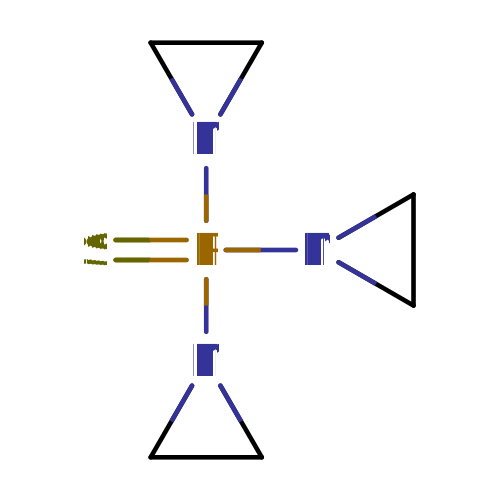
DescriptionN,N'N'-triethylenethiophosphoramide (ThioTEPA) is a cancer chemotherapeutic member of the alkylating agent group, now in use for over 50 years. It is a stable derivative of N,N',N''- triethylenephosphoramide (TEPA). It is mostly used to treat breast cancer, ovarian cancer and bladder cancer. It is also used as conditioning for Bone marrow transplantation. Its main toxicity is myelosuppression.
Contaminant Sources
  • HMDB Contaminants - Urine
  • IARC Carcinogens Group 1
  • STOFF IDENT Compounds
  • T3DB toxins
  • ToxCast & Tox21 Chemicals
Contaminant Type
  • Drug
  • Metabolite
  • Organic Compound
  • Synthetic Compound
Chemical Structure
Thumb
Synonyms
ValueSource
ThioplexKegg
TepadinaKegg
RethioKegg
GirostanHMDB
TespaHMDB
TespaminHMDB
Thio-tepaHMDB
Thio tepaHMDB
TriethylenethiophosphoramideHMDB
Tris(1-aziridinyl)phosphine sulfideHMDB
ThiophosphamideHMDB
Chemical FormulaC6H12N3PS
Average Molecular Mass189.218 g/mol
Monoisotopic Mass189.049 g/mol
CAS Registry Number52-24-4
IUPAC Nametris(aziridin-1-yl)-λ⁵-phosphanethione
Traditional Namethiophosphamide
SMILESS=P(N1CC1)(N1CC1)N1CC1
InChI IdentifierInChI=1S/C6H12N3PS/c11-10(7-1-2-7,8-3-4-8)9-5-6-9/h1-6H2
InChI KeyFOCVUCIESVLUNU-UHFFFAOYSA-N
Chemical Taxonomy
Description belongs to the class of organic compounds known as organic thiophosphoric acids and derivatives. These are organic compounds containing the thiophosphoric acid functional group or a derivative thereof, with the general structure RP(R')(R'')=S, where R,R',R'' = O,N, halogen residue.
KingdomOrganic compounds
Super ClassOrganic acids and derivatives
ClassOrganic thiophosphoric acids and derivatives
Sub ClassNot Available
Direct ParentOrganic thiophosphoric acids and derivatives
Alternative Parents
Substituents
  • Organic thiophosphoric acid or derivatives
  • Azacycle
  • Organoheterocyclic compound
  • Aziridine
  • Organic nitrogen compound
  • Organopnictogen compound
  • Hydrocarbon derivative
  • Organonitrogen compound
  • Aliphatic heteromonocyclic compound
Molecular FrameworkAliphatic heteromonocyclic compounds
External Descriptors
Biological Properties
StatusDetected and Not Quantified
OriginExogenous
Cellular Locations
  • Cytoplasm
  • Extracellular
  • Membrane
Biofluid LocationsNot Available
Tissue LocationsNot Available
PathwaysNot Available
ApplicationsNot Available
Biological RolesNot Available
Chemical RolesNot Available
Physical Properties
StateSolid
AppearanceWhite powder.
Experimental Properties
PropertyValue
Melting Point51.5°C
Boiling PointNot Available
Solubility1.9E+005 mg/L (at 25°C)
Predicted Properties
PropertyValueSource
Water Solubility9.27 g/LALOGPS
logP0.17ALOGPS
logP-1ChemAxon
logS-1.3ALOGPS
pKa (Strongest Basic)-0.3ChemAxon
Physiological Charge0ChemAxon
Hydrogen Acceptor Count3ChemAxon
Hydrogen Donor Count0ChemAxon
Polar Surface Area9.03 ŲChemAxon
Rotatable Bond Count3ChemAxon
Refractivity50.72 m³·mol⁻¹ChemAxon
Polarizability18.23 ųChemAxon
Number of Rings3ChemAxon
Bioavailability1ChemAxon
Rule of FiveYesChemAxon
Ghose FilterNoChemAxon
Veber's RuleYesChemAxon
MDDR-like RuleNoChemAxon
Spectra
Spectra
Spectrum TypeDescriptionSplash KeyView
Predicted GC-MSPredicted GC-MS Spectrum - GC-MS (Non-derivatized) - 70eV, Positivesplash10-0007-9700000000-870c297591c0a9b9707cSpectrum
Predicted GC-MSPredicted GC-MS Spectrum - GC-MS (Non-derivatized) - 70eV, PositiveNot AvailableSpectrum
LC-MS/MSLC-MS/MS Spectrum - LC-ESI-qTof , Positivesplash10-0udj-2910000000-ba7d9f76d09c90907cd5Spectrum
LC-MS/MSLC-MS/MS Spectrum - , positivesplash10-0udj-2910000000-ba7d9f76d09c90907cd5Spectrum
Predicted LC-MS/MSPredicted LC-MS/MS Spectrum - 10V, Positivesplash10-0006-0900000000-0cd73bb1e3f4935cf116Spectrum
Predicted LC-MS/MSPredicted LC-MS/MS Spectrum - 20V, Positivesplash10-0005-3900000000-5c3374f9826ed342ca4eSpectrum
Predicted LC-MS/MSPredicted LC-MS/MS Spectrum - 40V, Positivesplash10-0006-9000000000-8dc6d03ec98f9c80f9d2Spectrum
Predicted LC-MS/MSPredicted LC-MS/MS Spectrum - 10V, Negativesplash10-000i-2900000000-bb1e4366af9868c15a01Spectrum
Predicted LC-MS/MSPredicted LC-MS/MS Spectrum - 20V, Negativesplash10-074s-0900000000-dc8c896ef045e2852518Spectrum
Predicted LC-MS/MSPredicted LC-MS/MS Spectrum - 40V, Negativesplash10-0006-9100000000-7251e3acc37a1500dc98Spectrum
Predicted LC-MS/MSPredicted LC-MS/MS Spectrum - 10V, Positivesplash10-0002-0900000000-1123ba8976a8239bb663Spectrum
Predicted LC-MS/MSPredicted LC-MS/MS Spectrum - 20V, Positivesplash10-0002-0900000000-103f3980559601ae7672Spectrum
Predicted LC-MS/MSPredicted LC-MS/MS Spectrum - 40V, Positivesplash10-0f6x-9700000000-b8be72202a635e78e521Spectrum
Predicted LC-MS/MSPredicted LC-MS/MS Spectrum - 10V, Negativesplash10-000i-0900000000-460ca1d15e5d5215d31fSpectrum
Predicted LC-MS/MSPredicted LC-MS/MS Spectrum - 20V, Negativesplash10-000i-0900000000-acd27824890aefdaae3fSpectrum
Predicted LC-MS/MSPredicted LC-MS/MS Spectrum - 40V, Negativesplash10-0006-9700000000-601e44410bd7bac39398Spectrum
MSMass Spectrum (Electron Ionization)splash10-00kn-6900000000-6d6b7c109663ea65ad79Spectrum
1D NMR13C NMR SpectrumNot AvailableSpectrum
1D NMR1H NMR SpectrumNot AvailableSpectrum
1D NMR13C NMR SpectrumNot AvailableSpectrum
1D NMR1H NMR SpectrumNot AvailableSpectrum
1D NMR13C NMR SpectrumNot AvailableSpectrum
1D NMR1H NMR SpectrumNot AvailableSpectrum
1D NMR13C NMR SpectrumNot AvailableSpectrum
1D NMR1H NMR SpectrumNot AvailableSpectrum
1D NMR13C NMR SpectrumNot AvailableSpectrum
1D NMR1H NMR SpectrumNot AvailableSpectrum
1D NMR13C NMR SpectrumNot AvailableSpectrum
1D NMR1H NMR SpectrumNot AvailableSpectrum
1D NMR13C NMR SpectrumNot AvailableSpectrum
1D NMR1H NMR SpectrumNot AvailableSpectrum
1D NMR13C NMR SpectrumNot AvailableSpectrum
1D NMR1H NMR SpectrumNot AvailableSpectrum
1D NMR13C NMR SpectrumNot AvailableSpectrum
1D NMR1H NMR SpectrumNot AvailableSpectrum
1D NMR13C NMR SpectrumNot AvailableSpectrum
1D NMR1H NMR SpectrumNot AvailableSpectrum
Toxicity Profile
Route of ExposureNot Available
Mechanism of ToxicityThe alkyl group is attached to the guanine base of DNA, at the number 7 nitrogen atom of the imidazole ring. They stop tumor growth by crosslinking guanine nucleobases in DNA double-helix strands, directly attacking DNA. This makes the strands unable to uncoil and separate. As this is necessary in DNA replication, the cells can no longer divide. These drugs act nonspecifically.
MetabolismRoute of Elimination: Urinary excretion of 14C-labeled thiotepa and metabolites in a 34-year old patient with metastatic carcinoma of the cecum who received a dose of 0.3 mg/kg intravenously was 63%. Half Life: 1.5 to 4.1 hours
Toxicity ValuesNot Available
Lethal DoseNot Available
Carcinogenicity (IARC Classification)1, carcinogenic to humans. (2)
Uses/SourcesThioTEPA is used a as conditioning treatment prior to allogeneic or autologous haematopoietic progenitor cell transplantation (HPCT) in haematological diseases in adult and paediatric patients. Also, when high dose chemotherapy with HPCT support it is appropriate for the treatment of solid tumours in adult and paediatric patients.
Minimum Risk LevelNot Available
Health EffectsNot Available
SymptomsNot Available
TreatmentNot Available
Concentrations
Not Available
DrugBank IDDB04572
HMDB IDHMDB0015576
FooDB IDNot Available
Phenol Explorer IDNot Available
KNApSAcK IDNot Available
BiGG IDNot Available
BioCyc IDNot Available
METLIN IDNot Available
PDB IDNot Available
Wikipedia LinkThioTEPA
Chemspider ID5254
ChEBI ID128310
PubChem Compound ID5453
Kegg Compound IDC07641
YMDB IDNot Available
ECMDB IDNot Available
References
Synthesis Reference

John Kazan, “Process for producing thiotepa.” U.S. Patent US4918199, issued February, 1954.

MSDSNot Available
General References
1. Maanen MJ, Smeets CJ, Beijnen JH: Chemistry, pharmacology and pharmacokinetics of N,N',N" -triethylenethiophosphoramide (ThioTEPA). Cancer Treat Rev. 2000 Aug;26(4):257-68.