Record Information
Version1.0
Creation Date2014-09-11 02:06:22 UTC
Update Date2026-03-26 18:38:14 UTC
Accession NumberCHEM003678
Identification
Common NameZidovudine
ClassSmall Molecule
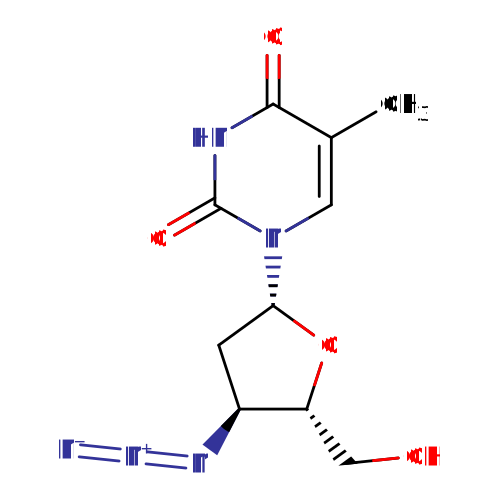
DescriptionA dideoxynucleoside compound in which the 3'-hydroxy group on the sugar moiety has been replaced by an azido group. This modification prevents the formation of phosphodiester linkages which are needed for the completion of nucleic acid chains. The compound is a potent inhibitor of HIV replication, acting as a chain-terminator of viral DNA during reverse transcription. It improves immunologic function, partially reverses the HIV-induced neurological dysfunction, and improves certain other clinical abnormalities associated with AIDS. Its principal toxic effect is dose-dependent suppression of bone marrow, resulting in anemia and leukopenia.
Contaminant Sources
  • HMDB Contaminants - Urine
  • IARC Carcinogens Group 2B
  • STOFF IDENT Compounds
  • T3DB toxins
  • ToxCast & Tox21 Chemicals
Contaminant Type
  • Amide
  • Anti-HIV Agent
  • Antimetabolite
  • Drug
  • Ether
  • Metabolite
  • Organic Compound
  • Reverse Transcriptase Inhibitor
  • Synthetic Compound
Chemical Structure
Thumb
Synonyms
ValueSource
AzidothymidineChEBI
AZTChEBI
RetrovirChEBI
ZidovudinChEBI
ZidovudinumChEBI
3'-Azido-3'-deoxythymidineKegg
3'-Azido-2',3'-dideoxythymidineHMDB
AZT antiviralHMDB
BWA 509uHMDB
AZT (antiviral)HMDB
3' Azido 3' deoxythymidineHMDB
Antiviral aztHMDB
BW a509UHMDB
3' Azido 2',3' dideoxythymidineHMDB
AZT, antiviralHMDB
BWA-509uHMDB
BWA509uHMDB
Chemical FormulaC10H13N5O4
Average Molecular Mass267.241 g/mol
Monoisotopic Mass267.097 g/mol
CAS Registry Number30516-87-1
IUPAC Name1-[(2R,4S,5S)-4-azido-5-(hydroxymethyl)oxolan-2-yl]-5-methyl-1,2,3,4-tetrahydropyrimidine-2,4-dione
Traditional Namezidovudine
SMILESCC1=CN([C@H]2C[C@H](N=[N+]=[N-])[C@@H](CO)O2)C(=O)NC1=O
InChI IdentifierInChI=1S/C10H13N5O4/c1-5-3-15(10(18)12-9(5)17)8-2-6(13-14-11)7(4-16)19-8/h3,6-8,16H,2,4H2,1H3,(H,12,17,18)/t6-,7+,8+/m0/s1
InChI KeyHBOMLICNUCNMMY-XLPZGREQSA-N
Chemical Taxonomy
Description belongs to the class of organic compounds known as pyrimidine 2',3'-dideoxyribonucleosides. Pyrimidine 2',3'-dideoxyribonucleosides are compounds consisting of a pyrimidine linked to a ribose which lacks a hydroxyl group at positions 2 and 3.
KingdomOrganic compounds
Super ClassNucleosides, nucleotides, and analogues
ClassPyrimidine nucleosides
Sub ClassPyrimidine 2',3'-dideoxyribonucleosides
Direct ParentPyrimidine 2',3'-dideoxyribonucleosides
Alternative Parents
Substituents
  • Pyrimidine 2',3'-dideoxyribonucleoside
  • Pyrimidone
  • Hydroxypyrimidine
  • Hydropyrimidine
  • Pyrimidine
  • Tetrahydrofuran
  • Heteroaromatic compound
  • Azo imide
  • Azo compound
  • Oxacycle
  • Azacycle
  • Organoheterocyclic compound
  • Organic zwitterion
  • Alcohol
  • Organic oxide
  • Organopnictogen compound
  • Organic oxygen compound
  • Primary alcohol
  • Organooxygen compound
  • Organonitrogen compound
  • Organic nitrogen compound
  • Hydrocarbon derivative
  • Aromatic heteromonocyclic compound
Molecular FrameworkAromatic heteromonocyclic compounds
External Descriptors
Biological Properties
StatusDetected and Not Quantified
OriginExogenous
Cellular Locations
  • Cytoplasm
  • Extracellular
  • Membrane
Biofluid LocationsNot Available
Tissue LocationsNot Available
PathwaysNot Available
ApplicationsNot Available
Biological RolesNot Available
Chemical RolesNot Available
Physical Properties
StateSolid
AppearanceWhite powder.
Experimental Properties
PropertyValue
Melting Point113 - 115°C
Boiling PointNot Available
Solubility2.01E+004 mg/L (at 25°C)
Predicted Properties
PropertyValueSource
Water Solubility16.3 g/LALOGPS
logP-0.1ALOGPS
logP-0.3ChemAxon
logS-1.2ALOGPS
pKa (Strongest Acidic)9.96ChemAxon
pKa (Strongest Basic)-3ChemAxon
Physiological Charge0ChemAxon
Hydrogen Acceptor Count6ChemAxon
Hydrogen Donor Count2ChemAxon
Polar Surface Area108.3 ŲChemAxon
Rotatable Bond Count3ChemAxon
Refractivity61.7 m³·mol⁻¹ChemAxon
Polarizability24.77 ųChemAxon
Number of Rings2ChemAxon
Bioavailability1ChemAxon
Rule of FiveYesChemAxon
Ghose FilterYesChemAxon
Veber's RuleNoChemAxon
MDDR-like RuleNoChemAxon
Spectra
Spectra
Spectrum TypeDescriptionSplash KeyView
Predicted GC-MSPredicted GC-MS Spectrum - GC-MS (Non-derivatized) - 70eV, Positivesplash10-014i-9220000000-d55aacb79cb345dd1f0aSpectrum
Predicted GC-MSPredicted GC-MS Spectrum - GC-MS (1 TMS) - 70eV, Positivesplash10-0100-9631000000-1d566216a7cf9f0cc760Spectrum
Predicted GC-MSPredicted GC-MS Spectrum - GC-MS (Non-derivatized) - 70eV, PositiveNot AvailableSpectrum
LC-MS/MSLC-MS/MS Spectrum - LC-ESI-QFT , negativesplash10-00di-0190000000-46ee7eb3034a9b20706dSpectrum
LC-MS/MSLC-MS/MS Spectrum - LC-ESI-QFT , negativesplash10-00di-0790000000-19916045eff2f2277d60Spectrum
LC-MS/MSLC-MS/MS Spectrum - LC-ESI-QFT , negativesplash10-0fk9-0900000000-836aff54cb90ce573db4Spectrum
LC-MS/MSLC-MS/MS Spectrum - LC-ESI-QFT , negativesplash10-00di-0900000000-cb1ef888d872056bce56Spectrum
LC-MS/MSLC-MS/MS Spectrum - LC-ESI-QFT , negativesplash10-00di-0900000000-97660ea43493fa2fa991Spectrum
LC-MS/MSLC-MS/MS Spectrum - LC-ESI-QFT , negativesplash10-05fr-0900000000-407e81a32dbf5eb07134Spectrum
LC-MS/MSLC-MS/MS Spectrum - LC-ESI-QFT , positivesplash10-004i-0900000000-743290b40f399a527da5Spectrum
LC-MS/MSLC-MS/MS Spectrum - LC-ESI-QFT , positivesplash10-004i-0900000000-667b9ae1f4c499b8cef6Spectrum
LC-MS/MSLC-MS/MS Spectrum - LC-ESI-QFT , positivesplash10-004i-0900000000-c6bf89700e58ad9aff83Spectrum
LC-MS/MSLC-MS/MS Spectrum - LC-ESI-QFT , positivesplash10-004i-1900000000-b644d0eec4449bae7675Spectrum
LC-MS/MSLC-MS/MS Spectrum - LC-ESI-QFT , positivesplash10-01t9-2900000000-d794028d708aa5c5d04fSpectrum
LC-MS/MSLC-MS/MS Spectrum - LC-ESI-QFT , positivesplash10-03gi-5900000000-b2b0a6ddec7e2e91e8c4Spectrum
LC-MS/MSLC-MS/MS Spectrum - 15V, Negativesplash10-00di-0190000000-7866a2ae697bd4bdd557Spectrum
LC-MS/MSLC-MS/MS Spectrum - 30V, Negativesplash10-00di-0790000000-7a80e5d85a6e3caa70dcSpectrum
LC-MS/MSLC-MS/MS Spectrum - 90V, Positivesplash10-03gi-4900000000-f20d571f80dacd82de5dSpectrum
LC-MS/MSLC-MS/MS Spectrum - 75V, Positivesplash10-01t9-2900000000-8d394bc55d4ea0b1cb90Spectrum
LC-MS/MSLC-MS/MS Spectrum - 15V, Positivesplash10-004i-0900000000-bd6dbcfb91438fe39bc1Spectrum
LC-MS/MSLC-MS/MS Spectrum - 30V, Positivesplash10-004i-0900000000-661e1e92b9a14d53eda3Spectrum
LC-MS/MSLC-MS/MS Spectrum - 60V, Positivesplash10-004i-0900000000-c1e03c652eda06f4c392Spectrum
Predicted LC-MS/MSPredicted LC-MS/MS Spectrum - 10V, Positivesplash10-014i-0090000000-65bdc875b481997f35b0Spectrum
Predicted LC-MS/MSPredicted LC-MS/MS Spectrum - 20V, Positivesplash10-03di-0090000000-cbe4e5e680eed587e220Spectrum
Predicted LC-MS/MSPredicted LC-MS/MS Spectrum - 40V, Positivesplash10-007c-9200000000-9732b6de02e7378e613cSpectrum
Predicted LC-MS/MSPredicted LC-MS/MS Spectrum - 10V, Negativesplash10-014i-2090000000-d30081dd79d918431d63Spectrum
Predicted LC-MS/MSPredicted LC-MS/MS Spectrum - 20V, Negativesplash10-014i-4290000000-42d4b65040e25cf691f5Spectrum
Predicted LC-MS/MSPredicted LC-MS/MS Spectrum - 40V, Negativesplash10-0006-9500000000-50cff13af2772ff9bd1eSpectrum
1D NMR1H NMR SpectrumNot AvailableSpectrum
1D NMR13C NMR SpectrumNot AvailableSpectrum
1D NMR1H NMR SpectrumNot AvailableSpectrum
1D NMR13C NMR SpectrumNot AvailableSpectrum
1D NMR1H NMR SpectrumNot AvailableSpectrum
1D NMR13C NMR SpectrumNot AvailableSpectrum
1D NMR1H NMR SpectrumNot AvailableSpectrum
1D NMR13C NMR SpectrumNot AvailableSpectrum
1D NMR1H NMR SpectrumNot AvailableSpectrum
1D NMR13C NMR SpectrumNot AvailableSpectrum
1D NMR1H NMR SpectrumNot AvailableSpectrum
1D NMR13C NMR SpectrumNot AvailableSpectrum
1D NMR1H NMR SpectrumNot AvailableSpectrum
1D NMR13C NMR SpectrumNot AvailableSpectrum
1D NMR1H NMR SpectrumNot AvailableSpectrum
1D NMR13C NMR SpectrumNot AvailableSpectrum
1D NMR1H NMR SpectrumNot AvailableSpectrum
1D NMR13C NMR SpectrumNot AvailableSpectrum
1D NMR1H NMR SpectrumNot AvailableSpectrum
1D NMR13C NMR SpectrumNot AvailableSpectrum
1D NMR1H NMR SpectrumNot AvailableSpectrum
Toxicity Profile
Route of ExposureRapid and nearly complete absorption from the gastrointestinal tract following oral administration; however, because of first-pass metabolism, systemic bioavailability of zidovudine capsules and solution is approximately 65% (range, 52 to 75%). Bioavailability in neonates up to 14 days of age is approximately 89%, and it decreases to approximately 61% and 65% in neonates over 14 days of age and children 3 months to 12 years, respectively. Administration with a high-fat meal may decrease the rate and extent of absorption.
Mechanism of ToxicityZidovudine, a structural analog of thymidine, is a prodrug that must be phosphorylated to its active 5ду_-triphosphate metabolite, zidovudine triphosphate (ZDV-TP). It inhibits the activity of HIV-1 reverse transcriptase (RT) via DNA chain termination after incorporation of the nucleotide analogue. It competes with the natural substrate dGTP and incorporates itself into viral DNA. It is also a weak inhibitor of cellular DNA polymerase ‘± and ‘_.
MetabolismHepatic. Metabolized by glucuronide conjugation to major, inactive metabolite, 3′-azido-3′-deoxy-5′- O-beta-D-glucopyranuronosylthymidine (GZDV). UGT2B7 is the primary UGT isoform that is responsible for glucuronidation. Compared to zidovudine, GZDV's area under the curve is approximately 3-fold greater. The cytochrome P450 isozymes are responsible for the reduction of the azido moiety to form 3'-amino-3'- deoxythymidine (AMT). Route of Elimination: As in adult patients, the major route of elimination was by metabolism to GZDV. After intravenous dosing, about 29% of the dose was excreted in the urine unchanged and about 45% of the dose was excreted as GZDV. Half Life: Elimination half life, HIV-infected patients, IV administration = 1.1 hours (range of 0.5 - 2.9 hours)
Toxicity ValuesLD50 is 3084 mg/kg (orally in mice).
Lethal DoseNot Available
Carcinogenicity (IARC Classification)2B, possibly carcinogenic to humans. (7)
Uses/SourcesUsed in combination with other antiretroviral agents for the treatment of human immunovirus (HIV) infections.
Minimum Risk LevelNot Available
Health EffectsNot Available
SymptomsSymptoms of overdose include fatigue, headache, nausea, and vomiting.
TreatmentNot Available
Concentrations
Not Available
DrugBank IDDB00495
HMDB IDHMDB0014638
FooDB IDNot Available
Phenol Explorer IDNot Available
KNApSAcK IDNot Available
BiGG IDNot Available
BioCyc IDCPD-15110
METLIN IDNot Available
PDB IDNot Available
Wikipedia LinkZidovudine
Chemspider ID32555
ChEBI ID10110
PubChem Compound ID35370
Kegg Compound IDC07210
YMDB IDNot Available
ECMDB IDNot Available
References
Synthesis ReferenceNot Available
MSDSLink
General References
1. Mitsuya H, Yarchoan R, Broder S: Molecular targets for AIDS therapy. Science. 1990 Sep 28;249(4976):1533-44.
2. Mitsuya H, Weinhold KJ, Furman PA, St Clair MH, Lehrman SN, Gallo RC, Bolognesi D, Barry DW, Broder S: 3'-Azido-3'-deoxythymidine (BW A509U): an antiviral agent that inhibits the infectivity and cytopathic effect of human T-lymphotropic virus type III/lymphadenopathy-associated virus in vitro. Proc Natl Acad Sci U S A. 1985 Oct;82(20):7096-100.
3. Yarchoan R, Mitsuya H, Broder S: AIDS therapies. Sci Am. 1988 Oct;259(4):110-9.
4. De Clercq E: HIV resistance to reverse transcriptase inhibitors. Biochem Pharmacol. 1994 Jan 20;47(2):155-69.
5. Connor EM, Sperling RS, Gelber R, Kiselev P, Scott G, O'Sullivan MJ, VanDyke R, Bey M, Shearer W, Jacobson RL, et al.: Reduction of maternal-infant transmission of human immunodeficiency virus type 1 with zidovudine treatment. Pediatric AIDS Clinical Trials Group Protocol 076 Study Group. N Engl J Med. 1994 Nov 3;331(18):1173-80.
6. Court MH, Krishnaswamy S, Hao Q, Duan SX, Patten CJ, Von Moltke LL, Greenblatt DJ: Evaluation of 3'-azido-3'-deoxythymidine, morphine, and codeine as probe substrates for UDP-glucuronosyltransferase 2B7 (UGT2B7) in human liver microsomes: specificity and influence of the UGT2B7*2 polymorphism. Drug Metab Dispos. 2003 Sep;31(9):1125-33.
7. https://www.ncbi.nlm.nih.gov/pubmed/?term=19112024
8. https://www.ncbi.nlm.nih.gov/pubmed/?term=26859826
9. https://www.ncbi.nlm.nih.gov/pubmed/?term=29438107
10. https://www.ncbi.nlm.nih.gov/pubmed/?term=9203666