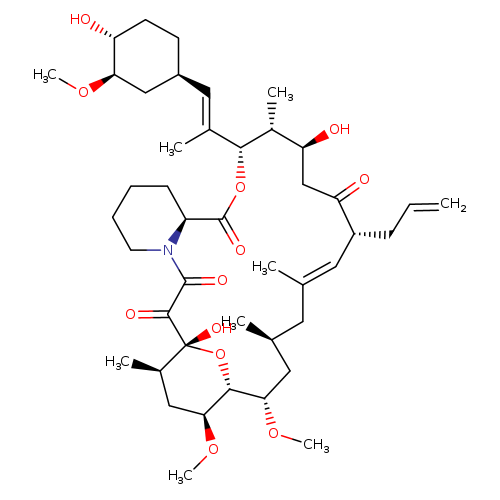
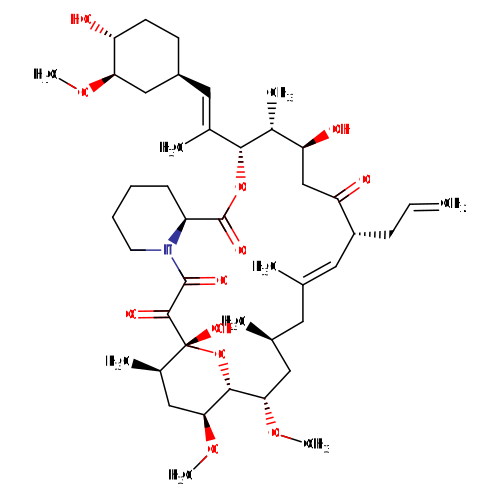
Tacrolimus (also FK-506 or Fujimycin) is an immunosuppressive drug whose main use is after organ transplant to reduce the activity of the patient's immune system and so the risk of organ rejection. It is also used in a topical preparation in the treatment of severe atopic dermatitis, severe refractory uveitis after bone marrow transplants, and the skin condition vitiligo. It was discovered in 1984 from the fermentation broth of a Japanese soil sample that contained the bacteria Streptomyces tsukubaensis. Tacrolimus is chemically known as a macrolide. It reduces peptidyl-prolyl isomerase activity by binding to the immunophilin FKBP-12 (FK506 binding protein) creating a new complex. This FKBP12-FK506 complex interacts with and inhibits calcineurin thus inhibiting both T-lymphocyte signal transduction and IL-2 transcription.
belongs to the class of organic compounds known as macrolide lactams. These are cyclic polyketides containing both a cyclic amide and a cyclic ester group.
Absorption of tacrolimus from the gastrointestinal tract after oral administration is incomplete and variable. The absolute bioavailability in adult kidney transplant patients is 17Њ±10%; in adults liver transplant patients is 22Њ±6%; in healthy subjects is 18Њ±5%. The absolute bioavailability in pediatric liver transplant patients was 31Њ±24%. Tacrolimus maximum blood concentrations (Cmax) and area under the curve (AUC) appeared to increase in a dose-proportional fashion in 18 fasted healthy volunteers receiving a single oral dose of 3, 7, and 10 mg. When given without food, the rate and extent of absorption were the greatest. The time of the meal also affected bioavailability. When given immediately after a meal, mean Cmax was reduced 71%, and mean AUC was reduced 39%, relative to the fasted condition. When administered 1.5 hours following the meal, mean Cmax was reduced 63%, and mean AUC was reduced 39%, relative to the fasted condition.
Mechanism of Toxicity
The mechanism of action of tacrolimus in atopic dermatitis is not known. While the following have been observed, the clinical significance of these observations in atopic dermatitis is not known. It has been demonstrated that tacrolimus inhibits T-lymphocyte activation by first binding to an intracellular protein, FKBP-12. A complex of tacrolimus-FKBP-12, calcium, calmodulin, and calcineurin is then formed and the phosphatase activity of calcineurin is inhibited. This prevents the dephosphorylation and translocation of nuclear factor of activated T-cells (NF-AT), a nuclear component thought to initiate gene transcription for the formation of lymphokines. Tacrolimus also inhibits the transcription for genes which encode IL-3, IL-4, IL-5, GM-CSF, and TNF-, all of which are involved in the early stages of T-cell activation. Additionally, tacrolimus has been shown to inhibit the release of pre-formed mediators from skin mast cells and basophils, and to downregulate the expression of FceRI on Langerhans cells.
Metabolism
Hepatic, extensive, primarily by CYP3A4. The major metabolite identified in incubations with human liver microsomes is 13-demethyl tacrolimus. In in vitro studies, a 31-demethyl metabolite has been reported to have the same activity as tacrolimus.
Route of Elimination: In man, less than 1% of the dose administered is excreted unchanged in urine. When administered IV, fecal elimination accounted for 92.6±30.7%, urinary elimination accounted for 2.3±1.1%.
Half Life: The elimination half life in adult healthy volunteers, kidney transplant patients, liver transplants patients, and heart transplant patients are approximately 35, 19, 12, 24 hours, respectively. The elimination half life in pediatric liver transplant patients was 11.5±3.8 hours, in pediatric kidney transplant patients was 10.2±5.0 (range 3.4-25) hours.
No indication of carcinogenicity to humans (not listed by IARC).
Uses/Sources
For use after allogenic organ transplant to reduce the activity of the patient's immune system and so the risk of organ rejection. It was first approved by the FDA in 1994 for use in liver transplantation, this has been extended to include kidney, heart, small bowel, pancreas, lung, trachea, skin, cornea, and limb transplants. It has also been used in a topical preparation in the treatment of severe atopic dermatitis.
Minimum Risk Level
Not Available
Health Effects
Not Available
Symptoms
Side effects can be severe and include blurred vision, liver and kidney problems (it is nephrotoxic), seizures, tremors, hypertension, hypomagnesemia, diabetes mellitus, hyperkalemia, itching, insomnia, confusion.
Pan Sup Chang, Hoon Cho, “Water soluble polymer-tacrolimus conjugated compounds and process for preparing the same.” U.S. Patent US5922729, issued April, 1997.