Record Information
Version1.0
Creation Date2014-09-11 05:14:06 UTC
Update Date2026-03-31 19:09:09 UTC
Accession NumberCHEM003694
Identification
Common NameAmiodarone
ClassSmall Molecule
DescriptionAn antianginal and antiarrhythmic drug. It increases the duration of ventricular and atrial muscle action by inhibiting Na,K-activated myocardial adenosine triphosphatase. There is a resulting decrease in heart rate and in vascular resistance.
Contaminant Sources
  • HMDB Contaminants - Urine
  • STOFF IDENT Compounds
  • T3DB toxins
  • ToxCast & Tox21 Chemicals
Contaminant Type
  • Amine
  • Anti-Arrhythmia Agent
  • Drug
  • Enzyme Inhibitor
  • Ester
  • Ether
  • Organic Compound
  • Synthetic Compound
  • Vasodilator Agent
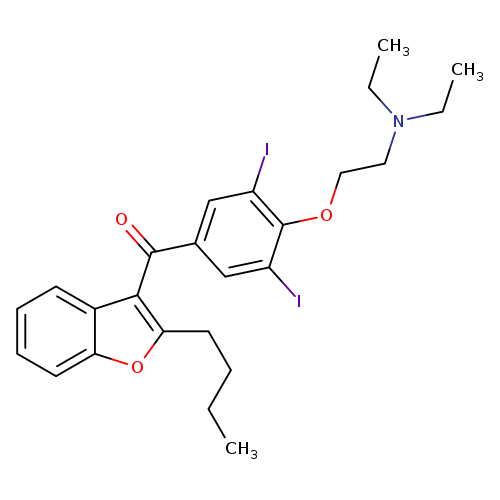
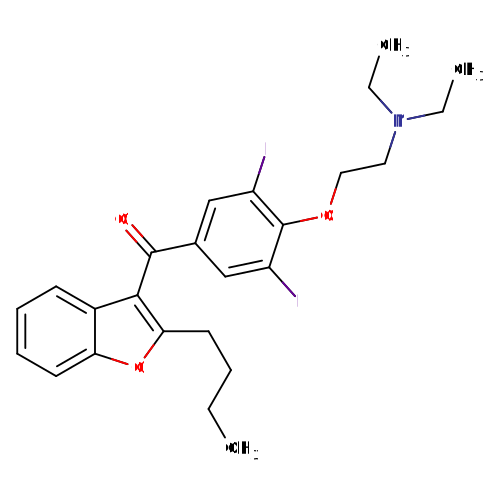
Chemical Structure
Thumb
Synonyms
ValueSource
2-Butyl-3-(3,5-diiodo-4-(2-diethylaminoethoxy)benzoyl)benzofuranChEBI
2-Butyl-3-benzofuranyl 4-(2-(diethylamino)ethoxy)-3,5-diiodophenyl ketoneChEBI
2-N-Butyl-3',5'-diiodo-4'-N-diethylaminoethoxy-3-benzoylbenzofuranChEBI
AmiodaronaChEBI
AmiodaronumChEBI
Amiodarone baseHMDB
Alphapharm brand OF amiodarone hydrochlorideHMDB
CorbionaxHMDB
Hexal brand OF amiodarone hydrochlorideHMDB
Leurquin brand OF amiodarone hydrochlorideHMDB
ASTA medica brand OF amiodarone hydrochlorideHMDB
AmiodarexHMDB
Amiodarone hydrochlorideHMDB
AmiohexalHMDB
Berenguer infale brand OF amiodarone hydrochlorideHMDB
Betapharm brand OF amiodarone hydrochlorideHMDB
BraxanHMDB
CordarexHMDB
OrtacroneHMDB
Pharma investi brand OF amiodarone hydrochlorideHMDB
RytmaroneHMDB
Sanofi winthrop brand OF amiodarone hydrochlorideHMDB
TachydaronHMDB
TrangorexHMDB
AmiobetaHMDB
CordaroneHMDB
Hydrochloride, amiodaroneHMDB
KordaronHMDB
SKF 33134 aHMDB
SKF 33134-aHMDB
AratacHMDB
Armstrong brand OF amiodarone hydrochlorideHMDB
g Gam brand OF amiodarone hydrochlorideHMDB
Wyeth brand OF amiodarone hydrochlorideHMDB
Chemical FormulaC25H29I2NO3
Average Molecular Mass645.312 g/mol
Monoisotopic Mass645.024 g/mol
CAS Registry Number1951-25-3
IUPAC Name{2-[4-(2-butyl-1-benzofuran-3-carbonyl)-2,6-diiodophenoxy]ethyl}diethylamine
Traditional Nameamiodarone
SMILESCCCCC1=C(C(=O)C2=CC(I)=C(OCCN(CC)CC)C(I)=C2)C2=CC=CC=C2O1
InChI IdentifierInChI=1S/C25H29I2NO3/c1-4-7-11-22-23(18-10-8-9-12-21(18)31-22)24(29)17-15-19(26)25(20(27)16-17)30-14-13-28(5-2)6-3/h8-10,12,15-16H,4-7,11,13-14H2,1-3H3
InChI KeyIYIKLHRQXLHMJQ-UHFFFAOYSA-N
Chemical Taxonomy
Description belongs to the class of organic compounds known as aryl-phenylketones. These are aromatic compounds containing a ketone substituted by one aryl group, and a phenyl group.
KingdomOrganic compounds
Super ClassOrganic oxygen compounds
ClassOrganooxygen compounds
Sub ClassCarbonyl compounds
Direct ParentAryl-phenylketones
Alternative Parents
Substituents
  • Aryl-phenylketone
  • Benzofuran
  • Phenol ether
  • 3-aroylfuran
  • Benzoyl
  • Phenoxy compound
  • Alkyl aryl ether
  • Halobenzene
  • Iodobenzene
  • Benzenoid
  • Monocyclic benzene moiety
  • Aryl iodide
  • Aryl halide
  • Heteroaromatic compound
  • Furan
  • Tertiary aliphatic amine
  • Tertiary amine
  • Oxacycle
  • Organoheterocyclic compound
  • Ether
  • Amine
  • Organic nitrogen compound
  • Hydrocarbon derivative
  • Organic oxide
  • Organopnictogen compound
  • Organonitrogen compound
  • Organoiodide
  • Organohalogen compound
  • Aromatic heteropolycyclic compound
Molecular FrameworkAromatic heteropolycyclic compounds
External Descriptors
Biological Properties
StatusDetected and Not Quantified
OriginExogenous
Cellular Locations
  • Membrane
Biofluid LocationsNot Available
Tissue LocationsNot Available
PathwaysNot Available
ApplicationsNot Available
Biological RolesNot Available
Chemical RolesNot Available
Physical Properties
StateSolid
AppearanceWhite powder.
Experimental Properties
PropertyValue
Melting Point156°C
Boiling PointNot Available
SolubilityLow
Predicted Properties
PropertyValueSource
Water Solubility0.0048 g/LALOGPS
logP7.24ALOGPS
logP7.64ChemAxon
logS-5.1ALOGPS
pKa (Strongest Basic)8.47ChemAxon
Physiological Charge1ChemAxon
Hydrogen Acceptor Count3ChemAxon
Hydrogen Donor Count0ChemAxon
Polar Surface Area42.68 ŲChemAxon
Rotatable Bond Count11ChemAxon
Refractivity145.05 m³·mol⁻¹ChemAxon
Polarizability56.78 ųChemAxon
Number of Rings3ChemAxon
Bioavailability0ChemAxon
Rule of FiveNoChemAxon
Ghose FilterNoChemAxon
Veber's RuleNoChemAxon
MDDR-like RuleYesChemAxon
Spectra
Spectra
Spectrum TypeDescriptionSplash KeyView
Predicted GC-MSPredicted GC-MS Spectrum - GC-MS (Non-derivatized) - 70eV, Positivesplash10-000i-9000024000-088b6534d1659c5c174dSpectrum
LC-MS/MSLC-MS/MS Spectrum - LC-ESI-qTof , Positivesplash10-004r-0690000000-25202a61d19d3dfaed8bSpectrum
LC-MS/MSLC-MS/MS Spectrum - LC-ESI-QFT , positivesplash10-0002-0000009000-8cbab89986761a7a1bc9Spectrum
LC-MS/MSLC-MS/MS Spectrum - LC-ESI-QFT , positivesplash10-0pbj-9300003000-503a542bf1a7678f385eSpectrum
LC-MS/MSLC-MS/MS Spectrum - LC-ESI-QFT , positivesplash10-0a4i-9110000000-543b8de3c9ba390fa765Spectrum
LC-MS/MSLC-MS/MS Spectrum - LC-ESI-QFT , positivesplash10-0udi-0791000000-77d5d18989052c45b006Spectrum
LC-MS/MSLC-MS/MS Spectrum - LC-ESI-QFT , positivesplash10-0a59-0980000000-a77e32d189cf8e2acdf1Spectrum
LC-MS/MSLC-MS/MS Spectrum - LC-ESI-QFT , positivesplash10-0apl-0940000000-30e016c113387b37ca7cSpectrum
LC-MS/MSLC-MS/MS Spectrum - , positivesplash10-0002-0000009000-e87a9a6e983c00161bebSpectrum
LC-MS/MSLC-MS/MS Spectrum - 50V, Positivesplash10-0fb9-0192101000-d4f2f8589987e9dee2fcSpectrum
LC-MS/MSLC-MS/MS Spectrum - 40V, Positivesplash10-0002-0020009000-bc59c51779e07ba2a4a0Spectrum
LC-MS/MSLC-MS/MS Spectrum - 40V, Positivesplash10-0a4i-9100000000-cf7a06e18403e76cf41cSpectrum
LC-MS/MSLC-MS/MS Spectrum - 15V, Positivesplash10-0002-0000009000-ec39c036c89b5923fc2cSpectrum
LC-MS/MSLC-MS/MS Spectrum - 30V, Positivesplash10-0pb9-9200000000-5cde40904f838865e7baSpectrum
LC-MS/MSLC-MS/MS Spectrum - 20V, Positivesplash10-0002-1000009000-3e4fea6e220ba0a42af4Spectrum
LC-MS/MSLC-MS/MS Spectrum - 40V, Positivesplash10-0a4i-9100000000-cf88edc5ce5babf0e567Spectrum
LC-MS/MSLC-MS/MS Spectrum - 30V, Positivesplash10-0002-0000009000-9f22341a9246a58e0df5Spectrum
LC-MS/MSLC-MS/MS Spectrum - 20V, Positivesplash10-0002-0000009000-7304d2b67fba343a8883Spectrum
LC-MS/MSLC-MS/MS Spectrum - 10V, Positivesplash10-0002-0000009000-fad8f001fba3ffb05e41Spectrum
LC-MS/MSLC-MS/MS Spectrum - 35V, Positivesplash10-0f6t-6400009000-32088cd4966452222ef5Spectrum
Predicted LC-MS/MSPredicted LC-MS/MS Spectrum - 10V, Positivesplash10-0002-1200419000-3080963b2267302d337aSpectrum
Predicted LC-MS/MSPredicted LC-MS/MS Spectrum - 20V, Positivesplash10-0udi-6920532000-f1048ae0af01f6658877Spectrum
Predicted LC-MS/MSPredicted LC-MS/MS Spectrum - 40V, Positivesplash10-006x-7309200000-46ba6e78349f4d182fe7Spectrum
Predicted LC-MS/MSPredicted LC-MS/MS Spectrum - 10V, Negativesplash10-0006-1100029000-9b580022f60608cc2810Spectrum
Predicted LC-MS/MSPredicted LC-MS/MS Spectrum - 20V, Negativesplash10-006x-3202296000-a7445663ea627302ddceSpectrum
Predicted LC-MS/MSPredicted LC-MS/MS Spectrum - 40V, Negativesplash10-00di-7902160000-4817e1c5fca0d177a829Spectrum
Toxicity Profile
Route of ExposureSlow and variable (about 20 to 55% of an oral dose is absorbed).
Mechanism of ToxicityThe antiarrhythmic effect of amiodarone may be due to at least two major actions. It prolongs the myocardial cell-action potential (phase 3) duration and refractory period and acts as a noncompetitive a- and b-adrenergic inhibitor.
MetabolismAmiodarone is extensively metabolized in the liver via CYP2C8 (under 1% unchanged in urine), and can effect the metabolism of numerous other drugs. The major metabolite of amiodarone is desethylamiodarone (DEA), which also has antiarrhythmic properties. The metabolism of amiodarone is inhibited by grapefruit juice, leading to elevated serum levels of amiodarone. Route of Elimination: Amiodarone is eliminated primarily by hepatic metabolism and biliary excretion and there is negligible excretion of amiodarone or DEA in urine. Half Life: 58 days (range 15-142 days)
Toxicity ValuesIntravenous, mouse: LD50 = 178 mg/kg.
Lethal DoseNot Available
Carcinogenicity (IARC Classification)No indication of carcinogenicity to humans (not listed by IARC).
Uses/SourcesIntravenously, for initiation of treatment and prophylaxis of frequently recurring ventricular fibrillation and hemodynamically unstable ventricular tachycardia in patients refractory to other therapy. Orally, for the treatment of life-threatening recurrent ventricular arrhythmias such as recurrent ventricular fibrillation and recurrent hemodynamically unstable ventricular tachycardia.
Minimum Risk LevelNot Available
Health EffectsSome side effects have a significant mortality rate: specifically, hepatitis, exacerbation of asthma and congestive failure, and pneumonitis.
SymptomsNot Available
TreatmentNot Available
Concentrations
Not Available
DrugBank IDDB01118
HMDB IDHMDB0015250
FooDB IDNot Available
Phenol Explorer IDNot Available
KNApSAcK IDNot Available
BiGG IDNot Available
BioCyc IDNot Available
METLIN IDNot Available
PDB IDNot Available
Wikipedia LinkAmiodarone
Chemspider ID2072
ChEBI ID2663
PubChem Compound ID2157
Kegg Compound IDC06823
YMDB IDNot Available
ECMDB IDNot Available
References
Synthesis Reference

DrugSyn.org

MSDSNot Available
General References
1. https://www.ncbi.nlm.nih.gov/pubmed/?term=10188629
2. https://www.ncbi.nlm.nih.gov/pubmed/?term=16479044
3. https://www.ncbi.nlm.nih.gov/pubmed/?term=18368867
4. Rosenbaum MB, Chiale PA, Halpern MS, Nau GJ, Przybylski J, Levi RJ, Lazzari JO, Elizari MV: Clinical efficacy of amiodarone as an antiarrhythmic agent. Am J Cardiol. 1976 Dec;38(7):934-44.
5. Singh BN, Vaughan Williams EM: The effect of amiodarone, a new anti-anginal drug, on cardiac muscle. Br J Pharmacol. 1970 Aug;39(4):657-67.
6. Rosenbaum MB, Chiale PA, Haedo A, Lazzari JO, Elizari MV: Ten years of experience with amiodarone. Am Heart J. 1983 Oct;106(4 Pt 2):957-64.
7. CHARLIER R, DELTOUR G, TONDEUR R, BINON F: [Studies in the benzofuran series. VII. Preliminary pharmacological study of 2-butyl-3-(3,5-diiodo-4-beta-N-diethylaminoethoxybenzoyl)-benzofuran]. Arch Int Pharmacodyn Ther. 1962 Sep 1;139:255-64.
8. DELTOUR G, BINON F, TONDEUR R, GOLDENBERG C, HENAUX F, SION R, DERAY E, CHARLIER R: [Studies in the benzofuran series. VI. Coronary-dilating activity of alkylated and aminoalkylated derivatives of 3-benzoylbenzofuran]. Arch Int Pharmacodyn Ther. 1962 Sep 1;139:247-54.