Record Information
Version1.0
Creation Date2014-09-11 05:14:11 UTC
Update Date2026-03-27 00:18:17 UTC
Accession NumberCHEM003696
Identification
Common NameImipenem
ClassSmall Molecule
DescriptionSemisynthetic thienamycin that has a wide spectrum of antibacterial activity against gram-negative and gram-positive aerobic and anaerobic bacteria, including many multiresistant strains. It is stable to beta-lactamases. Clinical studies have demonstrated high efficacy in the treatment of infections of various body systems. Its effectiveness is enhanced when it is administered in combination with cilastatin, a renal dipeptidase inhibitor.
Contaminant Sources
  • HMDB Contaminants - Urine
  • T3DB toxins
  • ToxCast & Tox21 Chemicals
Contaminant Type
  • Amide
  • Amine
  • Anti-Bacterial Agent
  • Drug
  • Ester
  • Ether
  • Organic Compound
  • Synthetic Compound
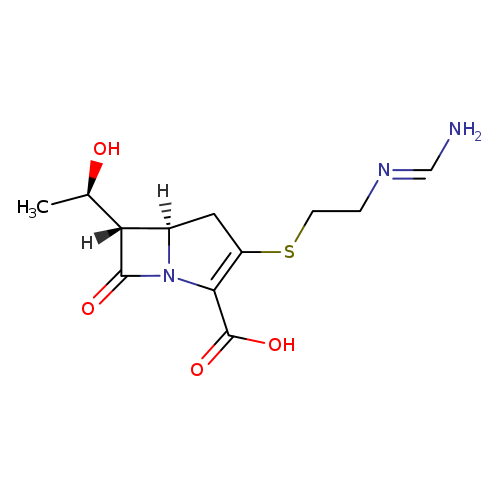
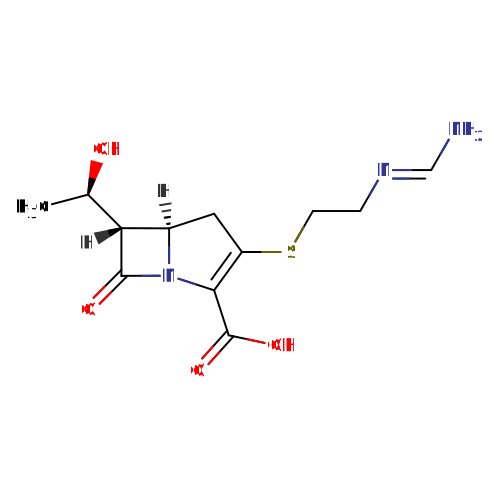
Chemical Structure
Thumb
Synonyms
ValueSource
(5R,6S)-3-((2-(Formimidoylamino)ethyl)thio)-6-((R)-1-hydroxyethyl)-7-oxo-1-azabicyclo(3.2.0)hept-2-ene-2-carboxylic acidChEBI
(5R,6S)-3-(2-Formimidoylamino-ethylsulfanyl)-6-((R)-1-hydroxy-ethyl)-7-oxo-1-aza-bicyclo[3.2.0]hept-2-ene-2-carboxylic acidChEBI
(5R,6S)-6-((R)-1-Hydroxyethyl)-3-(2-(iminomethylamino)ethylthio)-7-oxo-1-azabicyclo(3.2.0)hept-2-ene-2-carbonsaeureChEBI
Imipenem anhydrousChEBI
ImipenemumChEBI
N-Formimidoyl thienamycinChEBI
N-FormimidoylthienamycinChEBI
(5R,6S)-3-((2-(Formimidoylamino)ethyl)thio)-6-((R)-1-hydroxyethyl)-7-oxo-1-azabicyclo(3.2.0)hept-2-ene-2-carboxylateGenerator
(5R,6S)-3-(2-Formimidoylamino-ethylsulfanyl)-6-((R)-1-hydroxy-ethyl)-7-oxo-1-aza-bicyclo[3.2.0]hept-2-ene-2-carboxylateGenerator
(5R,6S)-3-(2-Formimidoylamino-ethylsulphanyl)-6-((R)-1-hydroxy-ethyl)-7-oxo-1-aza-bicyclo[3.2.0]hept-2-ene-2-carboxylateGenerator
(5R,6S)-3-(2-Formimidoylamino-ethylsulphanyl)-6-((R)-1-hydroxy-ethyl)-7-oxo-1-aza-bicyclo[3.2.0]hept-2-ene-2-carboxylic acidGenerator
IPMHMDB
ImipemideHMDB
Imipenem, N-formimidoyl thienamycinHMDB
IMPHMDB
Imipenem, anhydrousHMDB
N FormimidoylthienamycinHMDB
Anhydrous imipenemHMDB
Anhydrous, imipenemHMDB
Chemical FormulaC12H17N3O4S
Average Molecular Mass299.346 g/mol
Monoisotopic Mass299.094 g/mol
CAS Registry Number74431-23-5
IUPAC Name(5R,6S)-3-({2-[(E)-(aminomethylidene)amino]ethyl}sulfanyl)-6-[(1R)-1-hydroxyethyl]-7-oxo-1-azabicyclo[3.2.0]hept-2-ene-2-carboxylic acid
Traditional Namezienam
SMILES[H][C@]12CC(SCC\N=C\N)=C(N1C(=O)[C@]2([H])[C@@H](C)O)C(O)=O
InChI IdentifierInChI=1S/C12H17N3O4S/c1-6(16)9-7-4-8(20-3-2-14-5-13)10(12(18)19)15(7)11(9)17/h5-7,9,16H,2-4H2,1H3,(H2,13,14)(H,18,19)/t6-,7-,9-/m1/s1
InChI KeyZSKVGTPCRGIANV-ZXFLCMHBSA-N
Chemical Taxonomy
Description belongs to the class of organic compounds known as thienamycins. These are beta-lactam antibiotics that differ from penicillins in having the thiazolidine sulfur atom replaced by carbon, the sulfur then becoming the first atom in the side chain.
KingdomOrganic compounds
Super ClassOrganoheterocyclic compounds
ClassLactams
Sub ClassBeta lactams
Direct ParentThienamycins
Alternative Parents
Substituents
  • Thienamycin
  • Alpha-amino acid or derivatives
  • Pyrroline carboxylic acid
  • Pyrroline carboxylic acid or derivatives
  • Azepine
  • Vinylogous thioester
  • Pyrroline
  • Tertiary carboxylic acid amide
  • Azetidine
  • Carboxamide group
  • Secondary alcohol
  • Thioenolether
  • Sulfenyl compound
  • Carboximidamide
  • Azacycle
  • Amidine
  • Formamidine
  • Carboxylic acid amidine
  • Carboxylic acid derivative
  • Carboxylic acid
  • Monocarboxylic acid or derivatives
  • Hydrocarbon derivative
  • Imine
  • Organonitrogen compound
  • Organooxygen compound
  • Organosulfur compound
  • Carbonyl group
  • Alcohol
  • Organic oxygen compound
  • Organopnictogen compound
  • Organic oxide
  • Organic nitrogen compound
  • Aliphatic heteropolycyclic compound
Molecular FrameworkAliphatic heteropolycyclic compounds
External Descriptors
Biological Properties
StatusDetected and Not Quantified
OriginExogenous
Cellular Locations
  • Membrane
Biofluid LocationsNot Available
Tissue LocationsNot Available
PathwaysNot Available
ApplicationsNot Available
Biological RolesNot Available
Chemical RolesNot Available
Physical Properties
StateSolid
AppearanceWhite powder.
Experimental Properties
PropertyValue
Melting PointNot Available
Boiling PointNot Available
Solubility1E+004 mg/L
Predicted Properties
PropertyValueSource
Water Solubility0.78 g/LALOGPS
logP-0.19ALOGPS
logP-3.9ChemAxon
logS-2.6ALOGPS
pKa (Strongest Acidic)3.63ChemAxon
pKa (Strongest Basic)10.88ChemAxon
Physiological Charge0ChemAxon
Hydrogen Acceptor Count6ChemAxon
Hydrogen Donor Count3ChemAxon
Polar Surface Area116.22 ŲChemAxon
Rotatable Bond Count6ChemAxon
Refractivity75.84 m³·mol⁻¹ChemAxon
Polarizability31.1 ųChemAxon
Number of Rings2ChemAxon
Bioavailability1ChemAxon
Rule of FiveYesChemAxon
Ghose FilterNoChemAxon
Veber's RuleNoChemAxon
MDDR-like RuleNoChemAxon
Spectra
Spectra
Spectrum TypeDescriptionSplash KeyView
Predicted GC-MSPredicted GC-MS Spectrum - GC-MS (Non-derivatized) - 70eV, Positivesplash10-000y-9150000000-462b1a2f1803b594d4d8Spectrum
Predicted GC-MSPredicted GC-MS Spectrum - GC-MS (2 TMS) - 70eV, Positivesplash10-009i-9416300000-144f90b8d8b4d5b915f1Spectrum
Predicted GC-MSPredicted GC-MS Spectrum - GC-MS (Non-derivatized) - 70eV, PositiveNot AvailableSpectrum
Predicted LC-MS/MSPredicted LC-MS/MS Spectrum - 10V, Positivesplash10-0h3s-3973000000-885401af8e32fab56277Spectrum
Predicted LC-MS/MSPredicted LC-MS/MS Spectrum - 20V, Positivesplash10-0f7k-3490000000-71a354ac25ef670f7e55Spectrum
Predicted LC-MS/MSPredicted LC-MS/MS Spectrum - 40V, Positivesplash10-01r5-8910000000-6be5fb1963bd187b30b3Spectrum
Predicted LC-MS/MSPredicted LC-MS/MS Spectrum - 10V, Negativesplash10-0udl-3390000000-bdd7825d35f4fa7782d3Spectrum
Predicted LC-MS/MSPredicted LC-MS/MS Spectrum - 20V, Negativesplash10-0f79-9630000000-fc0b37e2773e0385e24fSpectrum
Predicted LC-MS/MSPredicted LC-MS/MS Spectrum - 40V, Negativesplash10-0f7o-9700000000-2d93b0c62bb2866f1242Spectrum
Predicted LC-MS/MSPredicted LC-MS/MS Spectrum - 10V, Positivesplash10-0udi-0049000000-036a1425b2ce83157756Spectrum
Predicted LC-MS/MSPredicted LC-MS/MS Spectrum - 20V, Positivesplash10-0r0r-0091000000-b0266dd67b8bcac9b820Spectrum
Predicted LC-MS/MSPredicted LC-MS/MS Spectrum - 40V, Positivesplash10-03gj-9640000000-118776f48915723d047fSpectrum
Predicted LC-MS/MSPredicted LC-MS/MS Spectrum - 10V, Negativesplash10-0002-3090000000-35b1ed105590a664c848Spectrum
Predicted LC-MS/MSPredicted LC-MS/MS Spectrum - 20V, Negativesplash10-001i-0920000000-e0bfaa17bbc903760f9dSpectrum
Predicted LC-MS/MSPredicted LC-MS/MS Spectrum - 40V, Negativesplash10-001i-4940000000-7d1255e0c1ee70f83743Spectrum
1D NMR1H NMR SpectrumNot AvailableSpectrum
1D NMR13C NMR SpectrumNot AvailableSpectrum
1D NMR1H NMR SpectrumNot AvailableSpectrum
1D NMR13C NMR SpectrumNot AvailableSpectrum
1D NMR1H NMR SpectrumNot AvailableSpectrum
1D NMR13C NMR SpectrumNot AvailableSpectrum
1D NMR1H NMR SpectrumNot AvailableSpectrum
1D NMR13C NMR SpectrumNot AvailableSpectrum
1D NMR1H NMR SpectrumNot AvailableSpectrum
1D NMR13C NMR SpectrumNot AvailableSpectrum
1D NMR1H NMR SpectrumNot AvailableSpectrum
1D NMR13C NMR SpectrumNot AvailableSpectrum
1D NMR1H NMR SpectrumNot AvailableSpectrum
1D NMR13C NMR SpectrumNot AvailableSpectrum
1D NMR1H NMR SpectrumNot AvailableSpectrum
1D NMR13C NMR SpectrumNot AvailableSpectrum
1D NMR1H NMR SpectrumNot AvailableSpectrum
1D NMR13C NMR SpectrumNot AvailableSpectrum
1D NMR1H NMR SpectrumNot AvailableSpectrum
1D NMR13C NMR SpectrumNot AvailableSpectrum
Toxicity Profile
Route of ExposureImipenem is not effectively absorbed from the gastrointestinal tract and therefore must be administered parenterally.
Mechanism of ToxicityImipenem acts as an antimicrobial through the inhibition of cell wall synthesis of various gram-positive and gram-negative bacteria. This inhibition of cell wall synthesis in gram-negative bateria is attained by binding to pencillin binding proteins (PBPs). In E. coli and selected strains of P. aeruginosa, imipenem has shown to have the highest affinity to PBP-2, PBP-1a, and PBP-1b. This preferential binding to PBP-2 and PBP-1b results in the direct conversion of the individual cell to a spheroblast, which leads to rapid cell lysis and death without filament formation.
MetabolismRenal. Half Life: 1 hour
Toxicity ValuesNot Available
Lethal DoseNot Available
Carcinogenicity (IARC Classification)No indication of carcinogenicity to humans (not listed by IARC).
Uses/SourcesFor the treatment of bacterial infections caused by susceptible bacteria.
Minimum Risk LevelNot Available
Health EffectsNot Available
SymptomsNot Available
TreatmentNot Available
Concentrations
Not Available
DrugBank IDDB01598
HMDB IDHMDB0015536
FooDB IDNot Available
Phenol Explorer IDNot Available
KNApSAcK IDNot Available
BiGG IDNot Available
BioCyc IDNot Available
METLIN IDNot Available
PDB IDNot Available
Wikipedia LinkImipenem
Chemspider ID94631
ChEBI ID471744
PubChem Compound ID104838
Kegg Compound IDC06665
YMDB IDNot Available
ECMDB IDNot Available
References
Synthesis Reference

Maurizio Zenoni, “Imipenem production process.” U.S. Patent US20020095034, issued July 18, 2002.

MSDSNot Available
General References
1. https://www.ncbi.nlm.nih.gov/pubmed/?term=1384868
2. https://www.ncbi.nlm.nih.gov/pubmed/?term=17361077
3. https://www.ncbi.nlm.nih.gov/pubmed/?term=24112243
4. https://www.ncbi.nlm.nih.gov/pubmed/?term=24247132
5. https://www.ncbi.nlm.nih.gov/pubmed/?term=2457043
6. https://www.ncbi.nlm.nih.gov/pubmed/?term=24903189
7. https://www.ncbi.nlm.nih.gov/pubmed/?term=25216543
8. https://www.ncbi.nlm.nih.gov/pubmed/?term=25351714
9. https://www.ncbi.nlm.nih.gov/pubmed/?term=434624
10. https://www.ncbi.nlm.nih.gov/pubmed/?term=9131470
11. Buckley MM, Brogden RN, Barradell LB, Goa KL: Imipenem/cilastatin. A reappraisal of its antibacterial activity, pharmacokinetic properties and therapeutic efficacy. Drugs. 1992 Sep;44(3):408-44.
12. Hellinger WC, Brewer NS: Imipenem. Mayo Clin Proc. 1991 Oct;66(10):1074-81.
13. Pastel DA: Imipenem-cilastatin sodium, a broad-spectrum carbapenem antibiotic combination. Clin Pharm. 1986 Sep;5(9):719-36.
14. Clissold SP, Todd PA, Campoli-Richards DM: Imipenem/cilastatin. A review of its antibacterial activity, pharmacokinetic properties and therapeutic efficacy. Drugs. 1987 Mar;33(3):183-241.
15. Birnbaum J, Kahan FM, Kropp H, MacDonald JS: Carbapenems, a new class of beta-lactam antibiotics. Discovery and development of imipenem/cilastatin. Am J Med. 1985 Jun 7;78(6A):3-21.
16. Kahan FM, Kropp H, Sundelof JG, Birnbaum J: Thienamycin: development of imipenen-cilastatin. J Antimicrob Chemother. 1983 Dec;12 Suppl D:1-35.
17. Richerson MA, Ambrose PG, Quintiliani R, Nightingale CH: Formulary review of the carbapenems: comparison of imipenem/cilastatin and meropenem. Conn Med. 1998 Mar;62(3):165-9.
18. Kattan JN, Villegas MV, Quinn JP: New developments in carbapenems. Clin Microbiol Infect. 2008 Dec;14(12):1102-11. doi: 10.1111/j.1469-0691.2008.02101.x.