Record Information
Version1.0
Creation Date2014-09-11 05:14:33 UTC
Update Date2026-03-31 18:54:45 UTC
Accession NumberCHEM003703
Identification
Common NameEstrone
ClassSmall Molecule
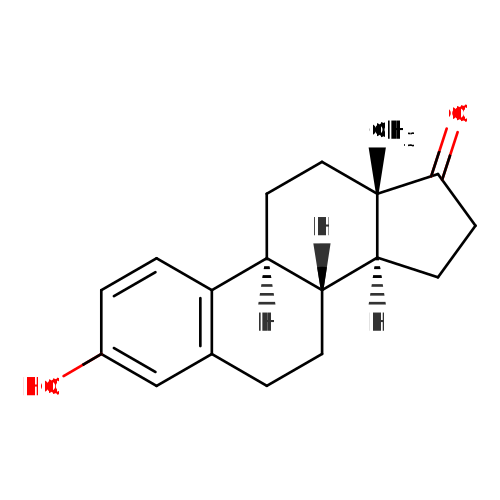
DescriptionEstrone, one of the major mammalian estrogens, is an aromatized C18 steroid with a 3-hydroxyl group and a 17-ketone. It is produced in vivo from androstenedione or from testosterone via estradiol. It is produced primarily in the ovaries, placenta, and in peripheral tissues (especially adipose tissue) through conversion of adrostenedione. Estrone may be further metabolized to 16-alpha-hydroxyestrone, which may be reduced to estriol by estradiol dehydrogenase.
Contaminant Sources
  • FooDB Chemicals
  • HMDB Contaminants - Urine
  • STOFF IDENT Compounds
  • T3DB toxins
  • ToxCast & Tox21 Chemicals
Contaminant Type
  • Animal Toxin
  • Anti-Menopausal Agent
  • Drug
  • Estrogen
  • Food Toxin
  • Metabolite
  • Natural Compound
  • Organic Compound
Chemical Structure
Thumb
Synonyms
ValueSource
3-Hydroxy-1,3,5(10)-estratrien-17-oneChEBI
Follicular hormoneChEBI
FolliculinChEBI
OestroneChEBI
(+)-EstroneHMDB
1,3,5(10)-Estratrien-3-ol-17-oneHMDB
3-Hydroxy-17-keto-estra-1,3,5-trieneHMDB
3-Hydroxyestra-1,3,5(10)-trien-17-oneHMDB
3-Hydroxyestra-1,3,5(10)-triene-17-oneHMDB
3-Hydroxyoestra-1,3,5(10)-trien-17-oneHMDB
D1,3,5(10)-Estratrien-3-ol-17-oneHMDB
Estrone, (+-)-isomerHMDB
Hyrex brand OF estroneHMDB
Estrone, (9 beta)-isomerHMDB
EstrovarinHMDB
KestroneHMDB
WehgenHMDB
Estrone, (8 alpha)-isomerHMDB
Hauck brand OF estroneHMDB
UnigenHMDB
Vortech brand OF estroneHMDB
Chemical FormulaC18H22O2
Average Molecular Mass270.366 g/mol
Monoisotopic Mass270.162 g/mol
CAS Registry Number53-16-7
IUPAC Name(1S,10R,11S,15S)-5-hydroxy-15-methyltetracyclo[8.7.0.0^{2,7}.0^{11,15}]heptadeca-2(7),3,5-trien-14-one
Traditional Name(1S,10R,11S,15S)-5-hydroxy-15-methyltetracyclo[8.7.0.0^{2,7}.0^{11,15}]heptadeca-2(7),3,5-trien-14-one
SMILES[H][C@@]12CCC(=O)[C@@]1(C)CC[C@]1([H])C3=C(CC[C@@]21[H])C=C(O)C=C3
InChI IdentifierInChI=1S/C18H22O2/c1-18-9-8-14-13-5-3-12(19)10-11(13)2-4-15(14)16(18)6-7-17(18)20/h3,5,10,14-16,19H,2,4,6-9H2,1H3/t14-,15-,16+,18+/m1/s1
InChI KeyDNXHEGUUPJUMQT-CBZIJGRNSA-N
Chemical Taxonomy
Description belongs to the class of organic compounds known as estrogens and derivatives. These are steroids with a structure containing a 3-hydroxylated estrane.
KingdomOrganic compounds
Super ClassLipids and lipid-like molecules
ClassSteroids and steroid derivatives
Sub ClassEstrane steroids
Direct ParentEstrogens and derivatives
Alternative Parents
Substituents
  • Estrogen-skeleton
  • 3-hydroxysteroid
  • Hydroxysteroid
  • 17-oxosteroid
  • Oxosteroid
  • Phenanthrene
  • Tetralin
  • 1-hydroxy-2-unsubstituted benzenoid
  • Benzenoid
  • Ketone
  • Carbonyl group
  • Organooxygen compound
  • Hydrocarbon derivative
  • Organic oxide
  • Organic oxygen compound
  • Aromatic homopolycyclic compound
Molecular FrameworkAromatic homopolycyclic compounds
External Descriptors
Biological Properties
StatusDetected and Not Quantified
OriginExogenous
Cellular Locations
  • Cytoplasm
  • Endoplasmic reticulum
  • Extracellular
  • Membrane
Biofluid LocationsNot Available
Tissue Locations
  • Kidney
  • Liver
Pathways
NameSMPDB LinkKEGG Link
Androgen and Estrogen MetabolismSMP00068 map00150
Sulfate/Sulfite MetabolismSMP00041 map00920
ApplicationsNot Available
Biological RolesNot Available
Chemical RolesNot Available
Physical Properties
StateSolid
AppearanceWhite powder.
Experimental Properties
PropertyValue
Melting Point260.2°C
Boiling Point154°C
Solubility30 mg/L (at 25°C)
Predicted Properties
PropertyValueSource
Water Solubility0.0039 g/LALOGPS
logP4.03ALOGPS
logP4.31ChemAxon
logS-4.8ALOGPS
pKa (Strongest Acidic)10.33ChemAxon
pKa (Strongest Basic)-5.4ChemAxon
Physiological Charge0ChemAxon
Hydrogen Acceptor Count2ChemAxon
Hydrogen Donor Count1ChemAxon
Polar Surface Area37.3 ŲChemAxon
Rotatable Bond Count0ChemAxon
Refractivity79.08 m³·mol⁻¹ChemAxon
Polarizability31.24 ųChemAxon
Number of Rings4ChemAxon
Bioavailability1ChemAxon
Rule of FiveYesChemAxon
Ghose FilterYesChemAxon
Veber's RuleYesChemAxon
MDDR-like RuleNoChemAxon
Spectra
Spectra
Spectrum TypeDescriptionSplash KeyView
GC-MSGC-MS Spectrum - GC-MS (1 TMS)splash10-05ox-3951000000-8bc438f505b3cf49b21fSpectrum
GC-MSGC-MS Spectrum - GC-MS (1 MEOX; 1 TMS)splash10-003u-4942000000-a72ea34d85d9d524c247Spectrum
GC-MSGC-MS Spectrum - GC-MS (1 MEOX; 1 TMS)splash10-0019-8931000000-aad9803af812c7c40f53Spectrum
GC-MSGC-MS Spectrum - EI-B (Non-derivatized)splash10-00di-2940000000-2d417e7ecb4a8b87b817Spectrum
GC-MSGC-MS Spectrum - EI-B (Non-derivatized)splash10-00di-0980000000-5b293db89a0f2efeb784Spectrum
GC-MSGC-MS Spectrum - GC-MS (Non-derivatized)splash10-05ox-3951000000-8bc438f505b3cf49b21fSpectrum
GC-MSGC-MS Spectrum - GC-MS (Non-derivatized)splash10-003u-4942000000-a72ea34d85d9d524c247Spectrum
GC-MSGC-MS Spectrum - GC-MS (Non-derivatized)splash10-0019-8931000000-aad9803af812c7c40f53Spectrum
Predicted GC-MSPredicted GC-MS Spectrum - GC-MS (Non-derivatized) - 70eV, Positivesplash10-0adl-1970000000-871531490fb22b8fe12fSpectrum
Predicted GC-MSPredicted GC-MS Spectrum - GC-MS (1 TMS) - 70eV, Positivesplash10-009t-1093000000-a8d755d13e3b819514c8Spectrum
Predicted GC-MSPredicted GC-MS Spectrum - GC-MS (Non-derivatized) - 70eV, PositiveNot AvailableSpectrum
Predicted GC-MSPredicted GC-MS Spectrum - GC-MS (TMS_1_2) - 70eV, PositiveNot AvailableSpectrum
Predicted GC-MSPredicted GC-MS Spectrum - GC-MS (TBDMS_1_1) - 70eV, PositiveNot AvailableSpectrum
Predicted GC-MSPredicted GC-MS Spectrum - GC-MS (TBDMS_1_2) - 70eV, PositiveNot AvailableSpectrum
LC-MS/MSLC-MS/MS Spectrum - Quattro_QQQ 10V, Positive (Annotated)splash10-00di-0190000000-071e67516e11357ff64eSpectrum
LC-MS/MSLC-MS/MS Spectrum - Quattro_QQQ 25V, Positive (Annotated)splash10-0a4j-4910000000-20e059a7c508ba492af3Spectrum
LC-MS/MSLC-MS/MS Spectrum - Quattro_QQQ 40V, Positive (Annotated)splash10-067i-9700000000-9ff5214f08822f238fa9Spectrum
LC-MS/MSLC-MS/MS Spectrum - EI-B (HITACHI M-80) , Positivesplash10-00di-2940000000-3b9744c27d6a3d2eff6eSpectrum
LC-MS/MSLC-MS/MS Spectrum - LC-ESI-qTof , Positivesplash10-0ukc-2690000000-7afb48e267c7b334213bSpectrum
LC-MS/MSLC-MS/MS Spectrum - Linear Ion Trap , negativesplash10-014i-0690000000-a76244de959b06ec896eSpectrum
LC-MS/MSLC-MS/MS Spectrum - LC-ESI-ITFT , positivesplash10-0a59-0910000000-4a1bc1cbc90c3e5281e6Spectrum
LC-MS/MSLC-MS/MS Spectrum - LC-ESI-ITFT , positivesplash10-0a59-0900000000-0830d4ad43804976f508Spectrum
LC-MS/MSLC-MS/MS Spectrum - LC-ESI-ITFT , positivesplash10-0udi-0390000000-41440e74b3f0b5f365d7Spectrum
LC-MS/MSLC-MS/MS Spectrum - LC-ESI-ITFT , positivesplash10-0udi-0390000000-fdc0255246e3a9013d0aSpectrum
LC-MS/MSLC-MS/MS Spectrum - , positivesplash10-0a59-2910000000-fc5173d435c3c7fc603cSpectrum
LC-MS/MSLC-MS/MS Spectrum - LC-ESI-QFT , positivesplash10-00di-0390000000-25cecb1c4785e7bffd56Spectrum
LC-MS/MSLC-MS/MS Spectrum - 35V, Positivesplash10-0pb9-0930000000-d947dbed0baa600d21a1Spectrum
LC-MS/MSLC-MS/MS Spectrum - 10V, Positivesplash10-00di-0190000000-38b40bed2e5c895d292fSpectrum
LC-MS/MSLC-MS/MS Spectrum - 20V, Positivesplash10-0pc0-0920000000-391eea72f6dda0eaa3c2Spectrum
LC-MS/MSLC-MS/MS Spectrum - 45V, Negativesplash10-0159-0900000000-350b322964f2315bf505Spectrum
LC-MS/MSLC-MS/MS Spectrum - 30V, Negativesplash10-014i-0690000000-277d92852a8f35c82f11Spectrum
LC-MS/MSLC-MS/MS Spectrum - 40V, Negativesplash10-0002-0910000000-db57c4d24dab84acfe27Spectrum
LC-MS/MSLC-MS/MS Spectrum - 60V, Negativesplash10-014i-0900000000-61f2965f743c194d4628Spectrum
Predicted LC-MS/MSPredicted LC-MS/MS Spectrum - 10V, Positivesplash10-00di-0190000000-64cf013a5b0ad5e8bf56Spectrum
Predicted LC-MS/MSPredicted LC-MS/MS Spectrum - 20V, Positivesplash10-00fr-0590000000-40418c285df2157226dcSpectrum
Predicted LC-MS/MSPredicted LC-MS/MS Spectrum - 40V, Positivesplash10-0fb9-6980000000-724c68b368fbe3d38f5eSpectrum
Predicted LC-MS/MSPredicted LC-MS/MS Spectrum - 10V, Negativesplash10-014i-0090000000-6778bd7122813b501c1eSpectrum
Predicted LC-MS/MSPredicted LC-MS/MS Spectrum - 20V, Negativesplash10-014i-0090000000-0f2e0b96bc30b346c581Spectrum
Predicted LC-MS/MSPredicted LC-MS/MS Spectrum - 40V, Negativesplash10-0f9i-1090000000-9ccbd9f351dd1f8e52cbSpectrum
MSMass Spectrum (Electron Ionization)splash10-00di-2930000000-c99df908474247066a2bSpectrum
1D NMR1H NMR SpectrumNot AvailableSpectrum
1D NMR13C NMR SpectrumNot AvailableSpectrum
2D NMR[1H,13C] 2D NMR SpectrumNot AvailableSpectrum
Toxicity Profile
Route of Exposure43%
Mechanism of ToxicityEstrogens enter the cells of responsive tissues (e.g. female organs, breasts, hypothalamus, pituitary) where they interact with estrogen receptors. Hormone-bound estrogen receptors dimerize, translocate to the nucleus of cells and bind to estrogen response elements (ERE) of genes. Binding to ERE alters the transcription rate of affected genes. Estrogens increase the hepatic synthesis of sex hormone binding globulin (SHBG), thyroid-binding globulin (TBG), and other serum proteins and suppress follicle-stimulating hormone (FSH) release from the anterior pituitary.
MetabolismHepatic. Half Life: 19 hours
Toxicity ValuesNot Available
Lethal DoseNot Available
Carcinogenicity (IARC Classification)No indication of carcinogenicity to humans (not listed by IARC).
Uses/SourcesFor management of perimenopausal and postmenopausal symptoms.
Minimum Risk LevelNot Available
Health EffectsNot Available
SymptomsSymptoms of overdose include nausea and vomiting. Estrogen related side effects include nausea, breast tenderness, fluid retention and edema, headaches and/or migraines, chloasma and poor contact lens fit. Estrogen hormone deficiency is associated with breakthrough bleeding, hypomenorrhea, irritability, depression and menopausal symptoms. Withdrawal bleeds may occur in females.
TreatmentNot Available
Concentrations
Not Available
DrugBank IDDB00655
HMDB IDHMDB0000145
FooDB IDFDB012798
Phenol Explorer IDNot Available
KNApSAcK IDC00003663
BiGG ID35059
BioCyc IDNot Available
METLIN ID264
PDB IDNot Available
Wikipedia LinkEstrone
Chemspider ID5660
ChEBI ID17263
PubChem Compound ID5870
Kegg Compound IDC00468
YMDB IDNot Available
ECMDB IDM2MDB004957
References
Synthesis Reference

Seiichi Takano, Kunio Ogasawara, “Method for producing (+)-estrone derivatives.” U.S. Patent US5424462, issued January, 1965.

MSDSLink
General References
1. Kocovsky, Paved; Baines, Richard S. Synthesis of estrone via a thallium(III)-mediated fragmentation of a 19-hydroxyandrost-5-ene precursor. Tetrahedron Letters (1993), 34(38), 6139-40.
2. Wolford ST, Argoudelis CJ: Measurement of estrogens in cow's milk, human milk, and dairy products. J Dairy Sci. 1979 Sep;62(9):1458-63. doi: 10.3168/jds.S0022-0302(79)83446-3.
3. Malekinejad H, Scherpenisse P, Bergwerff AA: Naturally occurring estrogens in processed milk and in raw milk (from gestated cows). J Agric Food Chem. 2006 Dec 27;54(26):9785-91. doi: 10.1021/jf061972e.
4. Courant F, Antignac JP, Maume D, Monteau F, Andre F, Le Bizec B: Determination of naturally occurring oestrogens and androgens in retail samples of milk and eggs. Food Addit Contam. 2007 Dec;24(12):1358-66. doi: 10.1080/02652030701329637.
5. Courant F, Antignac JP, Laille J, Monteau F, Andre F, Le Bizec B: Exposure assessment of prepubertal children to steroid endocrine disruptors. 2. Determination of steroid hormones in milk, egg, and meat samples. J Agric Food Chem. 2008 May 14;56(9):3176-84. doi: 10.1021/jf800096f. Epub 2008 Apr 16.
6. Nielsen TS, Norgaard JV, Purup S, Frette XC, Bonefeld-Jorgensen EC: Estrogenic activity of bovine milk high or low in equol using immature mouse uterotrophic responses and an estrogen receptor transactivation assay. Cancer Epidemiol. 2009 Jul;33(1):61-8. doi: 10.1016/j.canep.2009.04.003. Epub 2009 May 31.
7. Pape-Zambito DA, Roberts RF, Kensinger RS: Estrone and 17beta-estradiol concentrations in pasteurized-homogenized milk and commercial dairy products. J Dairy Sci. 2010 Jun;93(6):2533-40. doi: 10.3168/jds.2009-2947.
8. Tso J, Aga DS: A systematic investigation to optimize simultaneous extraction and liquid chromatography tandem mass spectrometry analysis of estrogens and their conjugated metabolites in milk. J Chromatogr A. 2010 Jul 16;1217(29):4784-95. doi: 10.1016/j.chroma.2010.05.024. Epub 2010 May 25.
9. Kocovsky, Paved; Baines, Richard S. Synthesis of estrone via a thallium(III)-mediated fragmentation of a 19-hydroxyandrost-5-ene precursor. Tetrahedron Letters (1993), 34(38), 6139-40.
10. Czernik PJ, Little JM, Barone GW, Raufman JP, Radominska-Pandya A: Glucuronidation of estrogens and retinoic acid and expression of UDP-glucuronosyltransferase 2B7 in human intestinal mucosa. Drug Metab Dispos. 2000 Oct;28(10):1210-6.
11. Pfeiffer E, Graf E, Gerstner S, Metzler M: Stimulation of estradiol glucuronidation: a protective mechanism against estradiol-mediated carcinogenesis? Mol Nutr Food Res. 2006 Apr;50(4-5):385-9.
12. Kuhl H, Wiegratz I: Can 19-nortestosterone derivatives be aromatized in the liver of adult humans? Are there clinical implications? Climacteric. 2007 Aug;10(4):344-53.
13. Parker WH, Broder MS, Liu Z, Shoupe D, Farquhar C, Berek JS: Ovarian conservation at the time of hysterectomy for benign disease. Clin Obstet Gynecol. 2007 Jun;50(2):354-61.
14. Stanway SJ, Delavault P, Purohit A, Woo LW, Thurieau C, Potter BV, Reed MJ: Steroid sulfatase: a new target for the endocrine therapy of breast cancer. Oncologist. 2007 Apr;12(4):370-4.
15. Ito K: Hormone replacement therapy and cancers: the biological roles of estrogen and progestin in tumorigenesis are different between the endometrium and breast. Tohoku J Exp Med. 2007 May;212(1):1-12.
16. Elshenawy S, Pinney SE, Stuart T, Doulias PT, Zura G, Parry S, Elovitz MA, Bennett MJ, Bansal A, Strauss JF 3rd, Ischiropoulos H, Simmons RA: The Metabolomic Signature of the Placenta in Spontaneous Preterm Birth. Int J Mol Sci. 2020 Feb 4;21(3). pii: ijms21031043. doi: 10.3390/ijms21031043.
17. https://www.ncbi.nlm.nih.gov/pubmed/?term=11786692
18. https://www.ncbi.nlm.nih.gov/pubmed/?term=19610377
19. https://www.ncbi.nlm.nih.gov/pubmed/?term=23647561
20. https://www.ncbi.nlm.nih.gov/pubmed/?term=24390165
21. https://www.ncbi.nlm.nih.gov/pubmed/?term=24398390