Record Information
Version1.0
Creation Date2014-09-11 05:15:10 UTC
Update Date2026-03-26 19:26:18 UTC
Accession NumberCHEM003715
Identification
Common NameQuercetin
ClassSmall Molecule
DescriptionQuercetin is a flavonoid widely distributed in many plants and fruits including red grapes, citrus fruit, tomato, broccoli and other leafy green vegetables, and a number of berries, including raspberries and cranberries. Quercetin itself (aglycone quercetin), as opposed to quercetin glycosides, is not a normal dietary component. Quercitin glycosides are converted to phenolic acids as they pass through the gastrointestinal tract. Quercetin has neither been confirmed scientifically as a specific therapeutic for any condition nor been approved by any regulatory agency. The U.S. Food and Drug Administration has not approved any health claims for quercetin. Nevertheless, the interest in dietary flavonoids has grown after the publication of several epidemiological studies showing an inverse correlation between dietary consumption of flavonols and flavones and reduced incidence and mortality from cardiovascular disease and cancer. In recent years, a large amount of experimental and some clinical data have accumulated regarding the effects of flavonoids on the endothelium under physiological and pathological conditions. The meta-analysis of seven prospective cohort studies concluded that the individuals in the top third of dietary flavonol intake are associated with a reduced risk of mortality from coronary heart disease as compared with those in the bottom third, after adjustment for known risk factors and other dietary components. A limited number of intervention studies with flavonoids and flavonoid containing foods and extracts has been performed in several pathological conditions. (1)
Contaminant Sources
  • Cosmetic Chemicals
  • FooDB Chemicals
  • HMDB Contaminants - Urine
  • IARC Carcinogens Group 3
  • STOFF IDENT Compounds
  • T3DB toxins
  • ToxCast & Tox21 Chemicals
Contaminant Type
  • Antioxidant
  • Ester
  • Food Toxin
  • Metabolite
  • Natural Compound
  • Organic Compound
  • Plant Toxin
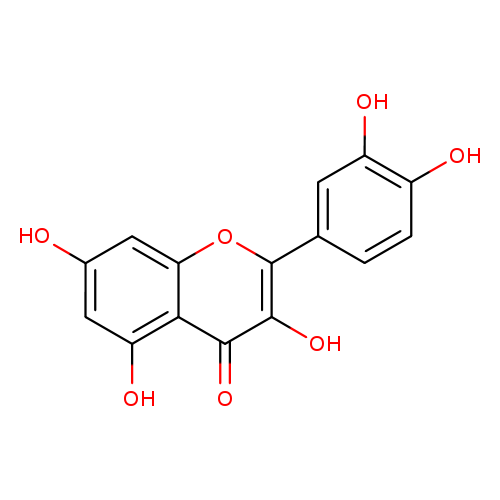
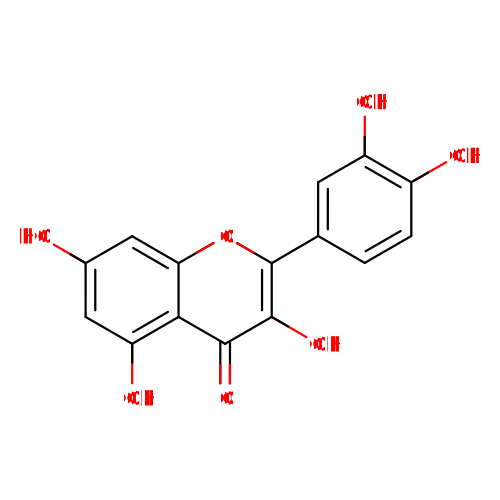
Chemical Structure
Thumb
Synonyms
ValueSource
2-(3,4-Dihydroxyphenyl)-3,5,7-trihydroxy-4H-1-benzopyran-4-oneChEBI
3,3',4',5,7-PentahydroxyflavoneChEBI
3,5,7,3',4'-PentahydroxyflavoneChEBI
SophoretinChEBI
XanthaurineChEBI
3,3',4,5,7-PentahydroxyflavoneKegg
DikvertinMeSH
2-(3,4-Dihydroxy-phenyl)-3,5,7-trihydroxy-chromen-4-oneHMDB
3',4',5,7-Tetrahydroxyflavan-3-olHMDB
3',4',5,7-Tetrahydroxyflavon-3-olHMDB
3,4',5,5',7-Pentahydroxy-flavoneHMDB
3,5,7-Trihydroxy-2-(3,4-dihydroxyphenyl)-4H-chromen-4-ONHMDB
Flavin meletinHMDB
MeletinHMDB
Quercetin dihydrateHMDB
QuercetolHMDB
QuertinHMDB
2-(3,4-Dihydroxyphenyl)-3,5,7-trihydroxy-4H-benzopyran-4-onePhytoBank
3,3’,4’,5,7-PentahydroxyflavonePhytoBank
3,5,7,3’,4’-PentahydroxyflavonePhytoBank
3,5,7-Trihydroxy-2-(3,4-dihydroxyphenyl)-4H-chromen-4-onePhytoBank
3'-HydroxykaempferolPhytoBank
3’-HydroxykaempferolPhytoBank
QuercetinePhytoBank
QuertinePhytoBank
Chemical FormulaC15H10O7
Average Molecular Mass302.236 g/mol
Monoisotopic Mass302.043 g/mol
CAS Registry Number117-39-5
IUPAC Name2-(3,4-dihydroxyphenyl)-3,5,7-trihydroxy-4H-chromen-4-one
Traditional Namequercetin
SMILESOC1=CC2=C(C(O)=C1)C(=O)C(O)=C(O2)C1=CC=C(O)C(O)=C1
InChI IdentifierInChI=1S/C15H10O7/c16-7-4-10(19)12-11(5-7)22-15(14(21)13(12)20)6-1-2-8(17)9(18)3-6/h1-5,16-19,21H
InChI KeyREFJWTPEDVJJIY-UHFFFAOYSA-N
Chemical Taxonomy
Description belongs to the class of organic compounds known as flavonols. Flavonols are compounds that contain a flavone (2-phenyl-1-benzopyran-4-one) backbone carrying a hydroxyl group at the 3-position.
KingdomOrganic compounds
Super ClassPhenylpropanoids and polyketides
ClassFlavonoids
Sub ClassFlavones
Direct ParentFlavonols
Alternative Parents
Substituents
  • 3-hydroxyflavone
  • 3'-hydroxyflavonoid
  • 3-hydroxyflavonoid
  • 4'-hydroxyflavonoid
  • 5-hydroxyflavonoid
  • 7-hydroxyflavonoid
  • Hydroxyflavonoid
  • Chromone
  • Benzopyran
  • 1-benzopyran
  • Catechol
  • 1-hydroxy-4-unsubstituted benzenoid
  • 1-hydroxy-2-unsubstituted benzenoid
  • Phenol
  • Pyranone
  • Benzenoid
  • Monocyclic benzene moiety
  • Pyran
  • Heteroaromatic compound
  • Vinylogous acid
  • Oxacycle
  • Organoheterocyclic compound
  • Polyol
  • Organic oxide
  • Organic oxygen compound
  • Hydrocarbon derivative
  • Organooxygen compound
  • Aromatic heteropolycyclic compound
Molecular FrameworkAromatic heteropolycyclic compounds
External Descriptors
Biological Properties
StatusDetected and Not Quantified
OriginExogenous
Cellular Locations
  • Membrane
Biofluid LocationsNot Available
Tissue LocationsNot Available
PathwaysNot Available
ApplicationsNot Available
Biological RolesNot Available
Chemical RolesNot Available
Physical Properties
StateSolid
AppearanceWhite powder.
Experimental Properties
PropertyValue
Melting Point316.5°C
Boiling PointNot Available
Solubility60 mg/L (at 16°C)
Predicted Properties
PropertyValueSource
Water Solubility0.26 g/LALOGPS
logP1.81ALOGPS
logP2.16ChemAxon
logS-3.1ALOGPS
pKa (Strongest Acidic)6.38ChemAxon
pKa (Strongest Basic)-4ChemAxon
Physiological Charge-1ChemAxon
Hydrogen Acceptor Count7ChemAxon
Hydrogen Donor Count5ChemAxon
Polar Surface Area127.45 ŲChemAxon
Rotatable Bond Count1ChemAxon
Refractivity76.86 m³·mol⁻¹ChemAxon
Polarizability28.54 ųChemAxon
Number of Rings3ChemAxon
Bioavailability1ChemAxon
Rule of FiveYesChemAxon
Ghose FilterYesChemAxon
Veber's RuleNoChemAxon
MDDR-like RuleNoChemAxon
Spectra
Spectra
Spectrum TypeDescriptionSplash KeyView
GC-MSGC-MS Spectrum - GC-MS (5 TMS)splash10-0bt9-2611390000-f8e98c928a7ed82acda4Spectrum
GC-MSGC-MS Spectrum - GC-MS (Non-derivatized)splash10-0bt9-2611390000-f8e98c928a7ed82acda4Spectrum
Predicted GC-MSPredicted GC-MS Spectrum - GC-MS (Non-derivatized) - 70eV, Positivesplash10-0079-0591000000-2a146657da898ec9322eSpectrum
Predicted GC-MSPredicted GC-MS Spectrum - GC-MS (5 TMS) - 70eV, Positivesplash10-00l2-2093078000-1de46637305246feffd2Spectrum
Predicted GC-MSPredicted GC-MS Spectrum - GC-MS (Non-derivatized) - 70eV, PositiveNot AvailableSpectrum
LC-MS/MSLC-MS/MS Spectrum - Quattro_QQQ 10V, Positive (Annotated)splash10-0udi-0009000000-d4689b76f41c73487399Spectrum
LC-MS/MSLC-MS/MS Spectrum - Quattro_QQQ 25V, Positive (Annotated)splash10-0udi-0967000000-613e61ec0c69ed0ee630Spectrum
LC-MS/MSLC-MS/MS Spectrum - Quattro_QQQ 40V, Positive (Annotated)splash10-0uy0-5910000000-ee816015eec26c8621b1Spectrum
LC-MS/MSLC-MS/MS Spectrum - LC-ESI-QTOF (UPLC Q-Tof Premier, Waters) 5V, Positivesplash10-0udi-0009000000-ec1cab852ed9f9f78fa4Spectrum
LC-MS/MSLC-MS/MS Spectrum - LC-ESI-QTOF (UPLC Q-Tof Premier, Waters) , Negativesplash10-0udi-1907000000-6f36df2733dadae380c2Spectrum
LC-MS/MSLC-MS/MS Spectrum - LC-ESI-QTOF (UPLC Q-Tof Premier, Waters) , Negativesplash10-0udi-0309000000-976a99c106ceca16d73bSpectrum
LC-MS/MSLC-MS/MS Spectrum - LC-ESI-QTOF (UPLC Q-Tof Premier, Waters) , Negativesplash10-0pi0-1900000000-b2e286366d41e47dd8fcSpectrum
LC-MS/MSLC-MS/MS Spectrum - LC-ESI-QTOF (UPLC Q-Tof Premier, Waters) , Negativesplash10-0udi-0209000000-e891863ec110aeb660b0Spectrum
LC-MS/MSLC-MS/MS Spectrum - LC-ESI-QTOF (UPLC Q-Tof Premier, Waters) , Positivesplash10-0udi-0940000000-aa52db00c1defe3ccf75Spectrum
LC-MS/MSLC-MS/MS Spectrum - LC-ESI-QTOF (UPLC Q-Tof Premier, Waters) , Positivesplash10-0udi-0219000000-5ef285c4b6bfd220b8b1Spectrum
LC-MS/MSLC-MS/MS Spectrum - LC-ESI-QTOF (UPLC Q-Tof Premier, Waters) , Positivesplash10-0udi-0219000000-547c83bb70e7da007d6cSpectrum
LC-MS/MSLC-MS/MS Spectrum - LC-ESI-QTOF (UPLC Q-Tof Premier, Waters) , Negativesplash10-0udi-1907000000-a59602c09f66e9656068Spectrum
LC-MS/MSLC-MS/MS Spectrum - LC-ESI-ITTOF (LCMS-IT-TOF) , Positivesplash10-0udi-0009000000-4416f39adf6c9b919bfaSpectrum
LC-MS/MSLC-MS/MS Spectrum - LC-ESI-ITTOF (LCMS-IT-TOF) , Negativesplash10-0udi-0019000000-eb14ec62fc2fb2f1da88Spectrum
LC-MS/MSLC-MS/MS Spectrum - LC-ESI-ITTOF (LCMS-IT-TOF) , Negativesplash10-0ufr-0910000000-0730bca525c17aac75c5Spectrum
LC-MS/MSLC-MS/MS Spectrum - ESI-TOF 10V, Negativesplash10-004i-0030290000-06238e4a98a4daad3265Spectrum
LC-MS/MSLC-MS/MS Spectrum - ESI-TOF , Negativesplash10-0udi-0039008002-9df3edfb34deb15f8474Spectrum
LC-MS/MSLC-MS/MS Spectrum - ESI-TOF 10V, Negativesplash10-0udi-0039008002-9df3edfb34deb15f8474Spectrum
LC-MS/MSLC-MS/MS Spectrum - ESI-TOF 20V, Negativesplash10-0uka-0193000000-3325ca1a080730a9c0bfSpectrum
Predicted LC-MS/MSPredicted LC-MS/MS Spectrum - 10V, Positivesplash10-0udi-0019000000-ee8570ac70818e8939bbSpectrum
Predicted LC-MS/MSPredicted LC-MS/MS Spectrum - 20V, Positivesplash10-0udi-0279000000-71b5db7ef8322cc8b9e9Spectrum
Predicted LC-MS/MSPredicted LC-MS/MS Spectrum - 40V, Positivesplash10-0zg0-7960000000-7edbb229853a642749acSpectrum
Predicted LC-MS/MSPredicted LC-MS/MS Spectrum - 10V, Negativesplash10-0udi-0009000000-21580b9d8394d2eea3a5Spectrum
Predicted LC-MS/MSPredicted LC-MS/MS Spectrum - 20V, Negativesplash10-0udi-0239000000-b77fcb9c0ce11dc515bfSpectrum
Predicted LC-MS/MSPredicted LC-MS/MS Spectrum - 40V, Negativesplash10-0apr-5940000000-0590bdee504c5ed6ba36Spectrum
1D NMR1H NMR SpectrumNot AvailableSpectrum
2D NMR[1H,13C] 2D NMR SpectrumNot AvailableSpectrum
Toxicity Profile
Route of ExposureNot Available
Mechanism of ToxicityQuercetin is a specific quinone reductase 2 (QR2) inhibitor, an enzyme (along with the human QR1 homolog) which catalyzes metabolism of toxic quinolines. Inhibition of QR2 in plasmodium may potentially cause lethal oxidative stress. The inhibition of antioxidant activity in plasmodium may contribute to killing the malaria causing parasites.
MetabolismNot Available
Toxicity ValuesNot Available
Lethal DoseNot Available
Carcinogenicity (IARC Classification)3, not classifiable as to its carcinogenicity to humans. (2)
Uses/SourcesNot Available
Minimum Risk LevelNot Available
Health EffectsNot Available
SymptomsNot Available
TreatmentNot Available
Concentrations
Not Available
DrugBank IDDB04216
HMDB IDHMDB0005794
FooDB IDFDB011904
Phenol Explorer ID291
KNApSAcK IDC00004631
BiGG IDNot Available
BioCyc IDCPD-520
METLIN IDNot Available
PDB IDQUE
Wikipedia LinkQuercetin
Chemspider ID4444051
ChEBI ID16243
PubChem Compound ID5280343
Kegg Compound IDC00389
YMDB IDYMDB01777
ECMDB IDECMDB23201
References
Synthesis Reference

Miguel M. Taya, Dionisio M. Aedo, Rene Ricard, “Quercetin pentamethyl carbamate and a process for its preparation.” U.S. Patent US4202825, issued October, 1975.

MSDSLink
General References
1. https://www.ncbi.nlm.nih.gov/pubmed/?term=16226777
2. https://www.ncbi.nlm.nih.gov/pubmed/?term=17015250
3. https://www.ncbi.nlm.nih.gov/pubmed/?term=17135030
4. https://www.ncbi.nlm.nih.gov/pubmed/?term=17426744
5. https://www.ncbi.nlm.nih.gov/pubmed/?term=18096136
6. https://www.ncbi.nlm.nih.gov/pubmed/?term=18484521
7. https://www.ncbi.nlm.nih.gov/pubmed/?term=18549926
8. https://www.ncbi.nlm.nih.gov/pubmed/?term=18564899
9. https://www.ncbi.nlm.nih.gov/pubmed/?term=18579649
10. https://www.ncbi.nlm.nih.gov/pubmed/?term=18785622
11. https://www.ncbi.nlm.nih.gov/pubmed/?term=19461927
12. https://www.ncbi.nlm.nih.gov/pubmed/?term=22920589
13. https://www.ncbi.nlm.nih.gov/pubmed/?term=23342112
14. https://www.ncbi.nlm.nih.gov/pubmed/?term=23359794
15. https://www.ncbi.nlm.nih.gov/pubmed/?term=27565033
16. https://www.ncbi.nlm.nih.gov/pubmed/?term=27589790
17. https://www.ncbi.nlm.nih.gov/pubmed/?term=27591927
18. https://www.ncbi.nlm.nih.gov/pubmed/?term=27704720
19. Krewson, Charles F. Colloidal flavonols. (1953), US 2637725 19530505 CAN 47:42700 AN 1953:42700
20. Krewson, Charles F. Colloidal flavonols. (1953), US 2637725 19530505 CAN 47:42700 AN 1953:42700
21. Perez-Vizcaino F, Duarte J, Andriantsitohaina R: Endothelial function and cardiovascular disease: effects of quercetin and wine polyphenols. Free Radic Res. 2006 Oct;40(10):1054-65.