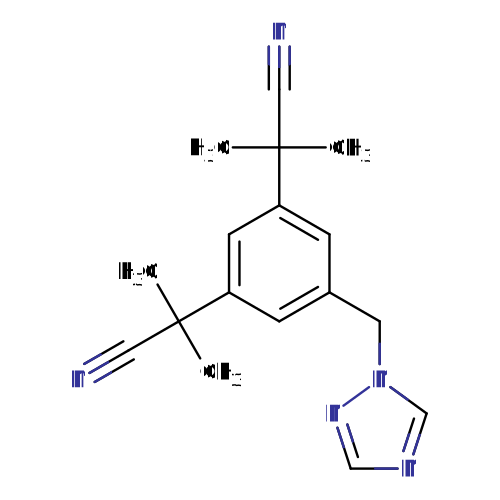
Record Information
Version1.0
Creation Date2014-09-11 05:17:00 UTC
Update Date2026-03-26 23:40:10 UTC
Accession NumberCHEM003753
Identification
Common NameAnastrozole
ClassSmall Molecule
DescriptionAnastrozole is a drug indicated in the treatment of breast cancer in post-menopausal women. It is used both in adjuvant therapy (i.e. following surgery) and in metastatic breast cancer. It decreases the amount of estrogens that the body makes. Anastrozole belongs in the class of drugs known as aromatase inhibitors. It inhibits the enzyme aromatase, which is responsible for converting androgens (produced by women in the adrenal glands) to estrogens.
Contaminant Sources
  • Disinfection Byproducts
  • EAFUS Chemicals
  • HMDB Contaminants - Urine
  • HPV EPA Chemicals
  • My Exposome Chemicals
  • OECD HPV Chemicals
  • STOFF IDENT Compounds
  • Suspected Compounds – Schymanski Project
  • T3DB toxins
  • ToxCast & Tox21 Chemicals
Contaminant Type
  • Amine
  • Antineoplastic Agent, Hormonal
  • Aromatase Inhibitor
  • Drug
  • Metabolite
  • Nitrile
  • Organic Compound
  • Synthetic Compound
Chemical Structure
Thumb
Synonyms
ValueSource
ArimidexKegg
alpha,alpha,Alpha',alpha'-tetramethyl-5-(1H-1,2,4-triazol-1-ylmethyl)-m-benzenediacetonitrileHMDB
AnastrozolHMDB
a,a,Alpha',alpha'-tetramethyl-5-(1H-1,2,4-triazol-1-ylmethyl)-m-benzenediacetonitrileHMDB
Α,α,alpha',alpha'-tetramethyl-5-(1H-1,2,4-triazol-1-ylmethyl)-m-benzenediacetonitrileHMDB
AstraZeneca brand OF anastrozoleHMDB
ICI D1033HMDB
Zeneca brand OF anastrozoleHMDB
Zeneca ZD 1033HMDB
2,2'-(5-(1H-1,2,4-Triazol-1-ylmethyl)-1,3-phenylene)bis(2-methylpropionitrile)HMDB
Astra brand OF anastrozoleHMDB
AnastrazoleHMDB
Chemical FormulaC17H19N5
Average Molecular Mass293.366 g/mol
Monoisotopic Mass293.164 g/mol
CAS Registry Number120511-73-1
IUPAC Name2-[3-(1-cyano-1-methylethyl)-5-(1H-1,2,4-triazol-1-ylmethyl)phenyl]-2-methylpropanenitrile
Traditional Nameanastrozole
SMILESCC(C)(C#N)C1=CC(=CC(CN2C=NC=N2)=C1)C(C)(C)C#N
InChI IdentifierInChI=1S/C17H19N5/c1-16(2,9-18)14-5-13(8-22-12-20-11-21-22)6-15(7-14)17(3,4)10-19/h5-7,11-12H,8H2,1-4H3
InChI KeyYBBLVLTVTVSKRW-UHFFFAOYSA-N
Chemical Taxonomy
Description belongs to the class of organic compounds known as phenylpropanes. These are organic compounds containing a phenylpropane moiety.
KingdomOrganic compounds
Super ClassBenzenoids
ClassBenzene and substituted derivatives
Sub ClassPhenylpropanes
Direct ParentPhenylpropanes
Alternative Parents
Substituents
  • Phenylpropane
  • Heteroaromatic compound
  • 1,2,4-triazole
  • Azole
  • Azacycle
  • Organoheterocyclic compound
  • Nitrile
  • Carbonitrile
  • Organic nitrogen compound
  • Organopnictogen compound
  • Hydrocarbon derivative
  • Organonitrogen compound
  • Aromatic heteromonocyclic compound
Molecular FrameworkAromatic heteromonocyclic compounds
External Descriptors
Biological Properties
StatusDetected and Not Quantified
OriginExogenous
Cellular Locations
  • Membrane
Biofluid LocationsNot Available
Tissue LocationsNot Available
PathwaysNot Available
ApplicationsNot Available
Biological RolesNot Available
Chemical RolesNot Available
Physical Properties
StateSolid
AppearanceWhite powder.
Experimental Properties
PropertyValue
Melting Point130.14°C
Boiling PointNot Available
Solubility0.5 mg/mL
Predicted Properties
PropertyValueSource
Water Solubility0.066 g/LALOGPS
logP2.31ALOGPS
logP3.03ChemAxon
logS-3.6ALOGPS
pKa (Strongest Basic)2.25ChemAxon
Physiological Charge0ChemAxon
Hydrogen Acceptor Count4ChemAxon
Hydrogen Donor Count0ChemAxon
Polar Surface Area78.29 ŲChemAxon
Rotatable Bond Count4ChemAxon
Refractivity97.47 m³·mol⁻¹ChemAxon
Polarizability31.97 ųChemAxon
Number of Rings2ChemAxon
Bioavailability1ChemAxon
Rule of FiveYesChemAxon
Ghose FilterYesChemAxon
Veber's RuleNoChemAxon
MDDR-like RuleNoChemAxon
Spectra
Spectra
Spectrum TypeDescriptionSplash KeyView
Predicted GC-MSPredicted GC-MS Spectrum - GC-MS (Non-derivatized) - 70eV, Positivesplash10-004i-3290000000-ff4ef0855ebb4330d2d2Spectrum
Predicted GC-MSPredicted GC-MS Spectrum - GC-MS (Non-derivatized) - 70eV, PositiveNot AvailableSpectrum
LC-MS/MSLC-MS/MS Spectrum - LC-ESI-qTof , Positivesplash10-004l-1390000000-8636c0aef7d79b805328Spectrum
LC-MS/MSLC-MS/MS Spectrum - , positivesplash10-004l-1390000000-8636c0aef7d79b805328Spectrum
LC-MS/MSLC-MS/MS Spectrum - , positivesplash10-004l-0190000000-739ac0c546bb150b1c60Spectrum
LC-MS/MSLC-MS/MS Spectrum - LC-ESI-QFT , positivesplash10-004i-0090000000-8ccdc5fa9f18334eae92Spectrum
LC-MS/MSLC-MS/MS Spectrum - 20V, Positivesplash10-03k9-0970000000-631de023e85e74dc9b97Spectrum
LC-MS/MSLC-MS/MS Spectrum - 35V, Positivesplash10-004i-0090000000-da446dd012935939477aSpectrum
LC-MS/MSLC-MS/MS Spectrum - 60V, Positivesplash10-004i-0290000000-68b444c53777d3d51749Spectrum
LC-MS/MSLC-MS/MS Spectrum - 90V, Positivesplash10-00kf-0910000000-40a907f3bc5fa1999ffdSpectrum
LC-MS/MSLC-MS/MS Spectrum - 30V, Positivesplash10-00e9-0900000000-55004c246dccb53413bbSpectrum
LC-MS/MSLC-MS/MS Spectrum - 10V, Positivesplash10-03k9-0980000000-71cd7bb463fca110eeabSpectrum
LC-MS/MSLC-MS/MS Spectrum - 35V, Positivesplash10-004i-0290000000-2b885de3e2d4dc88aa81Spectrum
LC-MS/MSLC-MS/MS Spectrum - 40V, Positivesplash10-00e9-0900000000-5113a05488a50bd3517cSpectrum
LC-MS/MSLC-MS/MS Spectrum - 50V, Positivesplash10-01b9-0900000000-908023356faf6f180af3Spectrum
Predicted LC-MS/MSPredicted LC-MS/MS Spectrum - 10V, Positivesplash10-0006-0090000000-84795d1e4c8cdc8517aaSpectrum
Predicted LC-MS/MSPredicted LC-MS/MS Spectrum - 20V, Positivesplash10-0006-0090000000-6a08f214a3b45616d2f4Spectrum
Predicted LC-MS/MSPredicted LC-MS/MS Spectrum - 40V, Positivesplash10-006x-2390000000-cad4b3339fe0a358312eSpectrum
Predicted LC-MS/MSPredicted LC-MS/MS Spectrum - 10V, Positivesplash10-0006-0090000000-84795d1e4c8cdc8517aaSpectrum
Predicted LC-MS/MSPredicted LC-MS/MS Spectrum - 20V, Positivesplash10-0006-0090000000-6a08f214a3b45616d2f4Spectrum
Predicted LC-MS/MSPredicted LC-MS/MS Spectrum - 40V, Positivesplash10-006x-2390000000-cad4b3339fe0a358312eSpectrum
Predicted LC-MS/MSPredicted LC-MS/MS Spectrum - 10V, Positivesplash10-0006-0090000000-84795d1e4c8cdc8517aaSpectrum
Predicted LC-MS/MSPredicted LC-MS/MS Spectrum - 20V, Positivesplash10-0006-0090000000-6a08f214a3b45616d2f4Spectrum
Predicted LC-MS/MSPredicted LC-MS/MS Spectrum - 40V, Positivesplash10-006x-2390000000-cad4b3339fe0a358312eSpectrum
Predicted LC-MS/MSPredicted LC-MS/MS Spectrum - 10V, Negativesplash10-0006-0090000000-cca188a9698d9ce00e77Spectrum
Predicted LC-MS/MSPredicted LC-MS/MS Spectrum - 20V, Negativesplash10-0006-0090000000-7e154d941cb439c9f5a9Spectrum
Predicted LC-MS/MSPredicted LC-MS/MS Spectrum - 40V, Negativesplash10-014r-5290000000-bd403a6901863274c5b7Spectrum
Toxicity Profile
Route of ExposureRapidly absorbed into the systemic cirulation following oral administration. Peak plasma concentrations are usually attained within 2 hours under fasting conditions, with steady-state plasma concentrations attained in approximately 7 days.
Mechanism of ToxicityAnastrozole selectively inhibits aromatase. The principal source of circulating estrogen (primarily estradiol) is conversion of adrenally-generated androstenedione to estrone by aromatase in peripheral tissues. Therefore, aromatase inhibition leads to a decrease in serum and tumor concentration of estrogen, leading to a decreased tumor mass or delayed progression of tumor growth in some women. Anastrozole has no detectable effect on synthesis of adrenal corticosteroids, aldosterone, and thyroid hormone. Organic nitriles decompose into cyanide ions both in vivo and in vitro. Consequently the primary mechanism of toxicity for organic nitriles is their production of toxic cyanide ions or hydrogen cyanide. Cyanide is an inhibitor of cytochrome c oxidase in the fourth complex of the electron transport chain (found in the membrane of the mitochondria of eukaryotic cells). It complexes with the ferric iron atom in this enzyme. The binding of cyanide to this cytochrome prevents transport of electrons from cytochrome c oxidase to oxygen. As a result, the electron transport chain is disrupted and the cell can no longer aerobically produce ATP for energy. Tissues that mainly depend on aerobic respiration, such as the central nervous system and the heart, are particularly affected. Cyanide is also known produce some of its toxic effects by binding to catalase, glutathione peroxidase, methemoglobin, hydroxocobalamin, phosphatase, tyrosinase, ascorbic acid oxidase, xanthine oxidase, succinic dehydrogenase, and Cu/Zn superoxide dismutase. Cyanide binds to the ferric ion of methemoglobin to form inactive cyanmethemoglobin. (7)
MetabolismHepatic. Metabolized mainly by N-dealkylation, hydroxylation, and glucuronidation to inactive metabolites. Primary metabolite is an inactive triazole. Route of Elimination: Hepatic metabolism accounts for approximately 85% of anastrozole elimination. Renal elimination accounts for approximately 10% of total clearance. Half Life: 50 hours
Toxicity ValuesIn rats, lethality is greater than 100 mg/kg.
Lethal DoseNot Available
Carcinogenicity (IARC Classification)No indication of carcinogenicity to humans (not listed by IARC).
Uses/SourcesFor adjuvant treatment of hormone receptor positive breast cancer , as well as hormonal treatment of advanced breast cancer in post-menopausal women. Has also been used to treat pubertal gynecomastia and McCune-Albright syndrome; however, manufacturer states that efficacy for these indications have not been established.
Minimum Risk LevelNot Available
Health EffectsNot Available
SymptomsNot Available
TreatmentNot Available
Concentrations
StatusValueUnitSample LocationReference
DrugBank IDDB01217
HMDB IDHMDB0015348
FooDB IDNot Available
Phenol Explorer IDNot Available
KNApSAcK IDNot Available
BiGG IDNot Available
BioCyc IDNot Available
METLIN IDNot Available
PDB IDNot Available
Wikipedia LinkAnastrozole
Chemspider ID2102
ChEBI ID2704
PubChem Compound ID2187
Kegg Compound IDC08159
YMDB IDYMDB15939
ECMDB IDNot Available
References
Synthesis Reference

Anil Khile, Narendra Joshi, Shekhar Bhirud, “Process for the preparation of anastrozole and intermediates thereof.” U.S. Patent US20060189670, issued August 24, 2006.

MSDSLink
General References
1. Howell A, Cuzick J, Baum M, Buzdar A, Dowsett M, Forbes JF, Hoctin-Boes G, Houghton J, Locker GY, Tobias JS: Results of the ATAC (Arimidex, Tamoxifen, Alone or in Combination) trial after completion of 5 years' adjuvant treatment for breast cancer. Lancet. 2005 Jan 1-7;365(9453):60-2.
2. Nabholtz JM: Role of anastrozole across the breast cancer continuum: from advanced to early disease and prevention. Oncology. 2006;70(1):1-12. Epub 2006 Jan 26.
3. Santen RJ, Brodie H, Simpson ER, Siiteri PK, Brodie A: History of aromatase: saga of an important biological mediator and therapeutic target. Endocr Rev. 2009 Jun;30(4):343-75. doi: 10.1210/er.2008-0016. Epub 2009 Apr 23.
4. Mauras N, Bishop K, Merinbaum D, Emeribe U, Agbo F, Lowe E: Pharmacokinetics and pharmacodynamics of anastrozole in pubertal boys with recent-onset gynecomastia. J Clin Endocrinol Metab. 2009 Aug;94(8):2975-8. doi: 10.1210/jc.2008-2527. Epub 2009 May 26.
5. Gangadhara S, Bertelli G: Long-term efficacy and safety of anastrozole for adjuvant treatment of early breast cancer in postmenopausal women. Ther Clin Risk Manag. 2009 Aug;5(4):291-300. Epub 2009 May 4.
6. Milani M, Jha G, Potter DA: Anastrozole Use in Early Stage Breast Cancer of Post-Menopausal Women. Clin Med Ther. 2009 Mar 31;1:141-156.