Record Information
Version1.0
Creation Date2014-09-11 05:17:08 UTC
Update Date2026-03-31 20:18:44 UTC
Accession NumberCHEM003756
Identification
Common NameAzelaic Acid
ClassSmall Molecule
DescriptionAzelaic acid is a saturated dicarboxylic acid found naturally in wheat, rye, and barley. It is a natural substance that is produced by Malassezia furfur (also known as Pityrosporum ovale), a yeast that lives on normal skin. It is effective against a number of skin conditions, such as mild to moderate acne, when applied topically in a cream formulation of 20%. It works in part by stopping the growth of skin bacteria that cause acne, and by keeping skin pores clear. Azelaic acid's antimicrobial action may be attributable to inhibition of microbial cellular protein synthesis.
Contaminant Sources
  • Cosmetic Chemicals
  • FooDB Chemicals
  • HMDB Contaminants - Feces
  • HMDB Contaminants - Urine
  • HPV EPA Chemicals
  • OECD HPV Chemicals
  • STOFF IDENT Compounds
  • T3DB toxins
  • ToxCast & Tox21 Chemicals
Contaminant Type
  • Antineoplastic Agent
  • Dermatologic Agent
  • Drug
  • Food Toxin
  • Metabolite
  • Natural Compound
  • Organic Compound
  • Plant Toxin
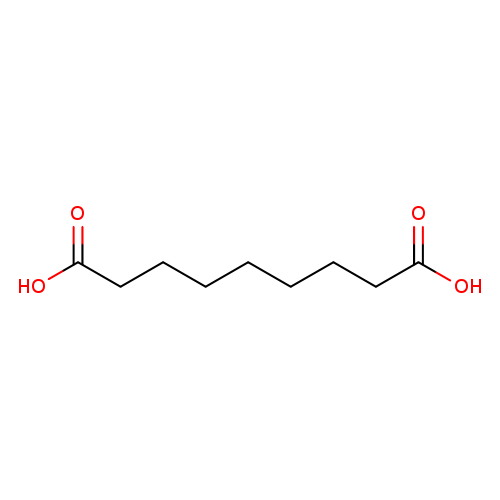
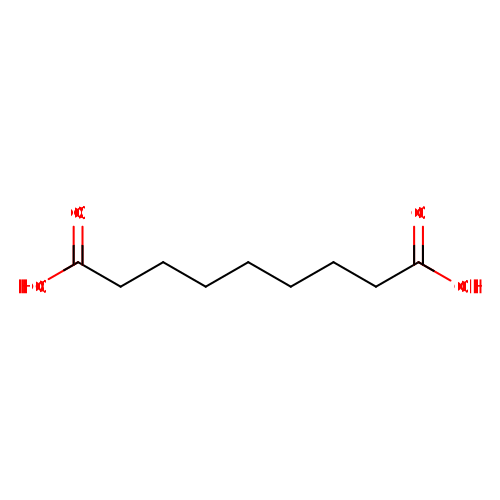
Chemical Structure
Thumb
Synonyms
ValueSource
1,7-DicarboxyheptaneChEBI
1,7-Heptanedicarboxylic acidChEBI
1,9-Nonanedioic acidChEBI
Acide azelaiqueChEBI
Acidum azelaicumChEBI
Anchoic acidChEBI
AzelainsaeureChEBI
AzelexChEBI
FinaceaChEBI
Lepargylic acidChEBI
N-Nonanedioic acidChEBI
NonandisaeureChEBI
SkinorenChEBI
Nonanedioic acidKegg
1,7-HeptanedicarboxylateGenerator
1,9-NonanedioateGenerator
AnchoateGenerator
LepargylateGenerator
N-NonanedioateGenerator
NonanedioateGenerator
AzelaateGenerator
Azalaic acidHMDB
AzelaicacidtechHMDB
Azelainic acidHMDB
AzelateHMDB
Emerox 1110HMDB
Emerox 1144HMDB
Emery'S L-110HMDB
FinevinHMDB
Heptanedicarboxylic acidHMDB
Nonanedioic acid azelaic acidHMDB
Nonanedioic acid homopolymerHMDB
Poly(azelaic anhydride)HMDB
Polyazelaic anhydrideHMDB
SkinoremHMDB
Azelaic acid, dilithium saltHMDB
Azelaic acid, dipotassium saltHMDB
Azelaic acid, disodium saltHMDB
Azelaic acid, monosodium saltHMDB
Azelaic acid, potassium saltHMDB
Azelaic acid, sodium saltHMDB
Monosodium azelateHMDB
Azelaic acidPhytoBank
Azelic acidPhytoBank
alpha,omega-Nonanedioic acidPhytoBank
α,ω-Nonanedioic acidPhytoBank
Chemical FormulaC9H16O4
Average Molecular Mass188.221 g/mol
Monoisotopic Mass188.105 g/mol
CAS Registry Number123-99-9
IUPAC Namenonanedioic acid
Traditional Nameazelaic acid
SMILESOC(=O)CCCCCCCC(O)=O
InChI IdentifierInChI=1S/C9H16O4/c10-8(11)6-4-2-1-3-5-7-9(12)13/h1-7H2,(H,10,11)(H,12,13)
InChI KeyBDJRBEYXGGNYIS-UHFFFAOYSA-N
Chemical Taxonomy
Description belongs to the class of organic compounds known as medium-chain fatty acids. These are fatty acids with an aliphatic tail that contains between 4 and 12 carbon atoms.
KingdomOrganic compounds
Super ClassLipids and lipid-like molecules
ClassFatty Acyls
Sub ClassFatty acids and conjugates
Direct ParentMedium-chain fatty acids
Alternative Parents
Substituents
  • Medium-chain fatty acid
  • Dicarboxylic acid or derivatives
  • Carboxylic acid
  • Carboxylic acid derivative
  • Organic oxygen compound
  • Organic oxide
  • Hydrocarbon derivative
  • Organooxygen compound
  • Carbonyl group
  • Aliphatic acyclic compound
Molecular FrameworkAliphatic acyclic compounds
External Descriptors
Biological Properties
StatusDetected and Not Quantified
OriginEndogenous
Cellular Locations
  • Cytoplasm
  • Extracellular
Biofluid LocationsNot Available
Tissue Locations
  • Prostate
  • Skin
PathwaysNot Available
ApplicationsNot Available
Biological RolesNot Available
Chemical RolesNot Available
Physical Properties
StateSolid
AppearanceWhite powder.
Experimental Properties
PropertyValue
Melting Point106.5°C
Boiling Point286.5°C at 1.00E+02 mm Hg
Solubility2400 mg/L (at 20°C)
Predicted Properties
PropertyValueSource
Water Solubility2.28 g/LALOGPS
logP1.37ALOGPS
logP1.82ChemAxon
logS-1.9ALOGPS
pKa (Strongest Acidic)4.15ChemAxon
Physiological Charge-2ChemAxon
Hydrogen Acceptor Count4ChemAxon
Hydrogen Donor Count2ChemAxon
Polar Surface Area74.6 ŲChemAxon
Rotatable Bond Count8ChemAxon
Refractivity46.54 m³·mol⁻¹ChemAxon
Polarizability20.5 ųChemAxon
Number of Rings0ChemAxon
Bioavailability1ChemAxon
Rule of FiveYesChemAxon
Ghose FilterYesChemAxon
Veber's RuleNoChemAxon
MDDR-like RuleNoChemAxon
Spectra
Spectra
Spectrum TypeDescriptionSplash KeyView
GC-MSGC-MS Spectrum - GC-MS (2 TMS)splash10-0v0r-4920000000-5a3ed693b1c4083f1f15Spectrum
GC-MSGC-MS Spectrum - GC-MS (Non-derivatized)splash10-0v0r-4920000000-5a3ed693b1c4083f1f15Spectrum
GC-MSGC-MS Spectrum - GC-EI-TOF (Non-derivatized)splash10-00mk-1910000000-83ba58dac4b0698643d0Spectrum
Predicted GC-MSPredicted GC-MS Spectrum - GC-MS (Non-derivatized) - 70eV, Positivesplash10-000f-9600000000-24638c458fa83f47c259Spectrum
Predicted GC-MSPredicted GC-MS Spectrum - GC-MS (2 TMS) - 70eV, Positivesplash10-00y0-9740000000-d157d08c3a7c87244190Spectrum
Predicted GC-MSPredicted GC-MS Spectrum - GC-MS (Non-derivatized) - 70eV, PositiveNot AvailableSpectrum
Predicted GC-MSPredicted GC-MS Spectrum - GC-MS (TMS_1_1) - 70eV, PositiveNot AvailableSpectrum
Predicted GC-MSPredicted GC-MS Spectrum - GC-MS (TBDMS_1_1) - 70eV, PositiveNot AvailableSpectrum
Predicted GC-MSPredicted GC-MS Spectrum - GC-MS (TBDMS_2_1) - 70eV, PositiveNot AvailableSpectrum
LC-MS/MSLC-MS/MS Spectrum - Quattro_QQQ 10V, Negative (Annotated)splash10-000i-0900000000-a118e433f0bd27a95b89Spectrum
LC-MS/MSLC-MS/MS Spectrum - Quattro_QQQ 25V, Negative (Annotated)splash10-006t-9600000000-93b3a375b722791cb5c9Spectrum
LC-MS/MSLC-MS/MS Spectrum - Quattro_QQQ 40V, Negative (Annotated)splash10-052k-9500000000-6b069f2fed947651b284Spectrum
LC-MS/MSLC-MS/MS Spectrum - LC-ESI-QQ (API3000, Applied Biosystems) 10V, Negativesplash10-000i-0900000000-7980b5eadcca6ee1eaddSpectrum
LC-MS/MSLC-MS/MS Spectrum - LC-ESI-QQ (API3000, Applied Biosystems) 20V, Negativesplash10-004i-0900000000-462585874f7661d40d5bSpectrum
LC-MS/MSLC-MS/MS Spectrum - LC-ESI-QQ (API3000, Applied Biosystems) 30V, Negativesplash10-004j-4900000000-0f65eeeed8c8a6ff3cc9Spectrum
LC-MS/MSLC-MS/MS Spectrum - LC-ESI-QQ (API3000, Applied Biosystems) 40V, Negativesplash10-0002-9300000000-d654ca3c764066f98358Spectrum
LC-MS/MSLC-MS/MS Spectrum - LC-ESI-QQ (API3000, Applied Biosystems) 50V, Negativesplash10-0002-9000000000-60a08bb384f2b4cbfca8Spectrum
LC-MS/MSLC-MS/MS Spectrum - LC-ESI-QQ , negativesplash10-000i-0900000000-7980b5eadcca6ee1eaddSpectrum
LC-MS/MSLC-MS/MS Spectrum - LC-ESI-QQ , negativesplash10-004i-0900000000-462585874f7661d40d5bSpectrum
LC-MS/MSLC-MS/MS Spectrum - LC-ESI-QQ , negativesplash10-004j-4900000000-0f65eeeed8c8a6ff3cc9Spectrum
LC-MS/MSLC-MS/MS Spectrum - LC-ESI-QQ , negativesplash10-0002-9300000000-fcefbd80852c2625bc0eSpectrum
LC-MS/MSLC-MS/MS Spectrum - LC-ESI-QQ , negativesplash10-0002-9000000000-60a08bb384f2b4cbfca8Spectrum
LC-MS/MSLC-MS/MS Spectrum - Linear Ion Trap , negativesplash10-004i-0900000000-26216115e75cad833509Spectrum
LC-MS/MSLC-MS/MS Spectrum - Linear Ion Trap , negativesplash10-004i-0900000000-7bef8272c481ea57a60bSpectrum
LC-MS/MSLC-MS/MS Spectrum - Linear Ion Trap , negativesplash10-004i-0900000000-751bf479539d4bd2b5e1Spectrum
LC-MS/MSLC-MS/MS Spectrum - Linear Ion Trap , negativesplash10-00di-0900000000-9a056a45b27896966bf9Spectrum
LC-MS/MSLC-MS/MS Spectrum - Linear Ion Trap , negativesplash10-00di-0900000000-3155fd845eec8f32ce93Spectrum
LC-MS/MSLC-MS/MS Spectrum - , negativesplash10-004r-0900000000-544110f97ebc0f97e15bSpectrum
Predicted LC-MS/MSPredicted LC-MS/MS Spectrum - 10V, Positivesplash10-00dr-0900000000-b1b7c1ab57d58a2405a8Spectrum
Predicted LC-MS/MSPredicted LC-MS/MS Spectrum - 20V, Positivesplash10-00g3-2900000000-d0ba7fbbe987efa4c818Spectrum
Predicted LC-MS/MSPredicted LC-MS/MS Spectrum - 40V, Positivesplash10-05qd-9100000000-8d65a19b998d18ad08acSpectrum
Predicted LC-MS/MSPredicted LC-MS/MS Spectrum - 10V, Negativesplash10-000i-0900000000-a7edc3ac66d27685b9d1Spectrum
Predicted LC-MS/MSPredicted LC-MS/MS Spectrum - 20V, Negativesplash10-00kr-1900000000-c56b9d972f88c58dc65bSpectrum
Predicted LC-MS/MSPredicted LC-MS/MS Spectrum - 40V, Negativesplash10-0a4l-9300000000-47cbefe19a788d7f36b9Spectrum
MSMass Spectrum (Electron Ionization)splash10-06rx-9100000000-6db2acb47ad4c6163063Spectrum
1D NMR1H NMR SpectrumNot AvailableSpectrum
1D NMR13C NMR SpectrumNot AvailableSpectrum
1D NMR1H NMR SpectrumNot AvailableSpectrum
1D NMR13C NMR SpectrumNot AvailableSpectrum
1D NMR1H NMR SpectrumNot AvailableSpectrum
1D NMR13C NMR SpectrumNot AvailableSpectrum
1D NMR1H NMR SpectrumNot AvailableSpectrum
1D NMR13C NMR SpectrumNot AvailableSpectrum
1D NMR1H NMR SpectrumNot AvailableSpectrum
1D NMR13C NMR SpectrumNot AvailableSpectrum
1D NMR1H NMR SpectrumNot AvailableSpectrum
1D NMR13C NMR SpectrumNot AvailableSpectrum
1D NMR1H NMR SpectrumNot AvailableSpectrum
1D NMR13C NMR SpectrumNot AvailableSpectrum
1D NMR1H NMR SpectrumNot AvailableSpectrum
1D NMR13C NMR SpectrumNot AvailableSpectrum
1D NMR1H NMR SpectrumNot AvailableSpectrum
1D NMR13C NMR SpectrumNot AvailableSpectrum
1D NMR1H NMR SpectrumNot AvailableSpectrum
1D NMR13C NMR SpectrumNot AvailableSpectrum
1D NMR1H NMR SpectrumNot AvailableSpectrum
1D NMR13C NMR SpectrumNot AvailableSpectrum
2D NMR[1H,13C] 2D NMR SpectrumNot AvailableSpectrum
Toxicity Profile
Route of ExposureApproximately 4% of the topically applied azelaic acid is systemically absorbed.
Mechanism of ToxicityThe exact mechanism of action of azelaic acid is not known. It is thought that azelaic acid manifests its antibacterial effects by inhibiting the synthesis of cellular protein in anaerobic and aerobic bacteria, especially Staphylococcus epidermidis and Propionibacterium acnes. In aerobic bacteria, azelaic acid reversibly inhibits several oxidoreductive enzymes including tyrosinase, mitochondrial enzymes of the respiratory chain, thioredoxin reductase, 5-alpha-reductase, and DNA polymerases. In anaerobic bacteria, azelaic acid impedes glycolysis. Along with these actions, azelaic acid also improves acne vulgaris by normalizing the keratin process and decreasing microcomedo formation. Azelaic acid may be effective against both inflamed and noninflamed lesions. Specifically, azelaic acid reduces the thickness of the stratum corneum, shrinks keratohyalin granules by reducing the amount and distribution of filaggrin (a component of keratohyalin) in epidermal layers, and lowers the number of keratohyalin granules.
MetabolismMainly excreted unchanged in the urine but undergoes some b-oxidation to shorter chain dicarboxylic acids. Route of Elimination: Azelaic acid is mainly excreted unchanged in the urine, but undergoes some нф-oxidation to shorter chain dicarboxylic acids. Half Life: The observed half-lives in healthy subjects are approximately 45 minutes after oral dosing and 12 hours after topical dosing, indicating percutaneous absorption rate-limited kinetics.
Toxicity ValuesOral LD50 in rat: >5 g/kg
Lethal DoseNot Available
Carcinogenicity (IARC Classification)No indication of carcinogenicity to humans (not listed by IARC).
Uses/SourcesFor the topical treatment of mild-to-moderate inflammatory acne vulgaris.
Minimum Risk LevelNot Available
Health EffectsNot Available
SymptomsNot Available
TreatmentNot Available
Concentrations
Not Available
DrugBank IDDB00548
HMDB IDHMDB0000784
FooDB IDFDB012192
Phenol Explorer IDNot Available
KNApSAcK IDC00045634
BiGG IDNot Available
BioCyc IDCPD0-1265
METLIN ID5750
PDB IDNot Available
Wikipedia LinkAzelaic_Acid
Chemspider ID2179
ChEBI ID48131
PubChem Compound ID2266
Kegg Compound IDC08261
YMDB IDNot Available
ECMDB IDECMDB21399
References
Synthesis Reference

Abdul Malek, Clevys J. Monasterios, G. Ronald Brown, Ved P. Gupta, “Two step oxidation process for the production of carboxylic acids such as azelaic acid from unsaturated substrates.” U.S. Patent US5380928, issued October, 1981.

MSDSLink
General References
1. Chen, Song; Yan, Jinlong. Synthesis of azelaic acid by chemical oxidation with oleic acid. Pige Huagong (2003), 20(6), 31-35.
2. Chen, Song; Yan, Jinlong. Synthesis of azelaic acid by chemical oxidation with oleic acid. Pige Huagong (2003), 20(6), 31-35.
3. Mayer-da-Silva A, Gollnick H, Detmar M, Gassmuller J, Parry A, Muller R, Orfanos CE: Effects of azelaic acid on sebaceous gland, sebum excretion rate and keratinization pattern in human skin. An in vivo and in vitro study. Acta Derm Venereol Suppl (Stockh). 1989;143:20-30.
4. Hermanns JF, Petit L, Martalo O, Pierard-Franchimont C, Cauwenbergh G, Pierard GE: Unraveling the patterns of subclinical pheomelanin-enriched facial hyperpigmentation: effect of depigmenting agents. Dermatology. 2000;201(2):118-22.
5. Hoffmann GF, Meier-Augenstein W, Stockler S, Surtees R, Rating D, Nyhan WL: Physiology and pathophysiology of organic acids in cerebrospinal fluid. J Inherit Metab Dis. 1993;16(4):648-69.
6. Korman SH, Mandel H, Gutman A: Characteristic urine organic acid profile in peroxisomal biogenesis disorders. J Inherit Metab Dis. 2000 Jun;23(4):425-8.
7. Rocamora V, Puig L, Romani J, de Moragas JM: Amelanotic lentigo maligna melanoma: report of a case and review of the literature. Cutis. 1999 Jul;64(1):53-6.
8. Russell JJ: Topical therapy for acne. Am Fam Physician. 2000 Jan 15;61(2):357-66.
9. Webster G: Combination azelaic acid therapy for acne vulgaris. J Am Acad Dermatol. 2000 Aug;43(2 Pt 3):S47-50.
10. Del Rosso JQ: A status report on the medical management of rosacea: focus on topical therapies. Cutis. 2002 Nov;70(5):271-5.
11. Liao DC: Management of acne. J Fam Pract. 2003 Jan;52(1):43-51.
12. Del Rosso JQ: Medical treatment of rosacea with emphasis on topical therapies. Expert Opin Pharmacother. 2004 Jan;5(1):5-13.
13. Wolf JE Jr: The role of topical metronidazole in the treatment of rosacea. Cutis. 2004 Jan;73(1 Suppl):19-28.
14. Frampton JE, Wagstaff AJ: Azelaic acid 15% gel: in the treatment of papulopustular rosacea. Am J Clin Dermatol. 2004;5(1):57-64.
15. Halder RM, Richards GM: Management of dyschromias in ethnic skin. Dermatol Ther. 2004;17(2):151-7.
16. Halder RM, Richards GM: Topical agents used in the management of hyperpigmentation. Skin Therapy Lett. 2004 Jun-Jul;9(6):1-3.
17. Lindow KB: Rosacea. An overview of diagnosis and management. Adv Nurse Pract. 2004 Dec;12(12):27-32.
18. Cayce KA, McMichael AJ, Feldman SR: Hyperpigmentation: an overview of the common afflictions. Dermatol Nurs. 2004 Oct;16(5):401-6, 413-6; quiz 417.
19. Wolf JE Jr: Present and future rosacea therapy. Cutis. 2005 Mar;75(3 Suppl):4-7; discussion 33-6.
20. van Zuuren EJ, Graber MA: The rigor of trials evaluating Rosacea treatments. Cutis. 2005 Mar;75(3 Suppl):13-6; discussion 33-6.
21. Purdy S: Acne vulgaris. Clin Evid. 2005 Jun;(13):2038-59.
22. Roebuck HL: Face up to rosacea. Nurse Pract. 2005 Sep;30(9):24-30, 35; quiz 36-7.
23. Callender VD: Considerations for treating acne in ethnic skin. Cutis. 2005 Aug;76(2 Suppl):19-23.
24. Nally JB, Berson DS: Topical therapies for rosacea. J Drugs Dermatol. 2006 Jan;5(1):23-6.
25. Fleischer AB Jr: The evolution of azelaic acid. Cutis. 2006 Feb;77(2 Suppl):4-6.
26. Draelos ZD: The rationale for advancing the formulation of azelaic acid vehicles. Cutis. 2006 Feb;77(2 Suppl):7-11.
27. Elewski B, Thiboutot D: A clinical overview of azelaic acid. Cutis. 2006 Feb;77(2 Suppl):12-6.
28. Del Rosso JQ: The use of topical azelaic acid for common skin disorders other than inflammatory rosacea. Cutis. 2006 Feb;77(2 Suppl):22-4.
29. Worret WI, Fluhr JW: [Acne therapy with topical benzoyl peroxide, antibiotics and azelaic acid]. J Dtsch Dermatol Ges. 2006 Apr;4(4):293-300.
30. Liu RH, Smith MK, Basta SA, Farmer ER: Azelaic acid in the treatment of papulopustular rosacea: a systematic review of randomized controlled trials. Arch Dermatol. 2006 Aug;142(8):1047-52.
31. Goodman G: Managing acne vulgaris effectively. Aust Fam Physician. 2006 Sep;35(9):705-9.
32. Purdy S: Acne vulgaris. Clin Evid. 2006 Jun;(15):2183-201.
33. Gupta AK, Gover MD, Nouri K, Taylor S: The treatment of melasma: a review of clinical trials. J Am Acad Dermatol. 2006 Dec;55(6):1048-65. Epub 2006 Sep 28.
34. Fitton A, Goa KL: Azelaic acid. A review of its pharmacological properties and therapeutic efficacy in acne and hyperpigmentary skin disorders. Drugs. 1991 May;41(5):780-98.
35. van Zuuren EJ, Gupta AK, Gover MD, Graber M, Hollis S: Systematic review of rosacea treatments. J Am Acad Dermatol. 2007 Jan;56(1):107-15. Epub 2006 Nov 7.
36. Gupta AK, Gover MD: Azelaic acid (15% gel) in the treatment of acne rosacea. Int J Dermatol. 2007 May;46(5):533-8.
37. Sreekumar A, Poisson LM, Rajendiran TM, Khan AP, Cao Q, Yu J, Laxman B, Mehra R, Lonigro RJ, Li Y, Nyati MK, Ahsan A, Kalyana-Sundaram S, Han B, Cao X, Byun J, Omenn GS, Ghosh D, Pennathur S, Alexander DC, Berger A, Shuster JR, Wei JT, Varambally S, Beecher C, Chinnaiyan AM: Metabolomic profiles delineate potential role for sarcosine in prostate cancer progression. Nature. 2009 Feb 12;457(7231):910-4. doi: 10.1038/nature07762.
38. Nguyen QH, Bui TP: Azelaic acid: pharmacokinetic and pharmacodynamic properties and its therapeutic role in hyperpigmentary disorders and acne. Int J Dermatol. 1995 Feb;34(2):75-84.
39. Mackrides PS, Shaughnessy AF: Azelaic acid therapy for acne. Am Fam Physician. 1996 Dec;54(8):2457-9.
40. https://www.ncbi.nlm.nih.gov/pubmed/?term=22770225
41. https://www.ncbi.nlm.nih.gov/pubmed/?term=24280644
42. https://www.ncbi.nlm.nih.gov/pubmed/?term=28600633