Record Information
Version1.0
Creation Date2014-09-11 05:17:37 UTC
Update Date2026-03-27 01:51:05 UTC
Accession NumberCHEM003768
Identification
Common NameFarnesol
ClassSmall Molecule
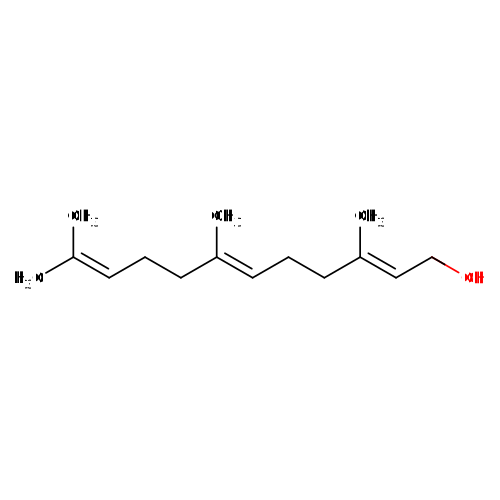
DescriptionFarnesol is a signaling molecule that is derived from farnesyl diphosphate, an intermediate in the isoprenoid/cholesterol biosynthetic pathway. Farnesol is a 15 carbon isoprenoid alcohol is the corresponding dephosphorylated form of the isoprenoid farnesyl diphosphate. Farnesol has a potential role in controlling the degradation of 3-hydroxy-3-methylglutaryl coenzyme A (HMGCoA) reductase (EC 1.1.1.34, NADPH-hydroxymethylglutaryl-CoA reductase). The enzyme is stabilized under conditions of cellular sterol depletion (e.g. statin-treated cells) and rapidly degraded in sterol-loaded cells. In mammalian cells, this enhanced degradation is dependent on the presence of both a sterol and a non-sterol derived from the isoprenoid pathway; farnesol, the dephosphorylated form of farnesyl diphosphate, can function as the non-sterol component. Farnesol has been shown to activate the farnesoid receptor (FXR), a nuclear receptor that forms a functional heterodimer with RXR. Thus, dephosphorylation of farnesyl diphosphate, an intermediate in the cholesterol synthetic pathway, might produce an active ligand for the FXR:RXR heterodimer. The physiological ligand for FXR remains to be identified; farnesol, may simply mimic the unidentified natural ligand(s). In addition, exogenous farnesol have an effect on several other physiological processes, including inhibition of phosphatidylcholine biosynthesis, induction of apoptosis, inhibition of cell cycle progression and actin cytoskeletal disorganization. Farnesol cellular availability is an important determinant of vascular tone in animals and humans, and provides a basis for exploring farnesyl metabolism in humans with compromised vascular function as well as for using farnesyl analogues as regulators of arterial tone in vivo. A possible metabolic fate for farnesol is its conversion to farnesoic acid, and then to farnesol-derived dicarboxylic acids (FDDCAs) which would then be excreted in the urine. Farnesol can also be oxidized to a prenyl aldehyde, presumably by an alcohol dehydrogenase (ADH), and that this activity resides in the mitochondrial and peroxisomal. Liver Endoplasmic reticulum and peroxisomal fractions are able to phosphorylate farnesol to Farnesyl diphosphate in a Cytosine triphosphate dependent fashion. (1, 2, 3, 4). Prenol is polymerized by dehydration reactions; when there are at least four isoprene units (n in the above formula is greater than or equal to four), the polymer is called a polyprenol. Polyprenols can contain up to 100 isoprene units (n=100) linked end to end with the hydroxyl group (-OH) remaining at the end. These isoprenoid alcohols are also called terpenols These isoprenoid alcohols are important in the acylation of proteins, carotenoids, and fat-soluble vitamins A, E and K. They are also building blocks for plant oils such as farnesol and geraniol. Prenol is also a building block of cholesterol (built from six isoprene units), and thus of all steroids. Prenol has sedative properities, it is probably GABA receptor allosteric modulator.When the isoprene unit attached to the alcohol is saturated, the compound is referred to as a dolichol. Dolichols are important as glycosyl carriers in the synthesis of polysaccharides.
Contaminant Sources
  • Cosmetic Chemicals
  • EAFUS Chemicals
  • FooDB Chemicals
  • HPV EPA Chemicals
  • STOFF IDENT Compounds
  • T3DB toxins
  • Tobacco Smoke Compounds
  • ToxCast & Tox21 Chemicals
Contaminant Type
  • Animal Toxin
  • Cigarette Toxin
  • Food Toxin
  • Household Toxin
  • Mammal Toxin
  • Metabolite
  • Natural Compound
  • Organic Compound
Chemical Structure
Thumb
Synonyms
ValueSource
(2-trans,6-trans)-3,7,11-Trimethyldodeca-2,6,10-trien-1-olChEBI
(2E,6E)-3,7,11-Trimethyl-2,6,10-dodecatrien-1-olChEBI
(2E,6E)-FarnesolChEBI
(e)-FarnesolChEBI
(e,e)-FarnesolChEBI
2-trans,6-trans-FarnesolChEBI
all-trans-FarnesolChEBI
trans,trans-alpha-FarnesolChEBI
trans,trans-FarnesolChEBI
trans-FarnesolChEBI
Ditrans,polycis-polyprenolKegg
trans,trans-a-FarnesolGenerator
trans,trans-Α-farnesolGenerator
2-cis,6-trans-FarnesolHMDB
3,7,11-Trimethyl-2,6,10-dodecatrien-1-olHMDB
Farnesyl alcoholHMDB
FCI 119aHMDB
NikkosomeHMDB
FarnesolMeSH
(E)-beta-FarnesolPhytoBank
(E)-β-FarnesolPhytoBank
(E,E)-3,7,11-Trimethyl-2,6,10-dodecatrien-1-olPhytoBank
(E,E)-Farnesyl alcoholPhytoBank
(t,t)-FarnesolPhytoBank
2,6-Di-trans-farnesolPhytoBank
2,6-trans,trans-FarnesolPhytoBank
3,7,11-Trimethyldodeca-2-trans,6-trans,10-trien-1-olPhytoBank
all-E-FarnesolPhytoBank
trans-1-Hydroxy-3,7,11-trimethyl-2,6,10-dodecatrienePhytoBank
trans-2,trans-6-FarnesolPhytoBank
3,7,11-Trimethyl-2,6,10-dodecen-1-olPhytoBank
Chemical FormulaC15H26O
Average Molecular Mass222.366 g/mol
Monoisotopic Mass222.198 g/mol
CAS Registry Number4602-84-0
IUPAC Name(2E,6E)-3,7,11-trimethyldodeca-2,6,10-trien-1-ol
Traditional Name(E)-farnesol
SMILESCC(C)=CCC\C(C)=C\CC\C(C)=C\CO
InChI IdentifierInChI=1S/C15H26O/c1-13(2)7-5-8-14(3)9-6-10-15(4)11-12-16/h7,9,11,16H,5-6,8,10,12H2,1-4H3/b14-9+,15-11+
InChI KeyCRDAMVZIKSXKFV-YFVJMOTDSA-N
Chemical Taxonomy
Description belongs to the class of organic compounds known as sesquiterpenoids. These are terpenes with three consecutive isoprene units.
KingdomOrganic compounds
Super ClassLipids and lipid-like molecules
ClassPrenol lipids
Sub ClassSesquiterpenoids
Direct ParentSesquiterpenoids
Alternative Parents
Substituents
  • Farsesane sesquiterpenoid
  • Sesquiterpenoid
  • Fatty alcohol
  • Fatty acyl
  • Organic oxygen compound
  • Hydrocarbon derivative
  • Primary alcohol
  • Organooxygen compound
  • Alcohol
  • Aliphatic acyclic compound
Molecular FrameworkAliphatic acyclic compounds
External Descriptors
Biological Properties
StatusDetected and Not Quantified
OriginEndogenous
Cellular Locations
  • Extracellular
  • Membrane
Biofluid LocationsNot Available
Tissue Locations
  • Epidermis
  • Fibroblasts
  • Intestine
  • Kidney
PathwaysNot Available
ApplicationsNot Available
Biological RolesNot Available
Chemical RolesNot Available
Physical Properties
StateSolid
AppearanceWhite powder.
Experimental Properties
PropertyValue
Melting Point< 25°C
Boiling Point111°C at 3.50E-01 mm Hg
SolubilityNot Available
Predicted Properties
PropertyValueSource
Water Solubility0.059 g/LALOGPS
logP4.84ALOGPS
logP4.16ChemAxon
logS-3.6ALOGPS
pKa (Strongest Acidic)16.33ChemAxon
pKa (Strongest Basic)-2.2ChemAxon
Physiological Charge0ChemAxon
Hydrogen Acceptor Count1ChemAxon
Hydrogen Donor Count1ChemAxon
Polar Surface Area20.23 ŲChemAxon
Rotatable Bond Count7ChemAxon
Refractivity74.98 m³·mol⁻¹ChemAxon
Polarizability28.7 ųChemAxon
Number of Rings0ChemAxon
Bioavailability1ChemAxon
Rule of FiveYesChemAxon
Ghose FilterYesChemAxon
Veber's RuleYesChemAxon
MDDR-like RuleNoChemAxon
Spectra
Spectra
Spectrum TypeDescriptionSplash KeyView
GC-MSGC-MS Spectrum - GC-MS (1 TMS)splash10-000x-9800000000-0366097ae9a2af6bafceSpectrum
GC-MSGC-MS Spectrum - GC-MS (1 TMS)splash10-001l-9800000000-eec57a93bb5862e554f1Spectrum
GC-MSGC-MS Spectrum - GC-MS (1 TMS)splash10-000x-8900000000-9c20df8f2d1959c137d7Spectrum
GC-MSGC-MS Spectrum - GC-MS (Non-derivatized)splash10-000x-9800000000-0366097ae9a2af6bafceSpectrum
GC-MSGC-MS Spectrum - GC-MS (Non-derivatized)splash10-001l-9800000000-eec57a93bb5862e554f1Spectrum
GC-MSGC-MS Spectrum - GC-MS (Non-derivatized)splash10-000x-8900000000-9c20df8f2d1959c137d7Spectrum
Predicted GC-MSPredicted GC-MS Spectrum - GC-MS (Non-derivatized) - 70eV, Positivesplash10-0a4u-9830000000-5e08d59a4cc2e87c9984Spectrum
Predicted GC-MSPredicted GC-MS Spectrum - GC-MS (1 TMS) - 70eV, Positivesplash10-05xr-9860000000-2eeca721058a47519afdSpectrum
Predicted GC-MSPredicted GC-MS Spectrum - GC-MS (Non-derivatized) - 70eV, PositiveNot AvailableSpectrum
LC-MS/MSLC-MS/MS Spectrum - Linear Ion Trap , positivesplash10-003u-0790000000-578343425424f42c9d58Spectrum
Predicted LC-MS/MSPredicted LC-MS/MS Spectrum - 10V, Positivesplash10-0ab9-1590000000-88a1356fe7cab3171954Spectrum
Predicted LC-MS/MSPredicted LC-MS/MS Spectrum - 20V, Positivesplash10-0avi-7930000000-81c18181dbd66735216aSpectrum
Predicted LC-MS/MSPredicted LC-MS/MS Spectrum - 40V, Positivesplash10-0gi0-9400000000-e44ecbea8a96f84abd43Spectrum
Predicted LC-MS/MSPredicted LC-MS/MS Spectrum - 10V, Negativesplash10-00di-0390000000-9beef594142e0da5de92Spectrum
Predicted LC-MS/MSPredicted LC-MS/MS Spectrum - 20V, Negativesplash10-006x-1980000000-3b9708ac6185abaf6d96Spectrum
Predicted LC-MS/MSPredicted LC-MS/MS Spectrum - 40V, Negativesplash10-05bf-4910000000-a8db2089f5647c8532adSpectrum
Predicted LC-MS/MSPredicted LC-MS/MS Spectrum - 10V, Negativesplash10-00di-0090000000-ab61d8a2af41e6ed2e49Spectrum
Predicted LC-MS/MSPredicted LC-MS/MS Spectrum - 20V, Negativesplash10-00di-0690000000-8a43271c10743cad1e3eSpectrum
Predicted LC-MS/MSPredicted LC-MS/MS Spectrum - 40V, Negativesplash10-00l2-4900000000-7dcaa3b1e66cfbe960c9Spectrum
Predicted LC-MS/MSPredicted LC-MS/MS Spectrum - 10V, Positivesplash10-05gi-5930000000-9f54facb49232e1c6a46Spectrum
Predicted LC-MS/MSPredicted LC-MS/MS Spectrum - 20V, Positivesplash10-05o0-9600000000-55d109ed92e3da30c7eaSpectrum
Predicted LC-MS/MSPredicted LC-MS/MS Spectrum - 40V, Positivesplash10-00l6-9100000000-bcc664ee21d185da076eSpectrum
MSMass Spectrum (Electron Ionization)splash10-014l-9200000000-8e5fae6943a545e4bc0bSpectrum
1D NMR13C NMR SpectrumNot AvailableSpectrum
1D NMR1H NMR SpectrumNot AvailableSpectrum
1D NMR13C NMR SpectrumNot AvailableSpectrum
1D NMR1H NMR SpectrumNot AvailableSpectrum
1D NMR13C NMR SpectrumNot AvailableSpectrum
1D NMR1H NMR SpectrumNot AvailableSpectrum
1D NMR13C NMR SpectrumNot AvailableSpectrum
1D NMR1H NMR SpectrumNot AvailableSpectrum
1D NMR13C NMR SpectrumNot AvailableSpectrum
1D NMR1H NMR SpectrumNot AvailableSpectrum
1D NMR13C NMR SpectrumNot AvailableSpectrum
1D NMR1H NMR SpectrumNot AvailableSpectrum
1D NMR13C NMR SpectrumNot AvailableSpectrum
1D NMR1H NMR SpectrumNot AvailableSpectrum
1D NMR13C NMR SpectrumNot AvailableSpectrum
1D NMR1H NMR SpectrumNot AvailableSpectrum
1D NMR13C NMR SpectrumNot AvailableSpectrum
1D NMR1H NMR SpectrumNot AvailableSpectrum
1D NMR13C NMR SpectrumNot AvailableSpectrum
1D NMR1H NMR SpectrumNot AvailableSpectrum
Toxicity Profile
Route of ExposureNot Available
Mechanism of ToxicityNot Available
MetabolismNot Available
Toxicity ValuesNot Available
Lethal DoseNot Available
Carcinogenicity (IARC Classification)No indication of carcinogenicity to humans (not listed by IARC).
Uses/SourcesThis is an endogenously produced metabolite found in the human body. It is used in metabolic reactions, catabolic reactions or waste generation.
Minimum Risk LevelNot Available
Health EffectsNot Available
SymptomsNot Available
TreatmentNot Available
Concentrations
Not Available
DrugBank IDNot Available
HMDB IDHMDB0004305
FooDB IDFDB014891
Phenol Explorer IDNot Available
KNApSAcK IDC00003132
BiGG IDNot Available
BioCyc ID2-TRANS6-TRANS-FARNESOL
METLIN ID7048
PDB IDNot Available
Wikipedia LinkFarnesol
Chemspider ID392816
ChEBI ID16619
PubChem Compound ID445070
Kegg Compound IDC06081
YMDB IDYMDB00404
ECMDB IDNot Available
References
Synthesis Reference

James Millis, “Production of farnesol and geranylgeraniol.” U.S. Patent US20030092144, issued May 15, 2003.

MSDSLink
General References
1. Imai, Kunio; Marumo, Shingo. Stereochemistry of C-1 hydrogen exchange during 2,3-double bond trans-cis isomerization of farnesol by Helminthosporium sativum. Tetrahedron Letters (1974), (49/50), 4401-4.
2. Imai, Kunio; Marumo, Shingo. Stereochemistry of C-1 hydrogen exchange during 2,3-double bond trans-cis isomerization of farnesol by Helminthosporium sativum. Tetrahedron Letters (1974), (49/50), 4401-4.
3. Horn TL, Long L, Cwik MJ, Morrissey RL, Kapetanovic IM, McCormick DL: Modulation of hepatic and renal drug metabolizing enzyme activities in rats by subchronic administration of farnesol. Chem Biol Interact. 2005 Apr 15;152(2-3):79-99.
4. Hanley K, Wood L, Ng DC, He SS, Lau P, Moser A, Elias PM, Bikle DD, Williams ML, Feingold KR: Cholesterol sulfate stimulates involucrin transcription in keratinocytes by increasing Fra-1, Fra-2, and Jun D. J Lipid Res. 2001 Mar;42(3):390-8.
5. DeBarber AE, Bleyle LA, Roullet JB, Koop DR: Omega-hydroxylation of farnesol by mammalian cytochromes p450. Biochim Biophys Acta. 2004 Jun 1;1682(1-3):18-27.
6. Saidi S, Luitaud C, Rouabhia M: In vitro synergistic effect of farnesol and human gingival cells against Candida albicans. Yeast. 2006 Jul 15;23(9):673-87.
7. Hanley K, Komuves LG, Ng DC, Schoonjans K, He SS, Lau P, Bikle DD, Williams ML, Elias PM, Auwerx J, Feingold KR: Farnesol stimulates differentiation in epidermal keratinocytes via PPARalpha. J Biol Chem. 2000 Apr 14;275(15):11484-91.
8. Forman BM, Goode E, Chen J, Oro AE, Bradley DJ, Perlmann T, Noonan DJ, Burka LT, McMorris T, Lamph WW, Evans RM, Weinberger C: Identification of a nuclear receptor that is activated by farnesol metabolites. Cell. 1995 Jun 2;81(5):687-93.
9. Staines AG, Sindelar P, Coughtrie MW, Burchell B: Farnesol is glucuronidated in human liver, kidney and intestine in vitro, and is a novel substrate for UGT2B7 and UGT1A1. Biochem J. 2004 Dec 15;384(Pt 3):637-45.
10. Fayard E, Schoonjans K, Auwerx J: Xol INXS: role of the liver X and the farnesol X receptors. Curr Opin Lipidol. 2001 Apr;12(2):113-20.
11. Edwards PA, Ericsson J: Signaling molecules derived from the cholesterol biosynthetic pathway: mechanisms of action and possible roles in human disease. Curr Opin Lipidol. 1998 Oct;9(5):433-40.
12. Roullet JB, Xue H, Chapman J, McDougal P, Roullet CM, McCarron DA: Farnesyl analogues inhibit vasoconstriction in animal and human arteries. J Clin Invest. 1996 May 15;97(10):2384-90.
13. Bostedor RG, Karkas JD, Arison BH, Bansal VS, Vaidya S, Germershausen JI, Kurtz MM, Bergstrom JD: Farnesol-derived dicarboxylic acids in the urine of animals treated with zaragozic acid A or with farnesol. J Biol Chem. 1997 Apr 4;272(14):9197-203.
14. Westfall D, Aboushadi N, Shackelford JE, Krisans SK: Metabolism of farnesol: phosphorylation of farnesol by rat liver microsomal and peroxisomal fractions. Biochem Biophys Res Commun. 1997 Jan 23;230(3):562-8.