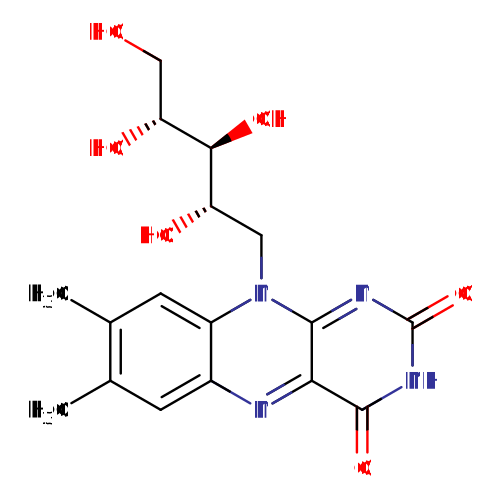
Record Information
Version1.0
Creation Date2014-09-11 05:17:53 UTC
Update Date2026-03-27 01:46:13 UTC
Accession NumberCHEM003774
Identification
Common NameRiboflavin
ClassSmall Molecule
DescriptionNutritional factor found in milk, eggs, malted barley, liver, kidney, heart, and leafy vegetables. The richest natural source is yeast. It occurs in the free form only in the retina of the eye, in whey, and in urine; its principal forms in tissues and cells are as flavin mononucleotide and flavin-adenine dinucleotide.
Contaminant Sources
  • Cosmetic Chemicals
  • EAFUS Chemicals
  • FooDB Chemicals
  • HMDB Contaminants - Urine
  • STOFF IDENT Compounds
  • T3DB toxins
  • ToxCast & Tox21 Chemicals
Contaminant Type
  • Amide
  • Drug
  • Food Toxin
  • Metabolite
  • Natural Compound
  • Nutraceutical
  • Organic Compound
  • Photosensitizing Agent
  • Plant Toxin
  • Vitamin B Complex
Chemical Structure
Thumb
Synonyms
ValueSource
1-Deoxy-1-(7,8-dimethyl-2,4-dioxo-3,4-dihydrobenzo[g]pteridin-10(2H)-yl)pentitolChEBI
6,7-Dimethyl-9-D-ribitylisoalloxazineChEBI
7,8-Dimethyl-10-(D-ribo-2,3,4,5-tetrahydroxypentyl)benzo[g]pteridine-2,4(3H,10H)-dioneChEBI
7,8-Dimethyl-10-(D-ribo-2,3,4,5-tetrahydroxypentyl)isoalloxazineChEBI
7,8-Dimethyl-10-ribitylisoalloxazineChEBI
e101ChEBI
LactoflavinChEBI
RiboflavinaChEBI
RIBOFLAVINEChEBI
RiboflavinumChEBI
Vitamin b2ChEBI
Vitamin gChEBI
BisulaseKegg
(-)-RiboflavinHMDB
1-Deoxy-1-(3,4-dihydro-7,8-dimethyl-2,4-dioxobenzo[g]pteridin-10(2H)-yl)-D-ribitolHMDB
6,7-Dimethyl-9-ribitylisoalloxazineHMDB
7,8-Dimethyl-10-(D-ribo-2,3,4,5-tetrahydroxypentyl)-benzo[g]pteridine-2,4(3H,10H)-dioneHMDB
BeflavinHMDB
BeflavineHMDB
Benzo[g]pteridine riboflavin deriv.HMDB
e 101HMDB
FlavaxinHMDB
Flavin BBHMDB
FlaxainHMDB
FOOD Yellow 15HMDB
HyreHMDB
LactobeneHMDB
LactoflavineHMDB
RibipcaHMDB
RibocrisinaHMDB
RibodermHMDB
RibosynHMDB
RibotoneHMDB
RibovelHMDB
Russupteridine yellow IIIHMDB
San yellow bHMDB
VitaflavineHMDB
Vitasan b2HMDB
Vitamin b 2HMDB
Chemical FormulaC17H20N4O6
Average Molecular Mass376.364 g/mol
Monoisotopic Mass376.138 g/mol
CAS Registry Number83-88-5
IUPAC Name7,8-dimethyl-10-[(2S,3S,4R)-2,3,4,5-tetrahydroxypentyl]-2H,3H,4H,10H-benzo[g]pteridine-2,4-dione
Traditional Nameriboflavin
SMILESCC1=C(C)C=C2N(C[C@H](O)[C@H](O)[C@H](O)CO)C3=NC(=O)NC(=O)C3=NC2=C1
InChI IdentifierInChI=1S/C17H20N4O6/c1-7-3-9-10(4-8(7)2)21(5-11(23)14(25)12(24)6-22)15-13(18-9)16(26)20-17(27)19-15/h3-4,11-12,14,22-25H,5-6H2,1-2H3,(H,20,26,27)/t11-,12+,14-/m0/s1
InChI KeyAUNGANRZJHBGPY-SCRDCRAPSA-N
Chemical Taxonomy
Description belongs to the class of organic compounds known as flavins. Flavins are compounds containing a flavin (7,8-dimethyl-benzo[g]pteridine-2,4-dione) moiety, with a structure characterized by an isoalloaxzine tricyclic ring.
KingdomOrganic compounds
Super ClassOrganoheterocyclic compounds
ClassPteridines and derivatives
Sub ClassAlloxazines and isoalloxazines
Direct ParentFlavins
Alternative Parents
Substituents
  • Flavin
  • Diazanaphthalene
  • Quinoxaline
  • Pyrimidone
  • Pyrazine
  • Pyrimidine
  • Benzenoid
  • Heteroaromatic compound
  • Vinylogous amide
  • Secondary alcohol
  • Lactam
  • Polyol
  • Azacycle
  • Alcohol
  • Hydrocarbon derivative
  • Organic oxide
  • Organopnictogen compound
  • Organic oxygen compound
  • Primary alcohol
  • Organooxygen compound
  • Organonitrogen compound
  • Organic nitrogen compound
  • Aromatic heteropolycyclic compound
Molecular FrameworkAromatic heteropolycyclic compounds
External Descriptors
Biological Properties
StatusDetected and Not Quantified
OriginEndogenous
Cellular Locations
  • Cytoplasm
  • Extracellular
Biofluid LocationsNot Available
Tissue Locations
  • Erythrocyte
  • Heart
  • Kidney
  • Liver
  • Prostate
Pathways
NameSMPDB LinkKEGG Link
Riboflavin MetabolismSMP00070 map00740
ApplicationsNot Available
Biological RolesNot Available
Chemical RolesNot Available
Physical Properties
StateSolid
AppearanceWhite powder.
Experimental Properties
PropertyValue
Melting Point280 dec°C
Boiling PointNot Available
Solubility84.7 mg/L (at 25°C)
Predicted Properties
PropertyValueSource
Water Solubility0.66 g/LALOGPS
logP-1ALOGPS
logP-0.92ChemAxon
logS-2.8ALOGPS
pKa (Strongest Acidic)5.97ChemAxon
pKa (Strongest Basic)-2.6ChemAxon
Physiological Charge-1ChemAxon
Hydrogen Acceptor Count9ChemAxon
Hydrogen Donor Count5ChemAxon
Polar Surface Area155.05 ŲChemAxon
Rotatable Bond Count5ChemAxon
Refractivity96.27 m³·mol⁻¹ChemAxon
Polarizability37.51 ųChemAxon
Number of Rings3ChemAxon
Bioavailability1ChemAxon
Rule of FiveYesChemAxon
Ghose FilterNoChemAxon
Veber's RuleNoChemAxon
MDDR-like RuleNoChemAxon
Spectra
Spectra
Spectrum TypeDescriptionSplash KeyView
GC-MSGC-MS Spectrum - EI-B (Non-derivatized)splash10-006x-4980000000-dd278a577316361d270aSpectrum
Predicted GC-MSPredicted GC-MS Spectrum - GC-MS (Non-derivatized) - 70eV, Positivesplash10-0btc-9014000000-75f046dc3c6cb008690eSpectrum
Predicted GC-MSPredicted GC-MS Spectrum - GC-MS (4 TMS) - 70eV, Positivesplash10-0zfs-5146149000-f9db57dd1ccd4a014604Spectrum
Predicted GC-MSPredicted GC-MS Spectrum - GC-MS (Non-derivatized) - 70eV, PositiveNot AvailableSpectrum
Predicted GC-MSPredicted GC-MS Spectrum - GC-MS (TMS_1_1) - 70eV, PositiveNot AvailableSpectrum
Predicted GC-MSPredicted GC-MS Spectrum - GC-MS (TMS_1_2) - 70eV, PositiveNot AvailableSpectrum
Predicted GC-MSPredicted GC-MS Spectrum - GC-MS (TMS_1_3) - 70eV, PositiveNot AvailableSpectrum
Predicted GC-MSPredicted GC-MS Spectrum - GC-MS (TMS_1_4) - 70eV, PositiveNot AvailableSpectrum
Predicted GC-MSPredicted GC-MS Spectrum - GC-MS (TMS_1_5) - 70eV, PositiveNot AvailableSpectrum
Predicted GC-MSPredicted GC-MS Spectrum - GC-MS (TMS_2_1) - 70eV, PositiveNot AvailableSpectrum
Predicted GC-MSPredicted GC-MS Spectrum - GC-MS (TMS_2_2) - 70eV, PositiveNot AvailableSpectrum
Predicted GC-MSPredicted GC-MS Spectrum - GC-MS (TMS_2_3) - 70eV, PositiveNot AvailableSpectrum
Predicted GC-MSPredicted GC-MS Spectrum - GC-MS (TMS_2_4) - 70eV, PositiveNot AvailableSpectrum
Predicted GC-MSPredicted GC-MS Spectrum - GC-MS (TMS_2_5) - 70eV, PositiveNot AvailableSpectrum
Predicted GC-MSPredicted GC-MS Spectrum - GC-MS (TMS_2_6) - 70eV, PositiveNot AvailableSpectrum
Predicted GC-MSPredicted GC-MS Spectrum - GC-MS (TMS_2_7) - 70eV, PositiveNot AvailableSpectrum
Predicted GC-MSPredicted GC-MS Spectrum - GC-MS (TMS_2_8) - 70eV, PositiveNot AvailableSpectrum
Predicted GC-MSPredicted GC-MS Spectrum - GC-MS (TMS_2_9) - 70eV, PositiveNot AvailableSpectrum
Predicted GC-MSPredicted GC-MS Spectrum - GC-MS (TMS_2_10) - 70eV, PositiveNot AvailableSpectrum
Predicted GC-MSPredicted GC-MS Spectrum - GC-MS (TMS_3_1) - 70eV, PositiveNot AvailableSpectrum
Predicted GC-MSPredicted GC-MS Spectrum - GC-MS (TMS_3_2) - 70eV, PositiveNot AvailableSpectrum
Predicted GC-MSPredicted GC-MS Spectrum - GC-MS (TMS_3_3) - 70eV, PositiveNot AvailableSpectrum
Predicted GC-MSPredicted GC-MS Spectrum - GC-MS (TMS_3_4) - 70eV, PositiveNot AvailableSpectrum
Predicted GC-MSPredicted GC-MS Spectrum - GC-MS (TMS_3_5) - 70eV, PositiveNot AvailableSpectrum
LC-MS/MSLC-MS/MS Spectrum - Quattro_QQQ 10V, Positive (Annotated)splash10-004i-0019000000-86365dedafa031aa7787Spectrum
LC-MS/MSLC-MS/MS Spectrum - Quattro_QQQ 25V, Positive (Annotated)splash10-0006-4390000000-ac1b59ab7cc2209f4241Spectrum
LC-MS/MSLC-MS/MS Spectrum - Quattro_QQQ 40V, Positive (Annotated)splash10-00dj-4900000000-72d33eb27b9bd6a13d9eSpectrum
LC-MS/MSLC-MS/MS Spectrum - LC-ESI-QTOF (UPLC Q-Tof Premier, Waters) , Positivesplash10-004l-0569000000-874b71fdc78d04853bf0Spectrum
LC-MS/MSLC-MS/MS Spectrum - LC-ESI-QTOF (UPLC Q-Tof Premier, Waters) , Negativesplash10-0a4i-0091000000-a82c54d3153103fcdb1fSpectrum
LC-MS/MSLC-MS/MS Spectrum - LC-ESI-qTof , Positivesplash10-004i-0239000000-659ca9fae9643f3ce73dSpectrum
LC-MS/MSLC-MS/MS Spectrum - LC-ESI-QTOF , negativesplash10-0a4i-0091000000-a82c54d3153103fcdb1fSpectrum
LC-MS/MSLC-MS/MS Spectrum - Linear Ion Trap , negativesplash10-0a4i-0090000000-2aff124ee1fc62c13844Spectrum
LC-MS/MSLC-MS/MS Spectrum - Linear Ion Trap , negativesplash10-0a4i-0090000000-f8b29c3e2c601a944a6cSpectrum
LC-MS/MSLC-MS/MS Spectrum - Linear Ion Trap , negativesplash10-0a4i-0090000000-4e8c9bd38ea0f5ae9a94Spectrum
LC-MS/MSLC-MS/MS Spectrum - LC-ESI-QTOF , positivesplash10-004l-0569000000-874b71fdc78d04853bf0Spectrum
LC-MS/MSLC-MS/MS Spectrum - Linear Ion Trap , positivesplash10-0006-0092000000-1f1be5508c1d50d8dff7Spectrum
LC-MS/MSLC-MS/MS Spectrum - Linear Ion Trap , positivesplash10-0006-0092000000-74bf0b86efe72fe37198Spectrum
LC-MS/MSLC-MS/MS Spectrum - Linear Ion Trap , positivesplash10-057i-0069000000-bb0522be4472e049dbc5Spectrum
LC-MS/MSLC-MS/MS Spectrum - Linear Ion Trap , positivesplash10-057i-0069000000-208440cf501d0b9050d7Spectrum
LC-MS/MSLC-MS/MS Spectrum - Linear Ion Trap , positivesplash10-006x-0029000000-8c3d72bf2a06d79bbd31Spectrum
LC-MS/MSLC-MS/MS Spectrum - Linear Ion Trap , positivesplash10-006x-0039000000-7d8dc991995cfc262ad1Spectrum
LC-MS/MSLC-MS/MS Spectrum - Linear Ion Trap , positivesplash10-0006-0092000000-4f524f1e6c8131751c92Spectrum
LC-MS/MSLC-MS/MS Spectrum - Linear Ion Trap , positivesplash10-0560-0069000000-edc332be3fcbf6d0c14bSpectrum
Predicted LC-MS/MSPredicted LC-MS/MS Spectrum - 10V, Positivesplash10-0a6r-1029000000-cb7561783d706b360970Spectrum
Predicted LC-MS/MSPredicted LC-MS/MS Spectrum - 20V, Positivesplash10-0bt9-4092000000-a884c2c509c2da1c9005Spectrum
Predicted LC-MS/MSPredicted LC-MS/MS Spectrum - 40V, Positivesplash10-0a6r-1190000000-1d77df8220a965f08454Spectrum
Predicted LC-MS/MSPredicted LC-MS/MS Spectrum - 10V, Negativesplash10-007o-9068000000-99f78bac6ce18b370145Spectrum
Predicted LC-MS/MSPredicted LC-MS/MS Spectrum - 20V, Negativesplash10-0006-9141000000-70e4d57c08631d27b93dSpectrum
Predicted LC-MS/MSPredicted LC-MS/MS Spectrum - 40V, Negativesplash10-0006-9220000000-ddd6caad2f26c593ced0Spectrum
1D NMR1H NMR SpectrumNot AvailableSpectrum
1D NMR13C NMR SpectrumNot AvailableSpectrum
1D NMR1H NMR SpectrumNot AvailableSpectrum
1D NMR13C NMR SpectrumNot AvailableSpectrum
1D NMR1H NMR SpectrumNot AvailableSpectrum
1D NMR13C NMR SpectrumNot AvailableSpectrum
1D NMR1H NMR SpectrumNot AvailableSpectrum
1D NMR13C NMR SpectrumNot AvailableSpectrum
1D NMR1H NMR SpectrumNot AvailableSpectrum
1D NMR13C NMR SpectrumNot AvailableSpectrum
1D NMR1H NMR SpectrumNot AvailableSpectrum
1D NMR13C NMR SpectrumNot AvailableSpectrum
1D NMR1H NMR SpectrumNot AvailableSpectrum
1D NMR13C NMR SpectrumNot AvailableSpectrum
1D NMR1H NMR SpectrumNot AvailableSpectrum
1D NMR13C NMR SpectrumNot AvailableSpectrum
1D NMR1H NMR SpectrumNot AvailableSpectrum
1D NMR13C NMR SpectrumNot AvailableSpectrum
1D NMR1H NMR SpectrumNot AvailableSpectrum
1D NMR13C NMR SpectrumNot AvailableSpectrum
1D NMR1H NMR SpectrumNot AvailableSpectrum
2D NMR[1H,13C] 2D NMR SpectrumNot AvailableSpectrum
Toxicity Profile
Route of ExposureVitamin B2 is readily absorbed from the upper gastrointestinal tract.
Mechanism of ToxicityBinds to riboflavin hydrogenase, riboflavin kinase, and riboflavin synthase. Riboflavin is the precursor of flavin mononucleotide (FMN, riboflavin monophosphate) and flavin adenine dinucleotide (FAD). The antioxidant activity of riboflavin is principally derived from its role as a precursor of FAD and the role of this cofactor in the production of the antioxidant reduced glutathione. Reduced glutathione is the cofactor of the selenium-containing glutathione peroxidases among other things. The glutathione peroxidases are major antioxidant enzymes. Reduced glutathione is generated by the FAD-containing enzyme glutathione reductase.
MetabolismHepatic. Half Life: 66-84 minutes
Toxicity ValuesNot Available
Lethal DoseNot Available
Carcinogenicity (IARC Classification)No indication of carcinogenicity to humans (not listed by IARC).
Uses/SourcesFor the treatment of ariboflavinosis (vitamin B2 deficiency).
Minimum Risk LevelNot Available
Health EffectsNot Available
SymptomsNot Available
TreatmentNot Available
Concentrations
Not Available
DrugBank IDDB00140
HMDB IDHMDB0000244
FooDB IDFDB012160
Phenol Explorer IDNot Available
KNApSAcK IDC00001552
BiGG IDNot Available
BioCyc IDRIBOFLAVIN
METLIN IDNot Available
PDB IDNot Available
Wikipedia LinkRiboflavin
Chemspider ID431981
ChEBI ID17015
PubChem Compound ID493570
Kegg Compound IDC00255
YMDB IDYMDB00534
ECMDB IDECMDB00244
References
Synthesis Reference

Hansgeorg Ernst, Wolfram Schmidt, Joachim Paust, “Preparation of riboflavin.” U.S. Patent US4567261, issued August, 1958.

MSDSLink
General References
1. https://www.ncbi.nlm.nih.gov/pubmed/?term=16658098
2. https://www.ncbi.nlm.nih.gov/pubmed/?term=22770225
3. https://www.ncbi.nlm.nih.gov/pubmed/?term=24643482
4. https://www.ncbi.nlm.nih.gov/pubmed/?term=25108762
5. Tishler, Max; Pfister, Karl, III; Babson, R. D.; Ladenburg, Kurt; Fleming, Ann J. Reaction between o-aminoazo compounds and barbituric acid. A new synthesis of riboflavin. Journal of the American Chemical Society (1947), 69 1487-92.
6. Agostini TS, Scherer R, Godoy HT: Simultaneous determination of B-group vitamins in enriched Brazilian dairy products. Crit Rev Food Sci Nutr. 2007;47(5):435-9. doi: 10.1080/10408390600846309.
7. Gaucheron F: Milk and dairy products: a unique micronutrient combination. J Am Coll Nutr. 2011 Oct;30(5 Suppl 1):400S-9S.
8. Park, Y. W; Juárez, Manuela ; Ramos, M.; Haenlein, G. F. W.. Physico-chemical characteristics of goat and sheep milk. Small Ruminant Res.(2007) 68:88-113 doi: 10.1016/j.smallrumres.2006.09.013
9. A. Foroutan et al. The Chemical Composition of Commercial Cow's Milk (in preparation)
10. USDA Food Composition Databases: https://ndb.nal.usda.gov/ndb/
11. Fooddata+, The Technical University of Denmark (DTU): https://frida.fooddata.dk/QueryFood.php?fn=milk&lang=en
12. Tishler, Max; Pfister, Karl, III; Babson, R. D.; Ladenburg, Kurt; Fleming, Ann J. Reaction between o-aminoazo compounds and barbituric acid. A new synthesis of riboflavin. Journal of the American Chemical Society (1947), 69 1487-92.
13. Mathew JL, Kabi BC, Rath B: Anti-oxidant vitamins and steroid responsive nephrotic syndrome in Indian children. J Paediatr Child Health. 2002 Oct;38(5):450-37.
14. Booth CK, Clark T, Fenn A: Folic acid, riboflavin, thiamine, and vitamin B-6 status of a group of first-time blood donors. Am J Clin Nutr. 1998 Nov;68(5):1075-80.
15. Boisvert WA, Mendoza I, Castaneda C, De Portocarrero L, Solomons NW, Gershoff SN, Russell RM: Riboflavin requirement of healthy elderly humans and its relationship to macronutrient composition of the diet. J Nutr. 1993 May;123(5):915-25.
16. Mikalunas V, Fitzgerald K, Rubin H, McCarthy R, Craig RM: Abnormal vitamin levels in patients receiving home total parenteral nutrition. J Clin Gastroenterol. 2001 Nov-Dec;33(5):393-6.
17. Belko AZ, Obarzanek E, Roach R, Rotter M, Urban G, Weinberg S, Roe DA: Effects of aerobic exercise and weight loss on riboflavin requirements of moderately obese, marginally deficient young women. Am J Clin Nutr. 1984 Sep;40(3):553-61.
18. Alexander M, Emanuel G, Golin T, Pinto JT, Rivlin RS: Relation of riboflavin nutriture in healthy elderly to intake of calcium and vitamin supplements: evidence against riboflavin supplementation. Am J Clin Nutr. 1984 Apr;39(4):540-6.
19. Baeckert PA, Greene HL, Fritz I, Oelberg DG, Adcock EW: Vitamin concentrations in very low birth weight infants given vitamins intravenously in a lipid emulsion: measurement of vitamins A, D, and E and riboflavin. J Pediatr. 1988 Dec;113(6):1057-65.
20. Maiani G, Mobarhan S, Nicastro A, Virgili F, Scaccini C, Ferro-Luzzi A: [Determination of glutathione reductase activity in erythrocytes and whole blood as an indicator of riboflavin nutrition]. Acta Vitaminol Enzymol. 1983;5(3):171-8.
21. Bamji MS, Bhaskaram P, Jacob CM: Urinary riboflavin excretion and erythrocyte glutathione reductase activity in preschool children suffering from upper respiratory infections and measles. Ann Nutr Metab. 1987;31(3):191-6.
22. Ajayi OA: Bioavailability of riboflavin from fortified palm juice. Plant Foods Hum Nutr. 1989 Dec;39(4):375-80.
23. Kodentsova VM, Vrzhesinskaya OA, Spirichev VB: Fluorometric riboflavin titration in plasma by riboflavin-binding apoprotein as a method for vitamin B2 status assessment. Ann Nutr Metab. 1995;39(6):355-60.
24. Bates CJ, Powers HJ: A simple fluorimetric assay for pyridoxamine phosphate oxidase in erythrocyte haemolysates: effects of riboflavin supplementation and of glucose 6-phosphate dehydrogenase deficiency. Hum Nutr Clin Nutr. 1985 Mar;39(2):107-15.
25. Brun TA, Chen J, Campbell TC, Boreham J, Feng Z, Parpia B, Shen TF, Li M: Urinary riboflavin excretion after a load test in rural China as a measure of possible riboflavin deficiency. Eur J Clin Nutr. 1990 Mar;44(3):195-206.
26. Mulherin DM, Thurnham DI, Situnayake RD: Glutathione reductase activity, riboflavin status, and disease activity in rheumatoid arthritis. Ann Rheum Dis. 1996 Nov;55(11):837-40.
27. Rao PN, Levine E, Myers MO, Prakash V, Watson J, Stolier A, Kopicko JJ, Kissinger P, Raj SG, Raj MH: Elevation of serum riboflavin carrier protein in breast cancer. Cancer Epidemiol Biomarkers Prev. 1999 Nov;8(11):985-90.
28. Zhou X, Huang C, Hong J, Yao S: [Nested case-control study on riboflavin levels in blood and urine and the risk of lung cancer]. Wei Sheng Yan Jiu. 2003 Nov;32(6):597-8, 601.
29. Thurnham DI, Zheng SF, Munoz N, Crespi M, Grassi A, Hambidge KM, Chai TF: Comparison of riboflavin, vitamin A, and zinc status of Chinese populations at high and low risk for esophageal cancer. Nutr Cancer. 1985;7(3):131-43.
30. Bates CJ, Prentice AM, Paul AA, Prentice A, Sutcliffe BA, Whitehead RG: Riboflavin status in infants born in rural Gambia, and the effect of a weaning food supplement. Trans R Soc Trop Med Hyg. 1982;76(2):253-8.
31. Dror Y, Stern F, Komarnitsky M: Optimal and stable conditions for the determination of erythrocyte glutathione reductase activation coefficient to evaluate riboflavin status. Int J Vitam Nutr Res. 1994;64(4):257-62.
32. Switzer BR, Stark AH, Atwood JR, Ritenbaugh C, Travis RG, Wu HM: Development of a urinary riboflavin adherence marker for a wheat bran fiber community intervention trial. Cancer Epidemiol Biomarkers Prev. 1997 Jun;6(6):439-42.
33. Sreekumar A, Poisson LM, Rajendiran TM, Khan AP, Cao Q, Yu J, Laxman B, Mehra R, Lonigro RJ, Li Y, Nyati MK, Ahsan A, Kalyana-Sundaram S, Han B, Cao X, Byun J, Omenn GS, Ghosh D, Pennathur S, Alexander DC, Berger A, Shuster JR, Wei JT, Varambally S, Beecher C, Chinnaiyan AM: Metabolomic profiles delineate potential role for sarcosine in prostate cancer progression. Nature. 2009 Feb 12;457(7231):910-4. doi: 10.1038/nature07762.
34. Zempleni J, Galloway JR, McCormick DB: Pharmacokinetics of orally and intravenously administered riboflavin in healthy humans. Am J Clin Nutr. 1996 Jan;63(1):54-66.