Record Information
Version1.0
Creation Date2014-09-11 05:18:34 UTC
Update Date2026-04-16 21:03:43 UTC
Accession NumberCHEM003792
Identification
Common Name4-Nonylphenol
ClassSmall Molecule
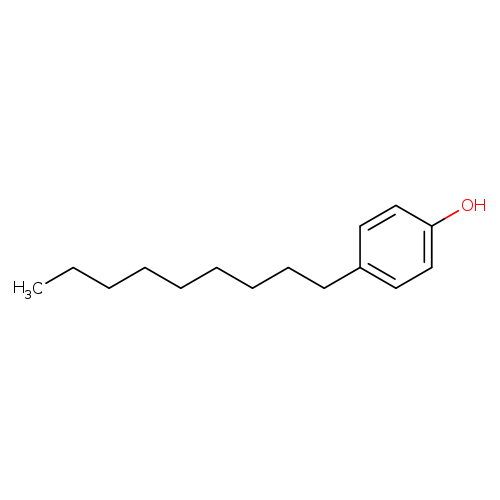
DescriptionEnvironmental pollutant arising from the degradation of nonionic surfactants in sewage Nonoxynol-9, one of the APEs, is used as a surfactant in cleaning and cosmetic products, and as a spermicide in contraceptives. Nonylphenol is an organic compound of the wider family of alkylphenols. It is a product of industrial synthesis formed during the alkylation process of phenols, particularly in the synthesis of polyethoxylate detergents. Because of their man-made origins, nonylphenols are classified as xenobiotics. In nonylphenols, a hydrocarbon chain of nine carbon atoms is attached to the phenol ring in either the ortho (2), meta (3), or para (4) position, with the most common ring isomers being ortho or para (e.g. figure 1 para-nonylphenol). Moreover, the alkyl chains can exist as either linear n-alkyl chains, or complex branched chains. Nonylphenol is commonly obtained as a mixture of isomers, and is thus usually found as a pale yellow liquid at room temperature with a freezing point of -10°C and a boiling point of 295-320°C. However, pure isomers of nonylphenol crystallize readily at room temperatures and for example, para-n-nonylphenol, forms white crystals at room temperature. Nonylphenol, and a related compound tert-octylphenol, were first detected as an air pollutant in New York City and New Jersey, probably due to its evaporation from the Hudson river and other smaller rivers in the region that routinely receive municipal wastewaters. It is possible that the atmosphere is a destructive sink for nonylphenol as it is probably reactive with atmospheric radicals and/or is photoactive.
Contaminant Sources
  • Disinfection Byproducts
  • FooDB Chemicals
  • HPV EPA Chemicals
  • My Exposome Chemicals
  • OECD HPV Chemicals
  • STOFF IDENT Compounds
  • T3DB toxins
  • ToxCast & Tox21 Chemicals
Contaminant Type
  • Cosmetic Toxin
  • Food Toxin
  • Household Toxin
  • Industrial/Workplace Toxin
  • Metabolite
  • Organic Compound
  • Pollutant
  • Synthetic Compound
Chemical Structure
Thumb
Synonyms
ValueSource
4-N-NonylphenolChEBI
p-N-NonylphenolChEBI
p-NonylphenolChEBI
Para nonyl phenolChEBI
4-N-Nonyl phenolHMDB
4-Nonyl-phenolHMDB
4-Tert-nonylphenolHMDB, MeSH
Nonyl-phenolHMDB
NonylphenolHMDB
Nonylphenol (mixed)HMDB
P -N -NonylphenolHMDB
P-Nonyl-phenolHMDB
P-Nonylphenol (endocrine disrupter)HMDB
Para-nonylphenolHMDB, MeSH
Phenol, nonyl derivs.HMDB
PPTHMDB
4-NonylphenolKEGG
Chemical FormulaC15H24O
Average Molecular Mass220.351 g/mol
Monoisotopic Mass220.183 g/mol
CAS Registry Number104-40-5
IUPAC Name4-nonylphenol
Traditional Name4-nonylphenol
SMILESCCCCCCCCCC1=CC=C(O)C=C1
InChI IdentifierInChI=1S/C15H24O/c1-2-3-4-5-6-7-8-9-14-10-12-15(16)13-11-14/h10-13,16H,2-9H2,1H3
InChI KeyIGFHQQFPSIBGKE-UHFFFAOYSA-N
Chemical Taxonomy
Description belongs to the class of organic compounds known as 1-hydroxy-2-unsubstituted benzenoids. These are phenols that are unsubstituted at the 2-position.
KingdomOrganic compounds
Super ClassBenzenoids
ClassPhenols
Sub Class1-hydroxy-2-unsubstituted benzenoids
Direct Parent1-hydroxy-2-unsubstituted benzenoids
Alternative Parents
Substituents
  • 1-hydroxy-2-unsubstituted benzenoid
  • Monocyclic benzene moiety
  • Organic oxygen compound
  • Hydrocarbon derivative
  • Organooxygen compound
  • Aromatic homomonocyclic compound
Molecular FrameworkAromatic homomonocyclic compounds
External Descriptors
Biological Properties
StatusDetected and Not Quantified
OriginExogenous
Cellular Locations
  • Membrane
Biofluid LocationsNot Available
Tissue LocationsNot Available
PathwaysNot Available
ApplicationsNot Available
Biological RolesNot Available
Chemical RolesNot Available
Physical Properties
StateSolid
AppearanceWhite powder.
Experimental Properties
PropertyValue
Melting Point41 - 42.5 °C
Boiling Point180-181°C
Solubility0.007 mg/mL at 25 °C
Predicted Properties
PropertyValueSource
Water Solubility0.0011 g/LALOGPS
logP6.09ALOGPS
logP5.74ChemAxon
logS-5.3ALOGPS
pKa (Strongest Acidic)10.31ChemAxon
pKa (Strongest Basic)-5.4ChemAxon
Physiological Charge0ChemAxon
Hydrogen Acceptor Count1ChemAxon
Hydrogen Donor Count1ChemAxon
Polar Surface Area20.23 ŲChemAxon
Rotatable Bond Count8ChemAxon
Refractivity69.89 m³·mol⁻¹ChemAxon
Polarizability28.58 ųChemAxon
Number of Rings1ChemAxon
Bioavailability1ChemAxon
Rule of FiveNoChemAxon
Ghose FilterNoChemAxon
Veber's RuleYesChemAxon
MDDR-like RuleNoChemAxon
Spectra
Spectra
Spectrum TypeDescriptionSplash KeyView
GC-MSGC-MS Spectrum - EI-B (Non-derivatized)splash10-000i-2900000000-20e92b9b8f11cb8548c0Spectrum
GC-MSGC-MS Spectrum - EI-B (Non-derivatized)splash10-000i-2900000000-7a162fc7755b07f777e5Spectrum
GC-MSGC-MS Spectrum - EI-B (Non-derivatized)splash10-000i-2900000000-20e92b9b8f11cb8548c0Spectrum
GC-MSGC-MS Spectrum - EI-B (Non-derivatized)splash10-000i-2900000000-7a162fc7755b07f777e5Spectrum
Predicted GC-MSPredicted GC-MS Spectrum - GC-MS (Non-derivatized) - 70eV, Positivesplash10-0a4l-9700000000-fe61e00c002a2c662478Spectrum
Predicted GC-MSPredicted GC-MS Spectrum - GC-MS (1 TMS) - 70eV, Positivesplash10-05i3-9340000000-6ce055b46c7aed006da8Spectrum
Predicted GC-MSPredicted GC-MS Spectrum - GC-MS (Non-derivatized) - 70eV, PositiveNot AvailableSpectrum
LC-MS/MSLC-MS/MS Spectrum - 60V, Negativesplash10-014i-0090000000-12014c03fa338ffb5aa7Spectrum
LC-MS/MSLC-MS/MS Spectrum - 45V, Negativesplash10-014i-0090000000-f719b8dd054b6c059a5aSpectrum
Predicted LC-MS/MSPredicted LC-MS/MS Spectrum - 10V, Positivesplash10-00di-0190000000-1088749f8c1369b2a470Spectrum
Predicted LC-MS/MSPredicted LC-MS/MS Spectrum - 20V, Positivesplash10-00di-7940000000-07de75334bf5f62511d9Spectrum
Predicted LC-MS/MSPredicted LC-MS/MS Spectrum - 40V, Positivesplash10-052f-9200000000-ce735aee103f15b85e14Spectrum
Predicted LC-MS/MSPredicted LC-MS/MS Spectrum - 10V, Negativesplash10-014i-0090000000-39c2fa3f29590455b87aSpectrum
Predicted LC-MS/MSPredicted LC-MS/MS Spectrum - 20V, Negativesplash10-014i-0090000000-16076e327a7f5affad33Spectrum
Predicted LC-MS/MSPredicted LC-MS/MS Spectrum - 40V, Negativesplash10-100c-5930000000-d3a16d7fd9d653998a31Spectrum
Predicted LC-MS/MSPredicted LC-MS/MS Spectrum - 10V, Positivesplash10-00di-9280000000-977825d44a9757c52a0eSpectrum
Predicted LC-MS/MSPredicted LC-MS/MS Spectrum - 20V, Positivesplash10-0a59-9100000000-3adc01f7ad81dc62e6edSpectrum
Predicted LC-MS/MSPredicted LC-MS/MS Spectrum - 40V, Positivesplash10-0apl-9200000000-3004aa4985fb6258b4e6Spectrum
Predicted LC-MS/MSPredicted LC-MS/MS Spectrum - 10V, Negativesplash10-014i-0090000000-4af4c4ee1c4acef7e18bSpectrum
Predicted LC-MS/MSPredicted LC-MS/MS Spectrum - 20V, Negativesplash10-014i-0090000000-4af4c4ee1c4acef7e18bSpectrum
Predicted LC-MS/MSPredicted LC-MS/MS Spectrum - 40V, Negativesplash10-05mo-7900000000-61a13c97ec4075e97e9bSpectrum
MSMass Spectrum (Electron Ionization)splash10-0a4i-0910000000-6dc5d11f43433e2b7f59Spectrum
Toxicity Profile
Route of ExposureNot Available
Mechanism of ToxicityNot Available
MetabolismNot Available
Toxicity ValuesNot Available
Lethal DoseNot Available
Carcinogenicity (IARC Classification)No indication of carcinogenicity to humans (not listed by IARC).
Uses/SourcesNot Available
Minimum Risk LevelNot Available
Health EffectsNot Available
SymptomsNot Available
TreatmentNot Available
Concentrations
Not Available
DrugBank IDNot Available
HMDB IDHMDB0038982
FooDB IDFDB018468
Phenol Explorer IDNot Available
KNApSAcK IDNot Available
BiGG IDNot Available
BioCyc IDNot Available
METLIN IDNot Available
PDB IDNot Available
Wikipedia LinkNonylphenol
Chemspider ID1688
ChEBI ID34440
PubChem Compound ID1752
Kegg Compound IDC14550
YMDB IDNot Available
ECMDB IDNot Available
References
Synthesis ReferenceNot Available
MSDSNot Available
General References
1. https://www.ncbi.nlm.nih.gov/pubmed/?term=18506497
2. https://www.ncbi.nlm.nih.gov/pubmed/?term=21823570
3. https://www.ncbi.nlm.nih.gov/pubmed/?term=22133150
4. https://www.ncbi.nlm.nih.gov/pubmed/?term=24805085
5. Hao CJ, Cheng XJ, Xia HF, Ma X: The endocrine disruptor 4-nonylphenol promotes adipocyte differentiation and induces obesity in mice. Cell Physiol Biochem. 2012;30(2):382-94. doi: 10.1159/000339032. Epub 2012 Jul 3.
6. Palumbo AJ, Koivunen M, Tjeerdema RS: Optimization and validation of a California halibut environmental estrogen bioassay using a heterologous ELISA. Sci Total Environ. 2009 Jan 1;407(2):953-61. doi: 10.1016/j.scitotenv.2008.09.046. Epub 2008 Nov 11.
7. Okai Y, Sato EF, Higashi-Okai K, Inoue M: Potentiating effect of an endocrine disruptor, paranonylphenol, on the generation of reactive oxygen species (ROS) in human venous blood -- association with the activation of signal transduction pathway. J UOEH. 2007 Sep 1;29(3):221-33.
8. Yannai, Shmuel. (2004) Dictionary of food compounds with CD-ROM: Additives, flavors, and ingredients. Boca Raton: Chapman & Hall/CRC.