Record Information
Version1.0
Creation Date2014-09-11 05:21:57 UTC
Update Date2026-03-27 01:03:50 UTC
Accession NumberCHEM003867
Identification
Common Name2,6-Di-tert-butyl-4-methylphenol
ClassSmall Molecule
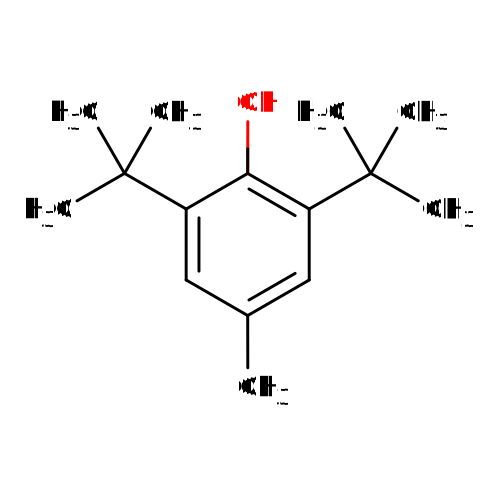
Description2,6-Di-tert-butyl-4-methylphenol is also known as butylated hydroxytoluene (BHT) or butylhydroxytoluene, is a lipophilic (fat-soluble) organic compound that is primarily used as an antioxidant food additive (E number E321) as well as an antioxidant additive in cosmetics, pharmaceuticals, jet fuels, rubber, petroleum products, electrical transformer oil, and embalming fluid. It is also found in certain plants, including soft-necked garlic. A recent study has found that phytoplankton, including the green algae, Botryococcus braunii, as well as three different cyanobacteria (Cylindrospermopsis raciborskii, Microcystis aeruginosa and Oscillatoria sp.) are capable of producing this compound.
Contaminant Sources
  • Cosmetic Chemicals
  • EAFUS Chemicals
  • FooDB Chemicals
  • HPV EPA Chemicals
  • IARC Carcinogens Group 3
  • OECD HPV Chemicals
  • STOFF IDENT Compounds
  • T3DB toxins
  • ToxCast & Tox21 Chemicals
Contaminant Type
  • Cosmetic Toxin
  • Food Additive
  • Food Toxin
  • Fuel
  • Metabolite
  • Organic Compound
  • Synthetic Compound
Chemical Structure
Thumb
Synonyms
ValueSource
2,6-Bis(1,1-dimethylethyl)-4-methylphenolChEBI
2,6-Di-t-butyl-4-methylphenolChEBI
2,6-Di-tert-butyl-1-hydroxy-4-methylbenzeneChEBI
2,6-Di-tert-butyl-4-cresolChEBI
2,6-Di-tert-butyl-p-cresolChEBI
BHTChEBI
Butylated hydroxytolueneChEBI
ButylhydroxytolueneChEBI
2,6 Di t butyl 4 methylphenolMeSH
2,6 Di tert butyl 4 methylphenolMeSH
2,6 Di tert butyl p cresolMeSH
4 Methyl 2,6 ditertbutylphenolMeSH
4-Methyl-2,6-ditertbutylphenolMeSH
Di tert butyl methylphenolMeSH
DibunolMeSH
Hydroxytoluene, butylatedMeSH
IonolMeSH
Ionol (BHT)MeSH
Di-tert-butyl-methylphenolMeSH
2,6-Bis(1,1-dimethylethyl)-4-methylphenol, 9ciHMDB
2,6-Di-tert-butyl-P-cresol, 8ciHMDB
Butyl hydroxy tolueneHMDB
e321HMDB
FEMA 2184HMDB
PopolHMDB
2,6-Bis(tert-butyl)-4-methylphenolHMDB
2,6-Di(tert-butyl)hydroxytolueneHMDB
2,6-Di-tert-butyl-4-hydroxytolueneHMDB
2,6-Di-tert-butyl-4-methyl phenolHMDB
2,6-Di-tert-butyl-4-methyl-1-hydroxybenzeneHMDB
2,6-Di-tert-butyl-4-methylhydroxybenzeneHMDB
2,6-Di-tert-butyl-4-methylphenolHMDB
2,6-Di-tert-butyl-p-cresoleHMDB
2,6-Di-tert-butyl-p-methylphenolHMDB
2,6-Di-tert-butylcresolHMDB
2,6-Di-tert-butylmethylphenolHMDB
2,6-Ditertbutyl paracresolHMDB
2,6-tert-Butyl-4-methylphenolHMDB
3,5-Bis(1,1-dimethylethyl)-4-hydroxytolueneHMDB
3,5-Di-tert-butyl-4-hydroxytolueneHMDB
3,5-Di-tert-butyl-p-hydroxytolueneHMDB
4-Hydroxy-3,5-di-tert-butyltolueneHMDB
4-Methyl-2,6-bis(1,1-dimethylethyl)phenolHMDB
4-Methyl-2,6-di-tert-butylphenolHMDB
4-Methyl-2,6-ditertbutyl phenolHMDB
Di-tert-Butyl-4-methylphenolHMDB
Di-tert-butyl-p-cresolHMDB
Di-tert-butylcresolHMDB
Dibutyl paracresolHMDB
Dibutylated hydroxytolueneHMDB
DibutylcresolHMDB
DibutylhydroxytolueneHMDB
o-Di-tert-butyl-p-methylphenolHMDB
Chemical FormulaC15H24O
Average Molecular Mass220.351 g/mol
Monoisotopic Mass220.183 g/mol
CAS Registry Number128-37-0
IUPAC Name2,6-di-tert-butyl-4-methylphenol
Traditional Nameional
SMILESCC1=CC(=C(O)C(=C1)C(C)(C)C)C(C)(C)C
InChI IdentifierInChI=1S/C15H24O/c1-10-8-11(14(2,3)4)13(16)12(9-10)15(5,6)7/h8-9,16H,1-7H3
InChI KeyNLZUEZXRPGMBCV-UHFFFAOYSA-N
Chemical Taxonomy
Description belongs to the class of organic compounds known as phenylpropanes. These are organic compounds containing a phenylpropane moiety.
KingdomOrganic compounds
Super ClassBenzenoids
ClassBenzene and substituted derivatives
Sub ClassPhenylpropanes
Direct ParentPhenylpropanes
Alternative Parents
Substituents
  • Phenylpropane
  • P-cresol
  • Toluene
  • Phenol
  • Organic oxygen compound
  • Hydrocarbon derivative
  • Organooxygen compound
  • Aromatic homomonocyclic compound
Molecular FrameworkAromatic homomonocyclic compounds
External Descriptors
Biological Properties
StatusDetected and Not Quantified
OriginExogenous
Cellular Locations
  • Membrane
Biofluid LocationsNot Available
Tissue LocationsNot Available
PathwaysNot Available
ApplicationsNot Available
Biological RolesNot Available
Chemical RolesNot Available
Physical Properties
StateSolid
AppearanceWhite powder
Experimental Properties
PropertyValue
Melting Point72 °C
Boiling Point265 °C
Solubility1.1 mg/mL
Predicted Properties
PropertyValueSource
Water Solubility0.015 g/LALOGPS
logP5.25ALOGPS
logP5.27ChemAxon
logS-4.2ALOGPS
pKa (Strongest Acidic)11.6ChemAxon
pKa (Strongest Basic)-4.6ChemAxon
Physiological Charge0ChemAxon
Hydrogen Acceptor Count1ChemAxon
Hydrogen Donor Count1ChemAxon
Polar Surface Area20.23 ŲChemAxon
Rotatable Bond Count2ChemAxon
Refractivity70.41 m³·mol⁻¹ChemAxon
Polarizability27.35 ųChemAxon
Number of Rings1ChemAxon
Bioavailability1ChemAxon
Rule of FiveNoChemAxon
Ghose FilterYesChemAxon
Veber's RuleYesChemAxon
MDDR-like RuleNoChemAxon
Spectra
Spectra
Spectrum TypeDescriptionSplash KeyView
GC-MSGC-MS Spectrum - EI-B (Non-derivatized)splash10-0a4i-2190000000-9fbadde6214d71846540Spectrum
GC-MSGC-MS Spectrum - EI-B (Non-derivatized)splash10-0a4i-7490000000-b8f13a22c093b1883667Spectrum
GC-MSGC-MS Spectrum - EI-B (Non-derivatized)splash10-0a4i-8590000000-bb65eb9156b08a98eb13Spectrum
GC-MSGC-MS Spectrum - EI-B (Non-derivatized)splash10-0a4i-4490000000-a19c5b42b06567024d6fSpectrum
GC-MSGC-MS Spectrum - EI-B (Non-derivatized)splash10-0a4i-3490000000-ddeff8b438c2941c327eSpectrum
GC-MSGC-MS Spectrum - EI-B (Non-derivatized)splash10-0a4i-2190000000-9fbadde6214d71846540Spectrum
GC-MSGC-MS Spectrum - EI-B (Non-derivatized)splash10-0a4i-7490000000-b8f13a22c093b1883667Spectrum
GC-MSGC-MS Spectrum - EI-B (Non-derivatized)splash10-0a4i-8590000000-bb65eb9156b08a98eb13Spectrum
GC-MSGC-MS Spectrum - EI-B (Non-derivatized)splash10-0a4i-4490000000-a19c5b42b06567024d6fSpectrum
GC-MSGC-MS Spectrum - EI-B (Non-derivatized)splash10-0a4i-3490000000-ddeff8b438c2941c327eSpectrum
Predicted GC-MSPredicted GC-MS Spectrum - GC-MS (Non-derivatized) - 70eV, Positivesplash10-0a4i-4890000000-937a0d7c9f6bc6884917Spectrum
Predicted GC-MSPredicted GC-MS Spectrum - GC-MS (1 TMS) - 70eV, Positivesplash10-00fr-3190000000-b316f5f5da9b2ca1a836Spectrum
Predicted GC-MSPredicted GC-MS Spectrum - GC-MS (Non-derivatized) - 70eV, PositiveNot AvailableSpectrum
LC-MS/MSLC-MS/MS Spectrum - DI-ESI-qTof , Negativesplash10-0gb9-0090000000-beb559334e11b52a6a6bSpectrum
LC-MS/MSLC-MS/MS Spectrum - 10V, Negativesplash10-014i-0090000000-32399a5e228ba02e4e32Spectrum
LC-MS/MSLC-MS/MS Spectrum - 20V, Negativesplash10-014i-0090000000-b36ce28bdef9bd2f364bSpectrum
LC-MS/MSLC-MS/MS Spectrum - 40V, Negativesplash10-0fr6-5090000000-217bda984af47583c311Spectrum
LC-MS/MSLC-MS/MS Spectrum - 10V, Positivesplash10-03di-0920000000-05e50a2a2ff373457054Spectrum
LC-MS/MSLC-MS/MS Spectrum - 20V, Positivesplash10-03di-0900000000-2cc85cec8e88b993179fSpectrum
LC-MS/MSLC-MS/MS Spectrum - 40V, Positivesplash10-001i-0900000000-3062a57022e6dc3200a3Spectrum
LC-MS/MSLC-MS/MS Spectrum - 30V, Positivesplash10-03di-0900000000-7cfc05798b5e4aee5874Spectrum
Predicted LC-MS/MSPredicted LC-MS/MS Spectrum - 10V, Positivesplash10-00di-0090000000-f5adfac3bff91424bb5aSpectrum
Predicted LC-MS/MSPredicted LC-MS/MS Spectrum - 20V, Positivesplash10-00di-1490000000-16fb4ab4552b3f6dc2d2Spectrum
Predicted LC-MS/MSPredicted LC-MS/MS Spectrum - 40V, Positivesplash10-0ab9-3920000000-413f3c2e53c1dfbc97f2Spectrum
Predicted LC-MS/MSPredicted LC-MS/MS Spectrum - 10V, Negativesplash10-014i-0090000000-361c47d317a34fbbf403Spectrum
Predicted LC-MS/MSPredicted LC-MS/MS Spectrum - 20V, Negativesplash10-014i-0090000000-27b24d01f4d65ae3d8ffSpectrum
Predicted LC-MS/MSPredicted LC-MS/MS Spectrum - 40V, Negativesplash10-014i-0970000000-c5d8c2d3517a4486f6c2Spectrum
Predicted LC-MS/MSPredicted LC-MS/MS Spectrum - 10V, Negativesplash10-014i-0090000000-4af4c4ee1c4acef7e18bSpectrum
Predicted LC-MS/MSPredicted LC-MS/MS Spectrum - 20V, Negativesplash10-014i-0090000000-4af4c4ee1c4acef7e18bSpectrum
Predicted LC-MS/MSPredicted LC-MS/MS Spectrum - 40V, Negativesplash10-0f7a-0950000000-311825055cfa82a1e870Spectrum
Predicted LC-MS/MSPredicted LC-MS/MS Spectrum - 10V, Positivesplash10-0avi-0930000000-c53bfeff3f15a3ffd931Spectrum
Predicted LC-MS/MSPredicted LC-MS/MS Spectrum - 20V, Positivesplash10-0a4i-7910000000-9e7b8280fd5866b2aa5cSpectrum
Predicted LC-MS/MSPredicted LC-MS/MS Spectrum - 40V, Positivesplash10-0a4l-9100000000-430b6d18363b02295050Spectrum
MSMass Spectrum (Electron Ionization)splash10-0a4i-7790000000-b645e922d4fa7b593cbcSpectrum
1D NMR1H NMR SpectrumNot AvailableSpectrum
1D NMR13C NMR SpectrumNot AvailableSpectrum
Toxicity Profile
Route of ExposureIngestion; Inhalation
Mechanism of ToxicityBHT is metabolized to quinone methides (QMs) which are responsible for promoting tumor formation in many animal models. One example of a QM is 2,6-di-tert-butyl-4-methylenecyclohexa-2,5-dienone (BHT-QM). QMs are strongly electrophilic and readily form adducts with proteins. Some of the QM targets include redox proteins such as glutathione S-transferase P1 (GST-P1), peroxiredoxin 6 (Prx6), Cu,Zn-superoxide dismutase (SOD1), carbonyl reductase, and selenium-binding protein 1, which have direct or indirect antioxidant functions. (1, 5). The modification of these proteins leads to decreased cellular protection from electrophiles and oxidants. Alkylation also may interfere with GSTP1 regulation of stress kinases, thereby influencing phosphorylation and cell growth. BHT also binds to the retinoic acid receptor which can lead to changes in cell development.
MetabolismOxidative metabolism (phase 1 reactions) mediated by the microsomal monooxygenase system is the major route for BHT degradation. Oxidation of the tert-butyl groups is most common in man. Gallates and 2-tert-butylhydroquinone are mainly metabolized by non-oxidative pathways (methylation or conjugation with sulphate and glucuronic acid). (2). In particular BHT is frequently metabolized to quinone methides (QMs) which are thought to be responsible for promoting tumor formation. One example of a QM is 2,6-di-tert-butyl-4-methylenecyclohexa-2,5-dienone (BHT-QM). QMs are strongly electrophilic and readily form adducts with proteins.
Toxicity ValuesNot Available
Lethal DoseIn rats, the oral LD50 was > 2930 mg/kg bw, the LD50 after dermal exposure was > 2000 mg/kg
Carcinogenicity (IARC Classification)3, not classifiable as to its carcinogenicity to humans. (6)
Uses/SourcesBHT is primarily used as an antioxidant food additive (E number E321) as well as an antioxidant additive in cosmetics, pharmaceuticals, jet fuels, rubber, petroleum products, electrical transformer oil, and embalming fluid.
Minimum Risk Level25 mg/kg/day for thyroid and liver damage. 100 mg/kg/day for cancer.
Health EffectsBHT is of low acute toxicity. Acute exposure to BHT can cause coughs and sore throat (inhalation), redness on the skin (via contact) and abdominal pain, confusion, dizziness and nausea (via ingestion). Long-term exposure to high doses of BHT is toxic in mice and rats, causing liver, thyroid and kidney problems and affecting lung function and blood coagulation. BHT can act as a tumour promoter in certain situations (3) although it is not a genotoxic carcinogen. Limited evidence suggests that high doses of BHT may mimic estrogen (4), the primary female sex hormone, and prevent expression of male sex hormones, resulting in adverse reproductive affects. On chronic oral exposure of rats, liver and thyroid are the main targets. Doses above 25 mg/kg bw/day BHT resulted in thyroid hyperactivity and enlargement of the liver.
SymptomsNot Available
TreatmentFor acute exposure: EYES: irrigate opened eyes for several minutes under running water. INGESTION: do not induce vomiting. Rinse mouth with water (never give anything by mouth to an unconscious person). Seek immediate medical advice. SKIN: should be treated immediately by rinsing the affected parts in cold running water for at least 15 minutes, followed by thorough washing with soap and water. If necessary, the person should shower and change contaminated clothing and shoes, and then must seek medical attention. INHALATION: supply fresh air. If required provide artificial respiration.
Concentrations
Not Available
DrugBank IDNot Available
HMDB IDHMDB0033826
FooDB IDFDB011992
Phenol Explorer IDNot Available
KNApSAcK IDC00042069
BiGG IDNot Available
BioCyc IDNot Available
METLIN IDNot Available
PDB IDNot Available
Wikipedia LinkButylated_hydroxytoluene
Chemspider ID13835296
ChEBI ID34247
PubChem Compound ID31404
Kegg Compound IDC14693
YMDB IDYMDB15971
ECMDB IDNot Available
References
Synthesis ReferenceNot Available
MSDSNot Available
General References
1. https://www.ncbi.nlm.nih.gov/pubmed/?term=11837686
2. https://www.ncbi.nlm.nih.gov/pubmed/?term=24612426
3. https://www.ncbi.nlm.nih.gov/pubmed/?term=24617543
4. Liu R, Mabury SA: Unexpectedly high concentrations of 2,4-di-tert-butylphenol in human urine. Environ Pollut. 2019 Sep;252(Pt B):1423-1428. doi: 10.1016/j.envpol.2019.06.077. Epub 2019 Jun 21.
5. Yannai, Shmuel. (2004) Dictionary of food compounds with CD-ROM: Additives, flavors, and ingredients. Boca Raton: Chapman & Hall/CRC.