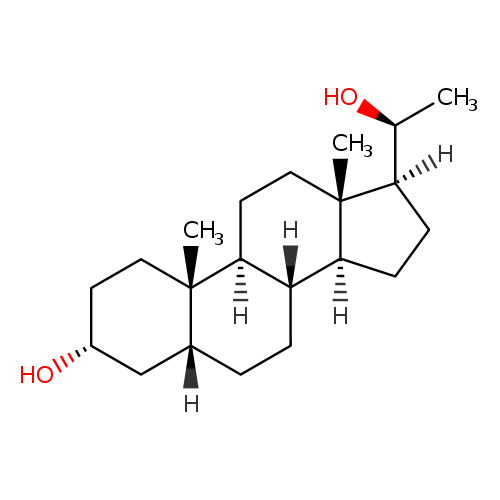
Pregnanediol is an endogenous human testosterone metabolite. It can be detected in the urine of adults and newborns in variable concentrations. Pregnanediol is abnormally elevated in patients with cytochrome P450 (P450C17, steroid 17alpha-monooxygenase, EC 1.14.99.9) oxidoreductase deficiency (Antley-Bixler syndrome, PORD, OMIM: 201750). Antley-Bixler syndrome is a multiple congenital malformation syndrome with craniosynostosis, radiohumeral synostosis, femoral bowing, choanal atresia or stenosis, joint contractures, urogenital abnormalities, and often early death. An assay of urinary pregnanediol excretion provides an accurate indication of outcome in threatened miscarriage in 74 - 93% percent of cases. Pregnanediol is one of the most important markers of pregnenolone administration, which can potentially be abused by athletes to maintain an equilibration of the steroidal environment after sex steroids administrations. Patients with recurrent vulvovaginal candidiasis have significantly lower levels of urinary pregnanediol (PMID: 126703, 16608896, 16906539, 1191599, 2905284, 15763596, 10360427, 11159778, 16687200). Pregnanediol excretion is low in women with suspected placental insufficiency and in women with uterine fibroma. Pregnanediol levels can change in endocrine disturbances such as hirsutism or Cushing's syndrome, depending on the stage of the disease. Pregnanediol has been tried as a more reliable compound to measure in screening of urinary steroids when suspecting doping, due to its not significant isotopic fractionation that could lead to false positive results in anti-doping testing. 13C-Enrichment caused by a diet change might be a reason of concern in athletes that move around between places and might have a considerable change of diet between competitions. In contrast to the results obtained with the carbon isotopic ratio, the profiling of urinary testosterone/epitestosterone (T/E) ratios is found to be unaffected by a diet change (PMID: 16338181, 5172227, 13636945, 14440289).
belongs to the class of organic compounds known as gluco/mineralocorticoids, progestogins and derivatives. These are steroids with a structure based on a hydroxylated prostane moiety.