Record Information
Version1.0
Creation Date2016-05-25 18:14:28 UTC
Update Date2026-04-14 15:15:20 UTC
Accession NumberCHEM021870
Identification
Common NameEstrone sulfate
ClassSmall Molecule
DescriptionEstrone sulfate (as estropipate) is a form of estrogen. It has several uses such as: alleviate symptoms of menopause as hormone replacement therapy, treatment some types of infertility, treatment of some conditions leading to underdevelopment of female sexual characteristics, treatment of vaginal atrophy, treatment of some types of breast cancer (particularly in men and postmenopausal women), treatment of prostate cancer and prevention of osteoporosis.
Contaminant Sources
  • FooDB Chemicals
  • HMDB Contaminants - Urine
  • STOFF IDENT Compounds
Contaminant TypeNot Available
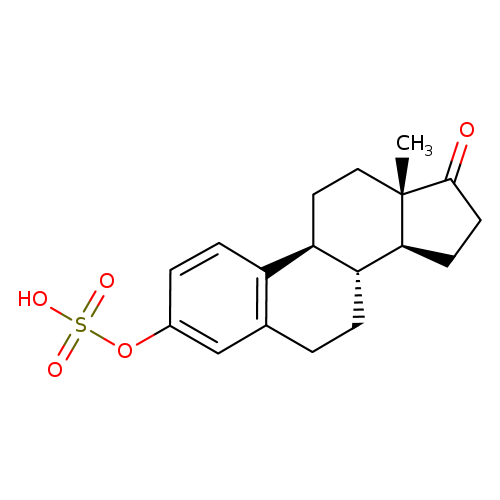
Chemical Structure
Thumb
Synonyms
ValueSource
3-Hydroxyestra-1,3,5(10)-trien-17-one hydrogen sulphateChEBI
Estrone hydrogen sulfateChEBI
Estrone sulphateChEBI
3-Hydroxyestra-1,3,5(10)-trien-17-one hydrogen sulfateGenerator
3-Hydroxyestra-1,3,5(10)-trien-17-one hydrogen sulfuric acidGenerator
3-Hydroxyestra-1,3,5(10)-trien-17-one hydrogen sulphuric acidGenerator
Estrone hydrogen sulfuric acidGenerator
Estrone hydrogen sulphateGenerator
Estrone hydrogen sulphuric acidGenerator
Estrone sulfuric acidGenerator
Estrone sulphuric acidGenerator
ConestoralHMDB
Estrogenic substancesHMDB
EstroneHMDB
Estrone hydrogen sulfateHMDB
Estrone hydrogen sulphateHMDB
Estrone 3-sulfateHMDB
Estrone 3-sulphateHMDB
Estrone sulfate sodiumHMDB
Estrone sulphate sodiumHMDB
Estrone-3-sulfateHMDB
Estrone-3-sulphateHMDB
PremarinHMDB
Sodium estrone 3-monosulfateHMDB
Sodium estrone 3-monosulphateHMDB
Sodium estrone 3-sulfateHMDB
Sodium estrone 3-sulphateHMDB
Estrone sulfate, sodium saltHMDB
Potassium estrone sulfateHMDB
Sodium estrone sulfateHMDB
Estrone sulfate, ammonium saltHMDB
Oestrone sulphateHMDB
EvexHMDB
Estrone sulfate, 16-(14)C-labeledHMDB
Estrone sulfate, 14C-labeledHMDB
Estrone sulfate, potassium saltHMDB
Chemical FormulaC18H22O5S
Average Molecular Mass350.429 g/mol
Monoisotopic Mass350.119 g/mol
CAS Registry Number481-97-0
IUPAC Name[(1S,10R,11S,15S)-15-methyl-14-oxotetracyclo[8.7.0.0²,⁷.0¹¹,¹⁵]heptadeca-2(7),3,5-trien-5-yl]oxidanesulfonic acid
Traditional NameOgen
SMILESC[C@]12CC[C@H]3[C@@H](CCC4=C3C=CC(OS(O)(=O)=O)=C4)[C@@H]1CCC2=O
InChI IdentifierInChI=1S/C18H22O5S/c1-18-9-8-14-13-5-3-12(23-24(20,21)22)10-11(13)2-4-15(14)16(18)6-7-17(18)19/h3,5,10,14-16H,2,4,6-9H2,1H3,(H,20,21,22)/t14-,15-,16+,18+/m1/s1
InChI KeyJKKFKPJIXZFSSB-CBZIJGRNSA-N
Chemical Taxonomy
Description belongs to the class of organic compounds known as sulfated steroids. These are sterol lipids containing a sulfate group attached to the steroid skeleton.
KingdomOrganic compounds
Super ClassLipids and lipid-like molecules
ClassSteroids and steroid derivatives
Sub ClassSulfated steroids
Direct ParentSulfated steroids
Alternative Parents
Substituents
  • Sulfated steroid skeleton
  • Estrane-skeleton
  • 17-oxosteroid
  • Oxosteroid
  • Phenanthrene
  • Arylsulfate
  • Tetralin
  • Benzenoid
  • Sulfuric acid ester
  • Sulfuric acid monoester
  • Sulfate-ester
  • Organic sulfuric acid or derivatives
  • Ketone
  • Hydrocarbon derivative
  • Organic oxide
  • Organooxygen compound
  • Carbonyl group
  • Organic oxygen compound
  • Aromatic homopolycyclic compound
Molecular FrameworkAromatic homopolycyclic compounds
External Descriptors
Biological Properties
StatusDetected and Not Quantified
OriginNot Available
Cellular LocationsNot Available
Biofluid LocationsNot Available
Tissue LocationsNot Available
PathwaysNot Available
ApplicationsNot Available
Biological RolesNot Available
Chemical RolesNot Available
Physical Properties
StateNot Available
AppearanceNot Available
Experimental Properties
PropertyValue
Melting PointNot Available
Boiling PointNot Available
SolubilityNot Available
Predicted Properties
PropertyValueSource
Water Solubility0.0059 g/LALOGPS
logP0.29ALOGPS
logP3.83ChemAxon
logS-4.8ALOGPS
pKa (Strongest Acidic)-1.7ChemAxon
pKa (Strongest Basic)-7.5ChemAxon
Physiological Charge-1ChemAxon
Hydrogen Acceptor Count4ChemAxon
Hydrogen Donor Count1ChemAxon
Polar Surface Area80.67 ŲChemAxon
Rotatable Bond Count2ChemAxon
Refractivity89.07 m³·mol⁻¹ChemAxon
Polarizability36.64 ųChemAxon
Number of Rings4ChemAxon
Bioavailability1ChemAxon
Rule of FiveYesChemAxon
Ghose FilterYesChemAxon
Veber's RuleNoChemAxon
MDDR-like RuleNoChemAxon
Spectra
Spectra
Spectrum TypeDescriptionSplash KeyView
Predicted GC-MSPredicted GC-MS Spectrum - GC-MS (Non-derivatized) - 70eV, Positivesplash10-0079-1195000000-45f680d267db2b386dfbSpectrum
Predicted GC-MSPredicted GC-MS Spectrum - GC-MS (Non-derivatized) - 70eV, PositiveNot AvailableSpectrum
Predicted LC-MS/MSPredicted LC-MS/MS Spectrum - 10V, Positivesplash10-0udi-0019000000-66837890a45e12ff4df5Spectrum
Predicted LC-MS/MSPredicted LC-MS/MS Spectrum - 20V, Positivesplash10-0ul0-1298000000-be851ade10d052513145Spectrum
Predicted LC-MS/MSPredicted LC-MS/MS Spectrum - 40V, Positivesplash10-0zi0-5934000000-d4c5c30541fd04c44e38Spectrum
Predicted LC-MS/MSPredicted LC-MS/MS Spectrum - 10V, Negativesplash10-0002-0019000000-45855a16f86d3580ba3cSpectrum
Predicted LC-MS/MSPredicted LC-MS/MS Spectrum - 20V, Negativesplash10-014i-0093000000-18cc1497d0c7397e16afSpectrum
Predicted LC-MS/MSPredicted LC-MS/MS Spectrum - 40V, Negativesplash10-0gc0-5090000000-83bfa06ed14805d78102Spectrum
Predicted LC-MS/MSPredicted LC-MS/MS Spectrum - 10V, Negativesplash10-0002-0009000000-e8b485c62cd4477fbfc9Spectrum
Predicted LC-MS/MSPredicted LC-MS/MS Spectrum - 20V, Negativesplash10-0002-9003000000-98936cb1b9953748d5a9Spectrum
Predicted LC-MS/MSPredicted LC-MS/MS Spectrum - 40V, Negativesplash10-0002-7192000000-e9e53d190e852f9b5b1fSpectrum
Predicted LC-MS/MSPredicted LC-MS/MS Spectrum - 10V, Positivesplash10-0udi-0019000000-d7902d7f420476e65a84Spectrum
Predicted LC-MS/MSPredicted LC-MS/MS Spectrum - 20V, Positivesplash10-0ue9-2189000000-15572bc45f5db3a69da1Spectrum
Predicted LC-MS/MSPredicted LC-MS/MS Spectrum - 40V, Positivesplash10-0gx1-6693000000-29c27e485a34d776e412Spectrum
Toxicity Profile
Route of ExposureNot Available
Mechanism of ToxicityNot Available
MetabolismNot Available
Toxicity ValuesNot Available
Lethal DoseNot Available
Carcinogenicity (IARC Classification)Not Available
Uses/SourcesNot Available
Minimum Risk LevelNot Available
Health EffectsNot Available
SymptomsNot Available
TreatmentNot Available
Concentrations
Not Available
DrugBank IDDB04574
HMDB IDHMDB0001425
FooDB IDFDB021804
Phenol Explorer IDNot Available
KNApSAcK IDNot Available
BiGG ID40054
BioCyc IDNot Available
METLIN ID3556
PDB IDNot Available
Wikipedia LinkEstrone sulfate
Chemspider ID2272513
ChEBI ID17474
PubChem Compound ID3001028
Kegg Compound IDC02538
YMDB IDNot Available
ECMDB IDM2MDB004961
References
Synthesis ReferenceNot Available
MSDSNot Available
General References
1. Price, Wm. H. Process for the production of alkali metal estrone sulfate salts. (1959), US Patent 2917522 19591215
2. Tso J, Aga DS: A systematic investigation to optimize simultaneous extraction and liquid chromatography tandem mass spectrometry analysis of estrogens and their conjugated metabolites in milk. J Chromatogr A. 2010 Jul 16;1217(29):4784-95. doi: 10.1016/j.chroma.2010.05.024. Epub 2010 May 25.
3. Price, Wm. H. Process for the production of alkali metal estrone sulfate salts. (1959), US Patent 2917522 19591215
4. Choi HY, Hobkirk R: Chromatofocusing of mammalian estrone sulfate sulfohydrolase activity. J Steroid Biochem. 1986 Dec;25(6):985-9.
5. Sherstha R, McKinley C, Russ P, Scherzinger A, Bronner T, Showalter R, Everson GT: Postmenopausal estrogen therapy selectively stimulates hepatic enlargement in women with autosomal dominant polycystic kidney disease. Hepatology. 1997 Nov;26(5):1282-6.
6. Gniot-Szulzycka J, Jakubowska A: Oestrone sulphate sulphohydrolase activity in nuclear envelopes from human placenta cell nuclei. Acta Biochim Pol. 1991;38(1):7-16.
7. Fredricsson B, Carlstrom K, Kjessler B, Lindstedt J, Ploen L, Ritzen M, de la Torre B: Incomplete androgen insensitivity: asymmetry in morphology and steroid profile and metabolism of the gonads. An analysis of a case. Acta Endocrinol (Copenh). 1985 Dec;110(4):564-71.
8. Fuchikami H, Satoh H, Tsujimoto M, Ohdo S, Ohtani H, Sawada Y: Effects of herbal extracts on the function of human organic anion-transporting polypeptide OATP-B. Drug Metab Dispos. 2006 Apr;34(4):577-82. Epub 2006 Jan 13.
9. Milewich L, Sontheimer RD, Herndon JH Jr: Steroid sulfatase activity in epidermis of acne-prone and non-acne-prone skin of patients with acne vulgaris. Arch Dermatol. 1990 Oct;126(10):1312-4.
10. Stewart JD, Lou Y, Squires EJ, Coussens PM: Using human microarrays to identify differentially expressed genes associated with increased steroidogenesis in boars. Anim Biotechnol. 2005;16(2):139-51.
11. Ekaratanawong S, Anzai N, Jutabha P, Miyazaki H, Noshiro R, Takeda M, Kanai Y, Sophasan S, Endou H: Human organic anion transporter 4 is a renal apical organic anion/dicarboxylate exchanger in the proximal tubules. J Pharmacol Sci. 2004 Mar;94(3):297-304.
12. Creidi P, Faivre B, Agache P, Richard E, Haudiquet V, Sauvanet JP: Effect of a conjugated oestrogen (Premarin) cream on ageing facial skin. A comparative study with a placebo cream. Maturitas. 1994 Oct;19(3):211-23.
13. Satoh H, Yamashita F, Tsujimoto M, Murakami H, Koyabu N, Ohtani H, Sawada Y: Citrus juices inhibit the function of human organic anion-transporting polypeptide OATP-B. Drug Metab Dispos. 2005 Apr;33(4):518-23. Epub 2005 Jan 7.
14. Bomba-Opon DA, Niesluchowska-Frydrych B, Szucka-May H, Kaminski P, Marianowski L: [Effects of oral administration of estrogen replacement therapy in surgical menopause]. Ginekol Pol. 2001 Dec;72(12A):1377-82.
15. Craddock AL, Love MW, Daniel RW, Kirby LC, Walters HC, Wong MH, Dawson PA: Expression and transport properties of the human ileal and renal sodium-dependent bile acid transporter. Am J Physiol. 1998 Jan;274(1 Pt 1):G157-69.
16. AvRuskin TW, Krishnan N, Juan CS: Congenital adrenal hypoplasia and male pseudohermaphroditism due to DAX1 mutation, SF1 mutation or neither: a patient report. J Pediatr Endocrinol Metab. 2004 Aug;17(8):1125-32.
17. Matsushima S, Maeda K, Kondo C, Hirano M, Sasaki M, Suzuki H, Sugiyama Y: Identification of the hepatic efflux transporters of organic anions using double-transfected Madin-Darby canine kidney II cells expressing human organic anion-transporting polypeptide 1B1 (OATP1B1)/multidrug resistance-associated protein 2, OATP1B1/multidrug resistance 1, and OATP1B1/breast cancer resistance protein. J Pharmacol Exp Ther. 2005 Sep;314(3):1059-67. Epub 2005 May 18.
18. Michaud DS, Manson JE, Spiegelman D, Barbieri RL, Sepkovic DW, Bradlow HL, Hankinson SE: Reproducibility of plasma and urinary sex hormone levels in premenopausal women over a one-year period. Cancer Epidemiol Biomarkers Prev. 1999 Dec;8(12):1059-64.
19. https://www.ncbi.nlm.nih.gov/pubmed/?term=15356081
20. https://www.ncbi.nlm.nih.gov/pubmed/?term=23717534