Record Information
Version1.0
Creation Date2016-05-27 01:10:36 UTC
Update Date2016-11-09 01:22:23 UTC
Accession NumberCHEM041057
Identification
Common NameMaltodecaose
ClassSmall Molecule
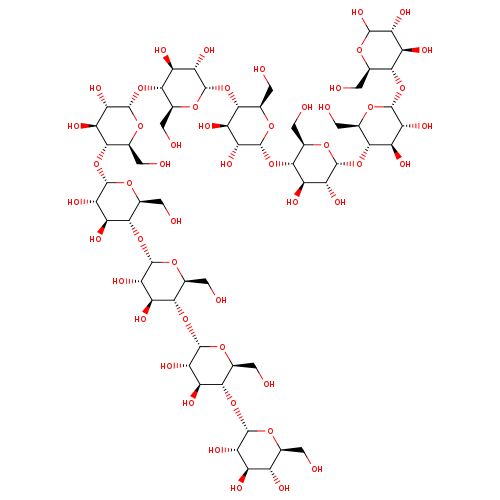
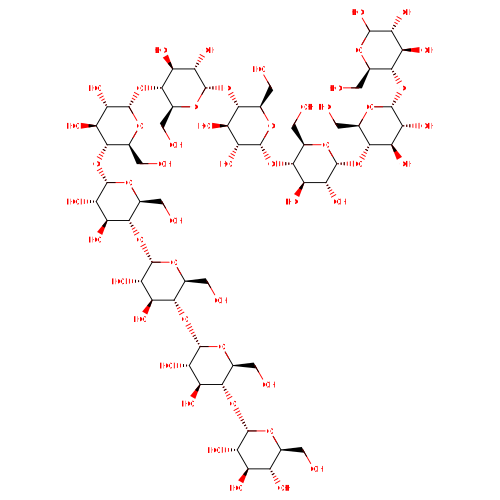
DescriptionMaltodecaose is a polysaccharide with 10 units of glucose and belongs to maltodextrins. Maltodextrin is a polysaccharide that is used as a food additive. It is produced from starch by partial hydrolysis and is usually found as a creamy-white hygroscopic spraydried powder. Maltodextrin is easily digestible, being absorbed as rapidly as glucose, and might be either moderately sweet or almost flavorless. It is commonly used for the production of natural sodas and candy such as SweeTarts. Maltodextrin consists of D-glucose units connected in chains of variable length. The glucose units are primarily linked with a(1→4) glycosidic bonds. Maltodextrin is typically composed of a mixture of chains that vary from three to nineteen glucose units long. Maltodextrins are classified by DE (dextrose equivalent) and have a DE between 3 to 20. (The higher the DE value, the shorter the glucose chains, the higher the sweetness and the higher the solubility.) Above DE 20, the European Union's CN code calls it glucose syrup, at DE 10 or lower the customs CN code nomenclature classifies maltodextrins as dextrins.
Contaminant Sources
  • FooDB Chemicals
Contaminant TypeNot Available
Chemical Structure
Thumb
Synonyms
ValueSource
b-CyclodextrinHMDB
beta-cyclo DextrinHMDB
beta-CycloamyloseHMDB
beta-CyclodextrinHMDB
beta-CycloheptaamyloseHMDB
beta-DextrinHMDB
BetadexHMDB
CycloheptaamyloseHMDB
CycloheptaglucanHMDB
CycloheptaglucosanHMDB
CycloheptapentyloseHMDB
CyclomaltoheptaoseHMDB
KleptoseHMDB
Kleptose bHMDB
Rhodocap NHMDB
Ringdex bHMDB
Ringdex BLHMDB
Schardinger beta-dextrinHMDB
Chemical FormulaC60H102O51
Average Molecular Mass1639.421 g/mol
Monoisotopic Mass1638.539 g/mol
CAS Registry Number37331-89-8
IUPAC Name(2S,3S,4R,5R,6S)-2-{[(2S,3R,4S,5S,6S)-6-{[(2S,3R,4S,5S,6S)-6-{[(2S,3R,4S,5S,6S)-6-{[(2S,3R,4S,5S,6S)-6-{[(2S,3R,4S,5S,6S)-6-{[(2R,3S,4R,5R,6R)-6-{[(2R,3S,4R,5R,6R)-6-{[(2R,3S,4R,5R,6R)-4,5-dihydroxy-2-(hydroxymethyl)-6-{[(2R,3S,4R,5R)-4,5,6-trihydroxy-2-(hydroxymethyl)oxan-3-yl]oxy}oxan-3-yl]oxy}-4,5-dihydroxy-2-(hydroxymethyl)oxan-3-yl]oxy}-4,5-dihydroxy-2-(hydroxymethyl)oxan-3-yl]oxy}-4,5-dihydroxy-2-(hydroxymethyl)oxan-3-yl]oxy}-4,5-dihydroxy-2-(hydroxymethyl)oxan-3-yl]oxy}-4,5-dihydroxy-2-(hydroxymethyl)oxan-3-yl]oxy}-4,5-dihydroxy-2-(hydroxymethyl)oxan-3-yl]oxy}-4,5-dihydroxy-2-(hydroxymethyl)oxan-3-yl]oxy}-6-(hydroxymethyl)oxane-3,4,5-triol
Traditional Name(2S,3S,4R,5R,6S)-2-{[(2S,3R,4S,5S,6S)-6-{[(2S,3R,4S,5S,6S)-6-{[(2S,3R,4S,5S,6S)-6-{[(2S,3R,4S,5S,6S)-6-{[(2S,3R,4S,5S,6S)-6-{[(2R,3S,4R,5R,6R)-6-{[(2R,3S,4R,5R,6R)-6-{[(2R,3S,4R,5R,6R)-4,5-dihydroxy-2-(hydroxymethyl)-6-{[(2R,3S,4R,5R)-4,5,6-trihydroxy-2-(hydroxymethyl)oxan-3-yl]oxy}oxan-3-yl]oxy}-4,5-dihydroxy-2-(hydroxymethyl)oxan-3-yl]oxy}-4,5-dihydroxy-2-(hydroxymethyl)oxan-3-yl]oxy}-4,5-dihydroxy-2-(hydroxymethyl)oxan-3-yl]oxy}-4,5-dihydroxy-2-(hydroxymethyl)oxan-3-yl]oxy}-4,5-dihydroxy-2-(hydroxymethyl)oxan-3-yl]oxy}-4,5-dihydroxy-2-(hydroxymethyl)oxan-3-yl]oxy}-4,5-dihydroxy-2-(hydroxymethyl)oxan-3-yl]oxy}-6-(hydroxymethyl)oxane-3,4,5-triol
SMILESOC[C@@H]1O[C@@H](O[C@@H]2[C@@H](O)[C@H](O)[C@H](O[C@@H]3[C@@H](O)[C@H](O)[C@H](O[C@@H]4[C@@H](O)[C@H](O)[C@H](O[C@@H]5[C@@H](O)[C@H](O)[C@H](O[C@@H]6[C@@H](O)[C@H](O)[C@H](O[C@H]7[C@H](O)[C@@H](O)[C@@H](O[C@H]8[C@H](O)[C@@H](O)[C@@H](O[C@H]9[C@H](O)[C@@H](O)[C@@H](O[C@H]%10[C@H](O)[C@@H](O)C(O)O[C@@H]%10CO)O[C@@H]9CO)O[C@@H]8CO)O[C@@H]7CO)O[C@H]6CO)O[C@H]5CO)O[C@H]4CO)O[C@H]3CO)O[C@H]2CO)[C@@H](O)[C@H](O)[C@H]1O
InChI IdentifierInChI=1S/C60H102O51/c61-1-11-21(71)22(72)33(83)52(94-11)104-43-13(3-63)96-54(35(85)24(43)74)106-45-15(5-65)98-56(37(87)26(45)76)108-47-17(7-67)100-58(39(89)28(47)78)110-49-19(9-69)102-60(41(91)30(49)80)111-50-20(10-70)101-59(40(90)31(50)81)109-48-18(8-68)99-57(38(88)29(48)79)107-46-16(6-66)97-55(36(86)27(46)77)105-44-14(4-64)95-53(34(84)25(44)75)103-42-12(2-62)93-51(92)32(82)23(42)73/h11-92H,1-10H2/t11-,12+,13-,14+,15-,16+,17-,18+,19-,20-,21-,22+,23+,24-,25+,26-,27+,28-,29+,30-,31-,32+,33-,34+,35-,36+,37-,38+,39-,40-,41-,42+,43-,44+,45-,46+,47-,48+,49-,50-,51?,52-,53+,54-,55+,56-,57+,58-,59-,60-/m0/s1
InChI KeyRJQKKZNUWRIHCS-VBNQBVOGSA-N
Chemical Taxonomy
Description belongs to the class of organic compounds known as oligosaccharides. These are carbohydrates made up of 3 to 10 monosaccharide units linked to each other through glycosidic bonds.

KingdomOrganic compounds
Super ClassOrganic oxygen compounds
ClassOrganooxygen compounds
Sub ClassCarbohydrates and carbohydrate conjugates
Direct ParentOligosaccharides
Alternative Parents
Substituents
  • Oligosaccharide
  • O-glycosyl compound
  • Glycosyl compound
  • Oxane
  • Secondary alcohol
  • Hemiacetal
  • Oxacycle
  • Organoheterocyclic compound
  • Polyol
  • Acetal
  • Hydrocarbon derivative
  • Primary alcohol
  • Alcohol
  • Aliphatic heteromonocyclic compound
Molecular FrameworkAliphatic heteromonocyclic compounds
External DescriptorsNot Available
Biological Properties
StatusDetected and Not Quantified
OriginNot Available
Cellular LocationsNot Available
Biofluid LocationsNot Available
Tissue LocationsNot Available
PathwaysNot Available
ApplicationsNot Available
Biological RolesNot Available
Chemical RolesNot Available
Physical Properties
StateNot Available
AppearanceNot Available
Experimental Properties
PropertyValue
Melting PointNot Available
Boiling PointNot Available
SolubilityNot Available
Predicted Properties
PropertyValueSource
Water Solubility431 g/LALOGPS
logP-2.2ALOGPS
logP-19ChemAxon
logS-0.58ALOGPS
pKa (Strongest Acidic)11.13ChemAxon
pKa (Strongest Basic)-3.9ChemAxon
Physiological Charge0ChemAxon
Hydrogen Acceptor Count51ChemAxon
Hydrogen Donor Count32ChemAxon
Polar Surface Area822.73 ŲChemAxon
Rotatable Bond Count28ChemAxon
Refractivity327.64 m³·mol⁻¹ChemAxon
Polarizability153.55 ųChemAxon
Number of Rings10ChemAxon
Bioavailability0ChemAxon
Rule of FiveNoChemAxon
Ghose FilterNoChemAxon
Veber's RuleNoChemAxon
MDDR-like RuleYesChemAxon
Spectra
Spectra
Spectrum TypeDescriptionSplash KeyView
Predicted LC-MS/MSPredicted LC-MS/MS Spectrum - 10V, Positivesplash10-00di-0311109011-944406bcab5a3f14fee2Spectrum
Predicted LC-MS/MSPredicted LC-MS/MS Spectrum - 20V, Positivesplash10-05fr-0422229033-801fd07ee2adc667d8f0Spectrum
Predicted LC-MS/MSPredicted LC-MS/MS Spectrum - 40V, Positivesplash10-05gl-0913227022-31e9b9fb6512817b44b4Spectrum
Predicted LC-MS/MSPredicted LC-MS/MS Spectrum - 10V, Negativesplash10-014i-0212139020-04ad00f142ff334599f7Spectrum
Predicted LC-MS/MSPredicted LC-MS/MS Spectrum - 20V, Negativesplash10-014i-0402129021-39cc47a26cfd6c3433b5Spectrum
Predicted LC-MS/MSPredicted LC-MS/MS Spectrum - 40V, Negativesplash10-0fvi-0915056031-013f53c133a3373898a9Spectrum
Predicted LC-MS/MSPredicted LC-MS/MS Spectrum - 10V, Negativesplash10-00kr-0000069000-0344d8fe2da1d8f0aa85Spectrum
Predicted LC-MS/MSPredicted LC-MS/MS Spectrum - 20V, Negativesplash10-05p9-5212259000-c81f4e330a75b89a9425Spectrum
Predicted LC-MS/MSPredicted LC-MS/MS Spectrum - 40V, Negativesplash10-0pdr-9516780132-ba7e0b4f273dc0edba4bSpectrum
Predicted LC-MS/MSPredicted LC-MS/MS Spectrum - 10V, Positivesplash10-007a-0301209011-9628fc7ded4282fae10bSpectrum
Predicted LC-MS/MSPredicted LC-MS/MS Spectrum - 20V, Positivesplash10-007a-0412339011-2f1040d4fabaf84cd432Spectrum
Predicted LC-MS/MSPredicted LC-MS/MS Spectrum - 40V, Positivesplash10-000b-7911234001-dda3db40897c4a58d175Spectrum
1D NMR13C NMR SpectrumNot AvailableSpectrum
1D NMR1H NMR SpectrumNot AvailableSpectrum
1D NMR13C NMR SpectrumNot AvailableSpectrum
1D NMR1H NMR SpectrumNot AvailableSpectrum
1D NMR13C NMR SpectrumNot AvailableSpectrum
1D NMR1H NMR SpectrumNot AvailableSpectrum
1D NMR13C NMR SpectrumNot AvailableSpectrum
1D NMR1H NMR SpectrumNot AvailableSpectrum
1D NMR13C NMR SpectrumNot AvailableSpectrum
1D NMR1H NMR SpectrumNot AvailableSpectrum
1D NMR13C NMR SpectrumNot AvailableSpectrum
1D NMR1H NMR SpectrumNot AvailableSpectrum
1D NMR13C NMR SpectrumNot AvailableSpectrum
1D NMR1H NMR SpectrumNot AvailableSpectrum
1D NMR13C NMR SpectrumNot AvailableSpectrum
1D NMR1H NMR SpectrumNot AvailableSpectrum
1D NMR13C NMR SpectrumNot AvailableSpectrum
1D NMR1H NMR SpectrumNot AvailableSpectrum
1D NMR13C NMR SpectrumNot AvailableSpectrum
1D NMR1H NMR SpectrumNot AvailableSpectrum
Toxicity Profile
Route of ExposureNot Available
Mechanism of ToxicityNot Available
MetabolismNot Available
Toxicity ValuesNot Available
Lethal DoseNot Available
Carcinogenicity (IARC Classification)Not Available
Uses/SourcesNot Available
Minimum Risk LevelNot Available
Health EffectsNot Available
SymptomsNot Available
TreatmentNot Available
Concentrations
Not Available
DrugBank IDNot Available
HMDB IDHMDB0012999
FooDB IDFDB029240
Phenol Explorer IDNot Available
KNApSAcK IDNot Available
BiGG IDNot Available
BioCyc IDNot Available
METLIN IDNot Available
PDB IDNot Available
Wikipedia LinkNot Available
Chemspider ID35032558
ChEBI IDNot Available
PubChem Compound ID53481573
Kegg Compound IDNot Available
YMDB IDNot Available
ECMDB IDNot Available
References
Synthesis ReferenceNot Available
MSDSNot Available
General References
1. Wind M, Hoffmann P, Wagner H, Thormann W: Chiral capillary electrophoresis as predictor for separation of drug enantiomers in continuous flow zone electrophoresis. J Chromatogr A. 2000 Oct 20;895(1-2):51-65.
2. Vela EM, Zhang L, Colpitts TM, Davey RA, Aronson JF: Arenavirus entry occurs through a cholesterol-dependent, non-caveolar, clathrin-mediated endocytic mechanism. Virology. 2007 Dec 5;369(1):1-11. Epub 2007 Aug 14.
3. Bashir S, Derrick PJ, Mutter R: Parameterising matrix-assisted laser desorption/ionization (MALDI): effect of solvents and co-additives on analyte peak intensities. Eur J Mass Spectrom (Chichester). 2004;10(4):487-93.
4. Anwar SH, Weissbrodt J, Kunz B: Microencapsulation of fish oil by spray granulation and fluid bed film coating. J Food Sci. 2010 Aug 1;75(6):E359-71. doi: 10.1111/j.1750-3841.2010.01665.x.
5. Singh UV, Udupa N: Reduced toxicity and enhanced antitumor efficacy of betacyclodextrin plumbagin inclusion complex in mice bearing Ehrlich ascites carcinoma. Indian J Physiol Pharmacol. 1997 Apr;41(2):171-5.
6. Cirri M, Maestrelli F, Corti G, Furlanetto S, Mura P: Simultaneous effect of cyclodextrin complexation, pH, and hydrophilic polymers on naproxen solubilization. J Pharm Biomed Anal. 2006 Sep 11;42(1):126-31. Epub 2006 Jan 6.
7. Sangalli ME, Zema L, Maroni A, Foppoli A, Giordano F, Gazzaniga A: Influence of betacyclodextrin on the release of poorly soluble drugs from inert and hydrophilic heterogeneous polymeric matrices. Biomaterials. 2001 Oct;22(19):2647-51.
8. Liao KC, Hogen-Esch T, Richmond FJ, Marcu L, Clifton W, Loeb GE: Percutaneous fiber-optic sensor for chronic glucose monitoring in vivo. Biosens Bioelectron. 2008 May 15;23(10):1458-65. doi: 10.1016/j.bios.2008.01.012. Epub 2008 Jan 18.
9. Andrighetto P, Carofiglio T, Fornasier R, Tonellato U: Capillary electrophoresis behavior of water-soluble anionic porphyrins in the presence of beta-cyclodextrin and its O-methylated derivatives. Electrophoresis. 2000 Feb;21(3):619-26.
10. Rubin J, Murphy TC, Rahnert J, Song H, Nanes MS, Greenfield EM, Jo H, Fan X: Mechanical inhibition of RANKL expression is regulated by H-Ras-GTPase. J Biol Chem. 2006 Jan 20;281(3):1412-8. Epub 2005 Nov 23.
11. Raja M, Sivaseelam A, Subbiah R, Yuvaraj NR, Chandran K, Annamalai K: Evaluation of efficacy and safety of nimesulide with betacyclodextrin vs nimesulide tablets in osteoarthritis. J Indian Med Assoc. 2001 Aug;99(8):451-2.
12. George SM, Gaylor JD, Leadbitter J, Grant MH: The effect of betacyclodextrin and hydroxypropyl betacyclodextrin incorporation into plasticized poly(vinyl chloride) on its compatibility with human U937 cells. J Biomed Mater Res B Appl Biomater. 2011 Feb;96(2):310-5. doi: 10.1002/jbm.b.31767. Epub 2010 Dec 17.
13. Wang J, Jiang C, Li X, Liu C, Cheng N, Hao Y: The protective mechanism of progesterone on blood-brain barrier in cerebral ischemia in rats. Brain Res Bull. 2009 Aug 14;79(6):426-30. doi: 10.1016/j.brainresbull.2009.05.018. Epub 2009 May 27.